31 Aug 2018

Flesh-Eating Swarms

By Adrienne Montgomerie


The buzzing starts faintly, then grows. Around and around your head, there is buzzing. Then two buzzing things, then you are surrounded by dozens of flying yellow bodies that… go on their way. Because the meat they’re looking to feed on is not you.

You might think of a sting when you think of bees, and you most definitely think of honey. But I bet you picture their fuzzy little legs heavy with yellow pollen from flowers, not a toothy grin, ripping into flesh.

A Wide World of Bees

There are almost 20 000 types of bees, and there only five types that eat meat. Common names for these flesh-eating bees include vulture bees and carrion bees. The scientific name is for this family of bees is Tragona.

They aren’t known to go out and hunt down prey. These aren’t the killer bees of folklore. These bees don’t even have a stinger!

Vulture bees typically gnaw on carrion, like vultures do. Carrion is an animal that is already dead. The only reason these bees seem to bother with living things is to keep them away from their food.

Sharing the Meat

Vulture bees usually take the bits of meat they gnaw off a dead thing back to the hive. There they spit it up (regurgitate it) as food for baby bees (larvae). This is their only source of protein. They don’t feed on flowers or collect pollen the way that other types of bees do. Their hive still produces honey though, and it is a lot like the honey we put on toast and in tea.

Some other types of bees bring meat back to the nest, but they’re using it as a building material. Those bees don’t eat the meat.

Tracking Vulture Bees

To find a vulture bee, you could try Mexico, but you’re better off going farther south to South America.


Photo of Tragona by José Reynaldo da Fonseca - Own work, CC BY 2.5, https://commons.wikimedia.org/w/index.php?curid=969999

24 Aug 2018

Suspense in the Kitchen

By Simon Shapiro


With an emulsifier attached to the droplets of II, this is a stable emulsion.
Molecular model of soy lecithin

21 Aug 2018

Insect Mimicry; Caterpillar Predators; Baby Snapping Turtles & Bird Eggs: Jan Thornhill Blog Post Updates

by Jan Thornhill 

This week's blog post was going to be about mimicry. I'd come across an insect in Chile that  was a fabulous example of automimicry – the kind where part of an animal's body looks like a more vulnerable part. 

Here's the first view I had of this insect:


"What a character!" I thought.  Kinda cute, and kinda homely at the same time, like an old shoe. 

Then I changed my camera angle...


...and saw that what I'd thought was a face was actually the insect's rear end. 

How fabulous – it's abdomen was pretty much a replica of its head, complete with bulging red eyeballs! 

If anyone knows anything about this beetle(?), I'd love to hear from you!!

And that was it. Kind of short for a blog post. But then I realized I'd already written a post about mimicry (Spider Art and Bioluminescent “Bombs”: Extreme Animal Mimicry) – and that I should just add this guy to that post as an update. And then I remembered more updates I needed to do.


Update # 2:


It seems like a no brainer to add this find to a post about cabbage moth caterpillars I wrote a couple of years ago, Wild Helpers in the Brussels Sprouts Patch


I found a tiny clay urn glued to our outdoor table yesterday. I knew it was some kind of wasp nest. I also knew that the tiny pot was going to be destroyed one way or another, so instead of leaving it to be crushed by a coffee cup or plate of sliced tomatoes, I sliced it off the table with a knife so I could see what was going on inside.


Oooh! 


The urn was built by a Potter Wasp nest – someone in the genus Eumenes

Potter Wasp, Eumenes sp. (Wikipedia)

Potter Wasps normally won't bother you. What they will do is construct tiny, marble-sized urns out of drops of mud.

Potter wasps sometimes include an urn "neck."
They fill these little pots with paralyzed caterpillars, then lay an egg on the inside clay surface. If all goes well, the egg will hatch and the wasp larva will feed on the caterpillars until it's mature enough to chew its way out of the pot and start its adult life.  


I don't think the egg in the one I found one "took." Or maybe something happened to the builder before she could lay an egg. Too bad, since there were five different desiccated caterpillars inside, one of which, judging by its pale green colour, was surely a cabbage caterpillar. 

A feast gone to waste.

Update # 3


A few weeks ago I wrote a post about a bird egg collection I donated to the Royal Ontario Museum, I Might Be a Criminal. I sent a link of the blog to the ROM's Mark Peck, who, in response, told me about a Canadian citizen scientist nest monitoring program that anyone can join: Project NestWatch

It looks like a fun summer project. A little late now, but there's always next year! Go to their website to see how It works:


Step 1:  Register for Project NestWatch 
Step 2:  Learn how to find and monitor nests using the resources provided on this site
Step 3:  Search for nests around your home, school, cottage, or elsewhere
Step 4:  Monitor your nest(s) throughout the breeding season
Step 5:  Submit your data online and contribute to Canada's national nest records database!


Update # 4:

I wrote a post a few years ago about helping snapping turtles on our road, A Baby Snapping Turtle Success Story. Snappers have been nesting on and near that same bridge for years. Then the county decided to replace the bridge. But what about the eggs that had already been laid? Solution: my neighbour Tracy and her daughter gathered the eggs and took them to the Ontario Turtle Conservation Centre (previously the Kawartha Turtle Trauma Centre) where they were incubated. Tracy picked them up when they hatched and sent me pictures of their release. 


Photos by Tracy Dafoe


Another friend brought 50 snapper eggs to the Ontario Turtle Conservation Centre a few weeks ago. At that point, the centre was already incubating 3,000 eggs! Please consider helping them in this important work!  


10 Aug 2018

The Art of Presenting Science = Literally!

Post by Helaine Becker

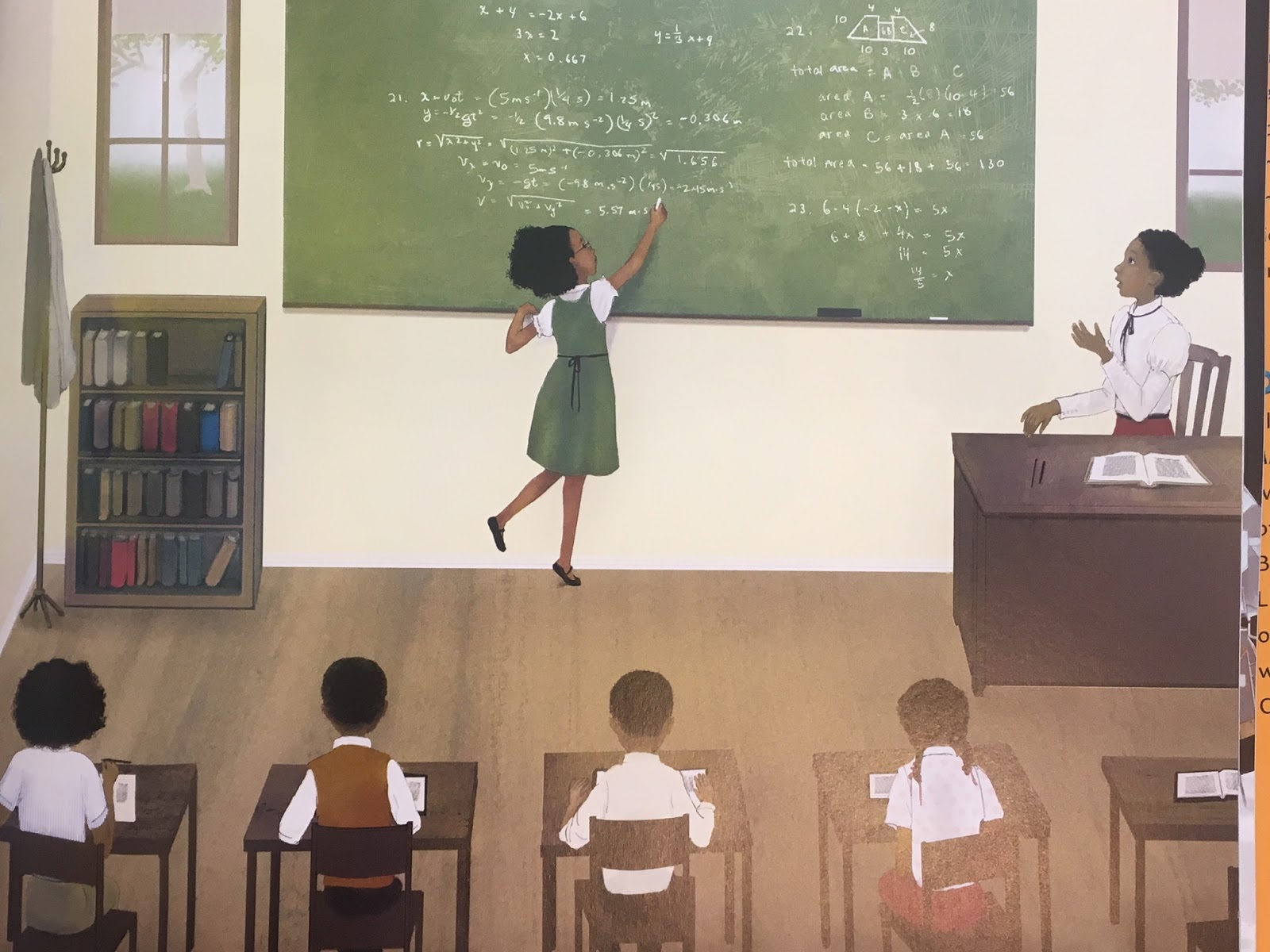
I had the great pleasure of working with illustrator Dow Phumiruk on Counting on Katherine: How Katherine Johnson Saved Apollo 13, which "launched" earlier this summer.


Dow's artwork, in my opinion, is stunning, and really brought the book to the next level. I was curious as to how she blended her knowledge of math and science with her artwork to create such effective illustrations. So I asked her.

Here is the result of that interview:

H: Your artwork in Counting on Katherine is so beautiful. But it's more than that - I can tell that it's historically accurate too. Can you describe your process - how did you research the illustrations in Counting on Katherine?

D: So much research!!

I started with online sources from NASA. I also watched online interviews with Katherine Johnson herself, which I found to be the most helpful to learn about her personality. I read about the start of NASA, about the solar system. I filled a folder on my computer with screenshots of images I thought might be useful for reference. I read the Hidden Figures narrative nonfiction book by Margot Shetterly (the movie did not come out until after my final art was turned in). I made trips to the library to look through books about space. I also looked at maps and images of what West Virginia looked like in the 1930s, including the Greenbrier Inn in her hometown, and what her classrooms might have looked like back then. I looked at online clothing ads and patterns as well as old photographs to see what styles of clothing best represented the fashion of each phase of her life. And of course, I found as many photographs of Katherine herself at different ages.


H: What were the biggest challenges? Biggest surprises?

D: The biggest challenge was the above-described quest for accuracy, from the math to the scenery from her childhood. It was really difficult to find enough photo reference from that long ago. Little details were hard to discern, like if her family might have owned a car upon moving to Institute, West Virginia. In addition, her achievements spanned decades, and this meant learning as much as I could about the evolution of our space program over this long period of time.

I was surprised about Katherine in general. I didn't know who she was upon receiving the pitch for this project. I couldn't believe I had not heard of her before. The more I learned about her life, the more I grew inspired!


H: The endpapers are stunning. They show a blackboard covered with mathematical equations and math problems. How did you, a)think to do this for the book, and b) come up with the material to put on the board?  

D:  I wanted to represent Katherine's genius with math-filled chalkboards. Picturing her as a young girl in front of these chalkboards made sense to emphasize the extent of her abilities since early childhood.

Coming up with the information to fill the chalkboards was not easy! I may have been proficient at math in my youth, but now advanced math is a challenge. Basic algebra and word problems, like the picnic pies and the rocket ship questions, are not a problem for me to make up. I was able to easily google search equations for circumference, radius, volumes of different shapes for example, to make up the ice cream cone question (in which I do not clarify is the volume of the parts of a one scoop cone, by the way!). Sometimes, as for the rocket ship trajectory question, I’d leave off needed information to answer the question (so that I wouldn't need to have an answer!).
  
I used multiple sources for the rest and especially for the higher level math and physics seen in the book. I got lots of help from my family, sampling bits from my girls' homework (their work spanned algebra to calculus) and basic physics equations from my husband’s old physics book (he is a former engineer). I also found some information online, altering the source by replacing letters and figures so it would not be just copied. In compiling this together to fill the board, I would sometimes intentionally obscure parts.

In the end, I would remind myself that this is a book about a mathematician and her brilliance and not a math textbook to keep myself from hyperventilating.


What projects are you working on now???

I have a couple books in the works, but they have not been announced yet. I will say that I am very excited to be both author and illustrator for these upcoming projects!


28 Jul 2018

I Might Be a Criminal

by Jan Thornhill

Yes, that's right. I might be a criminal. I might have inadvertently broken a law. Not only that, but, as it turns out, I might also have been breaking this law continuously for 20 years. 

Here's my story: Twenty years ago, someone offered me an antique bird's egg collection she'd got at a local auction some time earlier and no longer had reason to keep. Having heard about the "museum-in-a-bag" I drag around with me when I visit schools, she'd thought it would be right up my alley. She was correct. 


The collection was obviously old. Really old. The soft cotton batting that protected the blown egg shells was flecked with impurities and had browned with age. The names written neatly with fountain pen on the papered edges of the wooden box dividers had faded. Even some of the eggs had faded. The box itself was charmingly ancient.

The collection's faded robin egg compared to a piece of a fresh one.

Even the names suggested times of yore. Though many of the eggs were labelled with common names we still use today, such as "Crow" and "Robin," (albeit, some with creative spelling, i.e. "Meddallark" for meadowlark), others bore nicknames that have long since been replaced, i.e. "High Hole" for flicker. Yet others seemed to have been invented by the collector, such as "Purplest Swallow" (for a Purple Martin egg), and my personal favourite, a grackle egg that's labelled "Lightning Black Bird."  

"High Hole" is an old name for a flicker woodpecker.
"Lightning black bird" is a made-up name for a grackle.
Does anyone know offhand the dialect/accent
 that makes "meadow" medda? 

Because of all these things, I'd always been sure that the collection was really old – which at first was just an element of its charm. 

But then, while researching The Tragic Tale of the Great Auk, I discovered that it has been illegal to collect, purchase, or possess [my italics] bird eggs since 1916 when the North American Migratory Bird Treaty was jointly signed by Canada and the U.SI did some digging and found out that if I could prove that my egg collection predated the treaty, I could keep it free and clear. Otherwise, it was possibly illegal for me to own it. Suddenly the actual age of the collection mattered. But I had no proof of its antiquity. For all I knew, it could have been fifty years old or a hundred and fifty. 

The Great Auk egg page of my book,
  The Tragic Tale of the Great Auk.

The North American Migratory Bird Treaty is a cornerstone of world conservation efforts. In the early years of the 20th century, wild bird numbers were rapidly declining. They were in trouble. For centuries, there had been unregulated slaughter of native birds – for food, for taxidermy, for feathers, or just for fun. Eggs, too, were collected, sometimes for food, but also for fun: on both sides of the Atlantic, egg collecting was a popular hobby for more than a hundred years, which meant that even the eggs of the smallest songbirds were considered fair game, eggs so tiny they would be suitable only for a doll's breakfast. The pastime was so common throughout the 19th and early 20th century that there was a brisk business in bird egg trade, sales, and auctions as collectors, or oologists, tried to complete their collections. Naturally, the eggs of the rarest birds were the most exciting acquisitions.

Many ground-nesting song birds are secretive about the locations
of their nests. 
If I hadn't been hunting for morels,
I never would have found this Song Sparrow nest.  
See?

Granted, egg collecting could be challenging. First a nest had to be located and once it was found it had to be watched to gather the eggs at the optimum time – within a few days of being laid, so they could be "blown" while the yolk and albumen were still liquid. Blowing an egg was a delicate operation. A tiny hole was first drilled through one end with a needle. A slender pipe was then carefully inserted into the hole. Blowing into the pipe forced the contents of the egg to dribble out around it, (and presumably down the blower's fingers!). 


Note the needle holes in the centres of the two upended
eggs. Beside them is a High Hole egg that was
 not so expertly pierced before being blown.

Egg collecting could also be dangerous. In 1913, a man fell 200 feet to his death while trying to collect eggs from a Peregrine Falcon aerie. If two young women collecting wildflowers at the base of the cliff hadn't stumbled upon his body by accident, he may never have been found. Another man, Francis Birtwell, climbed 75 feet up a tree to reach a nest while honeymooning in New Mexico. On his way down, a rope looped around his neck, strangling him while his horrified bride watched from the below.


Many egg collections, sometimes containing thousands of "sets" of eggs (eggs from a single nest) were eventually donated to museums once the Migratory Bird Treaty came into effect. Because the oologists or "eggers" often kept detailed records of where and when the eggs had been collected, their collections are now invaluable to researchers, particularly in tracking changing nesting times, which is critical information in these times of climate change.

The ROM's ornithology department holds
almost 12,000 bird eggs. (Frankie Thornhill)
Which brings me back to my possibly criminal act.

Since I was unable to prove that my collection predated the treaty, and I had no intention of destroying the collection, (besides which, they're awkward things to store), I took the museum route. I called Mark Peck at the Royal Ontario Museum (see here for my post about the ROM's Great Auk) to see if I could donate my collection to their own collection of almost 12,000 eggs. Sadly, because mine had no provenance (documented chronology of ownership, etc.), nor any data about where or when the eggs were collected, they can't be used for study. But they will have a home in the ROM's extra egg cabinet. And I can stop worrying about the RCMP breaking down my door in the middle of the night.

And, oh yeah, I went back to the Song Sparrow nest eight days later. All five eggs had hatched. 


See?
No? Here's a closer view.

And here I temporarily moved the grasses aside.
Update 

August 21, 2018

I sent a link to this post to Mark Peck at the ROM and, in response, he told me about a Canadian citizen scientist nest monitoring program that anyone can join: Project NestWatch

Go to their website to see how It works:

Step 1:  Register for Project NestWatch 
Step 2:  Learn how to find and monitor nests using the resources provided on this site
Step 3:  Search for nests around your home, school, cottage, or elsewhere
Step 4:  Monitor your nest(s) throughout the breeding season
Step 5:  Submit your data online and contribute to Canada's national nest records database!