Showing posts with label Kim Woolcock. Show all posts

2 Dec 2022

Velvet Worms

by Kim Woolcock


When I started writing It’s Tough to be Tiny, I didn’t know what a velvet worm was. I stumbled across a reference to them while researching small creatures with superpowers, and the name immediately hooked me. Velvet worms?? Would they be fuzzy and cute? And why had I never heard of them?
It turns out they are not fuzzy but they are very cute. And they are deadly hunters. I am a sucker for creatures that are cute but deadly, and as soon as I started reading about them, I knew velvet worms needed a place in the book.
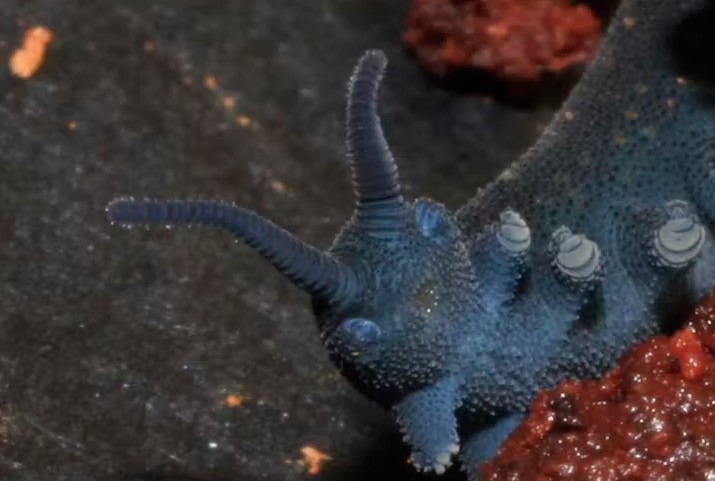
 

The velvet worm Euperipatoides flexes its slime glands.
Image by: Andras Kezzei/Flikr
Velvet worms have soft, squishy bodies, and a kind of nubbly appearance (the nubbins are tiny whiskers that help them feel their way through tight spaces). To me, they look like living sock puppets. Their unique way of hunting is what makes them famous, though. They shoot their prey with sticky goo that comes out of two nozzles (slime papillae) on their face. The goo nozzles wiggle back and forth, like a garden hose that no one’s holding onto. The prey gets covered in a layer of sticky goo that rapidly hardens into a stiff cage of glassy threads. The velvet worm can then bite the prey to inject innard-melting enzymes, and drink the prey milkshake at its leisure.
A velvet worm attacking its prey
By: Stacey Thomas

Scientists have been fascinated for almost a hundred years by how the slime transforms from a sprayable goo to a glassy thread (the process is reversible, too—the dried slime melts in water, and can re-harden!). Even cooler, the prey actually helps in its own capture. Its struggles help to dry out and stiffen the threads, similar to how kneading transforms bread from a sticky lump into a stretchy dough.

A velvet worm devouring its prey
By: Stacey Thomas

So how had I never heard of them? They are not exactly the most cosmopolitan creatures. There are only about 200 known species of velvet worms (phylum Onychophora), mostly in the litter layer in tropical and southern hemisphere forests. They hunt at night, and even the scientists who study them say they are kind of hard to find.
Adding to their mystery, velvet worms have recently been found to be related to Hallucigenia sparsa, a puzzling fossil from the Cambrian explosion about 500 million years ago. A tubelike creature with spines on one side and tentacles on the other, it was called Hallucigenia because it was so bizarre looking that scientists couldn’t tell which way was up or which end was its head, never mind what other animals it might be related to.
 

Hallucigenia sparsa fossil
Taken by: Michael Brett-Surman

A recent study used state-of-the-art electron microscopes to examine the claws of Hallucigenia and modern velvet worms, and found that they both have claws with layers like an onion, indicating they are related. I love knowing that Hallucigenia, once so bizarre no one had ANY idea what it was related to, has such adorable descendants.
If you’d like to learn more about the amazing world of minibeasts, check out my book It’s Tough to be Tiny: The Secret Life of Small Creatures, illustrated by Stacey Thomas (Flying Eye Books, 2022). It’s all about the superpowers of small creatures, from springtails to cone snails, and how they stay safe, hunt for their lunch, or buddy up with bigger creatures for the benefit of both. It’s full of glitter and gross, because nature is both.
 

Resources:

A Baer, S Schmidt, G Mayer, and MJ Harrington. (2019) Fibers on the fly: Multiscale mechanisms of fiber formation in the capture slime of velvet worms. Integrative and Comparative Biology 59(6): 1–10. https://doi.org/10.1093/icb/icz048

Baker CM, Buckman-Young RS, Costa CS, and Giribet G. (2021) Phylogenomic analysis of velvet worms (Onychophora) uncovers an evolutionary radiation in the neotropics. Molecular Biology and Evolution 38(12): 5391–5404. https://doi.org/10.1093/molbev/msab251

Garwood RJ, Edgecombe GD, Charbonnier S, Chabard D, Sotty D, and Giribet G. (2016) Carboniferous Onychophora from Montceau-les-Mines, France, and onychophoran terrestrialization. Invertebrate Biology 135(3):179–190. doi: 10.1111/ivb.12130.

Smith, M, Ortega-Hernández, J. (2014) Hallucigenia’s onychophoran-like claws and the case for Tactopoda. Nature 514, 363–366. https://doi.org/10.1038/nature13576

https://theconversation.com/the-worlds-weirdest-creature-finds-descendants-in-cuddly-velvet-worms-30438

https://www.nytimes.com/2015/07/07/science/hallucigenia-cambrian-explosions-strange-looking-poster-child.html

https://www.wired.com/2014/03/the-creature-feature-10-fun-facts-about-velvet-worms/

5 Aug 2022

It’s tough to be tiny—or is it??

by Kim Woolcock

Growing up, I was always the shortest person in my class. I was guaranteed to lose games of Keep Away. I could never reach the top shelf. And the basketball hoop seemed to be infinitely farther away from me than from other kids (OK, maybe there were other factors in my lack of baskets scored). But in sixth grade, my very tall friend gave me a sweatshirt that said, in glittery letters, Tiny but Tough, and that became my motto. So when my publisher sent me an image of a tardigrade (the poster children for Tiny but Tough):

Hypsibius dujardini

Taken by: Willow Gabriel, Goldstein Lab http://tardigrades.bio.unc.edu/

and asked what I thought about doing a book on minibeasts, I jumped at the chance. I decided right away that it would be about not just minibeasts, but the superpowers of minibeasts. Because there are plenty of upsides to being tiny.

I read a giant stack of science papers while researching this book, and I learned about SO many fascinating creatures. One of my favourites is the water scavenger beetle (Regimbartia attenuata). These guys are just round black dots, a few millimeters long. They look completely unassuming. They don’t have any obvious defenses, and if a frog tries to eat them, well, it succeeds. They get swallowed. <gulp!>

But!


That is not the end of the story. Because after being swallowed, these beetles walk right out. That’s right—they get swallowed, and they don’t care. A few minutes to a few hours later, the beetles emerge ALIVE from the frog’s butt. It’s not clear whether the beetles hike out through the frog’s intestines, or whether they tickle the frog’s innards, maybe by wiggling their legs, encouraging it to send them speedily on their way.* Either way, these otherwise inconspicuous creatures are escape artists par excellence.

Along the way I learned that larvae of the horse mint tortoise beetle (Physonata unipunctata) defend themselves by carrying a poop umbrella with their butt. That Asian jewel beetles (Sternocera aequisignata) camouflage themselves with glitter. That the walnut-sized bobtail squid keeps glowing bacteria in its belly, to disguise itself as a moonbeam while it feeds in the nighttime ocean. And that because ogre-faced spiders listen with their legs, they can catch prey while blindfolded (and yes, scientists make tiny blindfolds for spiders).


If you’d like to learn more about the amazing world of minibeasts, check out my book It’s Tough to be Tiny:The Secret Life of Small Creatures, illustrated by Stacey Thomas (Flying Eye Books, 2022). It’s all about the superpowers of small creatures, from springtails to cone snails, and how they stay safe, hunt for their lunch, or buddy up with bigger creatures for the benefit of both. It’s full of glitter and gross, because nature is both.

I’d like to know, which superpower would YOU choose?

* Wax-coated beetles didn’t make it out.


Resources:

K Kjernsmo, HM Whitney, NE Scott-Samuel, H Knowles, L Talas, and IC Cuthill. (2020) Iridescence as camouflage. Current Biology 30 (3): 551–555. https://doi.org/10.1016/j.cub.2019.12.013

M McFall-Ngai. (2008) Hawaiian bobtail squid. Current Biology 18(22):PR1-43-1044. https://doi.org/10.1016/j.cub.2008.08.059

JA Stafstrom, Hebets EA. (2016) Nocturnal foraging enhanced by enlarged secondary eyes in a net-casting spider. Biology Letters 12: 20160152. http://dx.doi.org/10.1098/rsbl.2016.0152

JA Stafstrom, G Menda, EI Nitzany, EA Hebets, and RR Hoy. (2020) Ogre-faced, net-casting spiders use auditory cues to detect airborne prey. Current Biology 30(24): P5033–5039.

S Sugiura. (2020) Active escape of prey from predator vent via the digestive tract. Current Biology. 30 (15): PR867–R868.

https://www.dailycamera.com/2010/07/22/jeff-mitton-tortoise-beetles-and-fecal-shields/

25 Mar 2022

Millipedes

by Kim Woolcock

It’s spring, and all kinds of creatures are crawling out from under the leaf litter. Including millipedes.

Their name means “thousand legs” (even though only one millipede, Eumillipes persephone, has more than a thousand legs, and it was just discovered in December 2021). Despite their many legs, they are not fast runners, and they cannot bite or sting. To prevent becoming tasty snacks, they have many defenses. The most well-known is their ability to curl into spirals, with their head in the middle.

Coiled Millipede in dry leaf litter
Taken by: Prosthetic Head


Some carry physical weapons. Polyxenid millipedes have interlocking bristles on their butt that they rub off on ants. The bristles get stuck on the ants, who give up attacking the millipede to remove the bristles. The bristles, which are barbed and have grappling hooks at the end, interlock as the ant tries to get them off. Some ants are too entangled to remove them, and die.

Polyxenus lagurus (Diplopoda, Polyxenida). Dundon, England, United Kingdom
Taken by: Andy Murray


But most millipedes carry chemical weapons, stored in the aptly named “repugnatorial glands." Millipedes can produce eight major types of repellent chemicals, from phenols to quinones to hydrogen cyanide (yes, cyanide).

When threatened, some millipedes squeeze muscles around their repugnatorial glands [editor's note: these are glands that drive away predators], dotting their backs with droplets of predator repellent. Others just let their defensive chemicals ooze out and coat their exoskeleton. But some can spray their repellent, up to 50 cm! Large millipedes from Hispaniola are reported to be able to blind chickens. Others, like Glomeris marginata, take a different tack, exuding a sedative similar to Quaalude, which can put wolf spiders to sleep (it also tastes terrible and it’s not known if predators ingest enough to actually fall asleep or if they’re just put off by the bad taste). Just in case, G. marginata includes sticky proteins in its secretions, entangling its would-be predators.

Flat-backed millipedes don’t mess around with bad tastes or smells—they produce hydrogen cyanide. Yes, cyanide, the famously fast-acting, potent poison. Millipedes are immune to it, and they can exude enough to kill birds and mice. Some of these cyanide producers, like Harpaphe haydeniana, are so deadly they have basically only one predator, the beetle Promecognathus laevissimus, which is also immune to cyanide.

Harpaphe haydeniana
Taken by: Franco Folini

All of this makes them sound rather menacing. But down there on the forest floor, protected by their chemical arsenal, they are performing an essential service: they are shredding up the leaf litter, grinding it into tiny pieces and making the nutrients more available for the rest of the food web. A study of the yellow-spotted millipede in BC’s coastal rainforest estimated that it consumes 36% of the annual coniferous litterfall. Just that one species! That is a lot of shredding.


To learn more about tiny creatures and their superpowers, check out my new book It’s Tough to be Tiny, coming out from Flying Eye Books in September, illustrated by Stacey Thomas. It’s full of fun facts about creatures like springtails and cone snails and how they evade predators, hunt for their lunch, and buddy up with bigger creatures for the benefit of both.


Resources
https://www.sciencenews.org/article/millipede-most-legs-eumillipes-persephone
https://blog.nature.org/science/2017/10/17/millipede-protects-itself-cyanide-yellow-spotted-bugs/
https://www.nature.com/articles/s41598-018-19996-6
https://www.pnas.org/doi/full/10.1073/pnas.1500014112
https://www.sciencedirect.com/science/article/pii/S0305197815001167
https://www.loc.gov/everyday-mysteries/zoology/item/how-are-millipedes-and-centipedes-alike-and-how-do-they-differ/
https://www.ncbi.nlm.nih.gov/pmc/articles/PMC38244/
https://cdnsciencepub.com/doi/10.1139/x00-014

31 Dec 2021

Fungal Fabric

by Kim Woolcock

The new year makes me think of new beginnings. Why not new bio-inspired technologies?
 

As microplastics clog up our newsfeeds and the biosphere, the search for biodegradable materials becomes more important. One that’s catching my attention is fungal fabric.

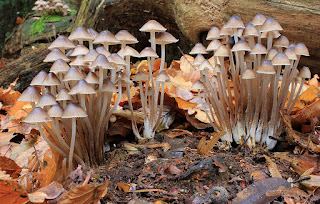
Mycena inclinata, Clustered bonnet
Image credit: Stu's Images

When many people think of fungi, they think of mushrooms or mold. Fungi are both of these things, but they are also so much more. The mushrooms that we see popping up in the rainy spring and fall are fruiting bodies, made to distribute spores. They are just the tip of the underground iceberg. Made of tightly intertwined fungal threads called hyphae, they are produced by huge webs of hyphae living invisibly in the soil, in rotting wood, in plant roots and leaves. These hyphae live inside their food, producing enzymes that degrade it, and then soaking up the released nutrients.


Oyster mushroom (Pleurotus ostreatus) mycelium growing on coffee grounds in a petri
dish
Image credit: Tobi Kellner


Hyphae can grow to form any shape (just look at the many shapes of mushrooms, from corals to cup fungi to tooth fungi), and dried mushrooms have a tough and rubbery texture. Innovators are leveraging this combination of traits to produce a wide variety of fungal fabrics. The hyphae are like the threads of cloth, interweaving as they grow. This fabric weaves itself!

Starting with waste products like sawdust or grain husks, designers add fungal spores, a small amount of water, and wait for the fungus to devour the food and fill the mold. Fungi grow quickly, so fungal leather can be produced in a matter of weeks. The resulting mat of hyphae can be dried, tanned, and dyed to produce “leather” that is strong, durable, breathable – and beautiful.

Designers are using fungal leather to make watches, purses, clothing, and shoes. Maybe some fashion-forward fungal leather items are just what my new year needs.


22 Oct 2021

Where Does The Green Go?

 by Kim Woolcock


It’s autumn where I am, and the leaves are turning. They look like they’re setting themselves on fire before they fall, going out in a blaze of glory. Crispy husks carpet the forest floor, ready to be turned into next year’s nutrients. 


Leaves of Acer palmatum subsp. matsumurae (Koidz) Ogata

Photo credit: 松岡明芳


I love it, but it also seems extravagant. Why don’t leaves just stay green until they fall?

It turns out the trees are being thrifty. The leaves are full of chloroplasts, which contain lots of chlorophyll, the green light-harvesting pigment that lets plants spin sunlight into sugar. Chlorophyll is expensive, nutrient-wise. It’s loaded with nitrogen, and so trees tuck it away for winter. They break down the chloroplasts, pack the nutrients for transport, and send them to the trunk and roots. When they’re done collecting what they need, they build a waxy wall between the branch and the leaf and then let the leaf drop.

Packing up the green pigment lets the yellow and orange pigments, carotenoids, shine through. They were there all along, helping the leaves capture light of different wavelengths, but they were masked by the green. As the chlorophyll is removed, the carotenoids pick up some of the slack, making as much energy as they can with the last rays of autumn.

Not all leaves turn yellow or orange—some turn flaming red, thanks to anthocyanins. These pigments aren’t there in the summer, but are made specially in the fall. They act as sunscreen, protecting other leaf molecules from sun damage after the chlorophyll’s gone. That’s why they’re brightest in areas where fall days are sunny. They’re also made from leftovers. As the days get shorter, leaves keep producing sugar and sending it to the roots. But when nights get too cold, sugar transport is slowed, and some sugar gets stuck in the leaves, where it’s made into anthocyanins instead.


The green is almost gone. Image credit: Sander van der Wel


It’s a big job, getting ready for winter. Consider a single aspen tree (Populus tremula). Researchers made a detailed calendar of fall events for this tree, tracking components such as pigments, metabolites, nutrients, and photosynthesis rate. The tree has several million leaves, each of which contains ~30 million cells. Each cell contains ~40 chloroplasts. So every autumn, the tree has to synchronize the dismantling and transport of 1015 chloroplasts (one quadrillion, or the total number of ants on earth, just for scale), all in about a month. That’s just one tree. No wonder they look like they’re on fire.

So that’s where the green goes. It’s stashed away in trunks and roots for the winter, waiting to be remobilized in spring. Winter has always seemed drab compared to fall, to me. But knowing this makes me look at winter tree trunks differently – they are actually full of secret green. 


Kim Ryall Woolcock is the co-author of Design Like Nature: Biomimicry for a Healthy Planet (Orca, 2021) with Megan Clendenan. Her next book Tough to be Tiny is coming out from Flying Eye Books in July 2022. You can find out more at www.kimwoolcock.com
 

Resources:

John King. 2011. “Reaching for the Sun: How Plants Work, second edition.” Cambridge University Press, Cambridge. 298 pp.

Johanna Keskitalo et al. 2005. “A Cellular Timetable of Autumn Senescence.” Plant Physiology, 139:4, 1635–1648. https://doi.org/10.1104/pp.105.066845

https://www.sciencedaily.com/releases/1997/10/971005050137.htm


2 Apr 2021

Biomimicry

Most of us know what a mime is -- that's a person who mimics a movement so it looks like they are climbing a rope or walking against a strong wind. Some people can mimic the voice of a famous person. But mimicry goes beyond trying to look like or sound like something else. Here's an introduction to Biomimicry, written for Sci/Why by Kim Woolcock and Megan Clendenan.

Biomimicry is a relatively new field of bio-inspired design that takes a page from nature’s handbook in an effort to create more sustainable, renewable products. Instead of what we can take from nature, biomimicry looks at what we can learn from nature. Biomimicry inventions and innovations can breathe new life into how we design our cities, how we manage waste, create packaging, robotics, clothing design, travel – the list is almost endless.

What would it be like if we could create anti-bacterial surfaces inspired by shark skin? Or design less painful needles by observing how mosquitos bite? What if we could figure out how better to transport vaccines by learning more about tiny organisms called tardigrades?

What if we could learn to design like nature?

For example, biomimicry can lend inspiration to green chemistry. From the glow of fireflies, to the stretchiness of spider silk, to the spicy kick of mustard, nature holds many examples of powerful chemicals that are produced inside organisms, at ambient temperature and pressure, unlike in industrial processes.

We all know glue doesn’t work very well when it’s wet. Have you ever tried gluing wet cardboard together? But non-toxic glues that work in wet conditions would be incredibly useful in medicine.

Scientists are looking to organisms that live in the intertidal zone, such as sandcastle worms (Phragmatopoma californica). These worms can glue grains of wet sand and shell into underwater fortresses that protect them from pounding waves. Plus, they’re kind of cute.


sandcastle worm photo By Fred Hayes for the University of Utah - University of Utah, CC BY-SA 3.0, https://commons.wikimedia.org/w/index.php?curid=8320561
By Fred Hayes for the University of Utah - University of Utah, CC BY-SA 3.0, https://commons.wikimedia.org/w/index.php?curid=8320561

The new glues could be used in bone reconstruction, instead of metal pins or plates. With strong, non-toxic adhesives that work in wet conditions, small pieces of bone could be held in place until they healed, as in facial reconstruction, in dentistry, and other medical and engineering applications.

 ~

Kim Woolcock and Megan Clendenan are co-authors of Design Like Nature: Biomimicry for a Healthy Planet, which is a new title in the Orca Footprints series that explores how biomimicry is inspiring scientists, engineers, and kids around the globe. It provides history and background on natural and synthetic materials, introduces the science of biomimicry, provides inspiring examples, and invites kids to imagine themselves as future biomimicry pioneers. 

Have you ever held a seashell and wondered how its delicate swirl can be so strong? Or lay down under a tree so tall it touches the clouds and wondered how it withstands the strongest winds? Nature is a genius at design!”