Showing posts with label frost. Show all posts

30 Jul 2021

Frost above zero

Photo: Pixabay

 In Southern Ontario, May 24th is the traditional day for planting annuals. That’s because the probability of frost after that date is negligible. Not this year. A few days after the 24th, Environment Canada warned us of the possibility of frost overnight, and they were correct. We had quite a lot of frost damage. The strange thing was that the overnight temperature was predicted to be above zero by a degree or two. I was puzzled because I thought you can only get frost at temperatures below freezing.

 To understand frost, you have to understand dew. Air contains moisture. The warmer the air, the more moisture it can hold. If the temperature keeps dropping, it reaches the “Dew Point” where the air can no longer contain its moisture and water droplets (dew) form out of the air. The Dew Point is dependent on the humidity of the air. If there a lot of moisture in the air, the Dew point is only a little below the actual temperature. If the air is relatively dry, the Dew Point is well below the actual temperature. What if the Dew Point is below freezing? Then we rename the Dew Point and call it the “Frost Point”. When the temperature drops to the Frost Point — you guessed it — instead of water condensing out of the air, frost appears. 

 Back to the mystery of frost when the temperature doesn’t reach freezing. Overnight, as the temperature drops, the ground radiates heat more quickly than the air. So the ground is colder than the air, and the air closest to the ground is colder than air higher up. The fact that cold air is denser and therefore sinks also contributes to the temperature increasing with height. A difference of four degrees between the ground and a height of 1.5 metres would be typical if there is no wind to mix the layers of air. 


Stevenson Box. Photo: Metfm, CC BY-SA 4.0, courtesy Wikimedia Commons   

And one learning from this is to remember that meteorology is not an exact science.

6 Dec 2013

Hair Ice and Singing Lakes and Icebergs: Fabulous Ice Phenomena


Jan Thornhill
Hair ice can grow 5 cm long
Hair ice growing from twig.


Antarctic sea ice from above
Antarctic sea ice (NASA)
My friend Ulli called one chilly morning a couple of weeks ago and said she’d found a stick in the woods for me. “A stick?” I said.

“You want it,” she said cryptically.

She was right. Though what she brought over ten minutes later looked like an ordinary piece of a dead alder branch, part of it was not ordinary in the least. One end had sprouted a glorious tuft of long silky white hair. Ulli had found hair ice!

Hair ice melting
Hair ice starting to melt. (Jan Thornhill)
Though you might think at first glance that hair ice is some kind of peculiar frost – it’s not. Frost forms when moisture in the air freezes on objects. Hair ice, on the other hand, starts from the inside and moves outwards. Moisture in a stick or twig is exuded through minute pores on the surface, and when this moisture hits humid sub-zero air the result is very fine filaments of ice that can grow up to five centimeters in length – filaments that look just like hair. It’s an uncommon phenomenon, and not just because weather conditions must be absolutely perfect. Here's the real glitch: the appearance of hair ice seems to be dependent on, of all things, fungi.

Hair Ice and Fungi

So what do fungi have to do with it? The idea that “a fungus participates in a decisive way” in the formation of hair ice, was first suggested in 1918 by the brilliant interdisciplinary scientist Alfred Wegener (who developed the theory of continental drift), but was unproven. Recently though, Gerhart Wagner and Christian Mätzler from the University of Bern have been studying "haareis" and its relationship to fungi. In one experiment they collected a number of twigs that had previously grown hair ice and treated them variously with three agents known to suppress the growth of fungi – heat, alcohol, and fungicide – while keeping a portion of each twig aside as a control. Afterwards, they froze all the samples under identical conditions, then compared the results. Sure enough, only the untreated pieces re-grew luxuriant manes of ice. 

The two scientists theorize that the living mycelium of various fungi within the wood (i.e. Exidia glandulosa or Tremella mesenterica) continues to metabolize at near freezing temperatures, producing heat and gases that force moisture outwards. When this moisture escapes through pores and comes into contact with humid below-freezing air, hair ice grows.

2cm long hair ice
Hair ice that grew overnight. (Jan Thornhill)
After reading about Wagner and MÃ¥tzler's success at coaxing hair ice to grow in the laboratory, I decided to try to try a simple experiment of my own. I soaked the stick Ulli had brought me in water (its original hair ice having quickly melted). I then laid it on a wet paper towel on a plate and put it out in our unheated boot room, then waited for the temperature to drop. By the 10:00 pm the whole stick was sprouting hair ice. By morning I had a new pet!

hair ice and ice globules
The end of the twig  formed solid globules of ice, possibly
because moisture was released too quickly to form hair ice. (Jan Thornhill) 

Singing Lakes

A few days later, another friend was talking about how much he loves the quality of the human voice outside on cold winter days. The topic of walking on frozen lakes came up. I asked if he’d ever heard a frozen lake “sing.”


person walking on frozen lake
Frozen lakes sing! (Nentori)
I’ve heard it several times – haunting, otherworldly sounds caused by ice expanding and contracting, which is most common when there are major fluctuations in temperature. The best sounds, and the ones that carry the furthest, occur when there is no snow cover – rare conditions on the lakes near where I live, but not unheard of. Listen to Andreas Bick’s extraordinary recording of this phenomenon on a lake in Germany here. Turn up the volume and brace yourself!


Antarctic Ice & Animal Sounds

Weddell seals underwater
Weddell seals whistle and chirp.
And then I discovered something even more wonderful: The Alfred Wegener Institute (yes! that's the same Alfred Wegener as mentioned above!) that co-ordinates German polar research in both the Arctic and Antarctic has an acoustic laboratory in Antarctica. They are always recording – and on their website they offer this MP3 audio livestream of Antarctic ice and animal sounds from near the Neumayer Station on the ice shelf of Atka Bay. You can listen to the under-ice sounds of the Antarctic in real time! I can't turn it off!

All of this icy stuff is so cool it warms my heart. 

More Links:

This page from the Alfred Wegener Institute has sound files of various seal and whale noises to listen for on the live audio feed, as well as rubbing ice, singing icebergs, and some “mystery” sounds that are truly astonishing.

Download Gerhart Wagner and Christian Mätzler"s paper,  "Haareis auf morschem Laubholz als biophysickalisches Phanomen"  or  "Hair Ice of Rotten Wood of Broadleaf Trees – A Biophysical Phenomenon" – lots of pictures, though only some parts are in English.


Weddell seals source: http://commons.wikimedia.org/wiki/File:Diving_weddell_seals.jpg

20 Sept 2013

First Frost... and a Book Giveaway!

By Guest Blogger Carolyn Fisher


Hi. I'm artist and author Carolyn Fisher. I write and illustrate picture books. Today I'm pinch-hitting on Sci/Why for Joan Marie Galat, who is gallivanting around Australia to look at stars in the southern hemisphere.

In my picture book The Snow Show, I wrote and illustrated a story about how snow is made.


When you're making a book, you do oodles of research. You brainstorm, you write, and then - if you're an illustrator like me - you draw zillions of sketches to plan out the pages. But because my editor gave me a 48-page limit on The Snow Show, there were lots of things that I left out.

Like how frost is made, for example. So today, in honour of September's dropping temperatures, I wanted to write about frost.

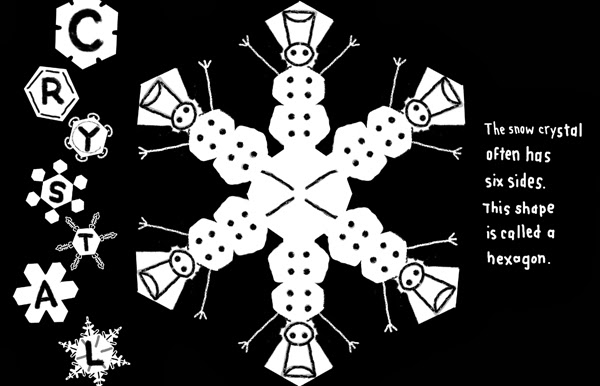
First, we have to talk about how snow grows. Here are some drawings that got rejected from The Snow Show:


Did you catch that? If the air temperature is below zero degrees Celsius (32 degrees Fahrenheit), water vapour molecules can change to ice without turning to liquid first. That’s called DEPOSITION. Snow crystals form when floating water vapour molecules change by deposition directly into ice crystals.

There, I just summarized The Snow Show in three sentences. Can you believe it took me 48 pages to say that?

Frost crystals grow the same way: water vapour molecules in the air freeze by deposition onto plants, glass, or snow surfaces. (Sometimes frost forms beneath snow surfaces: that’s called depth hoar and it can cause avalanches if conditions are right. But that’s a whole other blog post!)

BOOK GIVEAWAY: Is it frosty where you are? What’s the average first fall frost date where you live? Post your answer in the comments by 12 noon on September 30th and I’ll draw a name for a free signed copy of The Snow Show.

For more about snow and making picture books, check out my website: www.carolynfisher.com
For a snow study guide, download my free snow activity kit pdf: http://www.carolynfisher.com/study-guides/

And if you’re Joan Marie Galat? Don’t bother entering the first fall frost date in Australia. We all know that it’s spring down there!