By Claire Eamer
There's nothing like publishing a list of books to make more books and authors pop out of the woodwork! (Well, actually, we missed a few the first time.)
Anyway, our amazing and awesome and Really Long list of great science books for kids has already received its first update. Click the link for more science-y goodness!
This update courtesy of Sci/Why's perpetual motion machine, Helaine Becker. Thanks!

29 Mar 2015
Looking for a good book? We made a list!
By Claire Eamer
Everybody likes a good book, right? And we (she said modestly) write good books. Honest! We really do!!
(Can you tell I'm a bit excited about this?)
The Sci/Why crew and their writer-friends have compiled a list of Science-Themed Books for Children, all written by Canadian science writers. It's organized by curricular topic, so if you're looking for books about Astronomy, Biology, Evolution, Robots, or whatever your heart (or your kids' latest enthusiasm) desires, we've got you covered. Seriously.
Please feel free to download, share, forward, promote, and use. Especially, use.
This list is a work in progress. We'll try to update it regularly and add writers and books we've missed. You can help. If you're a Canadian author who hasn't sent us your list yet, please send. If you have a favourite Canadian kids' science book that's not on the list, let us know. And send us the publication details. Or post it in the Comments s
ection below.
Additions to the list can be sent to sciwhy (at) gmail (dot) com. They won't be added immediately - we're all pretty busy - but we'll get to them.
This first incarnation of our science book list was pulled together by Adrienne Mason, Helaine Becker, Joan Marie Galat, and Claire Eamer.
Everybody likes a good book, right? And we (she said modestly) write good books. Honest! We really do!!
 |
| Rick Massie photo |
(Can you tell I'm a bit excited about this?)
The Sci/Why crew and their writer-friends have compiled a list of Science-Themed Books for Children, all written by Canadian science writers. It's organized by curricular topic, so if you're looking for books about Astronomy, Biology, Evolution, Robots, or whatever your heart (or your kids' latest enthusiasm) desires, we've got you covered. Seriously.
Please feel free to download, share, forward, promote, and use. Especially, use.
This list is a work in progress. We'll try to update it regularly and add writers and books we've missed. You can help. If you're a Canadian author who hasn't sent us your list yet, please send. If you have a favourite Canadian kids' science book that's not on the list, let us know. And send us the publication details. Or post it in the Comments s
ection below.
Additions to the list can be sent to sciwhy (at) gmail (dot) com. They won't be added immediately - we're all pretty busy - but we'll get to them.
This first incarnation of our science book list was pulled together by Adrienne Mason, Helaine Becker, Joan Marie Galat, and Claire Eamer.
20 Mar 2015
Hands across the Border
Post by Helaine Becker
 Last week I was privileged to attend the Tucson Book Festival as one of the presenters. I did a Zoobots-focused presentation on the main stage. I also helped kids make colour-changing octopus skin, an activity found in The Big Green Book of the Big Blue Sea.
But perhaps the highlight of my program was co-presenting on a panel about "Science Writing for Children" along with three of the best science writers working in the U.S. today.
If you don't know them and their work, I'd love to share a little about each of them with you!
 Sarah Albee is the bestselling author of Bugged: How
 Elizabeth Rusch also brings a level of commitment to her work that simply boggles the mind. Yup, that's her, tramping over the still-steaming lava field after a devastating volcanic eruption, determined to get the story for Eruption. And yup, that's her, risking epic seasickness to get the goods for The Next Wave. And once she has the story? She tells it so dramatically, and with such "you-are-there" intensity that you can't stop turning the pages.
But perhaps the highlight of my program was co-presenting on a panel about "Science Writing for Children" along with three of the best science writers working in the U.S. today.
If you don't know them and their work, I'd love to share a little about each of them with you!
 Sarah Albee is the bestselling author of Bugged: How
Insects Changed History and Poop Happened. How can you not love someone who writes about malaria and cholera with such glee? Turns out she is now working on a book about poison. I can't wait til it comes out - though I won't sit next to her during ahem dinner if she is wearing a poison ring....
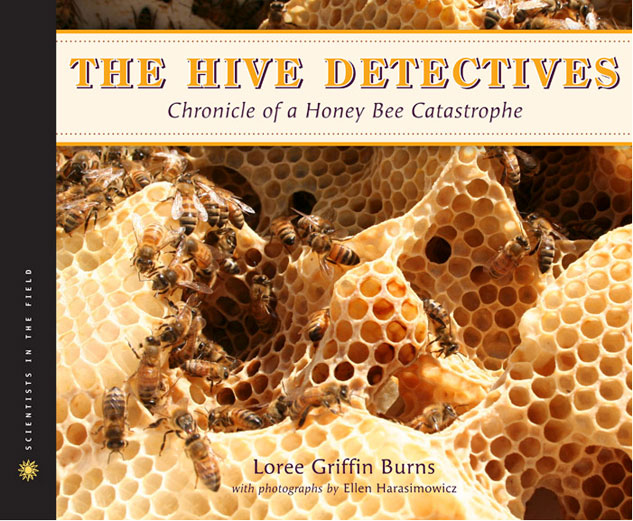
Loree Griffin Burns is super smart and super passionate. She brings both of these qualities to wonderful books about environmental issues like Tracking Trash: Flotsam Jetsam and the Science of Ocean Motion and Handle with Care. She is so committed to writing quality books that she
 allowed herself to be stung by bees, literally dozens of times, to get the perfect photo for the book. You can see the photo in question in The Hive Detectives.
 Elizabeth Rusch also brings a level of commitment to her work that simply boggles the mind. Yup, that's her, tramping over the still-steaming lava field after a devastating volcanic eruption, determined to get the story for Eruption. And yup, that's her, risking epic seasickness to get the goods for The Next Wave. And once she has the story? She tells it so dramatically, and with such "you-are-there" intensity that you can't stop turning the pages.
I am so pleased - and honoured - to now call these great ladies my friends. I welcome them as honorary Canadians to this Sci/Why blog, and look forward to bringing science fun to as many kids as we can on both sides of the border.
 |
| Sarah Albee, Loree Griffin Burns and Liz Rusch, with me (in purple). |
13 Mar 2015
Jumping Jiminy! It's Snow Flea Season!
 |
| Snow fleas look like hopping black specks in the snow (Rolf Schlangenhaft) |
Though there's still two feet of snow covering the forest floor, there are signs everywhere that spring is on its way. Chickadees have started singing their mating song! The warm sun is tatting lace into south-facing snowbanks! The driveway has turned to mud! And sunny depressions and ruts in the snow are liberally sprinkled with black pepper! But, wait a second...why would there be black pepper on the snow? And why is that black pepper JUMPING??
 |
| Close-up, tiny snow fleas have a blueish cast. |
The first time I found these leaping blackish blue dots in the snow, I had no clue what they were, so I called them snow fleas—which it turns out is what everybody else calls them, from Russia to Sweden to France— though they're not even remotely related to fleas. What they are is a very interesting type of springtail.

Springtails are very cute little guys that, though they have six legs like insects, are nonetheless different enough that they're not included in that class: among other little quirks, they have fewer abdominal segments, lack proper compound eyes, and shed their exoskeletons throughout their lives. They also have a special way way of jumping.
 |
| Sminthuridae sp. springtail (Tim Evison/Wikipedia) |
 |
| Remember these? |
Sadly,
springtails have no aiming ability, so they don't have much choice in the
direction they go, but the quick random "boings" can be enough to
keep them out of the mouths of predators.
Springtails are mini garburators that help to make soil by eating decaying organic
matter, algae, fungi and fungi spores, and poop—which is sometimes their own.
Thousands can be rummaging though the moist forest floor litter at your feet,
but are usually not noticed because they're so incredibly tiny. In the winter, snow fleas are eat spores that accumulate on the surface of melting snow.
 |
| When there's no snow, snow fleas can be found in forest litter. |
No one knows exactly why snow fleas creep up through melting channels in snow to the surface on warm days at the end of winter, but the fact that these minute "cold-blooded" creatures are capable of such activity in cold temperatures when other over-wintering insects remain dormant has interested researchers for a long time.
 |
| Thousands of snow fleas in tire ruts in snow... |
 |
| ...or in crevices. (both photos Rolf Schlangenhaft) |
A couple of these researchers, Laurie Graham and Peter Davies of Queen's University have isolated a protein from snow fleas that acts like antifreeze in their bodies. Though there are a number of different animals that have evolved proteins that protect their tissues against the nasty effects of freezing, including the woolly bear caterpillar and the grey tree frog, two characters featured in my recent book, Winter's Coming: A Story of Seasonal Change about animals preparing for winter, the protein found in snow fleas, has a novel, and possibly very useful characteristic that other animal "antifreezes" don't have: at higher temperatures they break down. The exciting possibility is that this protein might be of use for organ transplants, which could not only be kept colder, and therefore stored longer than they can be now, but also, when the organ is finally used, the protein will be cleared from a patient's before harmful antibodies can form.
Reference
Graham, L.A. and Davies, P.L. (2005) Glycine-rich antifreeze proteins from snow fleas. Science 310, 461.9 Mar 2015
Who Wants to be a Scientist?
By Claire Eamer
Okay - we're a little bit late for International Women's Day. But encouraging kids to think about science is what we're all about, here at Sci/Why. That includes girl kids and boy kids. And black, brown, white, yellow, and purple kids. (Purple??? You never know...). Kids of all sizes and abilities. And kids of every nationality.
So here are a few Canadian organizations that are trying to open up science to as many people as possible:
And to inspire you, here are a few amazing scientists and bits of science that you might or might not have heard about:
Okay - we're a little bit late for International Women's Day. But encouraging kids to think about science is what we're all about, here at Sci/Why. That includes girl kids and boy kids. And black, brown, white, yellow, and purple kids. (Purple??? You never know...). Kids of all sizes and abilities. And kids of every nationality.
So here are a few Canadian organizations that are trying to open up science to as many people as possible:
- The Society for Canadian Women in Science and Technology - a non-profit association that promotes, encourages and empowers women and girls in science, engineering and technology.
- Queen's University in Kingston, Ontario, has an Aboriginal Access to Engineering website to encourage aboriginal students to think about engineering and prepare for science and technology careers. It's got good information, whether you end up at Queen's or somewhere else.
- The Indigenous Physicians Association of Canada offers information and help for young aboriginal people who want to go into medicine.
And to inspire you, here are a few amazing scientists and bits of science that you might or might not have heard about:
- The Smithsonian's list of Ten Historic Female Scientists You Should Know About
- And a list of 10 Famous Women Scientists
- Here's an interesting list of African-American scientists
- And a few historic Canadian scientists of African descent
- The most famous scientist with a disability is Stephen Hawking, but he's not the only one.
- Here's an online magazine, Science in Africa, about what African scientists are up to these days
- And another magazine, Asian Scientist, about science in modern Asia
- This site has links to four short videos about Canadian scientists trained in the western tradition who are working together with people trained in aboriginal traditional knowledge
- Finally, if you want to know more about traditional knowledge and science, check out the Worldwide Indigenous Science Network's website.
27 Feb 2015
Spring Break Into Science - Science Books, That Is
by L. E. Carmichael
Every author's hosted a book launch or other event where not a single person shows up. We even have a theme song about it:
One of the best ways to avoid this kind of despair is to host a book party with friends, and that's what some of the Sci/Why bloggers are doing on Saturday, March 7.

Because we live in Nova Scotia, Ontario, and Alberta, an in-person event wasn't going to be practical. That's why the party is taking place on Facebook - and because it's a public event, anyone can attend, no matter where in the world they happen to be. Those in Australia might have to lose a bit of sleep though, as the party is from 1:00-5:00 pm EST (apologies, Australian friends!).
Can't hang out online all day? No problem! Each author is hosting her own hour:
1:00-2:00 - L. E. Carmichael - Forensic Science: In Pursuit of Justice and Fuzzy Forensics: DNA Fingerprinting Gets Wild
2:00-3:00 - Helaine Becker - Zoobots and Dirk Daring: Secret Agent
3:00-4:00 - Ishta Mercurio - Bite Into Bloodsuckers
4:00-5:00 - Joan Marie Galat - Branching Out: How Trees Are a Part of Our World
and you can pop in and out at your convenience. The event will be a great way to discover new books, explore science facts and other fun stuff, and kick off a science-filled Spring Break.
Will there be prizes, you ask? Why yes, in fact there will! Everyone who purchases a book during the event will receive a small gift - in my case, I'll mail out a personalized, autographed bookplate and a small bonus surprise. Purchasers will also be entered into the four grand prize draws for extra books and/or awesome book swag.
So consider this your invitation and click through to join the event - no "friending" is necessary. But feel free to invite your friends or otherwise spread the word. The more the merrier!
Every author's hosted a book launch or other event where not a single person shows up. We even have a theme song about it:
One of the best ways to avoid this kind of despair is to host a book party with friends, and that's what some of the Sci/Why bloggers are doing on Saturday, March 7.
Because we live in Nova Scotia, Ontario, and Alberta, an in-person event wasn't going to be practical. That's why the party is taking place on Facebook - and because it's a public event, anyone can attend, no matter where in the world they happen to be. Those in Australia might have to lose a bit of sleep though, as the party is from 1:00-5:00 pm EST (apologies, Australian friends!).
Can't hang out online all day? No problem! Each author is hosting her own hour:
1:00-2:00 - L. E. Carmichael - Forensic Science: In Pursuit of Justice and Fuzzy Forensics: DNA Fingerprinting Gets Wild
2:00-3:00 - Helaine Becker - Zoobots and Dirk Daring: Secret Agent
3:00-4:00 - Ishta Mercurio - Bite Into Bloodsuckers
4:00-5:00 - Joan Marie Galat - Branching Out: How Trees Are a Part of Our World
and you can pop in and out at your convenience. The event will be a great way to discover new books, explore science facts and other fun stuff, and kick off a science-filled Spring Break.
Will there be prizes, you ask? Why yes, in fact there will! Everyone who purchases a book during the event will receive a small gift - in my case, I'll mail out a personalized, autographed bookplate and a small bonus surprise. Purchasers will also be entered into the four grand prize draws for extra books and/or awesome book swag.
So consider this your invitation and click through to join the event - no "friending" is necessary. But feel free to invite your friends or otherwise spread the word. The more the merrier!
See you on the 7th!
20 Feb 2015
Traditional Fishing Science
By Paula Johanson
Traditional fishing methods are not only the use of a simple hook and line, or tickling fish in a stream. There are surprisingly effective technologies for catching fish, technologies that were used traditionally by First Nations people. Here on the coast of British Columbia in Canada and Washington State in the USA is the area called the Salish Sea, after the Coast Salish-speaking people who have been living here since the end of the last Ice Age. Saltwater fishing techniques were developed to a science by these coastal people.
But the use of Salish reef-nets fell out of practise when these nets were banned by the Canadian government over a hundred years ago. It was only through the efforts of several people living on the Saanich peninsula (in and near the city of Victoria, BC) that the first reef-net in a hundred years has been built and put to use.
Leading their project is Nick Claxton (XEMŦOLTW̱), a member of the Tsawout community and a PhD candidate at the University of Victoria in the Department of Curriculum and Instruction. He worked with a local school and members of the W̱SÁNEĆ nation to build a model of a traditional reef-net. The project was so successful that teachers throughout the school—math teachers, science teachers, socials teachers—began to teach their subjects through the model net.
Then, with the help of relatives from the Lummi Nation just across the border in Washington state, Nick and his associates built a reef-net in the traditional style. They put it to use on August 9, 2014, at a hereditary fishing location off Pender Island, as shown in this video they posted on YouTube.
Their short video will give you a sense of the power of that day and what it means to “carry on our fisheries as formerly,” as agreed to in the Douglas Treaty signed by the Saanich people in 1852.
If you're wondering what's so different about one net compared to another, well, there can be a lot of differences! This isn't a little net held and retrieved by one person. A reef-net is suspended between two open canoes. The upper part of the net is attached to floats, and the lower part is held down by weights.
If the video of this net being used doesn't load on your screen, you can click here to see a six-minute video, showing the project and the reef net being deployed.
Traditional fishing methods are not only the use of a simple hook and line, or tickling fish in a stream. There are surprisingly effective technologies for catching fish, technologies that were used traditionally by First Nations people. Here on the coast of British Columbia in Canada and Washington State in the USA is the area called the Salish Sea, after the Coast Salish-speaking people who have been living here since the end of the last Ice Age. Saltwater fishing techniques were developed to a science by these coastal people.
But the use of Salish reef-nets fell out of practise when these nets were banned by the Canadian government over a hundred years ago. It was only through the efforts of several people living on the Saanich peninsula (in and near the city of Victoria, BC) that the first reef-net in a hundred years has been built and put to use.
Leading their project is Nick Claxton (XEMŦOLTW̱), a member of the Tsawout community and a PhD candidate at the University of Victoria in the Department of Curriculum and Instruction. He worked with a local school and members of the W̱SÁNEĆ nation to build a model of a traditional reef-net. The project was so successful that teachers throughout the school—math teachers, science teachers, socials teachers—began to teach their subjects through the model net.
Then, with the help of relatives from the Lummi Nation just across the border in Washington state, Nick and his associates built a reef-net in the traditional style. They put it to use on August 9, 2014, at a hereditary fishing location off Pender Island, as shown in this video they posted on YouTube.
Their short video will give you a sense of the power of that day and what it means to “carry on our fisheries as formerly,” as agreed to in the Douglas Treaty signed by the Saanich people in 1852.
If you're wondering what's so different about one net compared to another, well, there can be a lot of differences! This isn't a little net held and retrieved by one person. A reef-net is suspended between two open canoes. The upper part of the net is attached to floats, and the lower part is held down by weights.
If the video of this net being used doesn't load on your screen, you can click here to see a six-minute video, showing the project and the reef net being deployed.
Subscribe to:
Posts (Atom)