Showing posts with label Claire Eamer. Show all posts

15 Jul 2022

Weird and Wonderful Animals

By Claire Eamer

I am fascinated by animals that surprise me, that make me rethink my assumptions about what is and isn't possible. Maybe they do something I'm sure they can't do. Or they find a completely unexpected way to survive in their bit of the world. Or they make me rethink how I survive in the world. 

Take, for example, the American dipper or water ouzel, scientific name Cinclus mexicanus.

American dipper. Photo by Ron Knight.
I used to live in Whitehorse, on the banks of the Yukon River in northern Canada. The river is huge and fast-flowing. And it's cold. In winter, it's mostly covered in ice with only a few patches of open water kept clear by the current.

Walking along a river trail one winter day, I saw a small black bird standing on the ice at the edge of the open water. As I watched, it dove straight into the (literally) icy water and disappeared. Just when I began to think it was drowned and frozen, it popped back out of the water and hopped onto the ice, looking none the worse for what should have been a near-death experience.

It was an American dipper, a species that pushes the boundaries of bird life. Dippers can stick their heads under water to search for food and swim underwater by using a flying movement with their short, strong wings. They can even walk along the bottom of a fast-moving stream, holding on with their extra-long toes and claws. 

An American dipper searches for food. Photo by David A Mitchell.

Watching that bird in Whitehorse led me to think about other animals that push boundaries, and that led to my book Lizards in the Sky: Animals Where You Least Expect Them (Annick Press). Snakes that glide from tree to tree, tiny worms that survive on glaciers, salamanders that live in the complete darkness of deep caves: they're all there.

My most recent animal book came from another kind of rethinking -- about why we find some animals or their habits disgusting and what they are really like if you don't just say, "Gross!" and turn away.


The result of my fascination with everything disgusting in the animal world was Extremely Gross Animals: Stinky, Slimy and Strange Animal Adaptations (Kids Can Press). It's full of animals that use puke and poop and spit and other gross stuff to survive. And if you look closely and ask questions, you'll find that they use it very well indeed.

I started by researching all things slimy and smelly (and found some great information), but I think my favourite beastie in the book is now the humble dung beetle. That might be because I found some in my own back yard.

It truth, dung beetles aren't all particularly humble. There are thousands of species of beetle that use dung as food or home or nest or all these. Some, like the elephant dung beetle, are big and showy. Elephant dung beetles actually eat elephant dung (thought it was just a name, didn't you?). Actually, they form it into a ball, roll it away, and bury it to make both a nest and food source for their young. 

[Take a look at Sci/Why contributor Margriet Ruurs's column about a trip to Africa, where she saw elephant dung balls -- and a lot more!] 

The dung beetles in my back yard aren't nearly as big or as showy. They don't roll the dung into balls. Instead, they dig little dens under it and use it as both protection and a food source for themselves and their young.

Two tiny dung beetles scurry away from the author.
I should explain that my back yard includes a couple of acres of forest on one of British Columbia's Gulf Islands -- and a lot of passing deer. I was curious about whether anything dung-beetle-like was using the deer droppings, so I went in search. 

I found a small pile of deer poop, about the size of a pocket wallet. It was dry on top and probably a few days old. I turned it over (using a stick, not my hand -- Come on! Some things really are a bit gross!). 

And there they were! Dung beetles -- two of them, peeking out of two little holes in the ground, the tunnels they had dug under the dung. Before I could tell them how pleased I was to discover them, they scooted away in search of another welcoming patch of deer droppings.

But I was pleased. It was a delight to meet some of the stars of my book face to face.


NOTE: The photos by Ron Knight and David A. Mitchell are licensed for use under Creative Commons Attribution 2.0.

6 May 2022

Woolly Bears in the Mountains

By Claire Eamer 

No! Not those bears! I'm talking caterpillars.

Woolly bears are those fluffy, hairy caterpillars that look a bit like tiny plush toys. They're common from Mexico to northern Canada. You might have seen a woolly bear trundling along a warm sidewalk in summer or climbing a plant stem to munch on leaves. Eventually, the caterpillar will pupate and emerge as a moth.

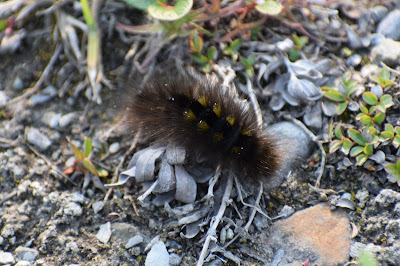
So what's so special about woolly bears in the mountains? Actually, it's one particular species -- the arctic woolly bear, Gynaephora groenlandica. Arctic woolly bears weren't supposed to be crawling around in the Yukon mountains, but that's where Isabel Barrio found them during the summer field season of 2010.

Alpine tundra in the Kluane Range, Yukon. D. Hik photo

Until then, arctic woolly bears had been found only on the tundra along the edge of the Arctic Ocean, almost entirely in Canada's Arctic Archipelago and on the shores of Greenland. They emerge from hibernation for about three weeks in June, munch mainly on Arctic willow, and go dormant again until the next June, spending much of their lives tucked away among the tundra stones, frozen solid. They spend so little time active that it takes them a seven years to develop from egg to moth -- the longest of any butterfly or moth.

There's no way a caterpillar not much bigger than a jelly bean could travel from the Arctic Ocean to the southern Yukon in that short period of activity. And yet -- there they were, arctic woolly bears, crawling around an alpine research camp in the Kluane Range, fully 900 kilometres south of where they were supposed to be.

"Caterpillars are relatively common in the alpine and I had been watching them for years," David Hik, the leader of the research group, wrote in an email, "but Isabel was the one who really started looking at them more closely."

A Yukon arctic woolly bear in search of dinner. Syd Cannings photo.

Today, Isabel Barrio is a professor at the Agricultural University of Iceland, but in 2010 she was working on her doctorate under the direction Hik, a specialist in the alpine ecosystems of the southwestern Yukon. And she had a sharp eye for caterpillars.

Hik explained that there are two arctic species of woolly bear caterpillar -- Gynaephora groenlandica and Gynaephora rossii (the larval form of Ross' tussock moth) -- and they are easy to confuse. G. rossii, however, has a wide range all around the Arctic and in the high mountains farther south, so it was logical to assume the Kluane Range caterpillars were G. rossii.

When Barrio looked closely at the older caterpillars, however, she realized they weren't G. rossii. As improbable as it seemed, they appeared to be arctic woolly bears. The research group collected 30 caterpillars that summer to confirm the identification and to learn more about them.

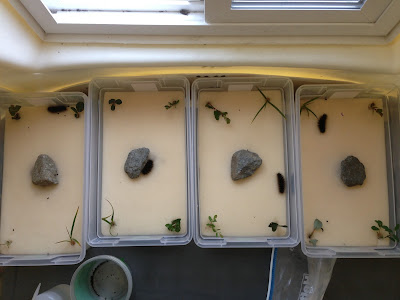
What's your favourite? An experiment to see what the Yukon caterpillars like to eat. D. Hik photo.

That led to another surprise. Analysis of the caterpillars' genetic code showed that the Yukon woolly bears were slightly different from other arctic woolly bears. They were, in fact, a newly discovered subspecies: Gynaephora groenlandica beringiana.

That last word is important. It refers to the fact that they were found in Beringia, the area of northwestern North America that remained ice-free during the last major glaciation. That probably explains their presence in the alpine valley. These fuzzy little beasts were likely crawling over the tough tundra vegetation of Beringia when most of Canada was buried under kilometres of ice -- and they're still there.

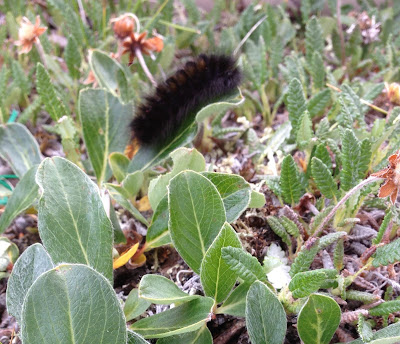
G. groenlandica beringiana perched on top of its supper. D. Hik photo.

Since Barrio's first identification of them, the caterpillars have been found in a few other locations in the Yukon. David Hik suspects they are widespread throughout the alpine areas of Beringia. He hopes that new research projects in the region will turn up more confirmed identifications -- and more information.

"They are very cool, and there is so much more to learn about them," he wrote.

26 Sept 2021

Alice E. Wilson: A Pioneer in Geology

By Claire Eamer

Several years ago, I wrote a book about pioneers in science and technology and how they were treated. It is called Before the World Was Ready: Stories of Daring Genius in Science (Annick Press, 2013). A couple of days ago, I had one of those awful authorly moments where you shout (internally, at least), "NO!!! I missed that!!!"

What I missed, or rather who I missed, was Alice E. Wilson, the first woman geologist in the Geological Survey of Canada. I'd never heard of her. And I should have. In fact, all Canadians should hear about her. And she should definitely have been in my book.

In Alice Wilson's case, the world at the beginning of the twentieth century -- most particularly, the Geological Survey of Canada -- was not ready for a woman to be a geologist. Wilson worked for the Geological Survey for 37 years, but only late in her career did she get the recognition (and pay) that would have come automatically to a man many years earlier.

Alice Evelyn Wilson was born in Cobourg, Ontario, in 1881, the daughter of a university professor. She and her two brothers spent much of their childhood hiking, camping, canoeing, and exploring the outdoors. They collected fossils and interesting minerals from the limestone formations around Cobourg, sparking in Alice a lifelong fascination with fossils.

When it came time to go to university, however, Alice chose to study modern languages. She explained later that at that time -- 1901 -- it was acceptable for a young woman to become a teacher, but not a scientist. Just a few classes short of her degree, however, Alice's health broke down, and she had to drop out of university for a long convalescence. 

Dr. Alice E. Wilson
When she recovered, she found a job at the Museum of Mineralogy in Toronto and rediscovered her childhood passion for rocks and fossils. In late 1909, she managed to get a temporary position with the palaeontology section of the Geological Survey of Canada, helping catalogue, organize and label the division's invertebrate fossil collection.

Alice's boss took a liking to her and helped her get a leave of absence to finish her degree. When she returned in 1911, it was as a permanent (if very junior) staff member. She stayed with the Survey until her compulsory retirement in 1946 at the age of 65. It reportedly took five employees to cover all the work she had been doing.

Even after retirement, she kept an office at the Geological Survey and continued her research until a few months before her death in 1964. She also taught palaeontology at Carleton University in Ottawa, led field trips, and wrote scientific papers and books, including an introduction to geology for children, The Earth Beneath Our Feet (Macmillan, 1947).

During all that long career, Alice Wilson faced an ongoing struggle against the limitations placed on her as a woman. And she constantly found ways around those limitations. 

She wasn't allowed to do remote fieldwork as that would mean travelling and living with men. (Scandalous!). So she conducted research in her own backyard, the St. Lawrence Valley, on foot and by bicycle, when the Survey wouldn't provide her with a car as they did for male geologists, and later in a car she bought herself. (A colleague said she was a terrifying driver, constantly talking and even turning around to address passengers in the back seat.)

Dr. Wilson waxing enthusiastic!

She applied for leave to pursue a doctoral degree -- a slam-dunk for a male employee -- but was turned down. Repeatedly. Still, every year she applied. Finally, in 1926, the Federation of University Women took up the struggle and embarrassed the Geological Survey into granting her leave. She received her doctorate in 1929.

The promotion that should have happened automatically when she earned her doctorate actually came seven years later when the Geological Survey discovered that their lowly female employee was receiving international recognition, including appointment as a Member of the Order of the British Empire (MBE) and election as a Fellow of the Geological Society of America. Two years later came another first: Alice Wilson was the first woman elected a Fellow of the Royal Society of Canada.

When asked in an interview how she coped with the resistance she met as a woman in science, she said: "If you meet a stone wall you don't pit yourself against it, you go around it and find a weakness." Dr. Alice Wilson found enough weaknesses in the various stone walls she encountered to achieve plenty of recognition in her own lifetime and after: an honorary doctorate from Carleton University; a photostory about her from the National Film Board; articles in major newspapers; and, in 1959, the Geological Survey held a reception to recognize her 50 years in geology, presenting her with bookends and a paper weight made from marble quarried in a marble deposit she had herself discovered.

Since her death, the honours continue. A meeting room at the Geological Survey's headquarters was named Alice Wilson Hall. In 2018, a plaque honouring her was installed in the Canadian Museum of Nature. And the Canadian Federation of University Women manages the annual Dr. Alice E. Wilson Awards, given to women pursuing graduate studies in the sciences.

And I really REALLY wish she were in my book!

Sources:

Alice Evelyn Wilson (1881-1964), on the website of the Chair for Women in Science and Engineering

Ricard, Alicen. Women's History Month: Dr. Alice Wilson, on the website of Westcoast Women in Engineering,Science and Technology, October 1, 2018.

Sarjeant, William A. S. Alice Wilson, first woman geologist with the Geological Survey of Canada, in Earth Sciences History, v. 12, no. 2, 1993, p. 122-128.

Sinclair, G. W. Memorial to Alice E. Wilson (1881-1964), in Bulletin of the Geological Society of America 77 (1966), p. 215-218.

Soldati, Arianna, and Cassie Freund. Meet Alice Wilson, the Canadian geologist who did the work of five people, on the website Massive Science, Feb. 27, 2020. 

Note: Photos retrieved from NRCan and used under the Open Government Licence -- Canada: https://open.canada.ca/en/open-government-licence-canada


16 Jul 2021

The "Ew!" Factor

By Claire Eamer

I have a new book out -- and it's so disgusting that it once put my editor right off her dinner. I'm proud of that! (Sorry-not-sorry, Stacey.)

The book is called Extremely Gross Animals: Stinky, Slimy and Strange Animal Adaptations, and it's exactly what it claims to be -- a book about the animals that make you go "Ew!" 


The thing is, once you get past the "Ew!" moment, these animals are fascinating. And adaptation itself is fascinating. 

For example, when I think of mucus, I mostly think of snot and all the unpleasantness that goes with a bad cold or (currently) my over-reaction to pollen in the air. As I blow my nose for the tenth time in a morning, I am not feeling all that friendly about snot. 

But when I learned about some of nature's snot-monsters, I started to change my mind. I'll be honest, I am just as likely as anyone to have a brief "Ew!" moment, but then.... Did you know that snot can be a primo defence mechanism? Or that snot can make a nice, safe place to sleep? Or a vehicle for travelling the world? Honestly, how can that not be fascinating?

And it's all true. Consider the hagfish, a far-from-beautiful eel-like fish with a mouth out of nightmares.

Pacific hagfish poking out of a hole 150 metres below the ocean surface. Credit: NOAA/CBNMS

Then think about picking up a hagfish, or sharing a tank with it as this fellow does. When a hagfish is attacked by a predator -- or even by a television commentator having an "Ew!" moment -- it can produce enough slime (mucus, snot, whatever you fancy) by the bucketful, enough to clog the gills of any fish that fancies it for dinner. Watch here to see some high school students have their own "Ew!" moment at a hagfish research lab at the University of Guelph.

But what about that snotty but safe place to sleep? That's not hagfish, that's the parrotfish, a much prettier denizen of the world's oceans. 

A rainbow parrotfish. Photo credit: Paul Asman and Jill Lenoble

A parrotfish spends its days pottering around coral reefs, eating algae that it has scraped off the coral with its bill-like mouth parts. At night, it sleeps safe and cozy in a cocoon of mucus freshly expelled from glands near its gills. Scientists aren't sure why. After all, you can't interview a parrotfish. However, the cocoon certainly keeps it safe from sharp encounters with coral, may protect it from parasites, and also would give it advance warning of any predator considering a midnight snack of parrotfish.

And the world traveller? Meet the violet sea snail, also called the purple bubble raft snail. 

This violet sea snail washed ashore in Maui with its bubble raft intact. Public domain photo.


As soon as it's born, the snail creates a raft of air bubbles enclosed in mucus to which its single foot is firmly stuck. The snail spends its life floating around the world's oceans upside-down, its foot attached to this mucus-and-bubble raft which keeps it safely at the water's surface. Both "Ew!" and "Awesome!"

And I haven't even begun to tell you what some animals can do with poop. Or puke. Or...well, you'll have to get the book for the rest of the grossness.

Enjoy!


23 Apr 2021

I have a new book!

By Claire Eamer

I HAVE A NEW BOOK COMING OUT JUNE 1!!!

(Oops. Did I shout? Sorry. It’s just that the birth of a new book is really quite exciting.)

Actually, let me tell you a bit about the book – and then I’ll move on to the “exciting.”

It’s called Extremely Gross Animals: Stinky, Slimy and Strange Animal Adaptations, published by my good friends at Kids Can Press. And it’s disgusting, in the best of all possible ways!

Note the tasteful use of both snot-green and puke-green on the book cover.

For example, did you know that baby elephants eat their mothers’ poop? And it’s good for them. Or that horned lizards shoot blood out of their eyes? (Okay, it’s from glands right near their eyes, but the effect is pretty much the same.) Or that giraffes can stick their tongues up their noses? And do!

The book has that and more – and I find it all fascinating. In fact, behaviour that looks icky at first glance usually turns out to be an unexpected but extremely useful way for an animal to survive and prosper. You can read all about it in my new book (did I mention that it’s called Extremely Gross Animals?) on June 1.

But back to the “exciting” bit….

A book isn't born either painlessly or quickly. It has a long, long gestation period. An elephant goes from fertilized egg to newborn baby in about 645 days, or about 21.5 months. Compared to a book, that’s downright speedy.

I checked back through my emails and found that I first mentioned the idea of Extremely Gross Animals to my editor at the end of August 2017. That means it will have had a gestion period of 44 months by the time it’s released to the world – more than twice the time it takes to produce an elephant. And all that for a book that’s just 40 pages long.

So what takes so long? Here’s a summary, based on my overflowing email archive (which I really should prune):

August 31, 2017: I mention in an email “…an old book idea I tinkered with a bit – gross and disgusting animals. I’m sure the world’s 8 to 12 year olds need this book!” My editor agreed, so we both started looking through lists of existing books to see if anyone had already written this book.

September 17, 2017: I submit a preliminary proposal for the book, designed not to duplicate any of the books we found in our search. The proposal bounces back and forth between me and the editor for a few months as we refine it.

January 9, 2018: I submit a full proposal to Kids Can Press (KCP): a detailed outline of the book, an explanation of the rationale behind it, a review of similar or competing titles, and suggestions about how it fits into the curriculum of several different school systems.

March 8, 2018: The KCP editorial board approves going ahead with the proposal, as long as there are enough good, kid-friendly photos of the animals. (There are.)

Long pause filled with personnel changes at KCP, publication schedule planning, and other mysterious goings-on. In other words, my proposal seems to have disappeared into a black hole.

November 8, 2018: After another editorial board meeting, input from the sales department, and more mysterious publisher activity, I’m told the book is a go. Yay!?! But that doesn’t mean the book is underway yet. I still don’t have a contract.

January 17, 2019: I receive a contract proposal from KCP. Then we (KCP, my literary consultant, and I) negotiate.

February 15, 2019: I have a contract with deadlines, royalty rates, lots and lots of fine print – and the book is officially underway! (At this point, of course, I have been researching my chosen animals for some time. But nothing’s official until it’s signed-official.)

…writing…researching…reorganizing…writing…more researching...more writing....

May 6, 2019: I submit the first draft of Extremely Gross Animals (although it doesn’t have that title yet).

May 28, 2019: Draft manuscript returned with editor’s comments.

June 6, 2019: I submit the second draft, along with a draft glossary and list of scientific names for some animals. A few days later, it starts circulating around the editorial department at KCP.

July 14, 2019: I receive editor’s comments on the second draft of the manuscript. I return the manuscript with a few changes a couple of days later, and then go on to work on the back matter, including the index word list, glossary, etc.

August 25, 2019: I receive a revised publication schedule from the publisher. The book has been moved forward to Spring 2021 publication instead of Fall 2021 (which still seems like a long way off). At this point, the designer, photo researcher, and printers get involved, with each stage checked by multiple people.

September 19, 2019: I receive the final edited version of the manuscript, along with the edited version of the end matter we’ve all been working on. Now we make decisions, such as figuring out which animals need to be identified by scientific name and how we do that without confusing the reader.

November 29, 2019: I receive the manuscript with the copy editor’s comments. These are usually the nitpicky bits related to the publisher’s house style, but it's also a chance for a fresh set of eyes to spot where something isn’t as clear as it should be. By this time, both the editor and I have read the manuscript so many times that we can’t reliably pick those moments out. So – yet a few more changes. At this point, I’m well over two years into this book.

April 29, 2020: The photo research is almost complete. The editor checks with me about a few of the photos – mainly whether they match the scientific information in the book.

May 7, 2020: I receive the first set pages (illustrated and laid out as they’ll appear in the book). My job is to check the text one more time, check all the photos to make sure they are scientifically accurate, and add any little touches that might seem necessary (for example, size references where it’s not clear how big or small the animal is). Comment from the editor: “And my advice is to do your review well before or well after eating -- after seeing the photos of the horsehair worms, I won't be eating spaghettini for quite a while.”

August 27, 2020: I receive a PDF file of the first complete colour version of the interior pages of the book. So pretty! And one more chance to catch problems. There aren’t many, but I send back my list of tweaks the next day.

September 9, 2020: I receive a draft of the cover copy (the text on the book’s back cover) for review.

September 22, 2020: I get my first look at the cover. Wow!

November 2, 2020: The final title is confirmed –

Author's delight -- a boxful of beautiful books!
Extremely Gross Animals: Stinky, Slimy and Strange Animal Adaptations – and I have official permission to start talking about the book.

And the rest is a matter of waiting to meet my book in person, face to …er…cover. That happened April 13 (less than four years after I started thinking about it), when my box of author's copies arrived. The rest of you will have to wait a few more weeks.

But you can pre-order the book at your local bookstore or online. It's called Extremely Gross Animals: Stinky, Slimy and Strange Animal Adaptations. Or did I already mention that?


6 Nov 2020

David Attenborough's Witness Statement

By Claire Eamer

I don't have a lot of heroes (of any gender), but in the field of science communication, David Attenborough definitely qualifies. For almost 70 years, the British naturalist and broadcaster has been observing, filming, and interpreting the natural world for audiences of all kinds and all ages.

That bit -- "all ages" -- is one of the reasons he's my hero. He doesn't talk down to his audience. Nor does he oversimplify. He speaks to his audience simply and directly. You don't have to be a scientist or even an adult to understand him. Attenborough demonstrates again and again that complicated subjects can be communicated effectively in language that anyone of almost any age can understand. It's a principle that I try to stick to in my own science writing.

During this clip filmed for the David Attenborough Instagram account, which is managed by the filmmakers, Sir David Attenborough explains why it’s vital for us to put nature at the heart of our decisions. (Source: https://attenboroughfilm.com/about/)

I also try to emulate the way he lets his passion show. Attenborough is as full of wonder at the natural world as he was more than 60 years ago, and he lets us see that. He has worked with dozens or scores of crews, producers, researchers, writers, and scientists over the years, but that humane and human face and voice have not changed. They ARE David Attenborough.

Now, in his 90s and nearing what must inevitably be the end of a long and remarkable life, David Attenborough has delivered what he calls his "witness statement." It's his summation of the changes to the natural world that he has witnessed over the decades, almost all caused by humankind, and his sense of our urgent need to deal with those changes. 

Attenborough's witness statement is delivered -- as is only right -- in the form of a beautifully filmed and narrated documentary: David Attenborough: A Life on Our Planet. The film is currently streaming on Netflix in Canada. If you have access to Netflix through an account or a library account, I recommend it highly.

I also recommend exploring the website set up by Attenborough's company and his partner in the project, the World Wildlife Fund. The site contains a wealth of information and background material for anyone inspired by the film. There are resources for schools, community groups, and for individuals. David Attenborough's witness statement is not just a look back at what we have lost but also a call to action for a better future.


14 Aug 2020

Not Your Grandma's Scientist

By Claire Eamer

The default image of a scientist used to be a white man -- usually with more fly-away white hair than was strictly necessary. Maybe a bit like the dude on the right...

Of course, we all know now that the image was never really accurate. After all, Crick and Watson's discovery of the nature of the DNA molecule owed a great deal to the remarkable work of Rosalind Franklin.

Our current awareness of the dangers of pesticides and similar chemicals was founded on the work and the riveting prose of biologist Rachel Carson. And the great 19th century astronomer, William Herschel, had an equally talented little sister, Caroline, who did much of his math for him and discovered three nebulae and eight comets on her own.

But still, the public face of science has all too often been a white man. Well, the times are changing (and none too soon!).

Take, for example, Evan Johnson-Ransom, a young Black grad student at Oklahoma State University whose delightful Twitter feed I discovered recently.
It's full of dinosaurs, fossils, recreations of ancient beasties, and lots of fascinating palaeo content. Especially, T. rex and its relatives -- which Mr. Johnson-Ransom hopes to spend the next few years studying. As I told him online, he is living every 8-year-old's dream!

Or how about the four young women who just started an organization called Minorities in Shark Sciences (MISS)? They're all passionate about sharks and hope to recruit more enthusiasts to join them.
But why sharks? One of the founders of the group, Carlee Jackson, said in a recent interview that she has been fascinated by sharks since the age of six, even though she grew up in shark-free Detroit. She studied marine biology in Florida, where she finally saw her first live shark in the wild. She thought it was...er...cute. But sharks are not just cute, she said. They're a vital part of the ocean ecosystem.

Sharks not your thing? How about birds? Actually, how about Dr. Letícia Soares. Originally from Brazil, she's working at the Advanced Facility for Avian Research at Western University in London, Ontario, where she studies the transmission of avian malaria in birds.
I discovered Dr. Soares on Twitter, where she was talking with great enthusiasm about birds, research, online conferences, and a certain Turquoise-fronted Amazon parrot that sings in one of the indigenous languages of Brazil. Her enthusiasm about all these topics and more is infectious.

You might notice a theme here -- Twitter. For all that it can be a nasty, poisonous place, Twitter can also open up worlds. It's a great place to find and sometimes interact with scientists of all shapes, sizes, colours, and preferences. There are even some very cool white-guy-scientists there. If you're interested in diversity in science, take a look around.

I should add, however, that diversity in science can often be found even closer to home. And it's not just the young folk. Take, for example, the president of my local university, Vancouver Island University in Nanaimo: Dr. Deb Saucier, a neuroscientist of Métis heritage and a recent recipient of the Indigenous Women in Leadership Award.

And from a previous generation, we in Canada have The Honourable Dr. Lillian Eva Quan Dyck. Daughter of a Chinese immigrant father and a Cree mother, she is a member of the Gordon First Nation in Saskatchewan. After a distinguished career in neuropsychiatry at the University of Saskatchewan, she was appointed to the Canadian Senate in 2005.

Finally, if you're curious about diversity in science, here are a few articles or websites to browse:
You can probably think of more examples and more sources. If so, just add them in the Comments below. I'd love to learn more!


22 May 2020

Did you know....?

By Claire Eamer

Have you noticed that the world is way too serious these days? I mean -- there are reasons why it's serious. I know that. But we can't do serious all day, every day. So here's some non-serious sciency stuff.

When I'm researching a new book, my family gets used to my wandering through the living room or sitting down to a meal and starting the conversation with, "Did you know...?" It means I've found another awesome, mind-boggling, who-woulda-thunk-it fact in my research. Some of those facts make it into the final book. Some don't. But I love them all. So here are a few.

When I was researching Out of the Ice: How Climate Change is Revealing the Past, I read about Ötzi the Iceman, the man who died 5300 years ago in the Alps and whose body lay frozen and preserved all that time, along with his travel gear. Which included socks! Somehow, knowing that a guy who lived and died so long ago wore socks makes him so much more real in my mind. And they weren't ordinary socks. He wore leather shoes stuffed with grass to protect him from the cold, and string socks to keep the grass in place.
Okay, it doesn't look much like a modern sock. But if you look closely at this
replica of the Iceman's footwear, you can see a kind of twine mesh sock
holding the insulating grass in place. The outside shoe had a bearskin sole
and deerskin upper. This replica is in the Bata Shoe Museum in
Toronto, Ontario.
Speaking of socks, here's another sock-fact I learned -- this time while researching What a Waste! Where Does Garbage Go? Roman soldiers wore socks! Inside their sandals!!

Here's the handle of a Roman razor, made in the form of a foot wearing
a sandal and sock. The rolled top of the sock is part way up calf, and, if you
look closely, you can see a herringbone pattern in the sock. That shows it was
probably made of woven material, not knitted yarn.
Photo by The Portable Antiquities Scheme, Philippa Walton.
When you think about it, that makes sense. Not every place the Romans went was as sandal-friendly as central Italy. At the Roman fort of Vindolanda in notoriously cold and wet northern England, an ancient rubbish dump revealed the truth. Almost 2000 years ago, someone in a Roman soldier's family (his mother?) sent him a care package containing -- as recorded in a letter that is still legible -- two pairs of sandals, two sets of underwear -- and socks.

Here's why that Roman soldier wouild have been grateful for warm socks.
He almost certainly spent time on duty at Hadrian's Wall, just north of
Vindolanda. Even on a fine, warm day like this, it's a rough and exposed
place. But in winter, with the cold and the rain and the wind...? Socks
would be very welcome. Claire Eamer photo.
Both those sock facts made it into their respective books, but just in passing. Maybe I need to write a book about socks? Okay, maybe not. But maybe a book about Indian Runner Ducks? They are weird! They stand upright, like penguins, and instead of waddling like your average duck, they can run.

Here's a little family of Indian Runner Ducks. They're sometimes called
bowling pin ducks or penguin ducks, and you can see why.
Photo by Alan Rockefeller - Own work, CC BY-SA 4.0,
 https://commons.wikimedia.org/w/index.php?curid=40930474
Runner ducks come from the East Indies, from some of the islands that now make up Indonesia. They're good egg-layers and good walkers -- which means they can be walked to market, rather than carried. They don't need water as much as most ducks, and their wings are too small for flying, so they are fairly easy to keep. But you've got to admit, they're a bit silly-looking!

And why my sudden interest in Indian Runner Ducks? I think it's related to the fact that there are currently seven Indian Runner Duck ducklings living in a basket in our laundry room. I'm looking forward to watching them race around the yard like speedy penguins in a few weeks.

Here -- have a duckling picture. If that doesn't cheer you up, I don't know what will.

Claire Eamer photo

28 Feb 2020

Everything Old is New Again

By Claire Eamer

An atlatl is a throwing stick. It’s a tool used to extend the reach and flexibility of a hunter’s arm so that he or she can throw a light spear farther, harder, and faster. And very accurately. The word atlatl comes from the Nahuatl language of the Aztecs, who used atlatls in hunting and war.

A model at the Natural History Museum in Vienna, Austria, shows an ancient
hunter using a simple atlatl and dart. Photo by Wolfgang Sauber.
At its simplest, an atlatl is a stick with a hook at one end. The hook fits into a dimple in the base of the spear – usually called a dart. The hunter holds the atlatl and dart in one hand, sweeps both forward in a throwing motion, and lets the dart fly.

Atlatl throwing. Illustration by Drew Shannon for
Out of the Ice: How Climate Change is Revealing the Past (Kids Can Press, 2018)
Sounds simple, but it’s so effective that people on all continents have used atlatls for thousands of years, and many still use them. Although it has been overshadowed in most cultures by the bow and arrow and by firearms, an atlatl is still a cheap, easy-to-make, and easy-to-use hunting weapon. All you really need to make one is a small knife and a straight-ish stick.

These two atlatls, currently in the Houston Museum of Natural Science, are
between 12,000 and 17,000 years old. They were found in caves or rock shelters in France.
The animal carved on the lower atlatl has been identified as a hyena. Claire Eamer photo.
Of course, not all atlatls are simple sticks. Humans like to embellish their tools. A couple of atlatls found in dry caves in France have carved images of animals that have been extinct in Europe for thousands of years. An Aztec atlatl in the British Museum is elaborately carved with images of warriors or gods and covered with gold.

I first heard about atlatls in the late 1990s, when I lived in the Yukon. A friend, Environment Canada caribou biologist Don Russell, was asked to confirm discovery of what appeared to be huge quantities of caribou droppings melting out of a high alpine ice patch near Whitehorse. (For the full story, see my book Out of the Ice: How Climate Change is Revealing the Past.)

Dimples in the ends of atlatl darts.
Illustration by Drew Shannon for
Out of the Ice: How Climate Change is
Revealing the Past
(Kids Can Press, 2018)
Don spotted something odd lying on the rocks beside the ice patch. It was a stick. Far above treeline, with no other wood around, he found a stick – with what looked like string wrapped around it and a tattered bit of feather.

“Cool,” said the archaeologists (more or less), when presented with the stick. “Part of an arrow, maybe even a century old. Very rare.” But testing showed it was even cooler. The stick was 4300 years old, and it wasn’t an arrow. The tell-tale dimple at one end showed that it was the remains of an atlatl dart. Long ago, around the time that ancient Britons were building Stonehenge, a hunter in the Yukon mountains flung a dart at a caribou – and missed. The dart disappeared into the snow and ice where the cold preserved it.

That was the first direct evidence of atlatl use in the Yukon. Wood normally disintegrates in a few years unless it’s preserved in some way – usually by extreme dryness or extreme cold. Cold is what saved the Yukon atlatl dart, and it has preserved other things too. Lots more wooden artifacts, including the rest of the dart Don found, have been discovered in the ice patches, as well as bone, antler, leather, and other materials that normally don’t survive for thousands of years. 
Kids choose their weapons at the atlatl range at the
Yukon Beringia Interpretive Centre in Whitehorse.
Yukon Government photo.
Today, most school kids in the Yukon know about atlatls and might even have tried their hand at them. Elsewhere, too, people are experimenting with atlatls. There are even formal atlatl competitions and modern atlatl hunters. It is, indeed, a case of “Everything old is new again.”

Ready to throw at the Yukon Beringia Interpretive Centre's atlatl target range.
Yukon Government photo
If you want to know more about the Yukon Ice Patches and see some of the finds, check out The Frozen Past, an illustrated booklet produced by the Yukon Government and the First Nations involved in the ice patch research.

If you'd like to see video of people throwing atlatls, here is the 2012 Atlatl Competition at Anasazi State Park Museum in the United States.


And, of course, you can always consult my own book -- Out of the Ice: How Climate Change is Revealing the Past (Kids Can Press, 2018) -- for the story of the Yukon discoveries and frozen discoveries elsewhere in the world.

13 Dec 2019

Food on the Move

By Claire Eamer

A vital component of a turkey dinner.
Image by skeeze from Pixabay
I've been thinking a lot about food lately. One reason is that I have been auditing a university class on food and drink in the archaeological record. Somehow, ancient peoples seem much more real when you start to figure out what they snacked on during a workday and what they ate and drank at a feast.

(Auditing classes, I've discovered, is a blast! All the fun of learning with none of the stress of exams.)

The other reason for thinking of food, of course, is that we're approaching the season of winter feasting. Turkey dinner. Mashed potatoes. Corn on the cob. Roasted squash. Cranberry sauce. Maybe a little hot sauce on the side for those who like dash of fire with their food.

But if you'd mentioned any of those foods to someone from Europe, Africa, or any part of Asia 600 years ago, they would have been baffled. All those foods came from the Americas, and no one outside the Americas had eaten them until the European invasion of the Americas began just over 500 years ago.

(Okay -- Europe has a kind of wild cranberry, but it's not the sort you'll find in the cranberry sauce served with your Christmas turkey.)

I learned just how many foods originated in the Americas a few years ago when I was researching The World in Your Lunch Box: The Wacky History and Weird Science of Everyday Foods. I was amazed -- not just at the variety of foods, but at how skilled the farmers of the Americas were and how quickly their foods spread to the rest of the world.

Teosinte is on the left, and modern corn is on the
right. Between them is a hybrid of teosinte and corn.
Image by John Doebley.
Consider, for example, corn. At least 8000 years ago, the people who lived in what is now Mexico and Central America began a long process of crop breeding that turned a common grass called teosinte into maize -- the plant served up as everything from tortillas to corn on the cob. Today, maize is still an extremely important food in Central and South America, but it's also the most important food crop in much of sub-Saharan Africa.

Or look at potatoes. They come from the Andes in South America, and you'll still find the biggest variety of potatoes there. But 500 years ago, the Spanish took a few kinds of potatoes back to Europe, and they spread. They spread so far and so fast that China is now the world's biggest producer and consumer of potatoes.

And that delicious-smelling turkey? The Ancient Puebloans who lived in the famous cliff dwellings of Mesa Verde 800 years ago kept turkeys penned in the alcoves behind their houses. In other parts of North America, such as the forests of what is now the eastern United States, turkeys were so plentiful that people didn't bother to keep them penned up. Why feed a bird when it can feed itself and still be available to hunt when you need it?

Those are just a few of the foods that came from the Americas. They, along with chili peppers, tomatoes, squash, chocolate, and a cornucopia of other delights, changed the nature and flavour of food around the world.

Now I'm hungry!

15 Nov 2019

Fishy Sauce and a Fishy Date

By Claire Eamer

The Garum Shop in the ancient Roman city of Pompeii was a small business that manufactured and sold a fish sauce called garum that Romans adored. The shop went out of business suddenly and permanently in 79 CE when the nearby volcano, Mount Vesuvius, erupted and buried it, the city, and several other communities under metres of volcanic rock and hot ash.

This is the Triclinium or dining room of a wealthy family
in Pompeii. The diners would have reclined on beds while
eating dishes liberally laced with garum. Claire Eamer photo.
In 1960, archaeologists uncovered the Garum Shop for the first time in 1880 years. Buried with it were six large ceramic containers called dolia and several of the large pottery vessels called amphorae used for everything from wine to -- in this case -- fish processing. The dolia contained the remains of garum in several stages of production, and some of the amphorae contained the well-preserved bones of hundreds of tiny fish.


Fishy flavour

Now, historians have known for centuries that the Romans loved garum and ate it in huge quantities. But they didn't know exactly what it was beyond a liquid made from decomposed, fermented fish, fish blood, fish guts, and other fishy bits. Doesn't sound very appealing, does it? But no one knew how appealing it might be because no one had tasted it in the better part of 2000 years.
A street-food booth in Pompeii. The railings are modern, but the rest of the shop
is just as the owner left it almost 2000 years ago. The counters have large ceramic
containers sunk into them to hold the day's offerings, certainly including garum.
Claire Eamer photo.

And we didn't have a decent recipe. Have you ever tried to recreate your mother's perfect chocolate cake icing or your grandmother's perfect butter tarts? (I have.) Even if you have the original recipe and you know exactly how it should taste, it's not easy. So -- no detailed recipe and no idea of what it should taste like made garum a mystery.

In the last few years, however, archaeological science has reached the point where those garum remains are more than a curiosity. Chemists are analyzing them to determine exactly what went into garum and in what quantities. And archaeozoologists are studying the fish bones to figure out what kind of fish were used.

Fishy calendars

The top is gone from this three-legged table, but the marble lion
feet remain. It was a valued antique. An inscription says it once
belonged to Casca Longus, the first to strike Caesar when he was
murdered in the Roman Senate in 44 BCE. Claire Eamer photo
That's where the fishy date comes in. For years, the most widely accepted date for the eruption of Mount Vesuvius was August 24, 79 CE. That was based on a letter written by an eye-witness, Pliny the Younger, whose uncle died in the eruption. But Pliny's letter was written 25 years after the event, and the original disappeared long ago. We only know it from translations and copies, and they don't agree on what the Roman date translates to in modern terms.

Back to the fish. Scientists studying fish bones from the Garum Shop determined that they came from a small Mediterranean fish called the common picarel (Spicara smaris) -- and that all the fish examined were 10 to 13 centimetres long, about a year old, and all female. Fish have growth rings in their bones, much like the growth rings of trees, so the scientists could even tell that they died when the water was warmest -- late summer or early autumn. Then they were thrown whole into amphorae and packed with brine and, probably, herbs. They had been in the amphorae from one to three or four weeks when the heavens rained hot ash and buried them.

The August 24 date for the eruption was already in doubt because of other archaeological evidence, and the fish evidence made it even fishier. Large shoals of female-only picarel come close to the shores of southern Italy in late August and September, so that would push the eruption date to mid-October or later.

Fish-free evidence

Huge millstones still sit in the courtyard
of a Pompeii bakery and flour mill.
Claire Eamer photo
Just a year or so ago, an even more definitive piece of evidence for a later date turned up -- a bit of writing scrawled on a wall in charcoal. It's just a date, probably left by a tradesman working on a house, but the date translates to October 17 in our calendar, almost two months after the workman should have died in the eruption. The latest guess is that Vesuvius blew its top about October 24.

So fish and a long-dead tradesman appear to have corrected a fishy historical date. And while we still don't know exactly what garum tasted like, the chemists are busy fishing (sorry -- couldn't resist) for the recipe.

References:
Carannante A. The last garum of Pompeii: Archaeozoological analyses on fish remains from the "garum shop" and related ecological inferences. Int J Osteoarchaeol. 2019;29:377-386.

Pompeii: Vesuvius eruption may have been later than thought. BBC News, 16 October 2018. Located at https://www.bbc.com/news/world-europe-45874858


30 Aug 2019

When Did Humans Reach the Americas?

By Claire Eamer

Now there's a question that opens a can of worms!

A couple of years ago, I wrote a short news article -- Archaeological Find Puts Humans in North America 10,000 Years Earlier Than Thought -- for Hakai Magazine. It was about a new analysis of bones found 40 years ago in the Bluefish Caves in the northern Yukon by Canadian anthropologist Jacques Cinq-Mars. The magazine followed it up with a lengthy and fascinating piece by Heather Pringle: From Vilified to Vindicated: the Story of Jacques Cinq-Mars.

Doctoral student Lauriane Bourgeon's analysis of the bones, particularly a horse jawbone with cut marks on it, appears to confirm Cinq-Mars's original conclusion -- that human hunters were using the Bluefish Caves at least 24,000 years ago, at the height of the last glaciation. At that time sea levels were much lower than today, and people could have crossed to North America from Siberia on the wide, dry, windswept plains of Beringia, a route now blocked by the waters of the Bering Strait.
Beringia land bridge-noaagov

At the time Cinq-Mars published his first account of the excavation, the prevailing theory said humans arrived in North America from northeastern Siberia about 14,000 years ago at a time when the glaciers were finally disappearing, but when there was still a dry-land link between Asia and North America. They then followed an ice-free corridor between glaciers that led them south to the rest of the Americas. The problem with that theory is the growing body of evidence that no such corridor existed or was inhabitable at that time, as well as another growing body of evidence that people were living well south of the glaciated lands before the glaciers disappeared.

Cinq-Mars's find and Bourgeon's re-analysis of it support another theory: the Beringian standstill hypothesis. According to that theory, humans moved into the dry region linking Asia and North America 10,000 years or more before the great ice sheets melted and the sea level rose. And there they stayed, making a decent living from the animals -- both large and small -- that shared their giant refuge from the ice.

But what about those people living farther south when the ice was still melting? Current thinking suggests they might have arrived by sea, travelling down the west coast of North America, with its rich resources of shellfish and other coastal foods. A report just released dates a cache of artifacts found in Idaho to 16,000 years ago. A joint research effort by Western scientists and First Nations in British Columbia recently found even more startling evidence to support the coastal theory -- 29 footprints left, probably, by a small family walking along a beach 13,000 years ago.

Unravelling the mystery of humans in the Americas is no easy task. Much of the evidence was ground to dust by kilometres-deep ice or flooded by rising seas as the ice melted. But scientists and Indigenous peoples are working on it. It's still a can of worms, but each worm that emerges changes the picture slightly and makes it a little clearer. And a lot more interesting.

Claire Eamer's most recent book is Out of the Ice: How Climate Change is Revealing the Past (Kids Can Press, 2018).

12 Jul 2019

Snakes at the Seaside and Birds in the Bush

By Claire Eamer

"Snake!" yelled 8-year-old Carys, and dove for the grassy bank beside the trail. She emerged clutching a deeply puzzled garter snake at least 60 centimetres long, with elegant checkerboard markings on its sides and a jagged yellow stripe running the length of its back.
Western garter snake, found at Pipers Lagoon Park, Nanaimo.
The rest of the group -- more than two dozen kids and adults, with an age range from 8 to 80-ish -- crowded around to admire her catch. Our leader, biology professor Tim Goater of Nanaimo's Vancouver Island University (VIU) identified it as a female western garter snake (Thamnophis elegans), almost certainly pregnant, and the largest specimen he had seen at Pipers Lagoon, the small seaside park we were exploring. Western garter snakes have a variable diet, depending on where they live, he explained. Carys's prize catch would specialize in hunting intertidal fishes among the park's rocks and tidepools.

Professor Tim Goater with
a large clam at Pipers Lagoon.
Once everyone had admired the snake, we put her back on the slope beside the trail and watched, fascinated, as she disappeared into the grass and undergrowth in less than a second.

The mixed group of kids and adults wasn't just a casual group of visitors to the seashore. We were students in a class called Explorations of Animal Diversity, one of 10 offerings at this year's edition of Grandkids University. The two-day program is open to kids aged 7 to 13 and to their grandparents or grandparent-equivalents (other senior relatives or special friends).

Carys, left, entranced by birdbanding.
Carys and I (I'm her great-aunt) were in our second year at Grandkids University this year. Her brother, Rowan, was in his third year. He and his special friend, Susan, spent two days in the chemistry lab, making soap, slime, invisible ink, instant ice cream, and pop-bottle rockets -- and learning a considerable amount of chemistry along the way.

Over two days, Carys and I got to see and handle garter snakes both in the lab and in the field, peer at insects through a dissecting microscope, search for animals in the intertidal zone, visit a bird-banding station, dissect a ratfish in search of parasites, and tour VIU's International Centre for Sturgeon Studies.

Master bander Eric Demers shows the wing feathers
of a Common Yellowthroat.
And, at the end of the two days, we all attended a graduation ceremony in the university's theatre. VIU's symbols -- a mace and a beautifully decorated steering paddle -- were formally piped through the theatre to the stage. Then, the VIU registrar, in full academic robes, presented each adult and child with a completion certificate. Kids and adults who had attended Grandkids University for 5 years also received "Masters" medals. (Both Rowan and Carys are determined to get their Masters!)
A female American Goldfinch receives its individualized band.
This is the 11th year for VIU's Grandkids University, and it drew a record 163 participants. Almost a dozen former kid participants have grown up to become VIU students, and a number of the participating adults also take VIU classes. Clearly it's part of the university's recruiting program, but it does more than just generate students.

Carys found a seastar that had lost one arm
and was still regrowing its replacement.
Both the kids and the grandparents learn things -- about the subject they are studying and about each other. For two days, they are equals, experiencing the pleasure of learning something new and interesting. The kids can see that adults don't know everything, but that they can learn. The adults get a chance to see how bright and capable the kids are.

And everyone is reminded that learning isn't drudgery. It's fun.

All photos by Claire Eamer.