Showing posts with label Otzi. Show all posts

22 May 2020

Did you know....?

By Claire Eamer

Have you noticed that the world is way too serious these days? I mean -- there are reasons why it's serious. I know that. But we can't do serious all day, every day. So here's some non-serious sciency stuff.

When I'm researching a new book, my family gets used to my wandering through the living room or sitting down to a meal and starting the conversation with, "Did you know...?" It means I've found another awesome, mind-boggling, who-woulda-thunk-it fact in my research. Some of those facts make it into the final book. Some don't. But I love them all. So here are a few.

When I was researching Out of the Ice: How Climate Change is Revealing the Past, I read about Ötzi the Iceman, the man who died 5300 years ago in the Alps and whose body lay frozen and preserved all that time, along with his travel gear. Which included socks! Somehow, knowing that a guy who lived and died so long ago wore socks makes him so much more real in my mind. And they weren't ordinary socks. He wore leather shoes stuffed with grass to protect him from the cold, and string socks to keep the grass in place.
Okay, it doesn't look much like a modern sock. But if you look closely at this
replica of the Iceman's footwear, you can see a kind of twine mesh sock
holding the insulating grass in place. The outside shoe had a bearskin sole
and deerskin upper. This replica is in the Bata Shoe Museum in
Toronto, Ontario.
Speaking of socks, here's another sock-fact I learned -- this time while researching What a Waste! Where Does Garbage Go? Roman soldiers wore socks! Inside their sandals!!

Here's the handle of a Roman razor, made in the form of a foot wearing
a sandal and sock. The rolled top of the sock is part way up calf, and, if you
look closely, you can see a herringbone pattern in the sock. That shows it was
probably made of woven material, not knitted yarn.
Photo by The Portable Antiquities Scheme, Philippa Walton.
When you think about it, that makes sense. Not every place the Romans went was as sandal-friendly as central Italy. At the Roman fort of Vindolanda in notoriously cold and wet northern England, an ancient rubbish dump revealed the truth. Almost 2000 years ago, someone in a Roman soldier's family (his mother?) sent him a care package containing -- as recorded in a letter that is still legible -- two pairs of sandals, two sets of underwear -- and socks.

Here's why that Roman soldier wouild have been grateful for warm socks.
He almost certainly spent time on duty at Hadrian's Wall, just north of
Vindolanda. Even on a fine, warm day like this, it's a rough and exposed
place. But in winter, with the cold and the rain and the wind...? Socks
would be very welcome. Claire Eamer photo.
Both those sock facts made it into their respective books, but just in passing. Maybe I need to write a book about socks? Okay, maybe not. But maybe a book about Indian Runner Ducks? They are weird! They stand upright, like penguins, and instead of waddling like your average duck, they can run.

Here's a little family of Indian Runner Ducks. They're sometimes called
bowling pin ducks or penguin ducks, and you can see why.
Photo by Alan Rockefeller - Own work, CC BY-SA 4.0,
 https://commons.wikimedia.org/w/index.php?curid=40930474
Runner ducks come from the East Indies, from some of the islands that now make up Indonesia. They're good egg-layers and good walkers -- which means they can be walked to market, rather than carried. They don't need water as much as most ducks, and their wings are too small for flying, so they are fairly easy to keep. But you've got to admit, they're a bit silly-looking!

And why my sudden interest in Indian Runner Ducks? I think it's related to the fact that there are currently seven Indian Runner Duck ducklings living in a basket in our laundry room. I'm looking forward to watching them race around the yard like speedy penguins in a few weeks.

Here -- have a duckling picture. If that doesn't cheer you up, I don't know what will.

Claire Eamer photo

22 Oct 2016

Iceman CSI: Tales from a 5300-year-old man

Forensic reconstruction imagines this is
what the 5300-year-old Ötzi looked like.
(Thilo Parg, CC BY-SA 3.0)
by Adrienne Montgomerie

An arrow sang through the air and plunged deep into a man’s shoulder 5300 years ago in Italy. That man fell as he gasped his last breath, his left arm flung awkwardly across his chest, pinned beneath him.

A mummy is not what you expect to find when you’re strolling through the Alp mountains with your husband. But that’s what happened to the group of mountaineers who found this mummified man in 1991.

What happened to this man? Why did he lay there, undiscovered, for so long? What can his body tell us about humans and life so long ago?

Because he died in a place that is always cold, his body did not disappear into the earth or get eaten by animals. All his parts are there, exactly where they were. He is not covered in rags like a mummy in a movie, but we say his body was mummified because it did not rot. This ancient man they named Ötzi, contains a lot of clues.
.

Learning without destroying

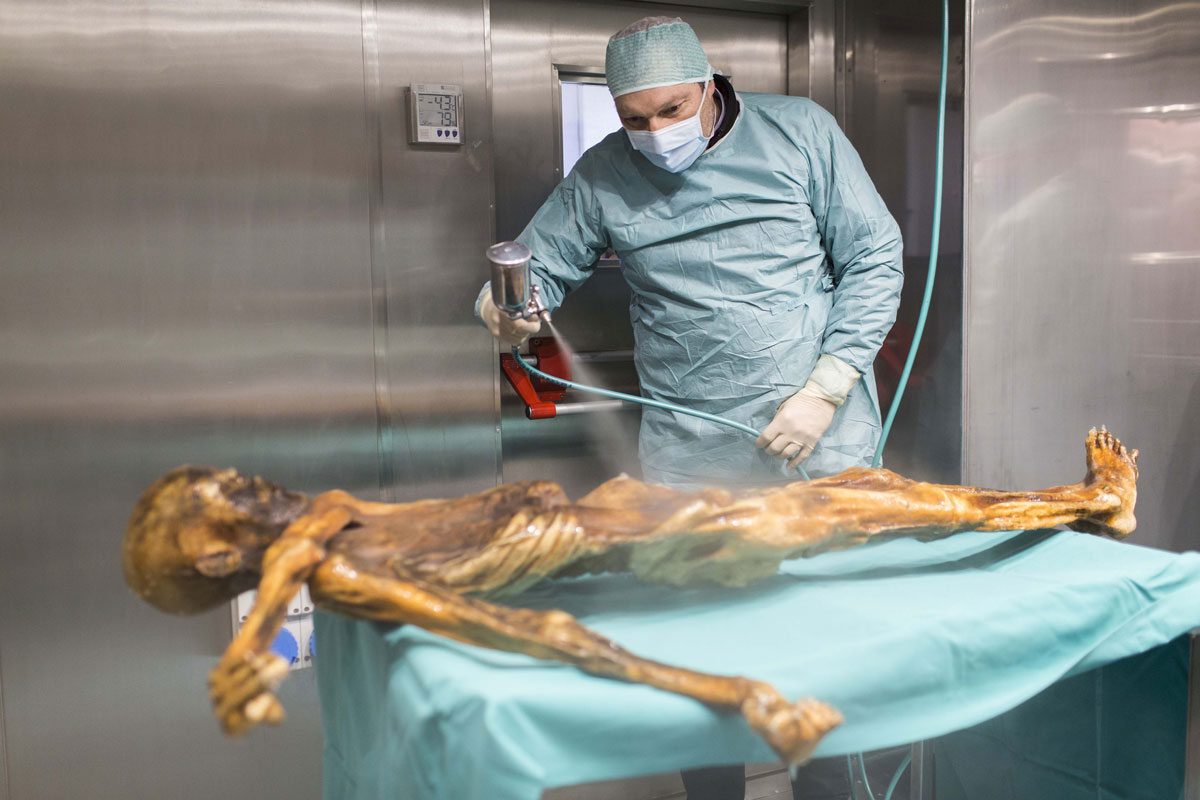
Early scientists would cut apart specimens to learn about them, but that destroyed the body. Today, scientists know that the more they can preserve, the more will be available for other scientists to learn from, and for new technologies that get developed in the future.

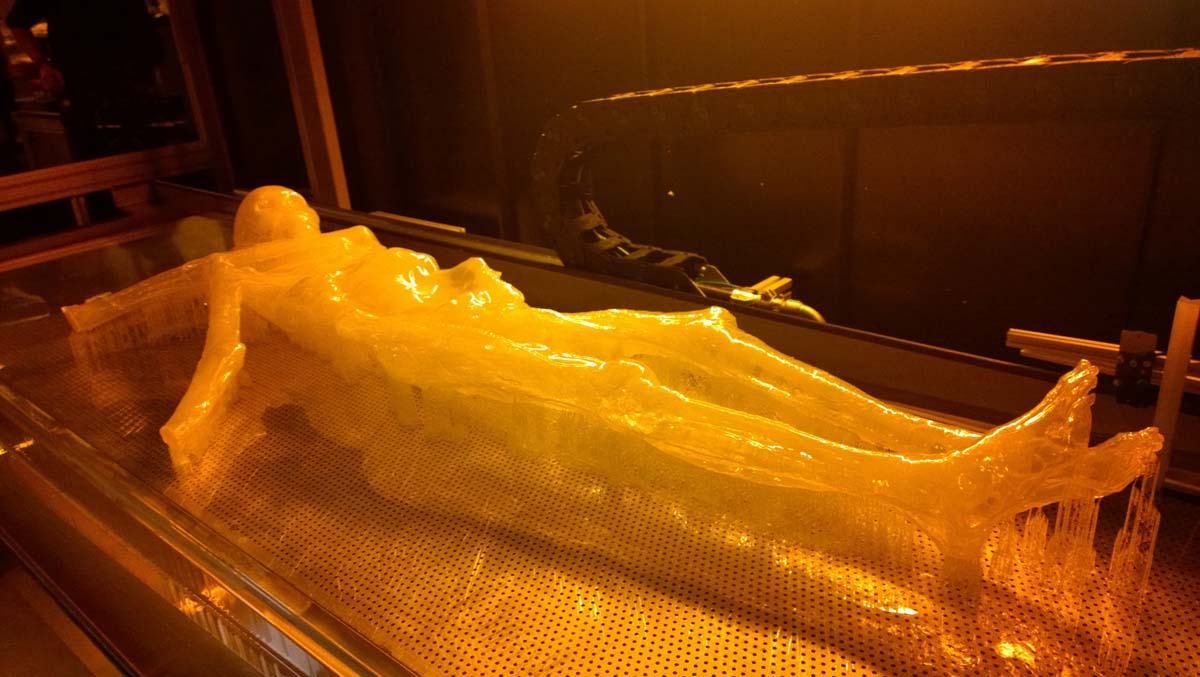
The body is too fragile let everyone examine it closely, so 3D printing was used to create a copy so people can get a closer look at him.
The 3D print formed the base that the sculpture is made from. (Materialise)
Preserving the iceman Ötzi, so that others can study him, means keeping his body in a room that is –6 °C and nearly 100% humidity — just like on a glacier. The room is dim too, to protect the artifacts from damaging light. An alarm goes off it the room changes.
Ötzi is kept at –6 °C and nearly 100% humidity. (South Tyrol Museum of Archaeology)
Dinosaur bones are replicated for display, too. That’s right, the bones you see in the museum are not the actual bones that were dug up. The originals are stored in conditions that keep them from falling apart, so that scientists (like archeologists) can study them.
.

What can scientists find out from the iceman?

Well, first, they can find out how long humans might have lived, so long ago. Because we have a lot of data about how bones age, scientists can estimate that Ötzi was 45 years old when he was killed.
Because of what we know about how vocal chords work, scientists can guess what Ötzi’s voice sounded like.

Because of the contents of his stomach, they can find out what kind of diet people had that long ago. His last meal was ibex, deer, and grain. His stomach also gives clues about where he travelled, because of the h. pylori bacteria they found in his gut came from Asia, very far away from Italy.

By analysing his DNA, they can find out that he was lactose intolerant, was likely to get heart disease, and had Lyme disease.
His shoes look a bit like Uggs.
(Wolfgang Sauber, CC BY-SA 3.0)

Because of the bits of clothes that were still on him, researchers can make guesses about the style of clothes he wore and the animals that they were able to kill (to use to make clothes).

Because of X-ray and CAT scans, we know there is an arrow-head lodged in his shoulder. But forensics showed he had many more injuries — the kinds that people get from a fight — and blood from four other people on his clothes and tools. Now experts think he actually died from a hit to his head.
.

Mysteries still

There’s still a lot you can’t know by examining a body. Wouldn’t you like to know where Ötzi lived and why he was in the mountains? Who he was fighting and why? How big was his family, and did his brothers and sisters play pranks on each other?
.

Learn more

There are a couple documentaries about Ötzi (Iceman Reborn, and others by NOVA), and several websites explaining different aspects scientists have discovered about him (follow the links in this article). You can even find out how a body becomes a mummy naturally

You can see the Ötzi copies in person at the DNA Learning Centres in New York city and Cold Spring Harbor, USA. To see him in person, you have to look through a small window into a climate-controlled room at the South Tyrol Museum of Archaeology in Bolzano, Italy.