Showing posts with label mummy. Show all posts

13 Apr 2018

The Littlest Mummy

Brooklyn Museum, 30 B.C.E. – 50 C.E.

Even people who really love Egyptology and know a lot about ancient mummies might be curious about this little bundle of linen. It's only about nine inches (21 centimeters) long, and less than two inches (3.5 centimeters) at its thickest point. What in the world could be mummified in such a small package?

The answer to this question can be found using modern technology! Modern scientists prefer to use non-destructive methods to learn more about mummies from the past. Instead of cutting or damaging their wrappings, they instead put them into a medical scanner.

Here's another mummy bundle with a very similar size, shape and date. When we look inside...what do we see?

Penn Museum, E12435: mummy from the side, paired with radiograph
It's a tiny animal! Even though the radiograph might seem a little hazy, this is obviously a small mammal skeleton. You can clearly make out the teeth and the long tail.

Most of us are not experts when it comes to mummies OR small mammals, but zooarchaeologist Kate Moore had the answer. It was the teeth that were the real give-away--this was a mummy of one of the world's smallest mammals, the Egyptian sacred shrew.

Dr. Moore and a shrew skull
Of course, this answer leads to more questions. What did a live Egyptian shrew look like, for example? And why would you make one into a sacred mummy?

The Egyptian pygmy shrew (Image Bibliotheca Alexandrina)
The answer to the first question is simple--an Egyptian sacred shrew was pretty adorable! It was a very tiny creature, which could easily fit into the palm of your hand. It was very similar in size and appearance to one of its close living relatives today, the Etruscan shrew.

Wikipedia image of Etruscan shrew.
The answer to the second question is a bit more complicated. The important thing to understand is that many animal mummies in ancient Egypt were made as votive offerings--they were gifts to be offered to the gods. The links between animals and the gods were symbolic.

Shrews, although they are very tiny, are incredibly fierce animals! And because they are such mighty mites, they are capable of killing snakes and destroying their eggs. In ancient Egypt, the shrews were representatives of the god Horus, the protector of the Sun. By day, Horus has the form of a Falcon, but by night, Horus takes the form of a shrew or an Egyptian mongoose, to keep up His eternal battle against the cobras and crocodiles that threaten the Sun on its cosmic journey.

___
WANT TO LEARN MORE?

Animal mummies are a fascinating topic, and there are lots of great resources where you can learn more about them.

SOULFUL CREATURES: ANIMAL MUMMIES OF ANCIENT EGYPT is available on Amazon. But if you can't afford your own copy, you might find it in your library. If your library doesn't have a copy--you could always ask them to buy one for the collection!

National Geographic Magazine also has a gallery of ancient Egyptian animal mummies, which has beautiful images. It is connected to an article which was published in the magazine in November 2009. Does your library have back issues of National Geographic?

The Penn Museum Artifact Lab has a blog where scientist Molly Gleeson publishes posts about the lab's study of animal mummies using modern scanning technology.

The New York Times ran an interesting article about the Soulful Creatures Exhibit at the Brooklyn Museum, which includes facts and interviews with scientists who study Egyptian animal mummies.

___
ABOUT THE AUTHOR

Arinn Dembo is a professional science fiction writer and software developer working in Vancouver, BC. She has degrees in Anthropology and Classical and Near Eastern Archaeology, and volunteers as a science educator at Vancouver's The Learnary, where she teaches an ongoing series of workshops called Gothic Science.

22 Oct 2016

Iceman CSI: Tales from a 5300-year-old man

Forensic reconstruction imagines this is
what the 5300-year-old Ötzi looked like.
(Thilo Parg, CC BY-SA 3.0)
by Adrienne Montgomerie

An arrow sang through the air and plunged deep into a man’s shoulder 5300 years ago in Italy. That man fell as he gasped his last breath, his left arm flung awkwardly across his chest, pinned beneath him.

A mummy is not what you expect to find when you’re strolling through the Alp mountains with your husband. But that’s what happened to the group of mountaineers who found this mummified man in 1991.

What happened to this man? Why did he lay there, undiscovered, for so long? What can his body tell us about humans and life so long ago?

Because he died in a place that is always cold, his body did not disappear into the earth or get eaten by animals. All his parts are there, exactly where they were. He is not covered in rags like a mummy in a movie, but we say his body was mummified because it did not rot. This ancient man they named Ötzi, contains a lot of clues.
.

Learning without destroying

Early scientists would cut apart specimens to learn about them, but that destroyed the body. Today, scientists know that the more they can preserve, the more will be available for other scientists to learn from, and for new technologies that get developed in the future.

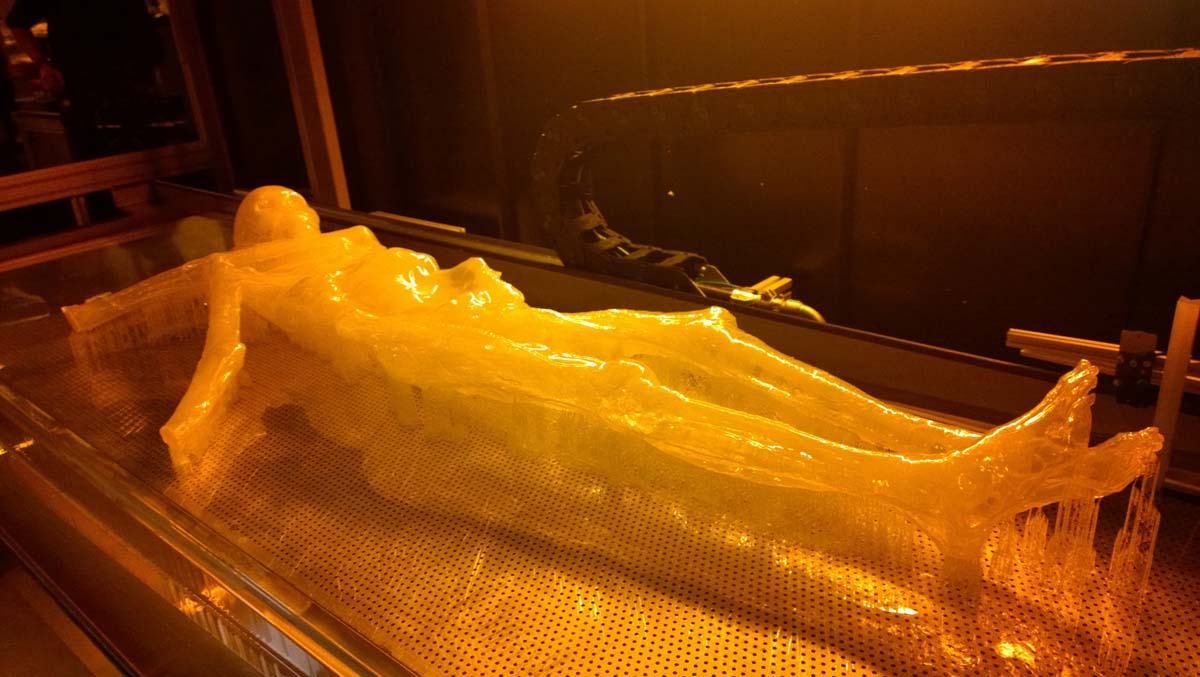
The body is too fragile let everyone examine it closely, so 3D printing was used to create a copy so people can get a closer look at him.
The 3D print formed the base that the sculpture is made from. (Materialise)
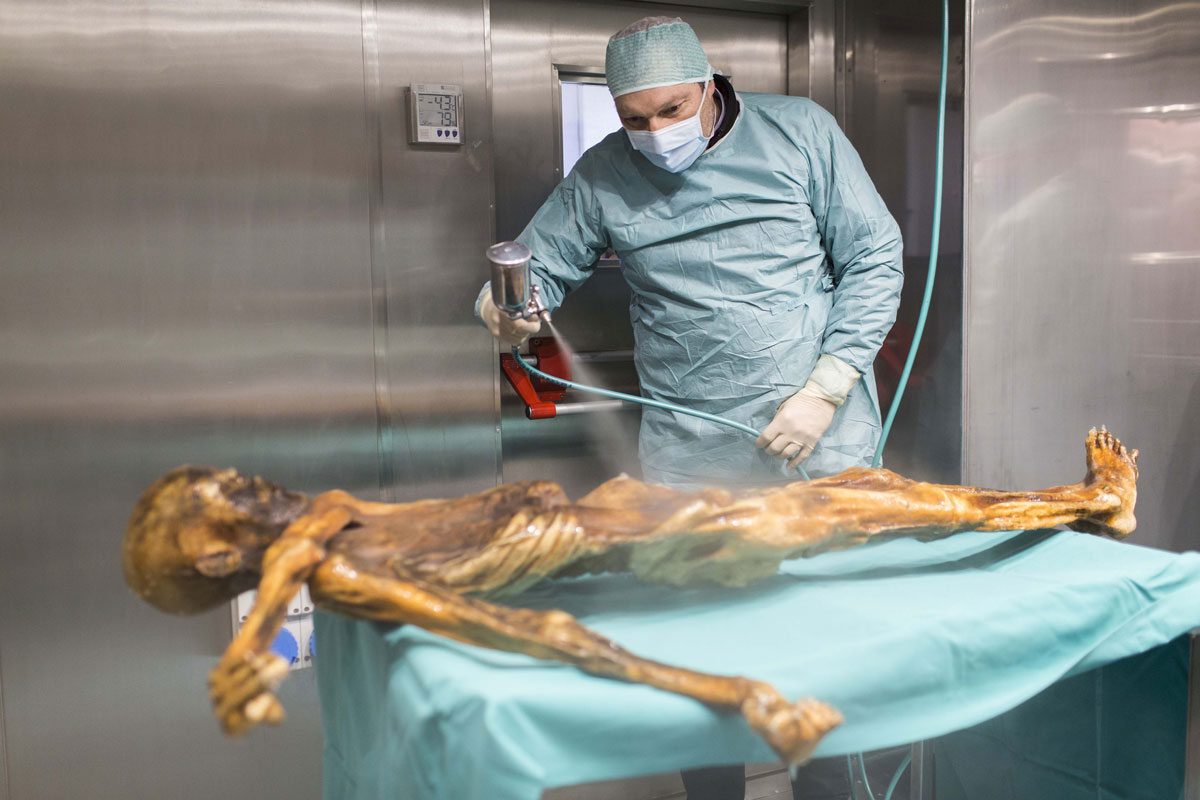
Preserving the iceman Ötzi, so that others can study him, means keeping his body in a room that is –6 °C and nearly 100% humidity — just like on a glacier. The room is dim too, to protect the artifacts from damaging light. An alarm goes off it the room changes.
Ötzi is kept at –6 °C and nearly 100% humidity. (South Tyrol Museum of Archaeology)
Dinosaur bones are replicated for display, too. That’s right, the bones you see in the museum are not the actual bones that were dug up. The originals are stored in conditions that keep them from falling apart, so that scientists (like archeologists) can study them.
.

What can scientists find out from the iceman?

Well, first, they can find out how long humans might have lived, so long ago. Because we have a lot of data about how bones age, scientists can estimate that Ötzi was 45 years old when he was killed.
Because of what we know about how vocal chords work, scientists can guess what Ötzi’s voice sounded like.

Because of the contents of his stomach, they can find out what kind of diet people had that long ago. His last meal was ibex, deer, and grain. His stomach also gives clues about where he travelled, because of the h. pylori bacteria they found in his gut came from Asia, very far away from Italy.

By analysing his DNA, they can find out that he was lactose intolerant, was likely to get heart disease, and had Lyme disease.
His shoes look a bit like Uggs.
(Wolfgang Sauber, CC BY-SA 3.0)

Because of the bits of clothes that were still on him, researchers can make guesses about the style of clothes he wore and the animals that they were able to kill (to use to make clothes).

Because of X-ray and CAT scans, we know there is an arrow-head lodged in his shoulder. But forensics showed he had many more injuries — the kinds that people get from a fight — and blood from four other people on his clothes and tools. Now experts think he actually died from a hit to his head.
.

Mysteries still

There’s still a lot you can’t know by examining a body. Wouldn’t you like to know where Ötzi lived and why he was in the mountains? Who he was fighting and why? How big was his family, and did his brothers and sisters play pranks on each other?
.

Learn more

There are a couple documentaries about Ötzi (Iceman Reborn, and others by NOVA), and several websites explaining different aspects scientists have discovered about him (follow the links in this article). You can even find out how a body becomes a mummy naturally

You can see the Ötzi copies in person at the DNA Learning Centres in New York city and Cold Spring Harbor, USA. To see him in person, you have to look through a small window into a climate-controlled room at the South Tyrol Museum of Archaeology in Bolzano, Italy.