Showing posts with label arctic. Show all posts

6 May 2022

Woolly Bears in the Mountains

By Claire Eamer 

No! Not those bears! I'm talking caterpillars.

Woolly bears are those fluffy, hairy caterpillars that look a bit like tiny plush toys. They're common from Mexico to northern Canada. You might have seen a woolly bear trundling along a warm sidewalk in summer or climbing a plant stem to munch on leaves. Eventually, the caterpillar will pupate and emerge as a moth.

So what's so special about woolly bears in the mountains? Actually, it's one particular species -- the arctic woolly bear, Gynaephora groenlandica. Arctic woolly bears weren't supposed to be crawling around in the Yukon mountains, but that's where Isabel Barrio found them during the summer field season of 2010.

Alpine tundra in the Kluane Range, Yukon. D. Hik photo

Until then, arctic woolly bears had been found only on the tundra along the edge of the Arctic Ocean, almost entirely in Canada's Arctic Archipelago and on the shores of Greenland. They emerge from hibernation for about three weeks in June, munch mainly on Arctic willow, and go dormant again until the next June, spending much of their lives tucked away among the tundra stones, frozen solid. They spend so little time active that it takes them a seven years to develop from egg to moth -- the longest of any butterfly or moth.

There's no way a caterpillar not much bigger than a jelly bean could travel from the Arctic Ocean to the southern Yukon in that short period of activity. And yet -- there they were, arctic woolly bears, crawling around an alpine research camp in the Kluane Range, fully 900 kilometres south of where they were supposed to be.

"Caterpillars are relatively common in the alpine and I had been watching them for years," David Hik, the leader of the research group, wrote in an email, "but Isabel was the one who really started looking at them more closely."
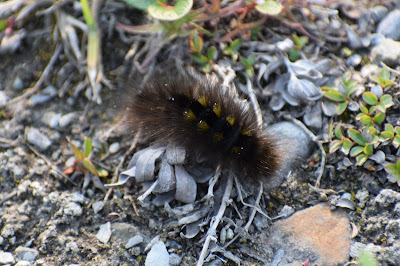
A Yukon arctic woolly bear in search of dinner. Syd Cannings photo.

Today, Isabel Barrio is a professor at the Agricultural University of Iceland, but in 2010 she was working on her doctorate under the direction Hik, a specialist in the alpine ecosystems of the southwestern Yukon. And she had a sharp eye for caterpillars.

Hik explained that there are two arctic species of woolly bear caterpillar -- Gynaephora groenlandica and Gynaephora rossii (the larval form of Ross' tussock moth) -- and they are easy to confuse. G. rossii, however, has a wide range all around the Arctic and in the high mountains farther south, so it was logical to assume the Kluane Range caterpillars were G. rossii.

When Barrio looked closely at the older caterpillars, however, she realized they weren't G. rossii. As improbable as it seemed, they appeared to be arctic woolly bears. The research group collected 30 caterpillars that summer to confirm the identification and to learn more about them.
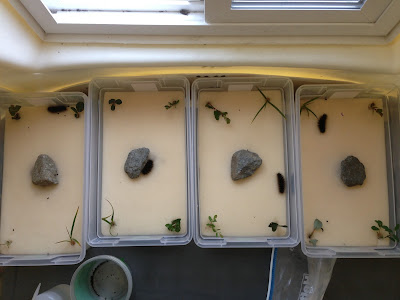
What's your favourite? An experiment to see what the Yukon caterpillars like to eat. D. Hik photo.

That led to another surprise. Analysis of the caterpillars' genetic code showed that the Yukon woolly bears were slightly different from other arctic woolly bears. They were, in fact, a newly discovered subspecies: Gynaephora groenlandica beringiana.

That last word is important. It refers to the fact that they were found in Beringia, the area of northwestern North America that remained ice-free during the last major glaciation. That probably explains their presence in the alpine valley. These fuzzy little beasts were likely crawling over the tough tundra vegetation of Beringia when most of Canada was buried under kilometres of ice -- and they're still there.
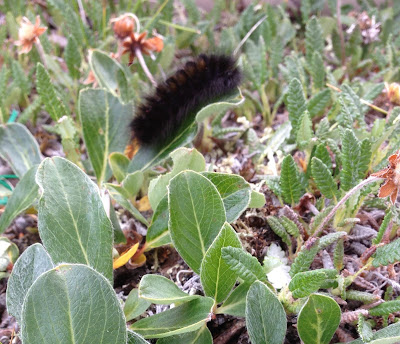
G. groenlandica beringiana perched on top of its supper. D. Hik photo.

Since Barrio's first identification of them, the caterpillars have been found in a few other locations in the Yukon. David Hik suspects they are widespread throughout the alpine areas of Beringia. He hopes that new research projects in the region will turn up more confirmed identifications -- and more information.

"They are very cool, and there is so much more to learn about them," he wrote.

28 Jul 2017

Arctic Publisher Shares Northern Voices, Traditional Knowledge

By Gillian O'Reilly

Looking for engaging, appealing and informative science-themed and technology-themed books that incorporate traditional knowledge? Look no further than Inhabit Media.

Inhabit Media, an Inuit-owned publishing house based in Iqaluit and Toronto, aims to “promote and preserve the stories, knowledge and talent of northern Canada.” The company publishes a wide range of books for adults and kids, plus two magazines: Kaakuluk: Nunavut’s Discovery Magazine for Kids and Pivut: The Magazine for Nunavut Youth.

With an author list that includes established and emerging Northern writers and elders, as well as knowledgeable Southerners, Inhabit offers readers a rich variety -- from board books on Inuit tools and clothes to informational picture books to YA novels, historical and contemporary. Publishing in English, French, Inuktitut and sometimes Inuinnaqtun, Inhabit works to ensure that its books are accessible to both Northern and Southern readers.

A recent success for the company has been the Animals Illustrated series for readers aged 4 to 6. Each book is a lively mix of animals facts and first-hand accounts from authors who live in the Arctic, accompanied by meticulous and appealing illustrations. There are now four books in the series, covering polar bears, narwhals, muskox and walruses. A fifth book, on bowhead whales, is coming this fall.

One of my personal favourites in Inhabit’s list is A Children’s Guide to Arctic Birds (2014), written by Mia Pelletier and illustrated by Danny Christopher (for ages 4 to 6). Informative, accurate and with gorgeous illustrations, the book looks at 12 birds that make the Arctic their permanent or seasonal home.

Another favourite is A Walk on the Tundra (2011) written by Anna Ziegler and Rebecca Hainnu and illustrated by Qin Leng (for ages 6 to 8). This is a picture book story that features a warm intergenerational relationship while incorporating a great deal of traditional knowledge.

Innuujaq reluctantly accompanies her grandmother on a walk to pick Arctic plants. Through it, she learns a few things about her grandmother and much about tasty, nourishing and medicinal plants. Included at the end are scientific descriptions of the plants, photographs and a glossary of Inuktitut words and phrases.

More recently, Ziegler, Hainnu and Leng collaborated on A Walk on the Shoreline (2015).

Discover your own favourites among Inhabit’s books at www.inhabitmedia.com!


2 Jun 2017

Beneath an Arctic Sea - Volcanoes Spewing Mud

By Claire Eamer

Normally, you wouldn’t expect the Beaufort Sea to be a hotbed of volcanic action. It’s covered with ice for much of the year. And during the short spell when the ice is gone, it’s a vast expanse of cold, featureless ocean that washes up on the northern coasts of Alaska, the Yukon, and the western Northwest Territories.
An underwater mud volcano as seen by the research ship's
scanners. Credit: Natural Resources Canada

But beneath that bland surface, the Beaufort holds a surprise – as many as 2000 mud volcanoes, says Steve Blasco, a respected geophysicist formerly with the Geological Survey of Canada. Before he retired, he was part of a research group studying the volcanoes.

They are essentially like any other volcano, but with mud instead of lava, he says. Pressure forces the liquid mud up through the first available weak spot in the more solid layer above it. In the case of the Beaufort mud volcanoes, that solid layer is beneath the seafloor, several hundred metres below the ocean surface. And the solid layer isn't Earth's crust, but permafrost.

Just because they’re out of sight beneath the waves doesn’t mean mud volcanoes are small. Some are more than a kilometre across and rise 10 storeys above the surrounding seafloor. Most have a shallow moat around them. Blasco says that with the right kind of instrumentation, it’s possible to track the volcanic chimneys, through which the mud flows, well down into the thick layer of sediment that covers much of the Beaufort seabed.
The profile of the mud volcano scanned above. The shallower continental shelf
is on the left, and the seafloor drops away into deep water on the right.
Credit: Natural Resources Canada
The Beaufort’s mud volcanoes are a peculiarly northern phenomenon, he says. “It all has to do with the permafrost.”

Fluids – water and hydrocarbons mixed with fine sediments – pool beneath the permafrost that underlies the land and much of the sea around the margin of the Beaufort. The fluids spread through the sub-permafrost layers until they come to a weak point where the growing pressure pushes them up through the permafrost, piling up layer upon layer of thin mud into a spreading undersea mountain.

The mud volcanoes aren’t distributed randomly over the seafloor. The weak spot that allows the mud to break through is often at the edge of the continental shelf, where the relatively shallow sea bottom drops away into the deep ocean, exposing and weakening the permafrost. About a third of the mud volcanoes mapped so far are along the shelf edge, Blasco says. Others are on the shelf itself or along the edges of the Mackenzie Trough, an undersea extension of the Mackenzie Valley.

Most of the volcanoes are no longer active, but about 50 of them still appear to be venting mud, some quite actively. And on a few of those, the Blasco's Geological Survey research group found signs of life: mats of bacteria apparently living off the chemicals in the mud.

Bacterial mats cover deep-sea mud vents in the Beaufort Sea.
Credit: Natural Resources Canada
Another team of scientists discovered even more signs of life on the volcanoes. In December 2015, Charles Paull of the Monterey Bay Aquarium Research Institute, Scott Dallimore of the Geological Survey of Canada and other members of the team published a scientific article describing what they found in a close study of a few of the still-active mud volcanoes.

Some of the sediment the scientists hauled up from the mud volcanoes contained skinny brown tube worms only a few centimetres long at most. The worms are closely related to tube worms found at a mud volcano in the Norwegian Arctic. In both cases, the worms and the bacteria appear to be part of a chemosynthetic community – that is, a community of animals living off the carbon spewed out, usually in the form of methane, from volcanic vents.

Similar groups of animals have been found around undersea vents in many parts of the world, but this is the first time they’re been discovered in the harsh conditions of the western Arctic. And there may be more life down there.

Video from a remotely operated underwater vehicle used in the same study showed that patches of the active undersea volcanoes are thick with bacteria and tube worms, and that shrimp and small fish seem to be especially plentiful at those sites. In fact, it appears that the Beaufort Sea’s mud volcanoes might be hotspots for both geology and biology.

The original purpose of the survey that mapped the volcanoes was to assess geohazards in the Beaufort Sea in preparation for oil and gas exploration. Mountains of mud rising from the ocean floor constitute potential hazards, but Blasco says they’re easy to avoid. Now that it’s known where they’re likely to occur and what they look like to underwater remote sensing instruments, exploration companies survey them and stay clear.

Of course, not everyone wants to stay clear. Oil and gas companies might want to avoid the mud volcanoes, but plenty of scientists would like to learn a lot more about them.

References:


28 Oct 2016

The Endangered Caribou

By Marie Powell

CC Jacob W. Frank
The caribou (Rangifer tarandus) is a remarkable animal. Part of the deer family, caribou are unique because both males and females have antlers. Also known as reindeer, caribou have roamed North America for some 1.8 million years. Barren-ground caribou evolved from these early ancestors. The Woodland and Peary caribou have been with us since before the Pleistocene epoch, or Great Ice Age.

The thing I like best about writing middle-grade non-fiction books is that you're always learning something new. The research I'm doing this week has led me north to the Yukon and Nunavut, where I've been learning about the caribou. For instance, some populations of caribou have been reduced by 95 percent in the past 15-20 years. That seems incredible.

I've also been reading Bill Waiser's A World We have Lost: Saskatchewan Before 1905, and his vivid description of the buffalo herds on the prairies a century ago. These buffalo created a whole ecosystem just by foraging on the land, Waiser says. The wanton slaughter of some 4-5 million buffalo in the 1870s led to famine and severe environmental change across the prairies. Looking out my window at the busy streets of Regina, I try to imagine how different life would be today if that hadn't happened. So, when I read about the decimation of the caribou herds, I can't help but wonder what effect this will have on our future.

CCAlfred Cook  
Caribou fall into two groups: populations that remain in one area and spread out there after calving (sedentary), and herds that move or migrate to a common calving area each year (migratory). They range across the tundra and boreal forest areas, from the Arctic and south into most Canadian provinces. As well as predators and hunting, changing weather patterns affect the foraging of migrating herds, which in turn affects the health of the females and calves. So does loss of habitat due to human development in northern regions. All of this threatens the caribou's survival.

Scientists are working together with the Inuit to see how changing weather patterns affect the ecosystem of the north. For example, studies of the sea ice show how important that ecosystem is to all life in the north. One resource that brings out these findings is the Inuit Siku (Sea Ice) Atlas at http://sikuatlas.ca/sea_ice.html, as Claire Eamer shares in her Sci/Why post from 2013.

CCAllen Shimada 
Researchers have also turned to traditional Inuit knowledge to try to save the caribou. A 2012 report calls for minimizing development activities in caribou ranges, among other suggestions. Governments have responded with what the CBC calls a "patchwork" of conservation activities. Some provinces -- like Saskatchewan -- moved to limit development, and more recently others (including Alberta) have begun to act along those lines as well.

Will our efforts be in time to save these majestic animals?

Here are some more links to information about the Arctic and the caribou:

Bergerud, A. T. “Caribou.” The Canadian Encyclopedia. http://www.thecanadianencyclopedia.ca/en/article/caribou/

Braun, David Maxwell. "Inuit Knowledge Critical to Arctic Science." National Geographic Society , August 18, 2011 http://voices.nationalgeographic.com/2011/08/18/inuit-knowledge-critical-to-arctic-science/

Eamer, Claire. "Over, under, and on Arctic sea ice." Sci/Why 2013. http://sci-why.blogspot.ca/2013/03/over-under-and-on-arctic-sea-ice.html

Lunn, Susan. "Caribou still under threat despite changing political climate, report says." CBC News, Dec. 14, 2015. http://www.cbc.ca/news/politics/caribou-still-under-threat-despite-changing-political-climate-report-says-1.3359751

Northern Involvement: Changing Animal Populations - Science Canada - July 22, 2016 http://www.science.gc.ca/default.asp?lang=En&n=CC02ABC9-1
https://www.youtube.com/watch?v=99f_VVHuR2I&feature=youtu.be 

Rudolph, T. D., Drapeau, P., St-Laurent, M-H. and Imbeau, L. 2012. "Status of Woodland Caribou (Rangifer tarandus caribou) in the James Bay Region of Northern Quebec." (Scientific report) http://www.gcc.ca/pdf/Final-Rapport-Status-of-Woodland-Caribou-James-Bay_Eeyou-Istchee.pdf

"Traditional Inuit knowledge combines with science to shape weather insights." Science Daily, April 7 2010. https://www.sciencedaily.com/releases/2010/04/100407190000.htm

Weatherhead et al. "Changes in weather persistence: Insight from Inuit knowledge." Global Environmental Change, 2010; DOI: 10.1016/j.gloenvcha.2010.02.002 http://www.sciencedirect.com/science/article/pii/S0959378010000087

Marie Powell lives on Treaty 4 land in Regina, Saskatchewan. She is the author of close to 40 children's and young adult books, including the historical fantasy Hawk (2015). She enjoys writing about science, history, and any subjects that help promote literacy.

9 Oct 2015

Meet the North

Post by Helaine Becker


Paddling North
I recently had the good fortune to meet author Jennifer Kingsley at the Lakefield Literary Festival. I was completely taken with her, and with her story of her current project: circumnavigating the Arctic via word of mouth. She'd talk to someone, who would tell her about someone else in the north she should meet, go see that person, talk to them and get another recommendation, and so on. How fabulous, I thought! How brilliant a demo of the science of communication, in action!

Jennifer Kingsley
I asked Jennifer if she'd talk to Sci-Why, and she very graciously agreed. She sent me her answers to my questions from Greenland, where she is now deep in her project.

Here is the interview:

1. Tell us a little bit about who you are, what you do and how you get started on the Meet the North Project.

I'm a Canadian who loves the outdoors, and I express that in two different ways. One: I'm a guide and naturalist, and I work on sailboats and ships in different parts of the world, primarily the Arctic. Two: I'm a writer and radio producer always looking for ways to bring stories and sounds out of remote regions and into the imaginations of my audience.
My first book is called Paddlenorth: Adventure, Resilience, and Renewal in the Arctic Wild, and it's about a 54-day canoe expedition across the Canadian Arctic.


2. Paddlenorth  is terrific. I was so intrigued by your presentation at the Lakefield Festival, I got the book right away! It's full of adventure, of course. But also heart. And there's some serious drama and mystery too. Heart-thumping, page-turning mystery.

Now, you've embarked on a new adventure! Can you describe the Meet the North project for Sci/Why readers?

Meet the North is my personal journey from WHAT is the Arctic to WHO is the Arctic. It's a project I created, and it's sponsored by Lindblad Expeditions/National Geographic.
Here's the skinny about Meet the North from the project web site www.meetthenorth.org:

#meetthenorth is a project about the lives of northerners from
Svalbard to Greenland, Iceland, the Canadian Arctic, and beyond.
These are among the most remarkable places on Earth, and the
best way to understand them is to ask those who know them best.
This project gets its direction from the people of the north.
Their ideas set our path; we listen, and we follow their lead.
By meeting one person at a time, and by asking that person to
introduce us to someone new, we are getting to know the
Arctic community, and we are sharing our journey with you.

Join the adventure on Instagram at #meetthenorth 

and by following @meetthenorth. Follow the
stories on this website too.


3. Sooooo coool! To my mind, your project is science in action, in that through your project, you are demonstrating and investigating human communication. Do you agree? Can you elaborate?

Meet the North is absolutely about human communication. It's about having a strong vision . . . but not much of a plan. I let the people that I meet set my path, so it's not until they introduce me to someone new that I know where I am going next. I think you could call it social science; it's similar to Snowball Sampling, which is used by some anthropologists.
I think what makes this project valuable and different is that it values the contribution of each individual. It's not about mapping the entire fabric; it's about finding one true thread.


4. It seems to me your project will provide valuable scientific data for use in other fields. Can you elaborate on that?

I believe that this project, and it's method, will help to uncover ideas and topics that would not be discovered otherwise. If I really want to know what is important to someone, I have to be very open. It doesn't serve me to come in with preconceived ideas, nor can I open with directive questions.
In this way, I think Meet the North could help fill out the picture painted by other work in other fields. It gives a human face to the data others are collecting.


5. Can you describe one encounter you have already had, and what it revealed/meant to you?

I just got home from Iceland, and at the beginning of my time there, I had one meeting set up. That one meeting led me, through a series of introductions, to the far east corner of the country which has been, perhaps, the least impacted by the recent tourism boom. By making personal connections to a very out of the way place, I discovered a project I would never have heard about otherwise.

Way out there, in a municipality of 500 people, there is a movement afoot to turn a fjord into a container port. This will only make sense more than a decade from now, if sea ice melts in a certain way and if global politics take a certain turn. It's an attempt to involve Iceland in the evolving Arctic economy, when many Icelanders are opening guest houses and selling souvenirs. It was a whiff of the change in the air - still faint but indicative of big changes ahead. So we interviewed the man spearheading this initiative, out in the middle of the heath. Who knows what will be there 10 years from now.


 Thanks, Jennifer! Good luck with your project, and please keep us posted!


21 Mar 2014

Science News of the Old and Oldest

By Claire Eamer

It's been a busy week or so in the world of science - a lot to keep track of. Here's a quick guide for those who, like me, are feeling a bit overwhelmed.

First, there's the Old: A couple of new dinosaurs have been identified.

One of them is a miniature cousin of the best-known predatory dinosaur, T. rex. This little guy (well relatively little, but still way bigger than any of us) has been named Nanuqsaurus hoglundi - meaning, roughly, polar bear lizard - and he roamed the Arctic 70 million years ago. You can read more about him, and find some pictures, here and here.

The other was found a few thousand kilometres south and east, in the states of North and South Dakota. It's a strange, half-birdlike creature that scientists have nicknamed "the chicken from Hell" - not because it's so scary, although its claws are impressive, but because it was found in a geological formation called Hell Creek. A little more formally, the chicken from Hell is Anzu wyliei, and you can learn more about it here.

And then there's the Oldest: What physicists think is a kind of cosmic fingerprint from the beginning of the universe - evidence of rapid expansion from the first split second after the Big Bang. It has caused a lot of excitement, and a lot of confusion. If you want to get unconfused, here are a few links:
And that, fellow science fans, is the momentous week that was!

13 Dec 2013

...And Eight Tiny Reindeer

By Claire Eamer


Zeus Box Studio image
Reindeer feature prominently in the media at this time of year -- especially that very rare subspecies of reindeer that flies through the air and pulls a sled carrying a fellow in a red suit.
But more about that them later.

Most reindeer roam the forest and tundra of Scandinavia and Russia and other parts of northern Europe and Asia, as far east as eastern Siberia and northern China. There’s even a small herd of reindeer on a mountain in Scotland.

In the same kind of habitat in northern North America, you find caribou. They look like reindeer and behave pretty much like reindeer. So what’s the difference?

Essentially none, says Don Russell, a Yukon caribou biologist and founding coordinator of the CircumArctic Rangifer Monitoring and Assessment Network (CARMA), an international organization concerned with the state of the Arctic's wild caribou and reindeer.

"The reindeer is just an Old World caribou. They are the same species, Rangifer tarandus," he says. And they're the dominant large herbivore, or plant-eater, in the circumpolar ecosystem. In fact, in most parts of the North, they're the only large herbivore.

That’s not to say that all reindeer and caribou are identical. There are quite a few variations in body shape and appearance, but those variations depend more on the kind of habitat the caribou and reindeer live in than what continent they come from.

There are three general groupings of reindeer and three matching groupings of caribou. Marine reindeer and the very similar Peary caribou of northern Canada live on Arctic islands or near the Arctic coast. Tundra reindeer and barrenground caribou tend to gather in large herds and migrate across vast swaths of territory, mainly north of the boreal forest. Forest reindeer and woodland caribou live in the northern regions of the boreal forest itself, usually in smaller herds than the tundra animals.


Looks can be deceiving. These reindeer, grazing peacefully in the middle of
town on the Norwegian islands of Svalbard, are actually wild animals.
Claire Eamer photo
We tend to think of reindeer as domestic animals, but that's not always the case. True, people in Scandinavia and Russia have been keeping domesticated reindeer for thousands of years. However, one of the world’s largest herds of wild Rangifer tarandus is the Taimyr reindeer herd, which lives on the Taimyr Peninsula in central Siberia and numbers many hundreds of thousands of animals.

The caribou of North America have never been domesticated, but not because they are genetically different from reindeer. The aboriginal peoples of North America simply never felt the need to domesticate caribou. Instead, they adapted their lifestyle to fit the seasonal wanderings of the wild herds.

Perhaps the oddest member of the Rangifer tarandus tribe is the Svalbard reindeer. Russell calls it the Shetland pony of the reindeer world. Svalbard is Norwegian territory, a small group of rocky islands about halfway between the Norwegian mainland and the North Pole. Isolated by hundreds of kilometres of ocean from any other land, Svalbard is home to a distinct population of reindeer, small, with short legs, snubbed muzzles, and chubby, barrel-shaped bodies.

Caribou biologist Don Russell calls Svalbard reindeer the Shetland ponies
of the Rangifer world. Their short legs and chubby bodies serve them well
on the islands of the remote Svalbard archipelago.
Claire Eamer photo

Svalbard reindeer aren't designed for speed, but they don't need to be. The only large predators on Svalbard are polar bears, and they're rarely interested in reindeer. On the other hand, those chubby bodies are important. Svalbard is a tough place to be a reindeer.

In winter, Svalbard reindeer have to eat whatever they can find. Most other Rangifer eat lichens, which are available in winter under the snow. On Svalbard, however, there are few lichens. Svalbard reindeer eat the first green shoots of sedges emerging in the spring. Through the summer, they work their way through lush tundra plants, packing on as much fat as possible. The fat has to last them through the lean times of winter when they go on a crash diet, often losing almost half their autumn weight by spring.

Meanwhile, about those flying reindeer. They seem chubby enough, but science has remarkably little to say about them. Perhaps it's the shortage of confirmed sightings. Nevertheless, given their unusual reported characteristics (flying, occasional appearance of a glowing red nose), they clearly deserve more research.

If you want to know more about wild caribou and reindeer, explore the CARMA website.

To hear from the people who depend on caribou and reindeer -- in their own words -- watch some of the videos at Voices of the Caribou People. It's a great resource for teachers and students studying life in the Arctic.

About those seasonal reindeer.... Here's a site devoted to the history of Santa Claus and his flying Rangifer team.

And the one with the unusual nose? That'd be Rudolph, eh?

Finally, remember those reindeer on a mountain in Scotland? Here they are, the Cairngorm reindeer.

13 Sept 2013

Great White (Northern) Science – LINKS and a CHALLENGE

By Claire Eamer

There’s lots of great science happening in the Great White North. (Actually, it’s not very white today – gorgeous fall colours instead – but you know what I mean.) And a lot of that science is being done by Northerners themselves. So I decided to spread the word.

Here’s the LINKS bit: I’ve dug out a few kid/teacher/librarian-friendly links for you. You’ll find them below, with short notes about where they lead.

And here’s the CHALLENGE bit: Hey, all you Northerners, scientists, science freaks (that’s me!), geeks (young and old), and wizards of Google-fu - let’s find some more! If you have a favourite science link to something that’s taking place in northern Canada, post it in the Comments section at the bottom. We can build something here.

So, here’s my first kick at the can - a mostly-but-not-entirely Yukon contribution.

This scimitar cat once roamed the Yukon grasslands. Today,
it snarls at visitors to the Yukon Beringia Interpretive Centre
in Whitehorse. Claire Eamer photo
Would you like to learn about the amazing animals that roamed the Yukon 20,000 years ago, when most of Canada was buried under kilometres of ice? Check out the Yukon Beringia Interpretive Centre's Education Corner. There's everything from educational materials for senior grades to colouring sheets for the little kids. And check back regularly. I was talking to the Beringia Centre folk yesterday, and they're planning some great new additions to the site.

If I've got you hooked on mammoths, giant sloths, and scimitar cats, there's more information about the latest research (and lots of cool photos) in the online (pdf) booklets Ice Age Klondike and Ice Age Old Crow, published by the Yukon Government.

By the way, if you want to know what life is like today at Old Crow, the Yukon's most northerly community and home of the Vuntut Gwitchin First Nation, check out the community website. It offers a sampler of the Gwich'in language, traditional stories, culture, history, cooking (lots of caribou recipes!), and a whole lot of other entertaining bits and pieces of information, including a collection of videos made by Old Crow students.

Back to ice ages and climate: how about climate change? The climate is warming faster in the North than anywhere else in Canada. What do northerners think about that? In 2000, the Inuvialuit people of Banks Island talked about their lives and how climate change is affecting them in a video called Inuit Observations of Climate Change, which is online in both a short version and a long version.

All that warming has turned up a few surprises. High in the  mountains of the Yukon and the Northwest Territories, there are patches of permanent ice, too small to be glaciers but too big to melt over the short summer. Until recently. Now many of them are melting and revealing a record of plant, animal, and human life going back thousands of years. I blogged about the ice patch discoveries here last year. The online (pdf) booklet The Frozen Past has both information and photos of Yukon finds. And Archaeology magazine has an online article about ice patch finds in other parts of the world.

For first-hand accounts at what it's like to live and do research at the northwest edge of Canada, check out this series of podcasts produced by the Wildlife Management Advisory Council (North Slope). You'll find everything from elder Danny C. Gordon's account of a lifetime of travel across the Yukon North Slope and park ranger Richard Gordon's song in praise of Herschel Island to permafrost researcher Chris Burn's musings on using both scientific and traditional knowledge to understand the land and its future.

Okay, that's my contribution - for now. I won't promise not to come back and add more links in the Comments section, but I'll let you guys have a chance first. What's your favourite science link for the North? And don't think just about the northern territories. Besides the Yukon, the Northwest Territories, and Nunavut, there's Labrador, Nunavik, and the northern regions of most of the provinces. Have I left anyone out? If so, add it in below.


11 Mar 2013

Over, Under, and On the Arctic Sea Ice

By Claire Eamer

The shrinking sea ice of the Arctic Ocean has been in the news a lot lately, along with photos of polar bears stranded on ice pans or wandering hungrily along bare shores. But what does the disappearing ice affect, apart from polar bears and some shipping companies that see a shorter sea route opening up?

Claire Eamer photo
Arctic sea ice supports a huge and complex ecosystem that ranges from polar bears, birds, and humans down to organisms too small to see without a microscope. Here are a few sites about that world - and a lot of gorgeous photographs!

The Census of Marine Life's Arctic Ocean Diversity website has great information and amazing images. Click on Species to see some of the creatures that make use of the Arctic Ocean and its ice, from top to the ocean bottom.

The US National Earth Science Teachers Association’s page on Arctic Marine Life gives a quick overview of Arctic Ocean biology, from algae to polar bears.

A young Russian scientist and photographer, Alexander Semenov, has been photographing Arctic sea life and sharing his photos with the world. There’s an article about him (with lots of lovely photos) and here's his own website and gallery.

How about the people who live with the ice all their lives? What can they tell us about it? The Inuit of northeastern Canada have been collecting traditional information about sea ice and sharing it at Inuit siku (sea ice) Atlas.

What does it really look like up there, around the Arctic Ocean, both above and below the ice? The photo galleries of Canada’s ArcticNet research program can give you a good idea.

And if you’re a student or a teacher and you want to see the Arctic for yourself, it just might be possible. Check out ArcticNet’s Schools on Board program.

28 Aug 2012

Arctic Fever Update

By Claire Eamer

On August 17, I posted an article about the rapid melting of arctic sea ice this summer and the likelihood that we were heading for a record low in sea ice extent. It happened just over a week later. On August 26, the ice cover in the Arctic Ocean hit a historic low. And it's still melting.

"So what?" you might ask. Doesn't that just mean more ships, more tourists, more economic development, and other good stuff? And maybe a few uncomfortable polar bears?

Over the next few weeks, as the ice melts, the Vancouver Aquarium's Aquablog is running a series of articles about what declining sea ice means for the Arctic and for the planet. Here's the first of them: Arctic Sea Ice Reaches Record Low.

And keep an eye on the blog for updates on this record-setting summer.

17 Aug 2012

The Arctic Is Running a Fever

By Claire Eamer

We've heard a lot about melting ice in the Arctic this summer, and we're likely to hear more. It takes a long time for polar ice to start melting and a long time for it to return, so the 2012 melt will continue for another month or so. That means -- almost certainly -- some new climate records. And with no sign of serious efforts to stop or slow the human contribution to climate change, there will be more records in the future.

A satellite image of the Northwest Passage, taken August 3, 2012,
shows large areas of open water.
Photo credit: NASA Earth Observatory images by Jesse Allen

Here are a few of the stories so far this summer:

Just a few days ago, scientists from the European Space Agency reported that sea ice in the Arctic is melting far faster than anyone predicted. Based on information from a satellite that measures the thickness of the ice, they estimate that 900 cubic kilometres of ice have disappeared every year since 2004. At that rate, they say, it could be as little as ten years until the day when a satellite image shows no ice at all in the Arctic Ocean at the peak of the summer melt.

Earlier this month, a giant cyclone raged over the Arctic Ocean. Storms are common at this time of year, but the researchers studying them said this was the biggest they had seen. The winds churned the ocean, breaking up the ice floes and making them more susceptible to melting.

In mid-July, a wash of warm air over Greenland triggered melting across 97 percent of the island's massive ice sheet. The last time this happened was in 1889. Scientists don't know if the melt this time is related to climate change, but they do know global warming is causing Greenland's glaciers to thin and chunks to break off, forming massive icebergs.

Does any of it matter? The quick answer is, yes. Whole ecosystems depend on arctic sea ice, from microscopic, single-celled organisms to polar bears. As the ice retreats, the open ocean absorbs more heat, warming the atmosphere above it and speeding up global warming. And melting of the fresh water locked up in Greenland's ice sheets would cause sea levels to rise around the world.

For a less quick, more detailed answer, and lots more about climate change, try some of these sites:

Arctic Sea Ice News & Analysis, from the United States' National Snow & Ice Data Center

RealClimate: Climate science from climate scientists

ClimateSight: an excellent blog by a young Canadian climate researcher