Showing posts with label sea. Show all posts

21 Aug 2020

Salty Slug Love

Slippery, slimy, oozy slugs; what’s not to love? Slugs can be small and slugs can be as long as your arm! Slugs can be sausage shaped and brown, or they can have leaves, legs, and lots of rainbow colours! They can live anywhere wet, and lots live under the sea. 
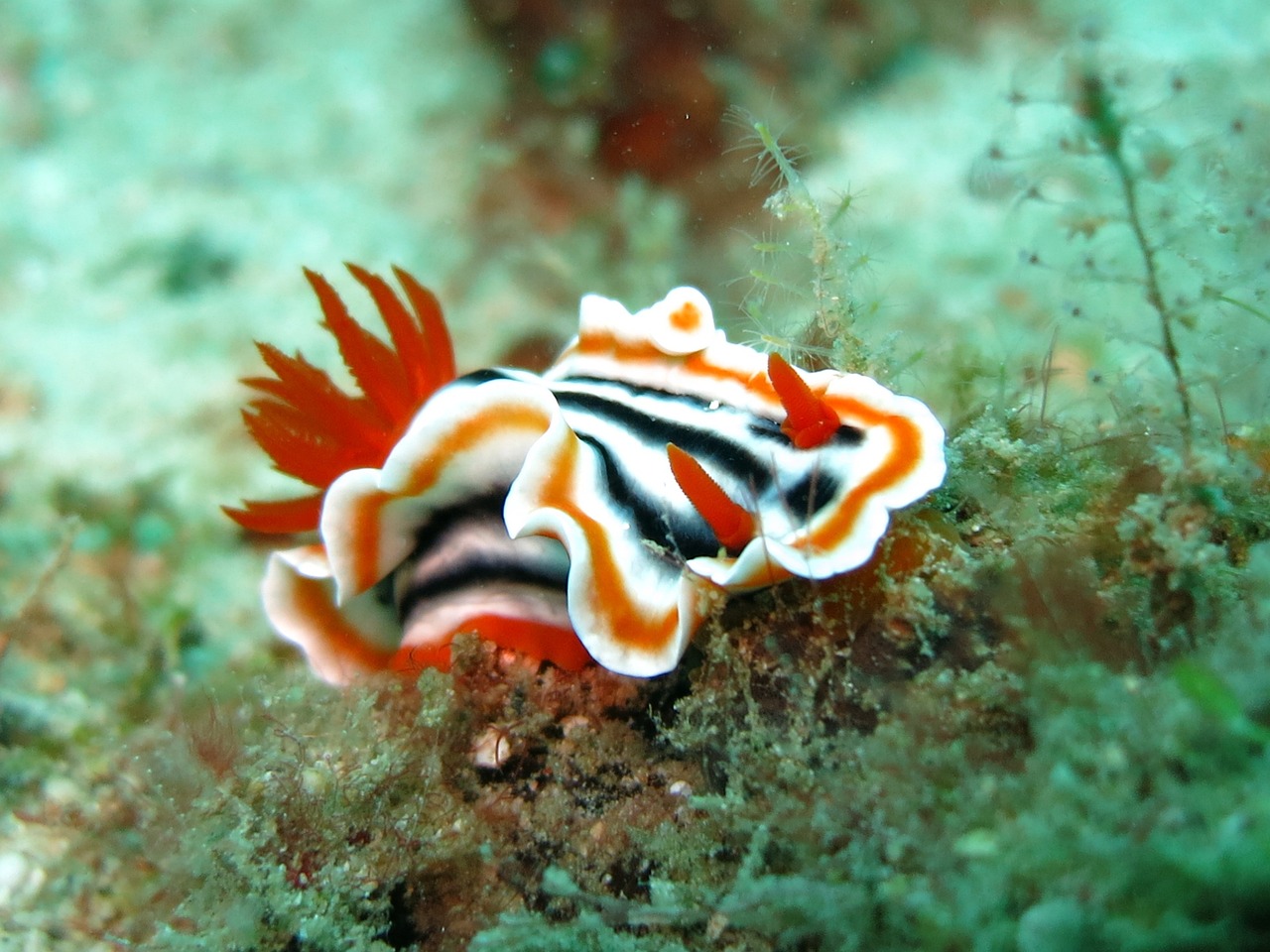
nudibranch chromodoris looks like ribbon candy

Salty Samples 

Sea slugs are a family of boneless animals that contain a particularly fancy looking molluscs called nudibranchs. Usually they’re small enough to fit on your hand, but they can be as long as a sheet of binder paper. Their shapes and colours result in names like “dragon” and “orange peel,” or “sea bunny,” “dancer” and “clown.” Start an image search and you could browse pictures of fanciful nudibranchs all day. There are more than 3000 kinds! 
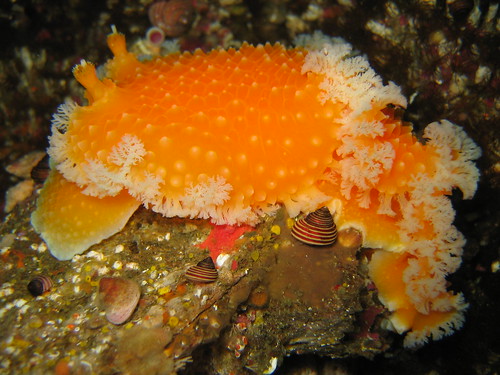
the "orange peel" nudibranch can be 50 cm long

Pantry Paint Packs 

Like flamingoes get their pink colour from their food, nudibranchs get their colour from their diet too. Check out this little creature that looks like a sheep that rolled in cut grass! It’s the leafy sheeps’ algae diet that makes them green. They store the chloroplasts from their food and that means photosynthesis happens inside their bodies like it does in plants. 
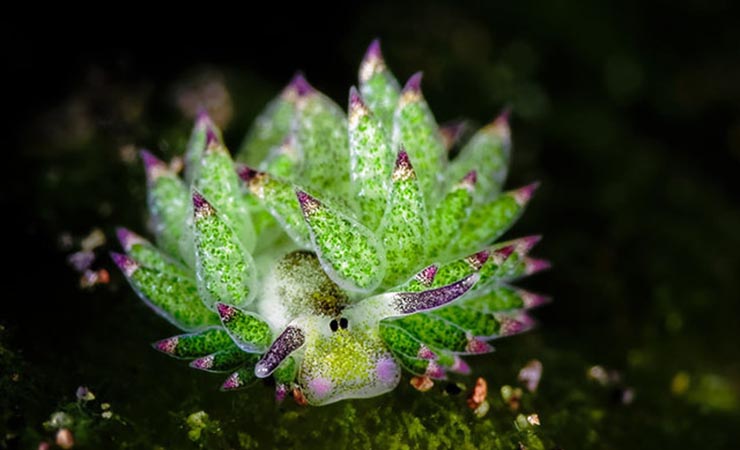
Nudibranch Brunch 

Nudibranchs are carnivorous! They eat algae, sponges, and even other sea slugs. Some also eat coral and even stinging jellyfish, and that makes them a bit toxic. Like the leafy sheep keeps some chloroplasts from its food, the jellyfish eating “blue dragon” keeps some of the stinging cells from its food. Like a lot of colourful things in nature, the bright hues warn us that they can hurt. Touching them can sting. 

Making Nudibranchs 

Any two nudibranchs can make babies together, because they all have both sex organs. They’re hermaphrodites, just like earthworms and most snails are. About 5 of every 100 animal species are hermaphroditic.
A gooey ribbon of fertilized eggs will hatch into nudibranchs that look just like their parents but smaller. Depending on the type, there can be 2 eggs or 25 million! Once they leave the nest, they’ll live just a few weeks to a year. 

Notice Nudibranchs 

To see a nudibranch in person, you’ll have to go out into the ocean because they don’t survive captivity for long. But you’ll find some of these saltwater slugs along every ocean coast — except in the Arctic and Antarctic circles. They love coral reefs. You will find nudibranchs in shallow water and way down in the deep. Look on the bottom, and remember they’re usually very small. Most photos of these creatures are taken with a close-up macro lens.
nembrotha nudibranch on the mouth of a glass drink bottle

20 Mar 2017

Explore Under the Sea, Live and Online

By Claire Eamer

From the website of the research ship, Okeanos Explorer: "From March 7 – 29, 2017, NOAA and partners will conduct a telepresence-enabled ocean exploration expedition on NOAA Ship Okeanos Explorer to collect critical baseline information about unknown and poorly known deepwater areas in the Howland and Baker Unit of the Pacific Remote Islands Marine National Monument and the Phoenix Islands Protected Area.

NOTE: ROV dives are planned, weather permitting, most days from March 8 - March 27, typically from about 8 am to 5 pm WST (March 7 - March 26, from 2 pm to 11 pm EDT)."

If you go to the dive website, you can watch the whole of the dive, seeing just what the scientists are seeing, and you hear scientists discussing what they are observing in real time. Warning: it's addictive!

A seastar is wrapped around the branches of a coral, hundreds of metres beneath
the surface of the Pacific Ocean. Screen capture from Okeanos Explorer feed.

4 Oct 2013

The Lane Anderson Awards for Excellence in Science Writing

Can you be just a little over the moon? No. Which is why I'm a LOT over the moon to have been named the winner of the 2012 Lane Anderson Award for Science Writing, in the Children's Books category for The Big Green Book of the Big Blue Sea.


The winner in the Adult category is Neil Turok for The Universe Within.


Here we are giddily clutching our plaques.  

Congrats to Neil and to everyone who participated in this great event! And a huge thanks to the Fitzhenry Family for endowing this award and highlighting the central role of science in our lives.

Here are the deets from the official announcement:

$10,000 Lane Anderson Award Winners

Celebrating the Best Science Writing in Canada

Toronto. 26th September, 2013:  The Fitzhenry Family Foundation announced the winners of the 2012 Lane Anderson Award. Finalists and winners were feted at an intimate dinner in Toronto.

The annual Lane Anderson Award, now in its fourth year, honours excellence in Canadian science writing, by highlighting two jury-selected books – one addressed to adult readers, the other written for children and/or middle grade readers.  Authors of the winning books each receive $10,000. 

There were a total of 20 submissions for this year’s award.

“We established this award because we believe passionately that science writing, and science reporting is vitally important for every Canadian today.  Science writing, research, and knowledge impacts the ways in which we live now, the ways our children will live in future, and the ways in which our children’s children will live their lives. As Canadians, we do not pay enough attention to science. We take it for granted.  The Lane Anderson Award is dedicated towards removing that indifference, two books at a time. We thank all of the authors and publishers and judges who are helping us pass along this message. It needs to be heard and heeded.”
- Hollister Doll & Sharon Fitzhenry Directors, Fitzhenry Family Foundation  

The annual Lane Anderson Award honours two jury-selected books, in the categories of adult and young reader, published in the field of science, and written by a Canadian. The winner in each category receives $10,000.


The 2012 Lane Anderson Prize Winners are:

The Universe Within by Neil Turok (Anansi)

The most anticipated nonfiction book of the season, this year's Massey Lectures is a visionary look at the way the human mind can shape the future.  Neil Turok is one of the world’s top physicists and founder of the African Institute for Mathematical Sciences (AIMS). He is currently the Director of the Perimeter Institute for Theoretical Physics.


Big Green Book of the Big Blue Sea by Helaine Becker (Kids Can Press)

Based on the idea that knowledge is power, The Big Green Book of the Big Blue Sea shows how the ocean works and why this immense ecosystem needs our protection. Experiments using everyday materials help explain the scientific concepts. Helaine Becker is a bestselling writer of children’s fiction, nonfiction and verse.


The two juries meet annually to consider all the submissions to the Lane Anderson Award and comprise editors, librarians, and previous Lane Anderson winners.

The Lane Anderson designation honours the maiden names of Robert Fitzhenry’s mother, Margaret Lane, and his wife, Hilda Anderson Fitzhenry.  The Fitzhenry Family Foundation is a privately directed Canadian foundation established in 1987 by Canadian publisher Robert I. Fitzhenry (1918-2008).  The Lane Anderson Award is administered by Christopher Alam, a partner at the law firm of Gowling Lafleur Henderson LLP.


7 Jun 2013

A day at the beach: Benllech, Wales, UK

View of Benllech Bay from our balcony (photos by L L Melton)
A Day at the beach: Benllech, Wales

For five days in May, I woke every morning to a view of the Irish Sea, as it shushed in and out on its regular tides.

My daughter and I stayed in Benllech, in Anglesey, Wales (UK). Since we live on the Saskatchewan prairie, right in the middle of Canada, it was a treat to find ourselves in a place where the mountains touch the seashore.

Our apartment was only a 10-minute walk from the beachfront. It didn't take us long to begin exploring this new habitat.

Wading at the shore (L L Melton)

On our first day, we pulled off our shoes and socks and walked on the yellow sand. It was a sunny day, with mild temperatures rising to about 12°C.

Benllech retained its Blue Flag status this year, which is a voluntary ecological label used in more than 48 countries around the world. It means that a beach follows a strict set of criteria including water quality, environmental management, safety, and services. In April, the Daily Post had called Benllech one of the 10 best beaches in North Wales.

When we waded on the seashore, the water felt warm and inviting. We noticed no one was actually swimming, though, which surprised us. We still needed our sweaters, even on this warm afternoon, and we noticed some people exploring in jackets.

Tidal pools in Benllech Beach (L L Melton)


Farther out on the water, people were enjoying water sports in wet suits. Canoeing, water surfing, and water skiing seemed popular. The water temperature in this part of the Red Wharf Bay averages 10°C (50°F), according to Surf Forecast. It's warmest in August (14-17°C) and coldest in February (5-9°C). Wetsuits are recommended.

Luckily, we waded in late afternoon, when the sun had been warming the shoreline for several hours. Generally, the sea takes longer to heat up than the sand, because the specific heat capacity of water is greater. This was the warmest dip in the sea my toes had ever enjoyed.

We shared the shore with a number of other creatures as well.
Lugworm casts (L L Melton)

For example, these strange tracks dotted one section of the sand. My daughter knew what they were, but I'd never seen lugworm casts before. These marine worms are popular bait for fishing, but we didn't see any of the actual worms or anyone digging for them while we were there.

We found treasures like this seashell all along the beach. Although broken shell and even small shards on the sand showed where seagulls and other seabirds had dined, many of the shells were intact.

This shoreline follows a section of the Anglesey Coastal Path starting at the nearby harbour village of Moelfre. The Coastal Path is a well-known walk, and this section leads along a hedged path near limestone cliffs, through wooded areas, and over boardwalks that provide many interesting views.

Crab (L L Melton)
But we preferred the leisurely walk along the shoreline, exploring as we went.

We saw several small crabs in the water and on land.
This fellow seemed to have somewhere to go, so we left him undisturbed.

Treasures from the sea (M E Powell)


We explored the tidal pools that formed along the way as well, and were often amazed at the conglomerates we discovered.

Here, for example, we found a variety of intact seashells and interesting rocks embedded in the rocky material jutting out in a line from the shore into the sea.

Our days at the beach proved all too short. Although we enjoyed exploring, there was so much left to see and do when our visit came to an end.

By Marie Powell

Marie Powell is a professional writer, and the author of Dragonflies are Amazing (Scholastic). Her six-book series of beginner readers will be published this fall. She stayed at 7 Llys Rhostrefor, Benllech, as a guest of Visit Wales.


22 Mar 2013

Diving into an Alien World

By Claire Eamer

In a couple of months, I'll be touring schools and libraries in Ontario, talking about some of the marvellous and strange animals in my book, Lizards in the Sky: Animals Where You Least Expect Them. So I've been thinking about critters and presentations and cool pictures and things like that... and, well, one thing led to another, and I found a whole raft of new, cool, and utterly weird critters in one of my favourite habitats, the deep ocean.

The ROV Hercules operates deep in the Atlantic Ocean.
Photo credit: Mountains in the Sea Research Team;
the IFE Crew; and NOAA/OAR/OER

We're talking deep, here--really deep. So deep and so strange that exploring the deep ocean is like exploring an alien planet. In fact, you need the equivalent of a space ship to go to the deep ocean, something that can see in the absolute dark and survive pressures that would crush the toughest submarine.

But, oh, the wonders when you get there!

How about this? Five full kilometres below the sunny surface of the Caribbean Sea is the Cayman Trough. It's utterly dark and very cold down there, but not everywhere. Just last month, scientists released video taken by a remotely operated undersea vehicle. It shows mineral chimneys at tall as four-storey buildings, belching smoky black water as hot as 400 degrees Celsius, four times the boiling point of water.

Even more astounding were the creatures lurking around those vents: fireworms that look like woolly caterpillars and delicate, almost-colourless shrimp with special organs for detecting hot water.
Super-heated water and rocks billow up from an undersea
volcano in the Pacific Ocean near New Zealand.
Photo credit: Submarine ROF 2006, NOAA Vents Program.

Over in the Pacific Ocean, there's an even deeper spot--Challenger Deep in the Mariana Trench, on the west side of the Pacific. At about 12.5 kilometres, it's the deepest spot in all Earth's oceans. And even there, where the pressure is 1000 times the pressure we experience at Earth's surface--even there, you'll find life. A lot of it! Tiny life, to be sure--bacteria. But they swarm there far more densely than in the shallower water at the edge of the Trench.

You don't even have to go super-deep to find the super-weird. Over the last couple of years, scientists have been finding some spectacularly strange creatures in the ocean surrounding Antarctica. National Geographic compiled a list of the five weirdest Antarctic species, including a transparent fish and sea spiders that breathe through holes in their bodies.
This feather-pen-like coral lives almost 2.5 kilometres 
below the ocean surface at Davidson Seamount, California.
Photo credit: NOAA/Monterey Bay Aquarium Research Institute.

Not to be outdone, the biologist who writes one of my favourite science blogs, The Echinoblog, compiled a list of the ten weirdest Antarctic invertebrates. His list includes a 30-centimetre worm with serious teeth!

Me, I'm waiting eagerly for the next list--maybe longer and even weirder.

In the meantime, I guess I had better get back to what started all this, preparing some presentations about my own favourite weird beasties. Seeya!

11 Mar 2013

Over, Under, and On the Arctic Sea Ice

By Claire Eamer

The shrinking sea ice of the Arctic Ocean has been in the news a lot lately, along with photos of polar bears stranded on ice pans or wandering hungrily along bare shores. But what does the disappearing ice affect, apart from polar bears and some shipping companies that see a shorter sea route opening up?

Claire Eamer photo
Arctic sea ice supports a huge and complex ecosystem that ranges from polar bears, birds, and humans down to organisms too small to see without a microscope. Here are a few sites about that world - and a lot of gorgeous photographs!

The Census of Marine Life's Arctic Ocean Diversity website has great information and amazing images. Click on Species to see some of the creatures that make use of the Arctic Ocean and its ice, from top to the ocean bottom.

The US National Earth Science Teachers Association’s page on Arctic Marine Life gives a quick overview of Arctic Ocean biology, from algae to polar bears.

A young Russian scientist and photographer, Alexander Semenov, has been photographing Arctic sea life and sharing his photos with the world. There’s an article about him (with lots of lovely photos) and here's his own website and gallery.

How about the people who live with the ice all their lives? What can they tell us about it? The Inuit of northeastern Canada have been collecting traditional information about sea ice and sharing it at Inuit siku (sea ice) Atlas.

What does it really look like up there, around the Arctic Ocean, both above and below the ice? The photo galleries of Canada’s ArcticNet research program can give you a good idea.

And if you’re a student or a teacher and you want to see the Arctic for yourself, it just might be possible. Check out ArcticNet’s Schools on Board program.

16 Nov 2012

What Makes an Octopus Blush - and How Exactly Do They Do It?

Posted by Helaine Becker

We've all heard about octopi that can change color to mimic their environment. But how do they do it? I discovered the answer when writing The Big Green Book of the Big Blue Sea for Kids Can Press.

The book is designed to present information to kids ages 8-12, but also to engage them with cool hands-on (or do we call that "experiential" now?) activities. Most people learn best by doing, and doing stuff that involves splashing water is pretty well a can't-fail learning opportunity.

The problem with octopi, though, was that I couldn't find a good activity anywhere out there to explain color-changing skin. I had to invent one.

Coming up with ideas is pretty easy for me. But coming up with ideas that any klutz, I mean kid, can do (And I am the klutz in question; if I can't do it successfully, it won't go in the book) wasn't a piece of cake. Luckily, cake was not required. Waxed paper and food coloring, however, were.

For all you lucky readers, here, in it's entirety, is the activity I invented. You'll find it, and many other fun and kooky things to try and do in The Big Green Book of the Big Blue Sea. Check it out, please!


 Seeing Spots?

Make your own octopus skin in less time than it takes an octopus to blush.

Image courtesy Pamsclipart.com
You Will Need
a large sheet of newspaper 
2 sheets of waxed paper about 30 cm (12 in.) square
yellow food coloring

1.     Lay the newspaper on your work surface to protect it.
2.     Lay down one sheet of waxed paper. Can you see the grayish newspaper through it? That’s the color of your octopus skin.
3.     Staying away from the edges of the waxed paper, carefully place 10–20 drops of food coloring on the waxed paper about 1 cm (½ in.) apart. Can you still see the gray newspaper between the colored dots?
4.     Hold the second sheet of waxed paper above the first sheet. Gently place it on top of the first sheet. See how the spots seem to spread out? Gently press on them with your thumb to spread them out even more. Can you still see the gray newspaper? Or does your octopus skin look yellow?
5.     Lift the top sheet of waxed paper off the bottom sheet. Do the dots return to their original size?


What’s Going On?
An octopus can change color to hide from prey or predators by blending into its surroundings. Many scientists think octopus also use color to communicate and express emotions, such as fear or dominance.

But how do our wriggly friends achieve this tint-o-riffic trick? Octopus skin contains microscopic pigment-filled structures called chromatophores, represented here by the dots of food coloring. Real chromatophores are so small, you can’t usually see them.

When an octopus wants to change its hue, it changes the size and shape of its chromatophores. Your thumb, forcing the dots to expand, acts like the small muscles in the octopus’s skin. They pull on the chromatophores to widen them. Now the skin they’re in is filled with color!

When the octopus relaxes, the chromatophores shrink back to their normal size. The octopus’s skin returns to its original color.*

*Excerpted from The Big Green Book of the Big Blue Sea, Copyright 2011 by Helaine Becker, Kids Can Press, Publisher. All rights reserved.


29 Jun 2012

No Ocean Necessary: Hands-on Science Activities for Beach Lovers

I grew up on the Eastern seaboard, so for me, summer means sand, surf, and soggy french fries from a red-striped paper box. It also means a long walk along the shore, picking up this and that, discovering something new every time. Last week, on New York's fabulous Jones Beach (an my old stomping grounds), we came across some sea lice on the beach - something I'd never seen in countless visits there.

Sea louse

Seeing this critter made me think about how you believe you know something, and then, much much later on, discover that what you thought you knew, about a person, a place, a fact, is incomplete or just plain wrong. Up until last week, my mental picture of Jones Beach did not include sea lice.  I now have had to modify that inner vision to include this new piece of data.

This is of course not the first time in my life I've had to revise my thinking on a subject. This past winter, while researching The Big Green Book of the Big Blue Sea,  I discovered that everything I thought I knew about pearls was wrong. No, they are not made by oysters when a bit of grit gets into their shell and irritates the lining.

What?????

You, like me, probably learned this fact aeons ago. How could it - we -  be wrong?

Even worse, the true cause of pearl formation has been known since 1856. People have been repeating incorrect information and spreading it for well over a hundred years. Jeesh.

So what does cause a pearl to form, if not a bit of grit? "The most beautiful pearl is only the brilliant sarcophagus of a worm," said Raphael Dubois in 1901. And in fact, the pearl is a method for entombing a parasite that has invaded the mollusk's shell. Slap it with a liquidy goo that soon hardens, and voila, the pest is neutralized.

One of the fun hands-on activities in The Big Green Book of the Big Blue Sea is making a real pearl of your own. Since finding and working with parasites is kind of yucky, I suggest you start the pearl the way I did - with a fake parasite/piece of grit. I used a tiny balled-up wad of paper. Over a period of several weeks, I coated the wad with layers of pearly white nail polish, letting the pearl dry between coats. Turn it over and repeat until you have a pearl like this one - pretty enough to wear, and not at all yukky.