Showing posts with label marine biology. Show all posts

4 Nov 2022

Spongebob and Patrick sighting!

There's a certain sponge and his friend, a seastar, in a television cartoon. If you've ever caught a few minutes of the cartoon show with SpongeBob SquarePants and Patrick, you'll recognise those characters in some real sea creatures filmed by a remotely operated undersea vehicle. Click here for a link to a short article on an Ocean Explorers website, with a 1 minute video. Take a minute to enjoy a live square sponge and a live pink starfish, filmed by a little submarine steered remotely by scientists.

This little video was filmed in 2021 during the North Atlantic Stepping Stones expedition, which you can read about at this link. The goals and objectives of this expedition are summed up on another page, which you can read about at this link, with discussions of mapping and animal observations, and the search for ferromanganese rocks. This expedition by scientists and several young interns was one of many interesting ocean exploration expeditions, which you can find at this link if you're looking for more on ocean science!


12 Dec 2021

Patterns for making snowflakes

 by Paula Johanson

If you're studying math, and fractions, sometimes it's hard at first to see the connection between numbers on a page and real life. That's when it's good to do some baking, where bakers use fractions and precise measurements to make wonderful cakes and cookies and pies. "Baking is science for  hungry people," wrote artist and writer Jeph Jacques in Questionable Content, his internet comic strip about friendship, romance, and robots.

There are other ways to use fractions and precision for fun. Do you like cutting paper to make snowflakes? Or do you like learning about marine life, like crabs or salmon or lobsters? How about making paper snowflakes with images of sea life? 

Here's a link to sea life snowflake patterns that can be downloaded for free, printed at home or the library, then cut out carefully to make decorations. Great for a project with budding marine biologists! These patterns were made by Andrea Mulder-Slayer and her husband Geoff Slater at Kinder Art. If you're making paper snowflakes with a mixed group of children and adults, this free set of patterns is a good thing to print out for that craft session.


16 Jul 2021

The "Ew!" Factor

By Claire Eamer

I have a new book out -- and it's so disgusting that it once put my editor right off her dinner. I'm proud of that! (Sorry-not-sorry, Stacey.)

The book is called Extremely Gross Animals: Stinky, Slimy and Strange Animal Adaptations, and it's exactly what it claims to be -- a book about the animals that make you go "Ew!" 


The thing is, once you get past the "Ew!" moment, these animals are fascinating. And adaptation itself is fascinating. 

For example, when I think of mucus, I mostly think of snot and all the unpleasantness that goes with a bad cold or (currently) my over-reaction to pollen in the air. As I blow my nose for the tenth time in a morning, I am not feeling all that friendly about snot. 

But when I learned about some of nature's snot-monsters, I started to change my mind. I'll be honest, I am just as likely as anyone to have a brief "Ew!" moment, but then.... Did you know that snot can be a primo defence mechanism? Or that snot can make a nice, safe place to sleep? Or a vehicle for travelling the world? Honestly, how can that not be fascinating?

And it's all true. Consider the hagfish, a far-from-beautiful eel-like fish with a mouth out of nightmares.

Pacific hagfish poking out of a hole 150 metres below the ocean surface. Credit: NOAA/CBNMS

Then think about picking up a hagfish, or sharing a tank with it as this fellow does. When a hagfish is attacked by a predator -- or even by a television commentator having an "Ew!" moment -- it can produce enough slime (mucus, snot, whatever you fancy) by the bucketful, enough to clog the gills of any fish that fancies it for dinner. Watch here to see some high school students have their own "Ew!" moment at a hagfish research lab at the University of Guelph.

But what about that snotty but safe place to sleep? That's not hagfish, that's the parrotfish, a much prettier denizen of the world's oceans. 

A rainbow parrotfish. Photo credit: Paul Asman and Jill Lenoble

A parrotfish spends its days pottering around coral reefs, eating algae that it has scraped off the coral with its bill-like mouth parts. At night, it sleeps safe and cozy in a cocoon of mucus freshly expelled from glands near its gills. Scientists aren't sure why. After all, you can't interview a parrotfish. However, the cocoon certainly keeps it safe from sharp encounters with coral, may protect it from parasites, and also would give it advance warning of any predator considering a midnight snack of parrotfish.

And the world traveller? Meet the violet sea snail, also called the purple bubble raft snail. 

This violet sea snail washed ashore in Maui with its bubble raft intact. Public domain photo.


As soon as it's born, the snail creates a raft of air bubbles enclosed in mucus to which its single foot is firmly stuck. The snail spends its life floating around the world's oceans upside-down, its foot attached to this mucus-and-bubble raft which keeps it safely at the water's surface. Both "Ew!" and "Awesome!"

And I haven't even begun to tell you what some animals can do with poop. Or puke. Or...well, you'll have to get the book for the rest of the grossness.

Enjoy!


22 Dec 2020

Merry Christmas! The Twelfth Dredge of Biomass


The Twelfth Dredge of Biomass
by Raymond K. Nakamura

For these taxing times, I tried a taxonomic take on an old favourite. Here is an annotated list of animal phyla, chosen for matching the number of syllables in the gifts mentioned in the song The Twelve Days of Christmas.

On the twelfth dredge of biomass, my true love gave to me —
This is supposing that you and your true love are fans of invertebrate zoology.

12 Annelida
Annelids are segmented worms, which include earthworms, as well as some marine ones called Christmas tree worms.


11 Platyhelminthes
Platyhelminthes are flatworms such as planarians, known for their ability to regenerate after being cut in half. 


10 Loricifera
Loricifera are relatively new in their discovery (1983). They would make fancy ornaments if they weren’t so tiny.


9 Cnidarians
Cnidarians include jellyfish, sea anemones, and coral, not to be confused with A Christmas Carol (a Charles Dickens story that can be read here on Project Gutenberg, a website sharing stories too old for copyright, or you can read about it on Wikipedia).


8 Nematoda
Nematoda are mostly tiny worms found in so many places that American nematodologist Nathan Cobb said in 1915,
 “If all the matter in the universe except the nematodes were swept away, our world would still be dimly recognizable ... we should find its mountains, hills, vales, rivers, lakes, and oceans represented by a film of nematodes."


7 Arthropoda
Arthropoda include all the insects and all the crustaceans. I studied barnacles, which are arthropods, and so did Charles Darwin so they must be cool.


6 Priapulids
Priapulids are unsegmented marine worms also sometimes call “penis worms” for their approximate similarity in shape and sometimes size. Perhaps not appropriate for a true love to send.


5 Chordata
Chordata are the phylum to which all the gifts in the original 12 Days of Christmas song included, except for the pear tree. 


4 Chaetognaths
Chaetognaths are tiny creatures that would look like nice ornaments or awesome dragons if they were bigger.


3 Molluscs
Molluscs are a diverse group that include clams, mussels, oysters, escargot, calamari and other items that go well with garlic butter. The creature I drew is a Nautilus, Greek for sailor, and the name of Captain Nemo’s submarine in Twenty Thousand Leagues Under the Sea (a Jules Verne book you can read at Project Gutenberg).


2 Tardigrades
Tardigrades are tiny creatures also known as “water bears.” They are remarkably resilience creatures capable of living in many places. They were even spilled on the moon, although we don’t know if they survived that.
 

1 Echinodermata
Echinodermata include sea stars, sea urchins, sand dollars, sea cucumbers, brittle stars, and feather stars. I got interested in marine biology because of sea urchin gonads and ended up doing a doctorate on of the hydrodynamics sand dollars. Please don’t use them as tree ornaments no matter how perfect they seem for the task.


Whatever your inclination, I hope you have a maritime merry time this winter solstice, trying out these alternatives for all the verses and putting the “sea” back in Season’s Greetings.

9 Oct 2020

POST NUMBER 500!! Pros and Cons of Studying Elsewhere

Here's our latest post, and it's a real milestone. Welcome to the FIVE HUNDREDTH post on our science writing blog! This one's a trip down memory lane.

Pros and Cons of Studying Elsewhere

by Raymond Nakamura

Ecology is a science in which place makes a big difference to what you study. During the pandemic, travel is not advised, so I thought I'd share some memories of when I went to Japan to study, as a kind of thought experiment.

As an undergraduate, I studied zoology as my specialist subject and Japanese language as my minor. I found out from studying French in high school, that if you don't use it, you lose it. One of my Japanese professors told me studying language would be boring, so I should learn it while studying something I was interested in. I figured that since Japan was an archipelago, it would be a good place to study marine biology. Never mind that my lowest grades were in Japanese language and marine biology.

This was back before the Internet, so finding Japanese professors took a bit of effort. I had to go through the library and scour the papercut delivering pages of scientific journals. Eventually, Professor Taiji Kikuchi at the Amakusa Marine Biological Laboratory of Kyushu University accepted me.

So I left my family home in the city of Toronto and packed up to live on my own in a little village in southern Japan. I ended up studying the population ecology of a stalked barnacle, Capitulum mitella


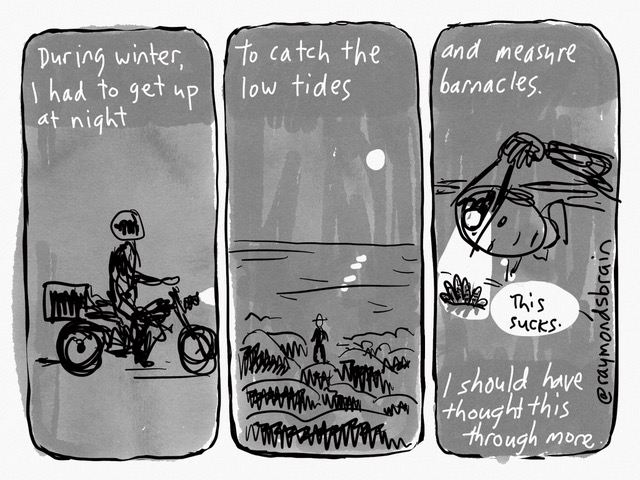
This meant marking more than a hundred individuals that I would measure during every low tide cycle. 

During the winter, that meant going out in the middle of the night.


Sometimes I went further afield to help with studies on endangered species...


...or surveys of less studied habitats, such as Zamami Island in Okinawa.


Sometimes I came across different creatures while doing research or during the course of my travels.


I also had the opportunity to find life in my own home. 
 

I found that studying disagreeable things is a way to cope with their existence. 


Others were more occasional visitors, such as land crabs, mice, spiders, and centipedes.


I realized I preferred my wildlife outdoors.

That was all many tide cycles ago. I now live in Vancouver, where I am a lapsed biologist, more interested in sharing discoveries by other people than working out my own. I practise Japanese on an app called Duolingo. And when the moon is full, I just think, "Isn't that pretty," instead of, “Gosh, these rocks are cold."  

12 Jul 2019

Snakes at the Seaside and Birds in the Bush

By Claire Eamer

"Snake!" yelled 8-year-old Carys, and dove for the grassy bank beside the trail. She emerged clutching a deeply puzzled garter snake at least 60 centimetres long, with elegant checkerboard markings on its sides and a jagged yellow stripe running the length of its back.
Western garter snake, found at Pipers Lagoon Park, Nanaimo.
The rest of the group -- more than two dozen kids and adults, with an age range from 8 to 80-ish -- crowded around to admire her catch. Our leader, biology professor Tim Goater of Nanaimo's Vancouver Island University (VIU) identified it as a female western garter snake (Thamnophis elegans), almost certainly pregnant, and the largest specimen he had seen at Pipers Lagoon, the small seaside park we were exploring. Western garter snakes have a variable diet, depending on where they live, he explained. Carys's prize catch would specialize in hunting intertidal fishes among the park's rocks and tidepools.

Professor Tim Goater with
a large clam at Pipers Lagoon.
Once everyone had admired the snake, we put her back on the slope beside the trail and watched, fascinated, as she disappeared into the grass and undergrowth in less than a second.

The mixed group of kids and adults wasn't just a casual group of visitors to the seashore. We were students in a class called Explorations of Animal Diversity, one of 10 offerings at this year's edition of Grandkids University. The two-day program is open to kids aged 7 to 13 and to their grandparents or grandparent-equivalents (other senior relatives or special friends).

Carys, left, entranced by birdbanding.
Carys and I (I'm her great-aunt) were in our second year at Grandkids University this year. Her brother, Rowan, was in his third year. He and his special friend, Susan, spent two days in the chemistry lab, making soap, slime, invisible ink, instant ice cream, and pop-bottle rockets -- and learning a considerable amount of chemistry along the way.

Over two days, Carys and I got to see and handle garter snakes both in the lab and in the field, peer at insects through a dissecting microscope, search for animals in the intertidal zone, visit a bird-banding station, dissect a ratfish in search of parasites, and tour VIU's International Centre for Sturgeon Studies.

Master bander Eric Demers shows the wing feathers
of a Common Yellowthroat.
And, at the end of the two days, we all attended a graduation ceremony in the university's theatre. VIU's symbols -- a mace and a beautifully decorated steering paddle -- were formally piped through the theatre to the stage. Then, the VIU registrar, in full academic robes, presented each adult and child with a completion certificate. Kids and adults who had attended Grandkids University for 5 years also received "Masters" medals. (Both Rowan and Carys are determined to get their Masters!)
A female American Goldfinch receives its individualized band.
This is the 11th year for VIU's Grandkids University, and it drew a record 163 participants. Almost a dozen former kid participants have grown up to become VIU students, and a number of the participating adults also take VIU classes. Clearly it's part of the university's recruiting program, but it does more than just generate students.

Carys found a seastar that had lost one arm
and was still regrowing its replacement.
Both the kids and the grandparents learn things -- about the subject they are studying and about each other. For two days, they are equals, experiencing the pleasure of learning something new and interesting. The kids can see that adults don't know everything, but that they can learn. The adults get a chance to see how bright and capable the kids are.

And everyone is reminded that learning isn't drudgery. It's fun.

All photos by Claire Eamer.

25 Oct 2017

Galapagos – From Blue-footed Boobies to Swimming with Sharks (Part 1)

By Margriet Ruurs

Margriet and Kees Ruurs start their Galapagos adventure.
Galapagos Islands: the very name conjures up images of a mysterious paradise, of unique species of animals that have adapted to their environment in special ways.

I am so glad and grateful that I had a chance to visit these faraway islands, even thought they have now lost some of their magic for me. But the intrigue has been replaced by memories of walking among iguanas and swimming with sharks and sea lions.

When we made the decision to travel to South America, there were two things high on our wish list: Easter Island and the Galapagos. I had read a wonderful, insightful book called Charles and Emma by Deborah Heiligman. This book heightened my wish to see these islands for myself.

We flew from Guayaquil, Ecuador, west across the Pacific and landed on one of the circa 40 Galapagos Islands (did you know there are so many islands here?!): Baltra. The humid heat hit us like a wall.

Tourists can travel to the Galapagos on their own or via a planned trip. But even if you go on your own, you cannot visit the National Park areas without a guide or small tour group. The Galapagos Islands are not only expensive to reach; they are expensive in every way, since all food and drink needs to come from far away.

A guide met us at the airport, expertly whisked our luggage away, and loaded us and about 18 others onto a bus. It was only a 10-minute drive to the boat launch where we climbed aboard a bobbing dinghy. We would repeat this exercise in agility many times in the coming days.

The dinghy brought us to a medium-sized yacht. The MV Coral I had about 14 cabins and a total of 20 guests on board plus a crew of 15, including two naturalists.


That first day we visited the Charles Darwin Station on Santa C,ruz Island. This is where the breeding program for the Galapagos Giant Tortoises takes place. Eggs from all over the islands are hatched here and the little Giant Tortoises (what do you call a little giant tortoise?) are raised until the age of five, when they are released in hopes that they will survive on their own.

We saw several huge, ancient tortoises as well as amazing prickly pear cactus trees that grow into huge trees over 400 years old. Unfortunately, the buildings were not open to the public and we did not see eggs or baby tortoises.

We walked through town and discovered that, like Easter Island, the Galapagos we had imagined was very different from reality. For instance, did you realize that the archipelago consists of nearly 40 islands, four of which are permanently inhabited?

And did you know that over 30,000 people live in Galapagos? I had no idea. The cities of Santa Cruz and San Cristobal have schools, stores, government buildings, and much more. Two airports serve the islands. Since Galapagos was used as a penal colony by Ecuador, most houses had bars and gates as opposed by the much more friendly atmosphere on Easter Island. The heat was incredible.

There is almost no rain on these lava islands. Some are lush and green, but others are a volcanic wasteland. In fact, one early explorer wrote home to describe that he had arrived in what he truly thought was hell!


That first night we slept well in our slightly rocking bunks. However, the next two nights were rough as we crossed open ocean and coped with high swells that rocked the small boat left to right and front to back. Things flew through the cabin, and we ended up sleeping on the outside deck. Most of us didn’t get sea sick, but we rocked for three days afterwards.

(To be continued....)

All photos are Copyright ©Margriet Ruurs

For Margriet's previous blog posts about her visit to Rapa Nui, also known as Easter Island, click here and here.

20 Mar 2017

Explore Under the Sea, Live and Online

By Claire Eamer

From the website of the research ship, Okeanos Explorer: "From March 7 – 29, 2017, NOAA and partners will conduct a telepresence-enabled ocean exploration expedition on NOAA Ship Okeanos Explorer to collect critical baseline information about unknown and poorly known deepwater areas in the Howland and Baker Unit of the Pacific Remote Islands Marine National Monument and the Phoenix Islands Protected Area.

NOTE: ROV dives are planned, weather permitting, most days from March 8 - March 27, typically from about 8 am to 5 pm WST (March 7 - March 26, from 2 pm to 11 pm EDT)."

If you go to the dive website, you can watch the whole of the dive, seeing just what the scientists are seeing, and you hear scientists discussing what they are observing in real time. Warning: it's addictive!

A seastar is wrapped around the branches of a coral, hundreds of metres beneath
the surface of the Pacific Ocean. Screen capture from Okeanos Explorer feed.

12 Aug 2016

Life and Death in the Salish Sea

By Claire Eamer
An orca, or killer whale, in the Salish Sea near Nanaimo.
Alan Daley photo

My husband, Alan, and I live on a small island in the Salish Sea, the body of water that lies between Vancouver Island and mainland British Columbia. Our place is on a low cliff overlooking the sea, and we spend a lot of time watching what goes on out on the water. That's what Alan was doing one afternoon early in May this year when he spotted a pod of orcas (killer whales). Here's his description of what he saw.

Alan speaking now:

Whales mill about a sea lion, its flipper visible in the turmoil.
Alan Daley photo
I discovered orcas just below off the cliff. They were milling about, and I noticed there was a sea lion in their midst. It was just lying still in the water for the most part. 

The whales repeatedly passed close to it, sometimes passing under it and flinging it partly out of the water. 

A sea lion tries to grab a breath, as killer whales attack it.
Alan Daley photo
Occasionally, I saw the sea lion put its head up and take a breath of air, but when it showed any signs of life, the beating intensified. 

There were a total of six whales. Two large males mostly hung out upwind/seaward of the action, and slapped the water occasionally with their tails. The smaller whales did most of the work. 

They seemed to have a strategy of exhausting the sea lion through physical beating and preventing it from breathing by huge splashes that sent it underwater. 

The injured sea lion is tossed into the air again.
Alan Daley photo
After I had watched for more than an hour, they headed off north with the sea lion seemingly moving without making any swimming motions. A couple hours later, I saw the body drift back down past the cliff.

Alan contacted the Orca Network to report the sighting and  included a couple of his photographs.

Howard Garrett of the Orca Network showed the photos to an expert, Dave Ellifrit of the Center for Whale Research. He identified the two large males as T19B and T19C, members of a pod of Bigg's killer whales -- also called transient killer whales.

Bigg's killer whales live in small family groups led by a female. They prey mainly on sea mammals, hunting up and down the coast of northwestern North America.

The kind of behaviour Alan watched might have been hunting lessons for young members of the pod or simply hunting practice. Steller sea lions are roughly the size of a bear and have formidable teeth and claws, so buffetting them with waves and tail-swipes keeps the whales safely away from the sharp bits.
Whales circle the sea lion, now seriously injured or dead. Alan Daley photo
The Salish Sea is also home to resident pods of killer whales. The resident whales live very different lives -- eating fish, mainly salmon, rather than sea mammals. They have different behaviour patterns, different dialects, and different cultures, and the two killer whale cultures seem to have very little contact with each other.

There's a wealth of information about both resident and Bigg's killer whales on the Orca Network website. And if you happen to be near the Salish Sea and spot some killer whales, let the network know. Every bit of information helps us understand and protect these amazing animals.

6 Sept 2014

Drift Cards for Citizen Science

Science is done not only in labs by people with white coats and clipboards, but also in the field. And "in the field" can mean on the water, and on the beach. So paddlers and beach-walkers can keep your eyes open this month for some citizen science opportunities on the Salish Sea!

These opportunities aren't as high-tech as the Neptune and Venus projects off-shore on the continental shelf. I've written about those before on the Sci/Why blog. Nor are they as specialized as the clam gardens research done on Quadra Island that was noted on the Kayak Yak blog, too. Nope, these current opportunities for ordinary citizens to participate in a science project involve picking up cards.
This photo is from the Raincoast Conservation Federation website.
 That doesn't sound very science-y at first. It doesn't sound like it has anything to do with kayaks, either. But hang on. These yellow cards are biodegradable plywood cards with detailed labelling, and they're being released at particular locations on the Salish Sea. If you find one while you're out in a boat or on a beach, pick it up and contact the scientists, who are part of a team involving the City of Vancouver, the Raincoast Conservation Federation, and the Georgia Strait Alliance. You will have helped track the way that floating items drift in real-life, real-time conditions.
There's an article about this drift card release on the CBC website at this link, and another more detailed article on the Vancouver Observer website at this link. You can also go to the website for the Salish Sea Spill Map, where the locations of card releases and recoveries are being tagged on a map. Is your home base on this map? Maybe you're planning a paddling trip and want to look up that location. Maybe you're thinking about what could happen if, instead of cards, there were other things released such as fossil fuels from a tanker? And now, this project makes a little more sense.
A close-up of one of the cards, from the Vancouver Observer article.
 Citizen science is not only about allowing ordinary untrained people to participate in projects by real scientists. It can be about seeing real science in use in the lives of ordinary citizens. We citizens interact with the environment when we're out on the water in our small boats or walking along shorelines. We can gather data in many more places than a scientist could ever get funding to cover. We get to be part of the community of learning.