Showing posts with label South Pacific. Show all posts

27 Oct 2017

Galapagos – From Blue-footed Boobies to Swimming with Sharks (Part 2)

By Margriet Ruurs

This is the second part of Margriet's story of her visit to the Galapagos Islands. Click here for the first part.
Blue-footed Boobie!

We hiked across Mosquera Islet seeing many birds up close, including – to my delight – the Blue-footed Boobie. We had watched documentaries about the Galapagos and were thrilled to see these birds in real life, as well as the bright red Sally Lightfoot Crabs scurrying across the black lava rocks, pelicans, swallowtail gulls, and many others.

Male Frigate Bird
One of the funnest animals was the sea lion. They look exactly like our North American seals, but the ears show that they are sea lions. It is amazing that all animals here have no fear of people. The seals come right at you, follow you like puppies, and want to play. It is the hardest thing not to reach out and pet them.

But this is a National Park and everything is highly protected. You cannot take a rock or a shell or touch anything. And rightly so.

Next we hiked North Seymour Island where the huge Frigate Birds soared overhead and young ones with white heads in perched in trees, looking like bald eagles.


Iguanas live on most islands but they are different species, having adapted to life on each island. Some islands had black iguanas; elsewhere they were yellow or even pink. We also saw the swimming ocean iguanas.

We hiked across Santa Fe and South Plaza islands. Being on a boat allowed us to visit more places but it also had the disadvantage of rocking and bobbing.

However, the biggest thrill for me was being able to swim off the back of the boat. Even after a few excited calls of “Shark!” I couldn’t figure out why it was okay to swim when there were sharks, but I trusted that our guides knew what they were doing.

We snorkeled several times, and it was beyond description to be in the ocean and have a large sea lion coming straight at me like a bullet, only to veer off at the last second. At one point two sea lions swam alongside me on either side. I watched turtles swimming below me, and hundreds and hundreds of colourful fishes like parrot fish.

And sharks. White tip sharks. Pretty cool.

On San Cristobal Island we strolled through the town and it was a bizarre experience to run into two friends from Kelowna!


We visited the Galapagos Interpretation Center. Sweat dripped of our bodies as we just stood still, reading about the violent human history on the islands. The animals really ought to be afraid of humans. They killed over 100,000 turtles and thousands of whales during the mid-1800s to mid-1900s. Nowadays, 97% of the islands is strictly protected as a National Park. All we can do is hope it will always stay this way and that Galapagos’s amazing variety of wildlife, which so well demonstrates its capacity to change and adapt to its natural environment, will be around for generations to come.


Reflecting back on it all, I am very glad to have been able to make this amazing trip and to see these special places on Earth. But it is a very long way to travel, expensive, and a bit overrated. Like ‘Serengeti’ the name ‘Galapagos’ has mysterious allure, but we have visited many places where plants and wildlife have adapted to their environment, and places like Australia’s Great Barrier Reef where we also saw giant tortoises and birds that stayed a foot away from us.

If you can go, do it. But otherwise, savour nature around you anywhere – nature is always incredible and forever adapting.

All photos are Copyright ©Margriet Ruurs

25 Oct 2017

Galapagos – From Blue-footed Boobies to Swimming with Sharks (Part 1)

By Margriet Ruurs

Margriet and Kees Ruurs start their Galapagos adventure.
Galapagos Islands: the very name conjures up images of a mysterious paradise, of unique species of animals that have adapted to their environment in special ways.

I am so glad and grateful that I had a chance to visit these faraway islands, even thought they have now lost some of their magic for me. But the intrigue has been replaced by memories of walking among iguanas and swimming with sharks and sea lions.

When we made the decision to travel to South America, there were two things high on our wish list: Easter Island and the Galapagos. I had read a wonderful, insightful book called Charles and Emma by Deborah Heiligman. This book heightened my wish to see these islands for myself.

We flew from Guayaquil, Ecuador, west across the Pacific and landed on one of the circa 40 Galapagos Islands (did you know there are so many islands here?!): Baltra. The humid heat hit us like a wall.

Tourists can travel to the Galapagos on their own or via a planned trip. But even if you go on your own, you cannot visit the National Park areas without a guide or small tour group. The Galapagos Islands are not only expensive to reach; they are expensive in every way, since all food and drink needs to come from far away.

A guide met us at the airport, expertly whisked our luggage away, and loaded us and about 18 others onto a bus. It was only a 10-minute drive to the boat launch where we climbed aboard a bobbing dinghy. We would repeat this exercise in agility many times in the coming days.

The dinghy brought us to a medium-sized yacht. The MV Coral I had about 14 cabins and a total of 20 guests on board plus a crew of 15, including two naturalists.


That first day we visited the Charles Darwin Station on Santa C,ruz Island. This is where the breeding program for the Galapagos Giant Tortoises takes place. Eggs from all over the islands are hatched here and the little Giant Tortoises (what do you call a little giant tortoise?) are raised until the age of five, when they are released in hopes that they will survive on their own.

We saw several huge, ancient tortoises as well as amazing prickly pear cactus trees that grow into huge trees over 400 years old. Unfortunately, the buildings were not open to the public and we did not see eggs or baby tortoises.

We walked through town and discovered that, like Easter Island, the Galapagos we had imagined was very different from reality. For instance, did you realize that the archipelago consists of nearly 40 islands, four of which are permanently inhabited?

And did you know that over 30,000 people live in Galapagos? I had no idea. The cities of Santa Cruz and San Cristobal have schools, stores, government buildings, and much more. Two airports serve the islands. Since Galapagos was used as a penal colony by Ecuador, most houses had bars and gates as opposed by the much more friendly atmosphere on Easter Island. The heat was incredible.

There is almost no rain on these lava islands. Some are lush and green, but others are a volcanic wasteland. In fact, one early explorer wrote home to describe that he had arrived in what he truly thought was hell!


That first night we slept well in our slightly rocking bunks. However, the next two nights were rough as we crossed open ocean and coped with high swells that rocked the small boat left to right and front to back. Things flew through the cabin, and we ended up sleeping on the outside deck. Most of us didn’t get sea sick, but we rocked for three days afterwards.

(To be continued....)

All photos are Copyright ©Margriet Ruurs

For Margriet's previous blog posts about her visit to Rapa Nui, also known as Easter Island, click here and here.

22 Sept 2017

Moving Moai and the Birdman Battle

By Margriet Ruurs

Note: This is the second of two posts by Margriet about Rapa Nui. To see the first, go to https://sci-why.blogspot.ca/2017/09/exploring-world-through-travel-rapa.html

Walking along the steep cliffs of the southwest coast of Rapa Nui, or Easter Island, I gaze down on foaming white waves pounding the shore of a small island: Moto Nui. This is where history was made.

The view of Moto Nui from the cliffs of the larger island, Rapa Nui.
The first inhabitants likely arrived on Rapa Nui in wooden canoes from far-away Tahiti. From these first few grew a population of thousands. But European diseases and fighting reduced their numbers to a low of 110 at one point. After the era of the moai (stone figure) carving culture, competing tribes designed a non-violent way to establish order on Easter Island: the Birdman Cult. Chosen young men competed for the right to have their tribe rule for the next year, until the next competition was held.

Birdman figure
The competition was held near the most important site on the island, the Rano Kau volcano, and consisted of climbing down the steep rock face of Orongo to the wild ocean below, building rafts from reeds, using these as flotation devices and swimming the rough kilometre-wide passage of pounding ocean to Moto Nui island.

The young men had to bring back the first egg laid by birds returning in spring. They tucked this egg into a woven headband, swam the ocean and climbed the cliff to hand the egg, unbroken, to the chief.

I saw tiny rock houses at Orongo and scattered rocks carved with birdman and boat pictures. We climbed the sides of the ancient volcano to look inside the crater, filled with shallow lakes where drinking water was collected and reeds for the rafts were cut.

The best came last, when we visited the site famous from so many photos – the long row of moai standing shoulder to shoulder. This is iconic face of Easter Island.


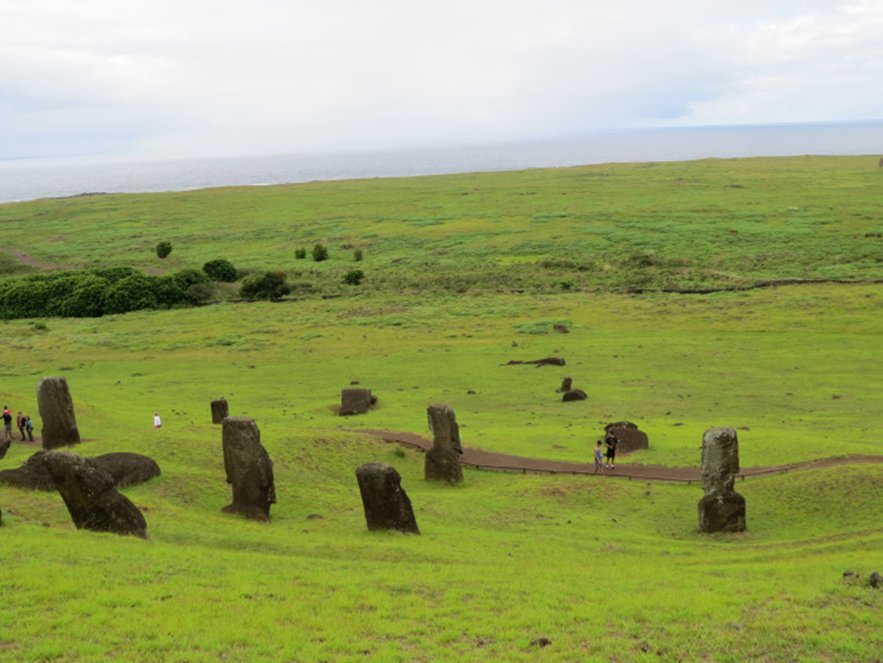
But my favourite site is the quarry. When I first heard the name, I pictured a rock excavation site where rocks were dug up. However, when you approach the quarry, it is as if the stone people have come to life and are walking out of the mountain from where they were born. A gently sloping green side of a volcano is scattered with upright figures. They seem to be walking down, stumbling and standing all over the slopes. The sight gave me goosebumps and a lump in my throat.

The moai were carved here from gigantic blocks of basalt and lava. Weighing many tons and measuring up to ten metres in height, their individual features were carved. I had heard that most figures only show the upper body while the lower half is still buried.

Before I saw them, I thought that this meant that the moai had been covered by drifting sand over the ages. But that is not true at all. There is no sand. Only lava and rocks. The artists did not have ladders, so they dug deep pits in which they lowered or raised the moai until they could reach their faces to carve them.

Once a figure was finished, it was erected and “walked” down the mountain to spots all over the island – a mind-boggling feat that National Geographic has tried to recreate.

Why did people stop carving and moving the figures? It seems like they were in the middle of ongoing projects when work came to a halt. No one knows why.

Why did the Rapa Nui create these statues in the first place? Scientists believe that well-to-do families ordered a moai in memory of an important member of the community. When this person died, male or female, a moai was constructed in his or her image and erected over their bones.

Once the grey basalt figure, with or without red lava topknot, had been given white coral eyes with a black obsidian center, it was believed that the deceased person’s spirit had entered the moai and would now protect Rapa Nui and its future generations.


For details on Easter Island and its history, click here: http://www.mysteriousplaces.com/easter_island/

See a reenactment of ‘walking’ the statues here: https://www.youtube.com/watch?v=yvvES47OdmY

All photos by Margriet and Kies Ruurs. For more of the Ruurs's travel adventures, visit their blog, Globetrotting Grandparents.

15 Sept 2017

Exploring the World Through Travel: Rapa Nui’s Moai

By Margriet Ruurs

I was lucky enough to take a trip to Easter Island, Chile, earlier this year. I had booked a flight from Santiago. Before getting there I imagined an old, small airplane. I don’t know why – but I had thought it would be a local airline with an old prop plane. The opposite turned out to be true: Latam is part of One World and operates a brand new Boeing 787 on the route to remote Easter Island across the south Pacific Ocean. Only during the long flight does it become clear how distant this place is. From mainland Chile you fly at a speed of 850 km an hour for about 5 hours! The island is almost halfway between mainland Chile and New Zealand.

Rapa Nui from the air.
We arrived in comfort. But now imagine that you are an early explorer, sailing the Pacific Ocean in search of new lands. After weeks of nothing but water, you spot land. A green island with round, cone-shaped hills and the odd ragged cliff dropping off into the roaring ocean. As this Dutch ship, under the command of Captain Roggeveen, cautiously approaches the island, furling the sails that billowed from its three tall masts, you spot people. Giants.

Huge, towering people standing shoulder to shoulder with their backs to the sea. These stone giants are most likely meant to honour chiefs and other important people. For more than a thousand years – no one knows their exact date – they have been standing here, silently. Only a few statues face out over the sea, looking in the direction of other Polynesian islands, possibly the Marquesa Islands from where the first inhabitants of Easter Island might have come by canoe.

Roggeveen did go on land and communicate with the native population. As it happened to be Easter for the European Christian sailors, they named the island Easter Island: Paas Eiland in Dutch, or Isla de Pascua in Spanish. Never mind that the island already had inhabitants and a name: Rapa Nui. Like other islands claimed by European nations, it has now gone back to using and being proud of its original name and so I shall refer to Easter Island as Rapa Nui here. Since 1965 the island has been under Chilean governance. It uses Chilean pesos but has its own Rapa Nui postage stamps.

The stone statues, for which the island is famous, are so shrouded in mystery that it is hard to realize that they stand on a normal island where regular people live in a regular town. I had only ever seen images of statues and green grass and found it slightly jarring to arrive in this mysterious place to see ordinary trucks, cola machines, dogs – just like in any other town. Where was the mystery?

We walked across the tarmac to the palm-frond-covered entrance of a tiny airport. Each and every new arrival is greeted with a lei of fresh flowers.  People here still speak Spanish but also Rapa Nui, which is very Polynesian and looks like Hawaiian to us.

Rapa Nui is roughly the same size as Canada’s Salt Spring Island with almost the same number of people, around 7000 – increasing with tourists. They also face similar problems, such as sustainability, water shortages and recycling. Of course this island is much further away from a mainland. Supplies used to come, and still may, once a year by ship. Everything else is flown in. So the cost of a soft drink or anything else is sky high. A small bottle of water, which was 1 dollar in Santiago, costs 3 dollars here. Everything needs to be recycled or re-used. A sign in our bathroom asked us not to "throw paper at the toilet" – which we took to mean no flushing of paper.


Our very first moai, or stone statues, was a row of five that, unlike all other moai, face out over the ocean rather than inland with their backs to the sea. Why? We can only guess and only “the ancestors” know the real answer. They sit near two platforms on which the moai typically rest. These platforms are built of huge square basalt blocks with straight lines and rounded corners. It is impressive how precisely these were constructed so many hundreds of years ago, without the use of metal tools.

Once the guide pointed it out, we noticed moai that have fallen forward, on their faces, and cracked. Many were destroyed during a civil war between the Long Ears and the Short Ears tribes around 1680, as well as by missionaries, neglect and the passing of time.

Top Knot lava stone
The standing, reconstructed moai are about 5 metres tall. Each face is quite individual. A few wear "top knots" – these round blocks of red lava have a smaller red part on top and are said to resemble not hats but hair, worn traditionally in a long ponytail tied in a knot on top of the head, just like most men here still wear it.
Typical modern men's "top knot" hair style on Rapa Nui
All photos by Margriet Ruurs. You can find more of Margriet's travel stories at Globetrotting Grandparents.