Showing posts with label animal. Show all posts

21 Aug 2020

Salty Slug Love

Slippery, slimy, oozy slugs; what’s not to love? Slugs can be small and slugs can be as long as your arm! Slugs can be sausage shaped and brown, or they can have leaves, legs, and lots of rainbow colours! They can live anywhere wet, and lots live under the sea. 
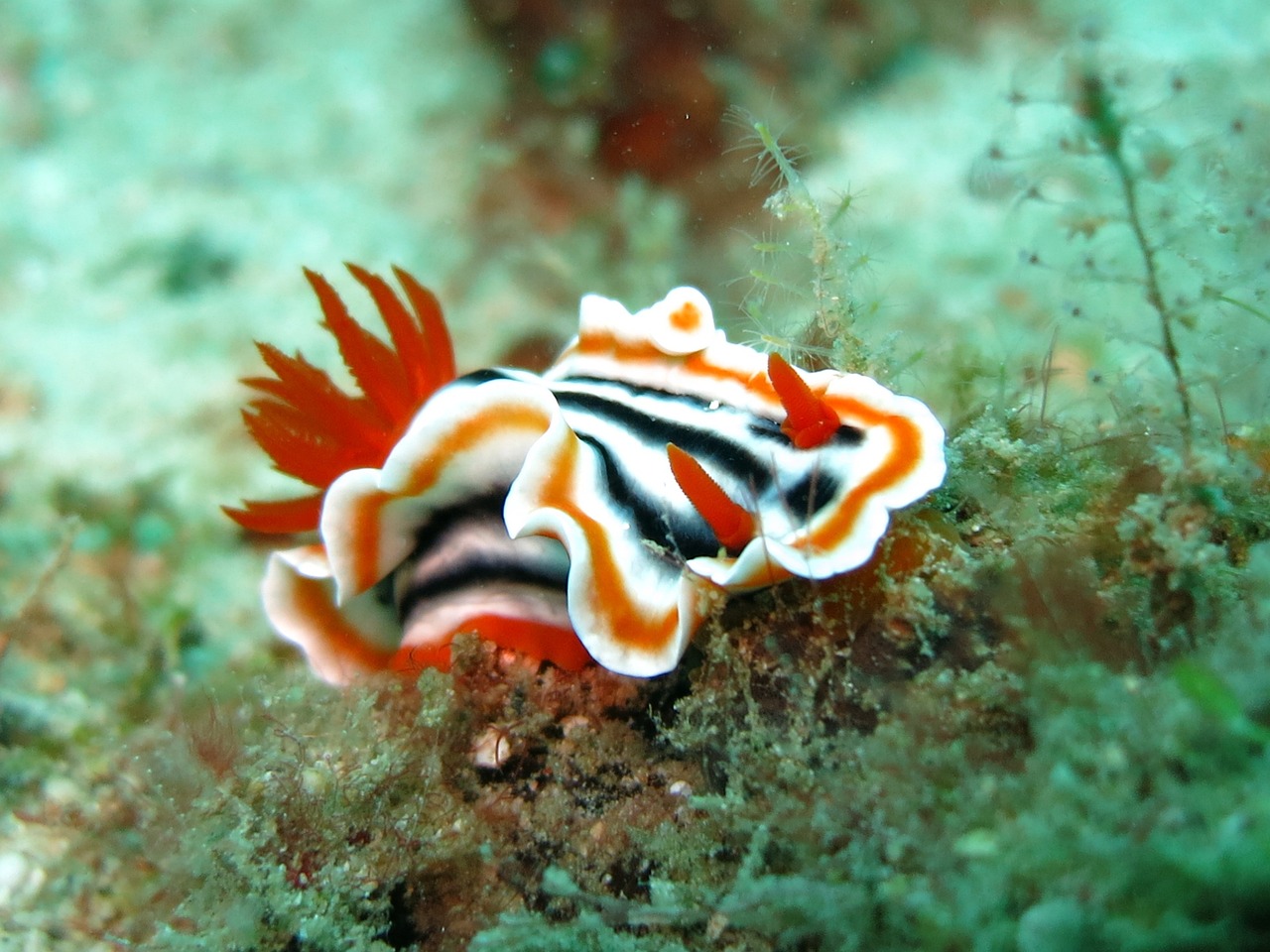
nudibranch chromodoris looks like ribbon candy

Salty Samples 

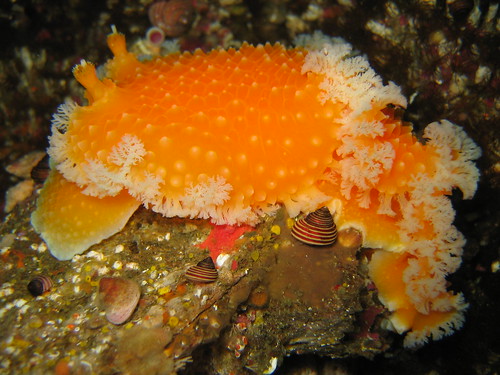
Sea slugs are a family of boneless animals that contain a particularly fancy looking molluscs called nudibranchs. Usually they’re small enough to fit on your hand, but they can be as long as a sheet of binder paper. Their shapes and colours result in names like “dragon” and “orange peel,” or “sea bunny,” “dancer” and “clown.” Start an image search and you could browse pictures of fanciful nudibranchs all day. There are more than 3000 kinds! 
the "orange peel" nudibranch can be 50 cm long

Pantry Paint Packs 

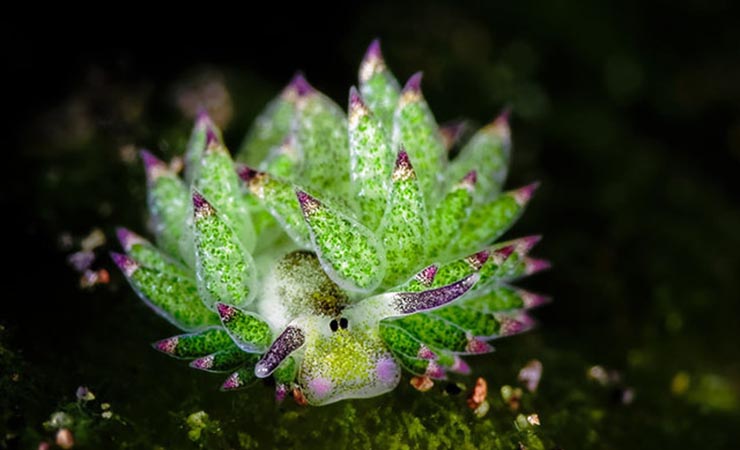
Like flamingoes get their pink colour from their food, nudibranchs get their colour from their diet too. Check out this little creature that looks like a sheep that rolled in cut grass! It’s the leafy sheeps’ algae diet that makes them green. They store the chloroplasts from their food and that means photosynthesis happens inside their bodies like it does in plants. 

Nudibranch Brunch 

Nudibranchs are carnivorous! They eat algae, sponges, and even other sea slugs. Some also eat coral and even stinging jellyfish, and that makes them a bit toxic. Like the leafy sheep keeps some chloroplasts from its food, the jellyfish eating “blue dragon” keeps some of the stinging cells from its food. Like a lot of colourful things in nature, the bright hues warn us that they can hurt. Touching them can sting. 

Making Nudibranchs 

Any two nudibranchs can make babies together, because they all have both sex organs. They’re hermaphrodites, just like earthworms and most snails are. About 5 of every 100 animal species are hermaphroditic.
A gooey ribbon of fertilized eggs will hatch into nudibranchs that look just like their parents but smaller. Depending on the type, there can be 2 eggs or 25 million! Once they leave the nest, they’ll live just a few weeks to a year. 

Notice Nudibranchs 

To see a nudibranch in person, you’ll have to go out into the ocean because they don’t survive captivity for long. But you’ll find some of these saltwater slugs along every ocean coast — except in the Arctic and Antarctic circles. They love coral reefs. You will find nudibranchs in shallow water and way down in the deep. Look on the bottom, and remember they’re usually very small. Most photos of these creatures are taken with a close-up macro lens.
nembrotha nudibranch on the mouth of a glass drink bottle

28 Oct 2016

The Endangered Caribou

By Marie Powell

CC Jacob W. Frank
The caribou (Rangifer tarandus) is a remarkable animal. Part of the deer family, caribou are unique because both males and females have antlers. Also known as reindeer, caribou have roamed North America for some 1.8 million years. Barren-ground caribou evolved from these early ancestors. The Woodland and Peary caribou have been with us since before the Pleistocene epoch, or Great Ice Age.

The thing I like best about writing middle-grade non-fiction books is that you're always learning something new. The research I'm doing this week has led me north to the Yukon and Nunavut, where I've been learning about the caribou. For instance, some populations of caribou have been reduced by 95 percent in the past 15-20 years. That seems incredible.

I've also been reading Bill Waiser's A World We have Lost: Saskatchewan Before 1905, and his vivid description of the buffalo herds on the prairies a century ago. These buffalo created a whole ecosystem just by foraging on the land, Waiser says. The wanton slaughter of some 4-5 million buffalo in the 1870s led to famine and severe environmental change across the prairies. Looking out my window at the busy streets of Regina, I try to imagine how different life would be today if that hadn't happened. So, when I read about the decimation of the caribou herds, I can't help but wonder what effect this will have on our future.

CCAlfred Cook  
Caribou fall into two groups: populations that remain in one area and spread out there after calving (sedentary), and herds that move or migrate to a common calving area each year (migratory). They range across the tundra and boreal forest areas, from the Arctic and south into most Canadian provinces. As well as predators and hunting, changing weather patterns affect the foraging of migrating herds, which in turn affects the health of the females and calves. So does loss of habitat due to human development in northern regions. All of this threatens the caribou's survival.

Scientists are working together with the Inuit to see how changing weather patterns affect the ecosystem of the north. For example, studies of the sea ice show how important that ecosystem is to all life in the north. One resource that brings out these findings is the Inuit Siku (Sea Ice) Atlas at http://sikuatlas.ca/sea_ice.html, as Claire Eamer shares in her Sci/Why post from 2013.

CCAllen Shimada 
Researchers have also turned to traditional Inuit knowledge to try to save the caribou. A 2012 report calls for minimizing development activities in caribou ranges, among other suggestions. Governments have responded with what the CBC calls a "patchwork" of conservation activities. Some provinces -- like Saskatchewan -- moved to limit development, and more recently others (including Alberta) have begun to act along those lines as well.

Will our efforts be in time to save these majestic animals?

Here are some more links to information about the Arctic and the caribou:

Bergerud, A. T. “Caribou.” The Canadian Encyclopedia. http://www.thecanadianencyclopedia.ca/en/article/caribou/

Braun, David Maxwell. "Inuit Knowledge Critical to Arctic Science." National Geographic Society , August 18, 2011 http://voices.nationalgeographic.com/2011/08/18/inuit-knowledge-critical-to-arctic-science/

Eamer, Claire. "Over, under, and on Arctic sea ice." Sci/Why 2013. http://sci-why.blogspot.ca/2013/03/over-under-and-on-arctic-sea-ice.html

Lunn, Susan. "Caribou still under threat despite changing political climate, report says." CBC News, Dec. 14, 2015. http://www.cbc.ca/news/politics/caribou-still-under-threat-despite-changing-political-climate-report-says-1.3359751

Northern Involvement: Changing Animal Populations - Science Canada - July 22, 2016 http://www.science.gc.ca/default.asp?lang=En&n=CC02ABC9-1
https://www.youtube.com/watch?v=99f_VVHuR2I&feature=youtu.be 

Rudolph, T. D., Drapeau, P., St-Laurent, M-H. and Imbeau, L. 2012. "Status of Woodland Caribou (Rangifer tarandus caribou) in the James Bay Region of Northern Quebec." (Scientific report) http://www.gcc.ca/pdf/Final-Rapport-Status-of-Woodland-Caribou-James-Bay_Eeyou-Istchee.pdf

"Traditional Inuit knowledge combines with science to shape weather insights." Science Daily, April 7 2010. https://www.sciencedaily.com/releases/2010/04/100407190000.htm

Weatherhead et al. "Changes in weather persistence: Insight from Inuit knowledge." Global Environmental Change, 2010; DOI: 10.1016/j.gloenvcha.2010.02.002 http://www.sciencedirect.com/science/article/pii/S0959378010000087

Marie Powell lives on Treaty 4 land in Regina, Saskatchewan. She is the author of close to 40 children's and young adult books, including the historical fantasy Hawk (2015). She enjoys writing about science, history, and any subjects that help promote literacy.
6 Sept 2013

The Facts About Cats

By Marie Powell

As the owner of two cats, I like to think I know a lot about them. I know what they like to eat, where they hide their toys, and how much trouble they can get into without really trying.

When I began writing "That Cat!" for my new "Word Families" series (Amicus Publishing, 2013), I found out how much I still had to learn about cats.

Writing a nonfiction book for children begins with research, so I pulled as many books as I could find from our library. I've included some of these books at the end of this post.

Here are just a few fascinating facts I discovered about cats:
  • Cats have 244 bones; people only have 206 bones.
  • Cats have 32 muscles in each ear; people have only six muscles in each ear.
  • Cats can rotate each ears by itself, and can even turn their ears 180 degrees in opposite directions. Cat hearing is so sharp that they can tell the difference between one person's footsteps and another's, and even between the sounds of different cars. (So they really do know it's you when they come running to the door!)
  • Cats walk on their toes: their heel bone is half-way up their leg.
  • Cats have scent glands on their paws, their foreheads, under their chins, and where their tails meet their backs. That's why they like scratching and rubbing -- and being rubbed, so they can transfer some scent onto you!
  • The sense of smell is very important to a cat. Cats even have an extra organ for smelling located inside their mouths, called the vomeronasal organ or Jacob's organ.
  • Cat tongues are rough because they have tiny, backward-facing spines made of keratin, called papillae.
An average cat, like our friendly Sabriel pictured here, has 24 whiskers or vibrissae on each side of his nose, as well as whiskers on his chin, above his eyes, and on the back of each foreleg. 
    Cats use their whiskers as part of their sense of touch. Their whiskers help them sense the direction of wind and air currents, measure distances, and navigate. 
As well, whiskers help show their mood. For example, the whiskers would move forward and down when relaxed, forward when aggressive, or flat when defensive.

Here are some of the books and resources on cats I used for these facts and more:
  • The Complete Cat by Vicky Hall (2008, Bantam Press)
  • The Secret Life of Your Cat by Vicky Hall (2010, Firefly Books)
  • Why do Cats Have Whiskers? by Elizabeth McLeod (2008, Kids Can Press)
  • Cat Care Essentials by Francesca Riccomini (2010, Hamlyn)
  • The Cat Expert by Rebecca Watson (2010, Transworld Publishers)
  • Pets 101: Cats, Animal Planet

Everyone loves watching cat videos, so just for fun, here are just a few of my favourites:

What habits and behaviours does your cat have that fascinate you? Please leave a comment -- or share a cat video!

Marie Powell is the author of seven books for children, including Dragonflies are Amazing (Scholastic) and a new six-book series of Word Families books published by Amicus Publishing


25 Jan 2013

Spider Art and Bioluminescent “Bombs”: Extreme Animal Mimicry


Exciting news for the world’s arachnophiles (spider lovers) broke late last year – a spider was discovered in the Peruvian Amazon that constructs a much larger fake spider in the center of its web. The as-yet-unnamed arachnid, likely belonging to the genus Cyclosa, creates its faux-spider masterpieces (some of which have eight legs!) out of leafy debris and dead insect parts. To further enhance the big-spider illusion, the real spider hides at the head of its creation and plucks strands of the web to make it vibrate.
The decoy spider's elaborate fake spider (Phil Torres)
So, does this spider make art? Nope, sorry – it’s not art. Creating a larger decoy of itself to frighten off potential predators is a form of self-protective mimicry that’s hardwired into the spider’s genes.
The most common form of mimicry is camouflage. Such visual mimicry can be as basic as a lion’s tawny coat blending in with the African savannah, or a gray-patterned moth disappearing when it lands on a similarly colored tree. More complex examples include caterpillars that pose as twigs, or leafy seadragons that are almost indistinguishable from seaweed, or spiders that, along with their webs, can be mistaken for bird droppings in both color and shape.
In Batesian mimicry, harmless species evolve to visually impersonate poisonous or distasteful species, which makes it much less likely that they, themselves, will be eaten. A master of this particular adaptation is the Indonesian mimic octopus.
The mimic octopus impersonates a flatfish, a scorpionfish, and a sea snake.
Octopuses are masters of disguise and can change color and pattern, and even texture, to match their surroundings. The mimic octopus’s self-defense strategy goes one step further – it’s a shape-shifter. This diminutive cephalopod has evolved an elaborate collection of behaviors that allow it to ape other marine animals. It stretches out its arms to imitate a scorpionfish flaring its poisonous spines, or hunkers down with only two legs extended in either direction to impersonate a venomous sea snake, or swims flattened out to mimic the shape of a flatfish. To date, this little octopus has been observed posing as fifteen other marine creatures! A fun twist to this amazing story is that scientists have recently witnessed a timid little black-marble jawfish, whose markings are strikingly similar to those of the mimic octopus, swimming perfectly disguised among the arms of one of these octopuses. A mimic mimics a mimic!
Australian chameleon gecko (Stewart MacDonald)
Decoy mimicry is yet another variation, in which animals have developed a means to either divert the attention of a predator or, conversely, to attract the attention of a potential meal.
One of the most radical practitioners of decoy mimicry is the gecko who, when threatened, is capable of discarding its own tail. The cast-off tails of some geckos flop around and writhe, offering a tantalizing alternative meal to predators while the geckos themselves escape. In Australia, the writhing, discarded tail of the chameleon gecko is made even more irresistible – it actually squeaks! Though self-amputation may sound like an extreme adaptation for survival, geckos are capable of growing replacement tails within a few months.

The adaptation of decoy mimicry isn’t confined to land animals. While studying life in the ocean’s depths aided by remote-controlled submarines, a group of scientists led by research zoologist Karen Osborn discovered seven new marine worms (annelids), some of which have developed a novel form of decoy mimicry – we just don’t know exactly what they’re mimicking.
Deep-sea marine worms release bioluminescent "bombs" (Karen Osborn)
These small bristly worms, the biggest no longer than a finger, come equipped with tiny balloons attached to their bodies near their heads. When one of these worms, which have been dubbed “green bombers,” is touched, it releases one or more of these bioluminescent “bombs” that give off intense green light for several seconds. It’s likely that a would-be predator, searching for a tasty morsel in the darkness, would be distracted by these mini floating lights while the worm is able to avoid being eaten by quickly swimming backwards out of harm’s way.


Update

August 21, 2018

I have to add this guy I came across in Chile. It's a fabulous example of automimicry – the kind where part of an animal's body looks like a more vulnerable part. 

Here's the first view I had of this insect:


"What a character!" I thought.  Kinda cute, and kinda homely at the same time, like an old shoe. 


Then I changed my camera angle... 


...and saw that what I'd thought was a face was actually the insect's rear end. 

How fabulous – it's abdomen was pretty much a replica of its head, complete with bulging red eyeballs! (If anyone knows anything about this beetle(?), I'd love to hear from you!!)


Here’s a link that has a video showing forward and backward movement of one of the newly discovered marine worms (genus Swima): http://news.sciencemag.org/sciencenow/2009/08/20-02.html
Here’s another that shows the mimic octopus in action: http://www.youtube.com/watch?v=H8oQBYw6xxc
And a delightful recording of the moment the decoy spider was discovered!: http://www.youtube.com/watch?v=RrWnZ7VySac