Showing posts with label climate change. Show all posts

7 Oct 2022

Museum in the Classroom: The Pleistocene Extinction Teaching Kits


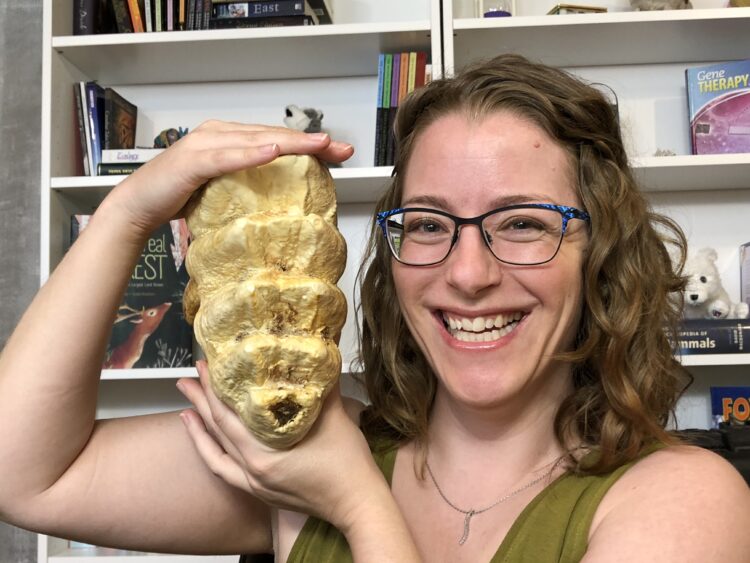
A mastodon molar is AS BIG AS MY HEAD, y'all.


by L. E. Carmichael

Did you have a dinosaur phase when you were a kid? I did. I was in the second grade, and I was obsessed. I pored over library books, memorizing five-syllable names and amazing the adults with my stockpile of bizarre dino facts (I still do that). I liked the armoured species best, because they were just so weird.

And then my parents took me to the Royal Tyrrell Museum to see real fossils. 

Mind. Blown.

Looking back, I can see how these early experiences helped spark my life-long obsession, not just with dinosaurs, but with all life on Earth. But not every child has opportunities to visit natural history museums, either with their families or on school field trips. That's why, when Dr. Lynda Colgan asked me to write the teacher's guides for her Learning with Palaeontology project, I jumped at the chance.

(Also, I'm pretty sure that all children's science writers are legally-obligated to write about dinosaurs at least once in their careers, so box checked!)

As with most of Lynda's ideas, this one was both simple and profound. First, we'd get some great big boxes. Next, we'd fill them with museum quality casts of real fossils, providing teacher's guides that provided the latest scientific knowledge about the species, while focusing on inquiry and hands-on learning. And then, we'd make the kits available to teachers for free.

And giant beavers? They were as big as black bears.
I mean, how cool is THAT?

The first two Kits, on the Pleistocene Extinction, are now available to borrow. Teacher-friends, here's what you need to know:

Features of the Kits

  • Fossil casts of mammals that lived in Canada during the Pleistocene
  • Supporting materials such as magnifying glasses, graphs, and charts
  • Teacher’s Guide containing
    • ALL the information needed to teach core concepts
    • Suggestions for hands-on learning and independent inquiry
    • Glossary, further reading lists, and bibliography of sources
  • Content vetted by experts in palaeontology, education, science communication, and Indigenous issues

Core Concepts and Skills

Junior Edition - Best for Grades 4-7

  • Habitat
  • Evolution and adaptations
  • Biodiversity and classification systems
  • Food chains and energy pyramids
  • Competition and predator/prey interactions
  • Climate change
  • Extinction

Senior Edition - Best for Grades 8-12

  • Habitat and geographic range
  • Evolution and adaptations
  • Competition and predator/prey interactions
  • Trophic cascades
  • Heredity and ancient DNA
  • Climate change
  • Extinction
  • De-extinction: biotechnology and bioethics
  • Correlation vs. causation

At both levels, students will:

  • Evaluate sources of information and assess their strengths and weaknesses
  • Draw conclusions using multiple lines of evidence
  • Understand the relevance of palaeontology to urgent contemporary issues

Junior/Elementary Kit

Borrowing Instructions:

Are you in Ontario? You're in luck! Head on over to the Queen's University Education Library catalogue and place a hold on a physical kit. The cases are on wheels, but they weigh about 40 pounds, so I recommend bringing a friend and a vehicle with a big trunk.

Not in Ontario? Don't worry, we have got you covered. Each Kit is also available in a digital edition, complete with 3D scans of the fossils that you can manipulate from your web browser. Direct links are here:

Junior/Elementary Level

The Pleistocene: Using Ice Age Mammals to Explore Climate, Habitat, and Extinction

Senior/High School Level

Conservation Palaeontology: Using Ice Age Mammals to Explore Climate Change and Extinction

Again, these resources are available to Canadian teachers absolutely free. I field tested them at some student workshops during Science Rendezvous in May, and I can guarantee your kids will be spellbound. I was beyond delighted at the level of critical thinking and curiosity my groups displayed while interacting with the fossils, and I can't wait to hear similar stories from classrooms across the country.

I also cannot wait to launch the new Kits we've been developing this year. Stay tuned, and keep exploring!


The Learning With Palaeontology Project is supported by:



with graphic design by:



24 May 2019

Time to Let the Kids Lead - and Follow Them!

Image by Goran Horvat from Pixabay
By Claire Eamer

In 2001, I went to work for the Northern Climate ExChange at Yukon College in Whitehorse. I was the Yukon coordinator of the now-defunct Canadian Climate Impacts and Adaptation Research Network (C-CIARN). My job was to help climate change researchers communicate and work with each other across disciplines and geographic barriers.

(Most scientists are not too good at talking to scientists in other fields, let alone to people outside science. That helps keep us science writers in business!)

Even then, almost two decades ago, the seriousness of a warming climate was far from a hard sell in the North. People were already seeing and feeling the changes:
  • earlier and longer forest fire seasons, 
  • accelerated permafrost melt, 
  • shorter ice seasons and weaker ice, and
  • changes in the mix of animals and plants. 
Image by Gerd Altmann from Pixabay
That all sounds a bit removed from most people's daily lives, doesn't it? But those changes have impacts. They mean:
  • smoke filling the air and fire threatening people's homes and livelihoods, 
  • crumbling highways and eroding coasts and riverbanks, 
  • limited and more dangerous winter travel, and
  • diminished supplies of country foods.
Beneath the grass along the muddy northern coast of Alaska and the Yukon is ice,
plenty of it. It's called ice-rich permafrost, but it's not so permanent any more.
And as the warming climate eats away at the ice, it eats away at the land as well.
Image from U.S. Geological Survey's Alaska Science Center, via NASA
However, convincing people and, especially, governments to take serious action is still a hard sell. Harder than I hoped it would be, all those years ago.

We tend to think we can make a few small changes, and eventually everything will be fine. Right? But a few small changes won't do it. We need to feel the emergency strongly enough to make big changes, to rethink how we live on the planet.

The thing that gives me hope these days is the kids. They're taking the climate emergency seriously. It began with young people taking their governments to court to force them to act. Then came Swedish teenager Greta Thunberg and her months'-long lonely vigil in front of the Swedish parliament, on school-strike for climate action. 
In Zagreb, the kids came out in force on May 3,
and adults joined them.
Image by Goran Horvat from Pixabay

Well, she's lonely no more. On May 3, kids all around the world joined her in walking out of school and into the streets, demonstrating to their elders and their governments that their future is under threat -- and the threat can no longer be ignored. Even on my little island, population barely scraping past 4,000 and a single elementary school, the kids took action. Every Grade 7 student, the oldest kids in the school, marched out of school and down the road to the village centre to show their support. Every. Single. One.

(That's the sort of moment that makes me proud to write for kids!)

Image by Kevin Snyman from Pixabay
That was just one day. The movement is building. Kids are striking and picketing in many parts of the world. More marches have been held. More will be held. They're learning how to do it and why it's important.

But can kids make enough of a difference? You bet they can! Greta Thunberg started with her parents. She convinced them there was a climate emergency, and now she's convincing the world.

A recent study in the United States shows that she's not alone. Researchers from North Carolina State University found that kids who learned about climate change could influence their parents, even the most conservative ones.

So, kids -- talk to your parents, and to everyone else, whether they want to listen or not. And parents, aunts, uncles, grandparents, adults of all sorts -- listen to the kids! It's their world that's in danger. And they're worth listening to. You might even want to give them a hand.


3 May 2019

The Surprising Truth About a 100-Year Flood

The surprising thing about 100-year events is that they can happen year after year, not just once every 100 years. That's because the term 100-year event is about chance (probability), not a schedule. It’s a statistical term that means a 100-year event has a 1 in 100 chance of happening each year.

It's One in a Hundred, Every Year

Think about flipping a coin. There's a 50/50 chance of getting heads each time you flip the coin. But you might actually get heads three times in a row. Or 50 times!
Each year, a river may flood or not. The chance of it flooding to a certain height is 1 in 100, or 1%. But the river may have flooded that high three years in a row. Or more!

Thousand Year Event 

Up on the Rouge River in Quebec, just north of the Ottawa River, there is so much flooding right now that it's a 1000-year event. Such a high water level is 10 times less likely to happen than a 100-year flood. Each year on the Rouge River, there is a 1 in 1000 chance that the water will rise this high — a 0.1% chance of it happening.

Figuring Out the Chances

How do we figure out the chances of an event happening? Meteorologists (weather scientists) need at least 10 years of data to math out the chances. The more data they have (say, 30 years’ worth, for example) the more accurate their calculations are. As climate change brings us more and more wacky weather, they’ll have to keep recalculating the chances. What was once a 1000-year event may now be 10 times more likely to happen. New calculations will tell us; and they’ll have to keep redoing those calculations as the data changes.

Not Just for Flooding

The terms 100-year event or 1000-year event can apply to anything: storms, cleaning you room, or having chocolate cake for dinner in the bathtub. Though that last thing might be a 1-millennium event, maybe you can make it happen this year and next.


Want to learn more? There’s a thorough but a bit complex explanation on the USGS (“geological service” that studies our planet) website.

Image by Pete Linforth from Pixabay
Story by Adrienne Montgomerie 

9 Feb 2018

Nature's Black Boxes

By Claire Eamer

Whenever an airplane crashes, you hear about investigators retrieving the plane's black box. It's a device that records essential information about the plane's operation, and it can help investigators reconstruct what happened to bring the plane down.

Tree rings show a tree's history. Claire Eamer photo
Well, there are black boxes in nature too -- lots of them. And they are important tools for scientists who are trying to figure out how Earth's climate changes and what impact those changes have had on the organisms that live on the planet. They're called climate proxies -- essentially indirect clues that let us deduce what past climates were like.

One of the best known black boxes is tree rings. Each year, a tree puts on a ring of new growth. In a good year, the growth ring will be wider, in a bad year, narrower. The science of studying what tree rings can tell us is called dendrochronology, and it has provided a huge amount of information about both natural and human history.

Trees aren't the only organisms that save information in rings. So do fish -- but their growth rings are in their ears. Tiny, disc-shaped bones in fishes' ears -- called otoliths or ear stones[PDF] -- add a ring of growth for every year of a fish's life. As with tree rings, the otolith rings vary, depending on the conditions the fish encountered that year. Even the chemistry of the annual rings changes, so they can hold information about the water the fish traveled through.

The annuli are visible as ridges on this ram's horns.
Pixabay photo
Mountain sheep have a slightly different kind of black box. The rams' horns grow longer and thicker each year, and the ridges that mark each year's growth are called annuli. Like tree rings and otolith rings, the annuli are larger or smaller depending on the conditions the animal experienced that year. In the Yukon, a long-term study of the horns of thinhorn sheep [PDF] revealed a climate fluctuation that repeats every 10 or 11 years and affects the larger ecosystem in which they live.

The biggest natural black box of all is Earth's ice. The great icefields in places like Greenland and Antarctica have been frozen for hundreds of thousands of years -- or even longer. But that ice didn't arrive all at once. It built up year by year with layers of snow that fell and then were compressed into ice by the layers that followed. Digging straight down into a massive icefield is like digging into the past.

Greenland glaciers like this one contain ice more than 100,000 years old.
Pixabay photo.

And that's what icefield scientists do. They drill into glaciers and icefields and extract long cores of ice. Then they analyze the thin layers, examining the chemistry of the water and bubbles of trapped air, the dust and pollen that settled on the glacier's surface, and anything else that might be frozen in the ice. The oldest ice found so far came from Antarctica and is an amazing 2.7 million years old. Ice cores are among the most powerful climate proxies we have, and much of our knowledge of very ancient climates comes from them.

For more information about dendrochronology, explore the EnvironmentalScience.org website.

For some of the things we can learn from fish otoliths, watch the short video on this page.

For a detailed explanation of ice core science, browse through Ice Core Basics.

And for more on climate proxies, try this NOAA site or this page on Palaeoclimatology.


13 Sept 2013

Great White (Northern) Science – LINKS and a CHALLENGE

By Claire Eamer

There’s lots of great science happening in the Great White North. (Actually, it’s not very white today – gorgeous fall colours instead – but you know what I mean.) And a lot of that science is being done by Northerners themselves. So I decided to spread the word.

Here’s the LINKS bit: I’ve dug out a few kid/teacher/librarian-friendly links for you. You’ll find them below, with short notes about where they lead.

And here’s the CHALLENGE bit: Hey, all you Northerners, scientists, science freaks (that’s me!), geeks (young and old), and wizards of Google-fu - let’s find some more! If you have a favourite science link to something that’s taking place in northern Canada, post it in the Comments section at the bottom. We can build something here.

So, here’s my first kick at the can - a mostly-but-not-entirely Yukon contribution.

This scimitar cat once roamed the Yukon grasslands. Today,
it snarls at visitors to the Yukon Beringia Interpretive Centre
in Whitehorse. Claire Eamer photo
Would you like to learn about the amazing animals that roamed the Yukon 20,000 years ago, when most of Canada was buried under kilometres of ice? Check out the Yukon Beringia Interpretive Centre's Education Corner. There's everything from educational materials for senior grades to colouring sheets for the little kids. And check back regularly. I was talking to the Beringia Centre folk yesterday, and they're planning some great new additions to the site.

If I've got you hooked on mammoths, giant sloths, and scimitar cats, there's more information about the latest research (and lots of cool photos) in the online (pdf) booklets Ice Age Klondike and Ice Age Old Crow, published by the Yukon Government.

By the way, if you want to know what life is like today at Old Crow, the Yukon's most northerly community and home of the Vuntut Gwitchin First Nation, check out the community website. It offers a sampler of the Gwich'in language, traditional stories, culture, history, cooking (lots of caribou recipes!), and a whole lot of other entertaining bits and pieces of information, including a collection of videos made by Old Crow students.

Back to ice ages and climate: how about climate change? The climate is warming faster in the North than anywhere else in Canada. What do northerners think about that? In 2000, the Inuvialuit people of Banks Island talked about their lives and how climate change is affecting them in a video called Inuit Observations of Climate Change, which is online in both a short version and a long version.

All that warming has turned up a few surprises. High in the  mountains of the Yukon and the Northwest Territories, there are patches of permanent ice, too small to be glaciers but too big to melt over the short summer. Until recently. Now many of them are melting and revealing a record of plant, animal, and human life going back thousands of years. I blogged about the ice patch discoveries here last year. The online (pdf) booklet The Frozen Past has both information and photos of Yukon finds. And Archaeology magazine has an online article about ice patch finds in other parts of the world.

For first-hand accounts at what it's like to live and do research at the northwest edge of Canada, check out this series of podcasts produced by the Wildlife Management Advisory Council (North Slope). You'll find everything from elder Danny C. Gordon's account of a lifetime of travel across the Yukon North Slope and park ranger Richard Gordon's song in praise of Herschel Island to permafrost researcher Chris Burn's musings on using both scientific and traditional knowledge to understand the land and its future.

Okay, that's my contribution - for now. I won't promise not to come back and add more links in the Comments section, but I'll let you guys have a chance first. What's your favourite science link for the North? And don't think just about the northern territories. Besides the Yukon, the Northwest Territories, and Nunavut, there's Labrador, Nunavik, and the northern regions of most of the provinces. Have I left anyone out? If so, add it in below.


11 Mar 2013

Over, Under, and On the Arctic Sea Ice

By Claire Eamer

The shrinking sea ice of the Arctic Ocean has been in the news a lot lately, along with photos of polar bears stranded on ice pans or wandering hungrily along bare shores. But what does the disappearing ice affect, apart from polar bears and some shipping companies that see a shorter sea route opening up?

Claire Eamer photo
Arctic sea ice supports a huge and complex ecosystem that ranges from polar bears, birds, and humans down to organisms too small to see without a microscope. Here are a few sites about that world - and a lot of gorgeous photographs!

The Census of Marine Life's Arctic Ocean Diversity website has great information and amazing images. Click on Species to see some of the creatures that make use of the Arctic Ocean and its ice, from top to the ocean bottom.

The US National Earth Science Teachers Association’s page on Arctic Marine Life gives a quick overview of Arctic Ocean biology, from algae to polar bears.

A young Russian scientist and photographer, Alexander Semenov, has been photographing Arctic sea life and sharing his photos with the world. There’s an article about him (with lots of lovely photos) and here's his own website and gallery.

How about the people who live with the ice all their lives? What can they tell us about it? The Inuit of northeastern Canada have been collecting traditional information about sea ice and sharing it at Inuit siku (sea ice) Atlas.

What does it really look like up there, around the Arctic Ocean, both above and below the ice? The photo galleries of Canada’s ArcticNet research program can give you a good idea.

And if you’re a student or a teacher and you want to see the Arctic for yourself, it just might be possible. Check out ArcticNet’s Schools on Board program.

28 Aug 2012

Arctic Fever Update

By Claire Eamer

On August 17, I posted an article about the rapid melting of arctic sea ice this summer and the likelihood that we were heading for a record low in sea ice extent. It happened just over a week later. On August 26, the ice cover in the Arctic Ocean hit a historic low. And it's still melting.

"So what?" you might ask. Doesn't that just mean more ships, more tourists, more economic development, and other good stuff? And maybe a few uncomfortable polar bears?

Over the next few weeks, as the ice melts, the Vancouver Aquarium's Aquablog is running a series of articles about what declining sea ice means for the Arctic and for the planet. Here's the first of them: Arctic Sea Ice Reaches Record Low.

And keep an eye on the blog for updates on this record-setting summer.

17 Aug 2012

The Arctic Is Running a Fever

By Claire Eamer

We've heard a lot about melting ice in the Arctic this summer, and we're likely to hear more. It takes a long time for polar ice to start melting and a long time for it to return, so the 2012 melt will continue for another month or so. That means -- almost certainly -- some new climate records. And with no sign of serious efforts to stop or slow the human contribution to climate change, there will be more records in the future.

A satellite image of the Northwest Passage, taken August 3, 2012,
shows large areas of open water.
Photo credit: NASA Earth Observatory images by Jesse Allen

Here are a few of the stories so far this summer:

Just a few days ago, scientists from the European Space Agency reported that sea ice in the Arctic is melting far faster than anyone predicted. Based on information from a satellite that measures the thickness of the ice, they estimate that 900 cubic kilometres of ice have disappeared every year since 2004. At that rate, they say, it could be as little as ten years until the day when a satellite image shows no ice at all in the Arctic Ocean at the peak of the summer melt.

Earlier this month, a giant cyclone raged over the Arctic Ocean. Storms are common at this time of year, but the researchers studying them said this was the biggest they had seen. The winds churned the ocean, breaking up the ice floes and making them more susceptible to melting.

In mid-July, a wash of warm air over Greenland triggered melting across 97 percent of the island's massive ice sheet. The last time this happened was in 1889. Scientists don't know if the melt this time is related to climate change, but they do know global warming is causing Greenland's glaciers to thin and chunks to break off, forming massive icebergs.

Does any of it matter? The quick answer is, yes. Whole ecosystems depend on arctic sea ice, from microscopic, single-celled organisms to polar bears. As the ice retreats, the open ocean absorbs more heat, warming the atmosphere above it and speeding up global warming. And melting of the fresh water locked up in Greenland's ice sheets would cause sea levels to rise around the world.

For a less quick, more detailed answer, and lots more about climate change, try some of these sites:

Arctic Sea Ice News & Analysis, from the United States' National Snow & Ice Data Center

RealClimate: Climate science from climate scientists

ClimateSight: an excellent blog by a young Canadian climate researcher


13 Apr 2012

Archaeology on Ice

By Claire Eamer

In 1997, as aspen leaves glowed golden and fireweed burned dark red in the early Yukon autumn, Gerry Kuzyk climbed the steep side of a mountain west of Whitehorse. Kuzyk had taken time off his job as a Yukon government biologist for a few days of sheep hunting, and the high bare slopes are where you find mountain sheep. If you’re lucky.

Kuzyk was lucky that day, but not quite in the way he expected. He made his way towards one of the pockets of permanent ice that nestle on the shady sides of Yukon mountains. Ice patches are made by season after season of snow that never quite melts, but compresses into layers of ice. The ice patches aren’t massive enough to flow like glaciers, but they are big enough to cool the air around them and provide animals like sheep and caribou with welcome relief from summer heat and insects.

As Kuzyk got closer to the ice, he saw something dark spilling from its edges. And he smelled it. Caribou dung, he thought, and lots of it. The ice patch was melting, releasing a huge quantity of half-frozen caribou poop. Kuzyk was puzzled because caribou hadn’t been seen in that area for the better part of a century.

A few days later, Kuzyk went back to the ice patch, this time accompanied by caribou biologist Don Russell. Russell confirmed that the dung had come from caribou. Then he bent over, pulled a stick from the mess, and asked, “What’s this?”

That was the beginning of a new chapter in archaeology: ice patch archaeology. The stick was a dart, a sort of short spear launched by a throwing stick called an atlatl. It still had the remains of three feathers bound to it with sinew, probably by the hunter who lost it about 4,300 years ago. The caribou dung itself had accumulated over even more thousands of years, frozen and preserved in the ice, just like the dart.

Ice patch archaeology is one of the unexpected consequences of global warming. Around the world, ice of all kinds is melting and revealing treasures from the ancient past, from pristine projectile points to lost bits of ancient clothing—not to mention the bones, horns, antlers, and droppings left by a variety of animals over more than 10,000 years.

This year, ice patch archaeologists are coming back to where it all started. Frozen Pasts – the 3rd International Glacial Archaeology Conference will be held June 3 to 8, 2012, in Whitehorse, Yukon, Canada. One of the conference hosts is the Kwanlin Dun First Nation, some of whose members might well be descended from the hunter who lost his atlatl dart so long ago.

For more information about Yukon ice patch archaeology, click here or here.

And here are a few other places where ice patches have revealed treasures: the Northwest Territories, the American Rockies, and Norway.

5 Apr 2012

Lightning Under the Hood: Part Two - The Battery Revolution

by L E Carmichael


Every battery has the same basic components: the anode (negative electrode); the cathode (positive electrode); and the electrolyte. There's also a separator, which prevents electrons from traveling directly from anode to cathode within the battery chamber. Instead, they exit through a wire, traveling through a lightbulb or electric motor before re-entering the battery. According to legend, when Raymond Gaston Planté invented the first battery in 1860, he used a separator made from his wife's petticoat! 
Raymond Gaston Planté
Its lacier components notwithstanding, Planté's lead-acid battery was a major breakthrough. A writer in the June 11, 1881 edition of the New York Times said, “It is quite possible that the man who has taught us to put up electricity in bottles has accomplished greater things than any inventor who has yet appeared.”

As a power source for electric vehicles, however, early batteries had some problems. Because the electrolytes were liquid, they sometimes froze in cold weather (a problem Canadian drivers still struggle with!). Hot weather was just as bad, because the water portion of the electrolyte evaporated. This meant drivers had to "top up" their batteries on a regular basis. Charles Duryea (whose gas-powered cars lost to Andrew Riker in the 1896 race) once told The Horseless Age that “A set of batteries [is] worse to take care of than a hospital full of sick dogs.”
Planté's battery

Changes to battery housings have addressed a lot of these problems, as did the invention of the block heater!  Today's gasoline-powered cars still use Planté's lead-acid batteries as starting batteries, and they were the energy source of choice for hybrids and electrics for decades. After all, lead-acid batteries are cheap and durable.  However, there's not a lot of power relative to weight.  To address this problem, scientists had to tackle the guts of the battery - the chemical reactions that produced the flow of electrons.

One alternative chemistry that seemed promising involved replacing lead with another metal, nickel.  Nickel-cadmium batteries (NiCAD) had better energy density, which meant vehicles could be driven farther and faster before having to be recharged.  However, NiCAD batteries are highly toxic and difficult to recycle. They also have what's known as memory: if NiCADs are repeatedly discharged half-way, then recharged, they eventually "remember" this partial state of charge.  As a result, the battery's full capacity can no longer be used.

Charles Duryea
Nickel metal hydride (NiMH) batteries are less toxic and less prone to memory issues. However, they're also more expensive and take longer to recharge.  Before alternative vehicles could really start competing with gas-guzzlers, a completely new battery would have to be invented. But the key breakthrough had nothing to do with cars, and everything to do with portable electronics. 


Stay tuned for the final installment - From Cell Phones to Sports Cars! 

---

For more information on battery chemistry, check out Battery University.

20 Jan 2012

Lightning Under the Hood: Part One - Riker's Race

by L E Carmichael

Andrew L. Riker
It's September 7, 1896, at Narragansett Park in Rhode Island. The first car race ever held on a track in North America is about to begin.  These newfangled horseless carriages are the biggest draw of the State Fair, and 50,000 people have crowed around the mile-long dirt oval to see them compete.

The starter cries, "Now go, if you can!" and seven drivers throw their vehicles into gear.   At once, Andrew Riker pulls into the lead, literally leaving his competitors in the dust.  He blazes around the track at a shocking 24 miles per hour and comes "dashing over the finish line, his body bent forward as though holding the reigns over some spirited steed."  As the car Riker invented rolls to a stop, the cheering crowd rushes forward for a closer look.

That car, by the way?  It hasn't got a gas tank.

The Riker Electric Trap has leather seats and wheels that are spoked, like a bicycle's.  It weighs 1500 pounds, more than half of which come from the lead-acid battery pack.  At a speed of ten miles per hour, it can travel for four hours before the batteries need to be recharged.  The car starts with the flick of a switch, runs quietly, doesn't rattle its passengers, and produces no noxious exhaust.  And thanks in part to this race, it's about to launch Riker's career as a successful automaker, respected inventor, and the very first president of the Society of Automotive Engineers.

The 1896 Riker Electric Trap
Due to a fire that destroyed most of his personal papers in 1900, we have few first-hand records of Riker's thoughts on cars in general and his own experiments in particular.  We do know, however, that he believed electric cars were lacking something special - a battery "capable of deep discharges, but still not of excessive weight, and this requires some special type of battery."  Despite serious effort, no one in Riker's day - not even Thomas Edison - could crack the battery problem.  Electric cars, despite supporters including the King of Siam and Clara Ford (wife of Henry), were replaced with the faster, cheaper internal combustion vehicles almost everyone drives today.

Thanks to rising gas prices, air pollution, and climate change, however, there's more interest in electric vehicles today than there's been since the 1920s.  And thanks to some major battery breakthroughs, they might just replace gasoline cars - before we run out of oil.

Stay tuned for Part 2 - The Battery Revolution!


---

You can find more information about Andrew Riker and his vehicles here.  More details on the Narragansett race are available in volume 1(11) of The Horseless Age, and in the September 19 and September 26 issues of Scientific American (1896).

30 Aug 2011

Harvest Time in the Forest

posted by Claire Eamer

It's harvest time here in the Yukon, at the northern edge of the boreal forest. The leaves on the aspen trees are beginning to turn sunshine-yellow, the fireweed is crimson, and the high alpine bushes are showing red. People are out in the bush every weekend, picking berries and gathering mushrooms.

So, I might add, are the bears, so the wise human berry-picker makes plenty of noise!

The forest here can look pretty sparse -- spindly trees and a forest floor covered with tiny plants, mosses, and lichens. You'd think that by the time the big two-footers and four-footers were done harvesting, there wouldn't be much left for anyone else.

But you'd be wrong. A lot of little creatures depend on the foods provided by the boreal forest to make it through the long winter, and they're out harvesting too. If you look closely at the tiny plants that flourish beneath the trees and along the forest's edge, you'll find plenty of goodies to gather.

In the alpine, where forest gradually gives way to alpine tundra, pikas are building up their haystacks. A small cousin of rabbits, a pika can stash away 20 kilograms of grasses, leaves, seeds, and flowers over the summer, much of it in large piles just outside the entrance to its burrow. When the winter wind whips across the bare mountainside, driving snow before it, a pika doesn't have to go far for a snack.

Down on the forest floor, the voles are also tucking away winter groceries. They're less ambitious than pikas, and a lot smaller -- like tiny, delicate mice. Still, a single northern red-backed vole might store up to 3 kilograms of seeds, berries, and fungi near its winter burrow.

But voles and many other creatures of the forest floor don't just depend on food hoards all winter. When snow covers all that autumn bounty and the forest looks barren, many of the forest's smallest creatures are still out there, awake and busy.

They scurry around all winter under the snow, in an area called the subnivean zone where the warmth of the ground partially melts the snow above it. There, tiny animals search the buried vegetation or scoot through tunnels in the snow above, still harvesting frozen blueberries, bearberries, cranberries, rosehips, seeds, kinnikinnick berries, fungi, and all the other tiny jewels of the boreal forest's treasure chest.

If you'd like to know more about what people and animals are harvesting in the Yukon forest, Jozien has a blog called Yukon Wild Berries.

To find out more about the physics of the subnivean world, the Cable Natural History Museum of Wisconsin has a nice online article about Subnivean Temperatures.

And here's a nice article in the St. Albert Gazette (Alberta) about subnivean life a little farther south in the boreal forest.

Or you can check out the chapter about life in the cold -- "Ice is Nice" -- in my book Lizards in the Sky: Animals Where You Least Expect Them.

Best of all, go for a walk in the autumn woods, with your local guidebook and a berry bucket. Happy harvest!

http://www.claireeamer.com/

10 Aug 2011

Henry Ford and the Green Car Revolution


By Judy Wearing

What does the history of invention have to do with modern technology issues?
The name Henry Ford is often associated with inventing the car. He did no such thing, though he did invent several models of car – the Model T being the best known. What Henry Ford did do was turn the car from a rich person’s toy into the main means of family transportation. This was a massive feat. To succeed, Ford had to overcome a long list of obstacles, which bear remarkable similarity to the obstacles facing the popularization of green car technology today.

Ford and his Model T had it rough…
Ford had a mission – at least one car owned by every family in America. To achieve this, he needed to invent a car that was strong enough to travel over rough roads. There were no garages and few mechanics around, so Ford also had to build a car that did not break down. He envisioned a car that was “so strong and so well made that no one ought ever to have to buy another one.”

The problem of price
And, so that every family in America could afford to buy this car, he worked for years and years to perfect the manufacturing process to bring the price down. The Model T in 1909 cost $950; in 1927 it cost $290. His investors did not like this strategy; they wanted to maximize profits. In response, Ford paid off all loans and went it alone.

The list goes on
The technology was expensive – Ford searched far and wide for materials to meet his standards cost-effectively.  Not only were garages and good roads scarce, but so were gas stations, car dealerships, and sales people. Ford had to create businesses to support the sale and maintenance of his cars.

Transporting the materials to build the cars – and getting them to his customers – relied on ships and railroad lines. These industries relied on income from passengers who would no longer need their services if they all had cars to get around. They were reluctant to help him; Ford had to develop his own rail and shipping companies to get around that one!

There was also some public resistance to the changes. Imagine the chaos on the roads, as horse-drawn buggies and generations of people used to travelling by horse were suddenly mixed with loud, fast machines.

The outcome
With ingenuity, Henry Ford overcame all these challenges. In 18 years, 15 million Model Ts were sold; transportation was changed forever.

What would Ford do now?
With the challenges facing society today, it sometimes seems impossible that green transportation can become commonplace enough to bring about the needed reduction in the pollution causing climate change.

The story of Henry Ford suggests that it is not impossible at all, though it will require determination and creativity. As Ford said, “If you think you can, or if you think you can’t, either way you’re right.”

Source: Wearing, J. (2009) Edison’s Concrete Piano: Flying tanks, Six-Nippled Sheep, Walk-on-Water Shoes and 12 other Flops from Great Inventors, ECW Press, Toronto.