Showing posts with label palaeontology. Show all posts

26 Sept 2021

Alice E. Wilson: A Pioneer in Geology

By Claire Eamer

Several years ago, I wrote a book about pioneers in science and technology and how they were treated. It is called Before the World Was Ready: Stories of Daring Genius in Science (Annick Press, 2013). A couple of days ago, I had one of those awful authorly moments where you shout (internally, at least), "NO!!! I missed that!!!"

What I missed, or rather who I missed, was Alice E. Wilson, the first woman geologist in the Geological Survey of Canada. I'd never heard of her. And I should have. In fact, all Canadians should hear about her. And she should definitely have been in my book.

In Alice Wilson's case, the world at the beginning of the twentieth century -- most particularly, the Geological Survey of Canada -- was not ready for a woman to be a geologist. Wilson worked for the Geological Survey for 37 years, but only late in her career did she get the recognition (and pay) that would have come automatically to a man many years earlier.

Alice Evelyn Wilson was born in Cobourg, Ontario, in 1881, the daughter of a university professor. She and her two brothers spent much of their childhood hiking, camping, canoeing, and exploring the outdoors. They collected fossils and interesting minerals from the limestone formations around Cobourg, sparking in Alice a lifelong fascination with fossils.

When it came time to go to university, however, Alice chose to study modern languages. She explained later that at that time -- 1901 -- it was acceptable for a young woman to become a teacher, but not a scientist. Just a few classes short of her degree, however, Alice's health broke down, and she had to drop out of university for a long convalescence. 

Dr. Alice E. Wilson
When she recovered, she found a job at the Museum of Mineralogy in Toronto and rediscovered her childhood passion for rocks and fossils. In late 1909, she managed to get a temporary position with the palaeontology section of the Geological Survey of Canada, helping catalogue, organize and label the division's invertebrate fossil collection.

Alice's boss took a liking to her and helped her get a leave of absence to finish her degree. When she returned in 1911, it was as a permanent (if very junior) staff member. She stayed with the Survey until her compulsory retirement in 1946 at the age of 65. It reportedly took five employees to cover all the work she had been doing.

Even after retirement, she kept an office at the Geological Survey and continued her research until a few months before her death in 1964. She also taught palaeontology at Carleton University in Ottawa, led field trips, and wrote scientific papers and books, including an introduction to geology for children, The Earth Beneath Our Feet (Macmillan, 1947).

During all that long career, Alice Wilson faced an ongoing struggle against the limitations placed on her as a woman. And she constantly found ways around those limitations. 

She wasn't allowed to do remote fieldwork as that would mean travelling and living with men. (Scandalous!). So she conducted research in her own backyard, the St. Lawrence Valley, on foot and by bicycle, when the Survey wouldn't provide her with a car as they did for male geologists, and later in a car she bought herself. (A colleague said she was a terrifying driver, constantly talking and even turning around to address passengers in the back seat.)

Dr. Wilson waxing enthusiastic!

She applied for leave to pursue a doctoral degree -- a slam-dunk for a male employee -- but was turned down. Repeatedly. Still, every year she applied. Finally, in 1926, the Federation of University Women took up the struggle and embarrassed the Geological Survey into granting her leave. She received her doctorate in 1929.

The promotion that should have happened automatically when she earned her doctorate actually came seven years later when the Geological Survey discovered that their lowly female employee was receiving international recognition, including appointment as a Member of the Order of the British Empire (MBE) and election as a Fellow of the Geological Society of America. Two years later came another first: Alice Wilson was the first woman elected a Fellow of the Royal Society of Canada.

When asked in an interview how she coped with the resistance she met as a woman in science, she said: "If you meet a stone wall you don't pit yourself against it, you go around it and find a weakness." Dr. Alice Wilson found enough weaknesses in the various stone walls she encountered to achieve plenty of recognition in her own lifetime and after: an honorary doctorate from Carleton University; a photostory about her from the National Film Board; articles in major newspapers; and, in 1959, the Geological Survey held a reception to recognize her 50 years in geology, presenting her with bookends and a paper weight made from marble quarried in a marble deposit she had herself discovered.

Since her death, the honours continue. A meeting room at the Geological Survey's headquarters was named Alice Wilson Hall. In 2018, a plaque honouring her was installed in the Canadian Museum of Nature. And the Canadian Federation of University Women manages the annual Dr. Alice E. Wilson Awards, given to women pursuing graduate studies in the sciences.

And I really REALLY wish she were in my book!

Sources:

Alice Evelyn Wilson (1881-1964), on the website of the Chair for Women in Science and Engineering

Ricard, Alicen. Women's History Month: Dr. Alice Wilson, on the website of Westcoast Women in Engineering,Science and Technology, October 1, 2018.

Sarjeant, William A. S. Alice Wilson, first woman geologist with the Geological Survey of Canada, in Earth Sciences History, v. 12, no. 2, 1993, p. 122-128.

Sinclair, G. W. Memorial to Alice E. Wilson (1881-1964), in Bulletin of the Geological Society of America 77 (1966), p. 215-218.

Soldati, Arianna, and Cassie Freund. Meet Alice Wilson, the Canadian geologist who did the work of five people, on the website Massive Science, Feb. 27, 2020. 

Note: Photos retrieved from NRCan and used under the Open Government Licence -- Canada: https://open.canada.ca/en/open-government-licence-canada


21 Sept 2018

A Frozen World Returns

By Claire Eamer

The wolf pup cleaned, preserved, and ready for display.
Yukon Government photo.
More than 50,000 years ago, when most of Canada was buried under kilometres-thick ice sheets, a wolf pup was born in one of the few places untouched by the ice -- a dry, grassy plain that extended across most of what is now the Yukon. No more than eight weeks later, the little wolf died, probably buried in a landslip and smothered while it slept in its den. The cold muck froze around it and stayed frozen, summer and winter, preserving the small body.

Just over two years ago, on July 13, 2016, gold miners on Last Chance Creek near Dawson City washed away some frozen sediment and found the little pup. It was frozen and dried but still remarkably well preserved. The miners immediately called in palaeontologist Grant Zazula and his colleagues in the Yukon government's Palaeontology Program. They were delighted with the find. To his knowledge, it's the only ice-age wolf ever found, Zazula says.

Only half of the caribou calf's body was found.
Yukon Government photo.
That was the second spectacular find of the 2016 summer. Six weeks earlier, miners on Paradise Hill -- another famous location in the historic Klondike Goldfields -- had discovered the frozen and mummified remains of a caribou calf. It wasn't as complete as the wolf pup, but nearly all of the front half of the body had survived, with skin, muscle, and hair intact.

Zazula and his colleagues knew they had something special, but they didn't realise quite how special until the results of radiocarbon dating came back. Both animals lived more than 50,000 years ago, the limit for radiocarbon dating. And the caribou calf had been found in association with a layer of volcanic ash that had settled to the ground about 80,000 years ago.

Yukon government palaeontologists Grant Zazula and Elizabeth Hall excavate
the caribou calf from the frozen muck of Paradise Hill near Dawson City, Yukon.
Yukon Government photo
Specimens that old are rare anywhere, and especially in the Yukon where the undulating landscape left few places for dead animals to lie and freeze undisturbed. There was no rush to preserve the bodies, Zazula says.

"We had them kicking around in our deep freeze for a couple of months. They were very well freeze-dried already."

The wolf pup's head before preservation, ice crystals visible.
Yukon Government photo
However, if anyone other than experts was going to see them, more work was required. Yukon Heritage applied for help from the experts at the Canadian Conservation Institute. And they got it. Today, both small bodies have been carefully thawed and preserved in a way that will make it possible to display them to the public. They are currently on display in Dawson at the Dänojà Zho Cultural Centre of the Tr’ondëk Hwëch’in First Nation, in whose traditional territory they were found. Later this fall, they will be moved to Whitehorse and a permanent display at the Yukon Beringia Interpretive Centre.

Meanwhile, scientific interest is building. Zazula is fielding calls from Pleistocene scholars around the world and brainstorming with them and his Yukon colleagues about what kind of questions the little corpses might answer. Is the wolf pup related to the wolves that live in the Yukon today, or did the Pleistocene wolf disappear to be replaced by a new population? Does the caribou calf have relatives living today? If so, which of the many caribou herds do they belong to? And that's just the beginning.

The thawing permafrost and melting ice of the world are revealing more and more clues to the past, both animal and human. That's the subject of my latest book, Out of the Ice: How Climate Change is Revealing the Past. The Yukon pup and calf are too recent to make it into the book, but it contains plenty of other fascinating evidence of lost or forgotten worlds.

26 May 2017

Three Men in a Canoe – A Fossil Legacy

By Larry Verstraete

Over the phone, Don Bell is matter-of-fact and modest, as if just about anyone could have accomplished what he, Henry Isaak, and David Lumgair did. But others didn't - at least not initially, nor to the same degree - and you don't have to look far to find proof of their legacy. It's a floor below the indoor hockey rink in Morden, Manitoba, in a sprawling space called the Canadian Fossil Discovery Centre (CFDC).

During my research for ‘Dinosaurs’ of the Deep: Discover Prehistoric Marine Life (Turnstone Press), Don Bell's name came up often. "He knows more than almost anyone," someone at CFDC told me. "You should call him."

So I did. "Can you tell me how this all started?" I asked.

"We were on a canoe trip," Don said.
(L to R) David Lumgair, Henry Isaak, Don Bell taken on the day they heard about the fossil find
(Photo courtesy of Don Bell)
In quick steps, Don covered the story of a 1972 canoe trip involving a group of paddlers. Don, Henry and Dave were in one canoe, keeping leisurely pace with the others. At a stop for lunch, discussion ensued about a recent discovery of dinosaur bones in the Morden area.

"Hank and I were interested," Don said.

Bitten by curiosity, Don and Henry, both teachers, struck out at 6 a.m. on a later weekend to search for the fossil. A mile west of Morden's Stanley Park, they turned south and drove another 300 metres. Lying exposed in a field, they discovered a large fossil skull. Immediately, they realized that it was not a dinosaur, but a long-extinct – and very large – marine reptile.

"We knew it was important," Don added.

Ill-equipped to bring the skull home, Don and Henry drove back to town to regroup. By the time they returned, two young fellows were there, hammering the fossil to pieces.
The Manitoba Escarpment near Morden, Manitoba.

The Morden region lies at the edge of the Manitoba Escarpment. Eighty million years ago, at the time of the dinosaurs, the Western Interior Seaway sliced across North American dividing it in half. The escarpment is a by-product of Manitoba’s watery past and a rich source of marine fossils from that period.

At the time, the Pembina Mountain Clays Company had been mining the area for bentonite, a type of volcanic clay used in detergents and other products. Fossils turned up frequently, often crunched to bits by heavy equipment.

Realizing the scale of destruction, Don and Henry embarked on a mission to save as many as possible. The two got to know the miners and struck up a deal. When fossils surfaced, miners placed a call to the pair. In the evening, after the miners shut down for the day, Don and Henry salvaged what they could before operations resumed in the morning. Sometimes they worked through the night, excavating and jacketing fossils by the glow of headlights. They carted their prizes home and stored them in Henry's garage and Don's basement.

Knowing the demands of teaching, I couldn't imagine a life of all-nighters. "What kept you going?" I asked Don.

"To me it was exciting, discovering something that hadn't been discovered before," he said.
A plesiosaur on display,
one of many collected  by Don and Henry.
What started as a small-scale operation mushroomed. Interest spread. Volunteers joined the effort. Henry tapped into government grants and hired university students to help. The pair consulted paleontologists and made weekend field trips to Kansas City, Drumheller, and the University of Calgary, places with Late Cretaceous fossils and people with the necessary know-how.

Early on, David Lumgair – the third man in the canoe – got involved, too. He lived on a farm near Thornhill, a few kilometres from Morden. Fossils often surfaced on his land, and Dave had an open-door policy when it came to the growing brood of fossil hunters. He welcomed them and let them set up shop on his property.

In just two years, the ambitious team unearthed 30 mosasaurs, 20 plesiosaurs, and hundreds of other fossils from the region around Morden. In 1974, David’s farm yielded a spectacular prize – an immense mosasaur. Nicknamed Bruce, it took several seasons to unearth and jacket the entire creature.
Bruce, the world's largest mosasaur, on exhibit at the Canadian Fossil Discovery Centre.

Eventually, the collection of fossils outgrew Don’s basement and Henry’s garage. It was moved to the Morden and District Museum, and then in 1976 to its present quarters in the lower level of Morden's Community Centre.

Today, the Canadian Fossil Discovery Centre is a world-class institution. It houses Canada's largest collection of Late Cretaceous marine vertebrate fossils. The undisputed star of the Centre is Bruce. The sprawling 13-metre-long mosasaur is the world’s largest exhibited mosasaur and a Guinness record-holder.
Two university students with Victoria Markstrom (R), Field Collection Manager
for the Canadian Fossil Discovery Centre at a dig site along the escarpment.
The Morden area continues to yield fossil treasures, and new finds are constantly being added to CFDC’s holdings. The place is a buzzing hive of research and educational programs, and a fitting reminder of what three people hooked by passion and persistence can achieve.

Links:
Canadian Fossil Discovery Centre   http://discoverfossils.com/
Turnstone Press  http://turnstonepress.com/
Larry Verstraete  https://www.larryverstraete.com/

Unless otherwise noted, all photos by Larry Verstraete.

30 Jan 2015

Old Fossils, New Knowledge – and the Case of the Misplaced Mastodons

By Claire Eamer

About 18,000 years ago, during the last ice age, the Yukon was a menagerie of exotic animals – scimitar cats, giant short-faced bears, and huge, lumbering woolly mammoths, among many others. Until recently, scientists thought those “others” included the mammoth’s distant cousins, mastodons.
Mastodon, by George Teichmann. Courtesy of Yukon Palaeontology Program.

And they had the radiocarbon dates to prove it. Two mastodon teeth from the Yukon had been reported in the scientific literature as dating from 18,000 years ago and 24,000 years ago, respectively.

But, increasingly, the dates didn’t sit right with Yukon government palaeontologist Grant Zazula. The more scientists learned about the ecology of the Yukon 18,000 years ago, the more puzzling the presence of mastodons became.

You see, mastodons were common in the mid-latitudes of North America, where they roamed the conifer forests, grazing on forest plants and browsing the twigs and needles of the trees. But both reported dates put mastodons in the Yukon at the height of the last glaciation. And there were no trees.

At that time, when most of Canada was buried in ice, the Yukon lay along the eastern edge of a vast, cold, dry, grassy plain that reached all the way to Siberia. It was perfect for grass-eaters, such as the woolly mammoth, but the cold and the lack of trees wouldn’t have suited mastodons.

What were tree-chomping cousins of elephants doing in a landscape virtually without trees? Actually, Zazula wondered, were they there at all? The teeth were the real deal, but what about the dates?

In the years since the teeth were dated, scientists have improved dating technology and learned a lot about the materials they’re working with.

And more mastodon fossils have turned up. A truckload of them, in fact – courtesy of Yukon gold miner Earl Bennett. Zazula met Bennett a few years ago, not long after he started his job as Yukon palaeontologist. Bennett told him he’d found a partial mastodon skeleton in the Klondike goldfields, where so many Yukon fossils have been discovered. The next day, he showed up at the palaeontology lab with a pickup truck full of giant bones.
Mastodon tooth. Courtesy of Yukon Palaeontology Program

So – with more bones and with new approaches to dating them, Zazula set out to see if mastodons really had adapted to life on a dry plain.

First, the original teeth were re-dated, using new techniques. This time, both showed as more than 50,000 years old. Radiocarbon dating only goes back reliably to about 50,000 years, so they could well be older.

To check the new dates, Zazula decided to date as many mastodon fossils as he could find. Altogether, he and his team (there are 15 named authors on the paper reporting the findings) managed to get 53 new dates on 36 fossils. The dates consistently came back near the 50,000-year limit of radiocarbon dating.

Ultimately, the scientists concluded that mastodons last lived in the Yukon about 75,000 years ago, when a warm period between glaciations (called an interglacial) lasted long enough for forests to grow and forest creatures, such as the mastodon, to move into them. Then the ice came back and the forests died – and so did the mastodons.

But how could those first reported dates be so wrong?

It’s easy. The samples were contaminated by carbon from much younger sources – humic (organic) acids in the soil and even the materials museums put on fossils to preserve them, Zazula said in an email interview..

The error wasn’t due to carelessness on the part of the first dating labs. Only recently have scientists developed ways to separate old carbon from new. Zazula’s tests were done with a technique that isolates a single amino acid, hydroxyproline, that occurs in collagen – a protein in bones and teeth.

“Probably 99.9% of the hydroxyproline in the natural world only occurs in collagen,” Zazula said. “So, by isolating this single amino acid, we can be confident that the carbon that is radiocarbon dated, only comes from the fossil itself, not from these darn humic acids from soils which can bind themselves to bone collagen.”
Grant Zazula takes a sample of mastodon bone for dating.

Museum specimens can be contaminated too, he said.

“The problem is that museums have been putting 'stuff' on fossils for centuries to preserve their collections. In most cases, records were not kept in regards to what they actually put on the fossils. So, who knows what is on these bones sometimes?”

With younger specimens, around 10,000 years, it’s not such a problem, because they still contain plenty of radioactive carbon, Zazula said. But by the time a fossil is 50,000 years old or more, there’s almost nothing left to sample.

“Introducing even the smallest molecule containing 'young' carbon-14 into the sample can completely change the radiocarbon date because you are essentially only measuring the contaminant then.”

Separating a few molecules of old carbon from the mass of newer material sounds – and is – technically difficult and frustratingly fiddly. But the resulting information has rewritten thousands of years of history and solved the lingering mystery of the misplaced mastodons.


Here are a couple of news stories on the mastodon research: at CBC and in the Globe and Mail.

You can listen to Grant Zazula talk about mastodons on the Dec. 6, 2014 episode of the CBC radio program, Quirks & Quarks.

Here’s a lengthy and well-illustrated set of posts about Yukon palaeontology and mastodons on the Mostly Mammoths, Mummies and Museums blog: Part 1 and Part 2. Part 3 is still to come, so keep your eyes open!

The article setting out the results of the project was “American mastodon extirpation in the Arctic and Subarctic predates human colonization and terminal Pleistocene climate change” in Proceedings of the National Academy of Sciences, Vol. 111 No. 52, which was published online (but behind a pay wall) on Dec. 1, 2014. The full list of authors is Grant D. Zazula, Ross D. E. MacPhee, Jessica Z. Metcalfe, Alberto V. Reyes, Fiona Brocke, Patrick S. Druckenmiller, Pamela Groves, C. Richard Harington, Gregory W. L. Hodgins, Michael L. Kunz, Fred J. Longstaffe, Daniel H. Mann, H. Gregory McDonald, Shweta Nalawade-Chavan, and John R. Southon.

22 Aug 2014

Shaking up the Face of Science History

By Claire Eamer

History books are still dominated by the doings of a bunch of white men - and the history of science is no exception. When I was researching my book Before the World Was Ready: Stories of Daring Genius in Science, I wanted to include more variety - women, people of other races, people from other cultures.

That, I discovered, is remarkably hard to do. I combed through a lot of books and articles, and I found some names to chase down. However, even with the names, information was often scarce or incomplete or not available in a language I can read.

Still – I found some smart and fascinating people, even more than I could fit into the book. Here are a few that made the cut.

We usually credit Copernicus with the idea that Earth is not the still centre of the universe, but rather a planet that spins on its axis and revolves around the Sun. But more than a thousand years earlier, in 499 CE, a young Indian mathematician and astronomer, Aryabhata, came to the same conclusion and wrote a book setting out his explanation – all in verse. He was only 23 years old at the time. India’s first satellite, launched in 1975, was named Aryabhata in his honour.

Aryabhata explaining his ideas, as seen by illustrator Sa Boothroyd. Courtesy of Annick Press.
Still among the stars, there was Caroline Herschel. Her brother, William, was a famous astronomer in 18th-century England, but Caroline was a pretty decent astronomer herself. A childhood illness left her stunted, barely 1.3 metres tall, but it didn’t stop her. She was an opera singer, kept house for her brother, took notes while he peered through his telescope, did mathematical calculations for him, and – in her spare time – made her own observations. She discovered eight comets and several nebulae, and she was the first woman to be made an honorary member of Britain's Royal Astronomical Society. Several comets, a lunar crater, and an asteroid have been named after her.

Mary Anning was an even less likely scientist than Caroline Herschel. She was born in 1799 to a very poor family in an English seaside resort. Mary, her mother, and her brother scoured the eroding cliffs near their home for fossils to sell from a table outside their tiny cottage. At age 12, Mary brought home one of the world’s first fossil ichthyosaurs. Later she discovered a plesiosaur, a pterosaur, and much more. She eventually became as much an expert as the wealthy scientists who bought her fossils, and, after her death, the president of the Geological Society of London delivered a speech in her honour.

Mary Anning and her fossil booth, according to illustrator Sa Boothroyd. Courtesy Annick Press.

One final example: Al-Jahiz. Al-Jahiz lived about 1,200 years ago in what is now Iraq. He was born poor, probably the descendant of an African slave, but he became a famous writer. One of his most famous works was the Book of Animals. In it, he wrote about food chains, in which smaller animals are eaten by ever-larger animals, all the way from minnows to sharks, and speculated about how the behaviour and even appearance of animals can be affected by their environment – ideas that wouldn’t become major concerns of European science until people like Charles Darwin came along, almost a thousand years later, to talk about evolution.

30 May 2014

Rockhounds Find Dinosaur -- In A City!

By Paula Johanson

There are everyday miracles and wonders all around us much of the time. There are wonders to be found even in cities where the marks of feet trampling the ground tend to hide anything unique. In some cities it seems that everything is the colour and shape of footprints! There are a couple of ways I try to see everyday wonders underfoot -- one way is by being a rockhound.

Rockhounds are people who do a very informal kind of citizen science. They collect rocks and learn about many kinds of stone. Here's a link to a pamphlet on rockhounding from the Geological Survey Branch of the British Columbia Ministry of Energy and Mines. 

I love to poke around at loose stones and also big rocks that stick up through the ground. Everywhere I go, I try to scrabble up hills and down gullies to find local rocks. There are often park trails to follow, but if all I have time to do is walk in a playground or along a beach, I do it. There's always a pebble or two in my pockets when I go home, except in places like Dinosaur Provincial Park where visitors are asked not to take away rocks that they find.

Bill Graveland took this photo of paleontologist Darla Zelenitsky as she pointed out the eye socket of a pachyrhinosaur skull found in the town of Drumheller, AB.

Now I'm reminded that scientists from universities are rockhounds too, and they are finding everyday miracles and wonders in unexpected places. Take Drumheller, Alberta, for example. This small city was the end point for my kayaking trip on the Red Deer River. I've walked through much of Drumheller on a few visits to the Royal Tyrrell Museum, and can report that there's a layer of amber-coloured dust over almost everything in town. The marks of footprints are everywhere that isn't paved. And in one well-trampled part of town, what looked like a bumpy rock turned out to be a dinosaur skull when some rockhounds took a closer look.

To be fair, after 60 million years in the ground it was also a bumpy rock. The skull had been preserved in rock as a fossil. How many dinosaur fossil fans have stepped on this big ol' fossil in recent years since the museum and rockhound stores were opened? No one knows.

I figure this dinosaur skull is a lesson to be aware of wonders and miracles underfoot and all around us. Instead of dividing the world into "Exciting Places" and "Oh Well -- Dull Old Home" I'm going to practise my rockhound skills at home as well as in distant places.

2 May 2012

Palaeo-Yukon Rocks!

By Claire Eamer

A couple of weeks ago, I posted a blog entry here about archaeological and palaeontological discoveries high in the Yukon mountains. Well, we're at it again! But this time, the big find is in a suburban Whitehorse basement.

Craig Duncan and Sandy Murphy just wanted to lay a new power line into their home in the Whitehorse suburb of Porter Creek, so last week they started digging a trench through their basement -- and struck bone! Before you say "haunted house" and "horror movie" though, relax. This bit of bone was attached to a hoof.

They stopped digging, collected as many bits of bone as possible, and took them to Grant Zazula, the Yukon Government Palaeontologist. He was -- and is -- thrilled. It's the remains of a bison. In fact, when the palaeontologists went back to Porter Creek and excavated further, they found an almost-complete skeleton of a bison.

Bison disappeared from the Yukon about four centuries ago, and no one knows why. The bison here now were introduced just a few decades ago. This skeleton might provide clues about the animals that lived here in the past and why they disappeared.

And how far in the past? The skeleton will be carbon-dated, but in the meantime, the palaeontologists are making bets. It could be as much as 10,000 years old!

For more detail about the find, see the Whitehorse Star story or this story that appeared in the Globe and Mail.

13 Apr 2012

Archaeology on Ice

By Claire Eamer

In 1997, as aspen leaves glowed golden and fireweed burned dark red in the early Yukon autumn, Gerry Kuzyk climbed the steep side of a mountain west of Whitehorse. Kuzyk had taken time off his job as a Yukon government biologist for a few days of sheep hunting, and the high bare slopes are where you find mountain sheep. If you’re lucky.

Kuzyk was lucky that day, but not quite in the way he expected. He made his way towards one of the pockets of permanent ice that nestle on the shady sides of Yukon mountains. Ice patches are made by season after season of snow that never quite melts, but compresses into layers of ice. The ice patches aren’t massive enough to flow like glaciers, but they are big enough to cool the air around them and provide animals like sheep and caribou with welcome relief from summer heat and insects.

As Kuzyk got closer to the ice, he saw something dark spilling from its edges. And he smelled it. Caribou dung, he thought, and lots of it. The ice patch was melting, releasing a huge quantity of half-frozen caribou poop. Kuzyk was puzzled because caribou hadn’t been seen in that area for the better part of a century.

A few days later, Kuzyk went back to the ice patch, this time accompanied by caribou biologist Don Russell. Russell confirmed that the dung had come from caribou. Then he bent over, pulled a stick from the mess, and asked, “What’s this?”

That was the beginning of a new chapter in archaeology: ice patch archaeology. The stick was a dart, a sort of short spear launched by a throwing stick called an atlatl. It still had the remains of three feathers bound to it with sinew, probably by the hunter who lost it about 4,300 years ago. The caribou dung itself had accumulated over even more thousands of years, frozen and preserved in the ice, just like the dart.

Ice patch archaeology is one of the unexpected consequences of global warming. Around the world, ice of all kinds is melting and revealing treasures from the ancient past, from pristine projectile points to lost bits of ancient clothing—not to mention the bones, horns, antlers, and droppings left by a variety of animals over more than 10,000 years.

This year, ice patch archaeologists are coming back to where it all started. Frozen Pasts – the 3rd International Glacial Archaeology Conference will be held June 3 to 8, 2012, in Whitehorse, Yukon, Canada. One of the conference hosts is the Kwanlin Dun First Nation, some of whose members might well be descended from the hunter who lost his atlatl dart so long ago.

For more information about Yukon ice patch archaeology, click here or here.

And here are a few other places where ice patches have revealed treasures: the Northwest Territories, the American Rockies, and Norway.

22 Nov 2011

I Dig Dinosaurs

One of the reasons I became a children's writer is because I've never grown up. I never have grown out of my fascination for arm-farts, explosions, or dinosaurs.

That's why my recent trip to Alberta's famed Royal Tyrrell Museum was such a dream come true. The Tyrrell sits smack on the pre-eminent fossil-hunting grounds of Drumheller's badlands, and boasts one of the best dinosaur collections in the world. Most of the awe-inspiring fossils in the Smithsonian's Natural History Museum in New York actually come from Drumheller ("stolen" by fossil gold rushers, but that's another story); still, they can't hold a candle to the displays at the Tyrrell.

So without further ado, I'll share some of my photos and experiences with you.

T-Rex, Albertosaurus and Edmontosaurus all hail from Drumheller.


Say "Cheese!"


This feller, called Deinonychus, isn't actually a dinosaur - it's a reptile.
 In our family, we always called him "The Potato Chip Monster."


In addition to a huge range of skeletons, the Tyrrell also has fabulous dioramas, including one that shows what the waters of ancient times may have looked like. 
Awww... it's a baby....and her just hatched egg.

And living "fossils"  - some Madagascar cockroaches, complete with the hiss.


We were taken behind the scenes, into the workroom where the scientists prepared and studied the fossils.

I love the toy ankylosaurus on the workstation. That's what this researcher is
working on - an incredible find uncovered by accident by miners in the oil sands.

Here, he's showing us the distinctive shape of the scaly skin. Too cool.

Science Writer Claire Eamer contemplates
a rather impressive ammonite specimen.

Here, we're being shown what is so groundbreaking about this mesosaurus
fossil. But shhh - I can't tell you what it is until theTyrrell
researchers publish their findings.


A walk through the warehouse was perhaps the most amazing and mindblowing part of the whole adventure. It reminded me of a stroll through IKEA, but instead of Billy Bookshelves, these racks held row after row of Triceratops heads.

The tour concluded with a scouting trip out into the Badlands to find some fossils of our own.


Can you spot the dinosaur bones sticking up from the ground in this picture?

The visit to the Tyrrell is one I'd recommend to anyone, especially if you have kids in tow. Try camping out in the museum, or going on a dig of your own through one of their comprehensive education programs.

I learned so much on this trip, I've turned it into two nonfiction book proposals, a proposal for an enhanced e-book series, and have even decided to use the museum and badlands as the setting for my sequel to Trouble in the Hills, my young adult adventure novel.

Who knows how a visit to Drumheller will inspire you?


14 Aug 2011

Book Review: Jurassic Poop by Jacob Berkowitz

Title: Jurassic Poop
Author: Jacob Berkowitz
Publisher: Kids Can Press
ISBN: 9781553378600


Book Source: library

That's right.  It's an entire book about fossil feces - more formally known as coprolites.  And what a book it is.   As the jacket blurb says, "Funny and informative, Jurassic Poop is flush with amazing facts, stories, and activities."

The puns, they write themselves - and I'm pretty sure Berkowitz uses most of them.  His tone throughout is light and funny - I'd call it tongue-in-cheek but under the circumstances that's a pretty disgusting thought - and perfectly suited to his middle-grade target audience.

There's a lot more to this book than scat jokes, however; it's full of wide-ranging and totally fascinating information.  Berkowitz covers everything you never knew about fossil doo - its formation, its discovery, and the identification of its sources.  He then goes on to discuss some of the wealth of information that can be gained by studying it.  The book also contains profiles of scat scientists and several activities - including a recipe for scent-free coprolite crafts.

Still not quite convinced?  Jurassic Poop won the 2007 American Institute of Physics Children's Book Award.  And when I hear giggling in the 9-12 nonfiction section at the bookstore, it's usually a sign this book's getting browsed.

For more information on Jacob Berkowitz and his books, you can visit his website, or watch for his posts right here on Sci/Why!

---

Posted by Lindsey Carmichael.  For more of her children's book reviews, check out her blog, Ten Stories Up.

5 Aug 2011

Dinosaur Huntress?

Posted by HELAINE BECKER

Sometimes life has a funny way of throwing odd coincidences at you. Carl Jung called them "synchronicities," and attributed them to the cosmic consciousness and Universal Oversoul (As a science writer, I tend to attribute them to the Law of Really Big Numbers, a feature of modern life that I examined in my book Are You Psychic?).

In May, I experienced one of these wonderful synchronicities. My adventure began at my local public library when a book on the "New Non-fiction" shelf leapt out at me. It's called Curiosity: A Love Story. With a title like that, and cover art showing cutely creepy prehistoric animals eating each other, there was no way this book was not coming home with me.


The author, Joan Thomas, is a Winnipegger. Her first novel, Reading by Lightning, won the Commonwealth Prize for Best First Book and Amazon Canada's First Novel Award. It was also chosen by the Globe and Mail as one of its Top 100 Books in the year it was published.

Curiosity tells the story of Mary Anning, a Victorian woman you know of thanks to a famous tongue twister: "She sells sea shells by the sea shore."

Mary Anning did indeed sell sea shells, but she also sold fossils. She combed the cliffs and beaches of Lyme Regis on England's south coast for the "snakestones" and other curiosities that turned up regularly there, the result of the the limestone cliffs routinely crumbling from the force of wind and water. Her curiosities were sold to scientists who were trying, for the first time, to piece together where these unexplained objects came from, and how life forms not found on Earth today could have been buried in cliffs and stone in a world that was believed to have remained unchanged since the Flood.

Mary Anning combing for Fossils
The novel tells the story of  the first paleontologists tentative steps toward knowledge from Mary's point of view. She was "just"  a peasant girl, with no education, but she had a keen mind and a far better understanding of the finds than of the men who purchased them from her.

Her story is riveting, and Thomas' skill as a writer transported me to those wet, windswept beaches that were Anning's haunts and home.

How strangely delightful, then, to unexpectedly find myself a mere two days later combing a windswept, rainy beach for fossils - without leaving Canada!

I'd finished reading Curiosity on Sunday. On Monday, I flew to Moncton, New Brunswick, to begin my tour for the Hackmatack Awards Authors in the Schools program. I'd be spending the next few days in rural Cumberland County, Nova Scotia, speaking to students about books and writing.

The historic lighthouse at Parrsboro,
one of the towns where I presented. It's
just down the coast from Joggins.
My host, Chantelle Taylor, is the Youth Services Librarian for the Cumberland County Library System. She arranged my visits, made sure I was fed and watered, and drove me back and forth across the county from school to school. On our second day together, we had some free time. I had just finished reading at the twee little library in River Hebert, when Chantelle announced we could pop over to Joggins to see the sights.

I don't know about you, but I'd never heard of Joggins. Chantelle told me it was a UNESCO World Heritage Site, and known for its signicant fossil finds, including the oldest reptile ever found.

I was surprised, to say the least. I consider myself to be somewhat knowledgeable about stuff like this. I'd dreamt of going to Drumheller for years, after all, and had just booked my air ticket to see the dinosaur bones there. Those were famous.

But Joggins???

Knock me over with a feather.
The cliffs at Joggins, on what seems to me to
be an uncharacteristically sunny day.
PhotoTravelgrove.com

Joggins is indeed a spectacular, and important, site. Cliffs rise straight up from the water's edge. And just like the cliffs in Lyme Regis, they are chock full (or should I say "chalk" full?) of fossils.


The oh-so significant oldest reptile fossil.
In fact, the fossils at Joggins are some of the oldest and best-preserved fossils anywhere dating from the Carboniferious Period. 

Even more significantly, the same scientists who studied Mary Anning's fossil curiosities practically wet themselves in excitement over the fossils from Joggins. Charles Darwin himself developed key ideas in his evolutionary theory after examining them.


A lovely, new museum sits atop the cliffs at Joggins. Attractive, well-designed and clearly labelled displays introduce the visitor to the Joggins world - both its prehistory and its modern history. (Carboniferous  = coal, and Joggins was until fairly recently, an active mining community. The museum was actually built on top of the old mine.)


After touring the museum, the main event: Chantelle and I headed out into the cold, driving rain and down the path to the beach to hunt for fossils.

I felt exactly like Mary Anning: cold, and wet, and blinded by rain, as I scanned the loose rocks of the beach for evidence of something marvelous.

Synchronicity indeed.

I knew that my single foray onto the beach would be unlikely to yield a fossil of the caliber of some of Mary Anning's finds. But I was determined to find something, anything, that could be called a fossil.

Here's the photo of what I found. I think that squiggly section on the right hand side is a "millipede" track. At least, it looks an awful lot like the ones showcased in the museum.


Can you see the fossily squiggle sitting a the 2:00 position in the rock?


I took this photo because the plaque describes
why Joggins is so important. But it also
has as it's headline the title of one of
my books, What's the Big Idea? :)


8 Jul 2011

Seeing the real McCoy... er, McDino

I love really old animals. Really, really old animals! Not just dinosaurs, but ancient mammals and sea monsters and proto-birds and mysterious undersea critters that have left their imprint in ancient rocks... all of them. And I love thinking about how they and their worlds link up with us and our world.

In fact, I love that so much that I've written two books on the subject: Super Crocs and Monster Wings, and Spiked Scorpions and Walking Whales.

So, imagine my delight at visiting the T. rex Discovery Centre in Eastend, a small town in southwestern Saskatchewan.


Although it was named for Scotty, the Tyrannosaurus rex found nearby, the Discovery Centre is a treasure trove of an amazing range of fossils from the area, from giant sea creatures that swam in the great inland sea that once covered most of the Great Plains to the strange-looking mammals that evolved to fill niches left by the disappearance of the dinosaurs 65 million years ago.

Still, Scotty the T. rex is pretty cool. With more than 65 percent of her skeleton complete, she (probably she) is the most complete T. rex found in Canada so far. Scotty was discovered 20 years ago near Eastend. All her fossil bits are in the Royal Saskatchewan Museum's fossil research lab, which is housed in the Discovery Centre. There's something rather amazing about peering through a huge glass window to see a complete set of fossilized dinosaur vertebrae laid out in order on four large shelves. Not replicas. The real thing!

Coincidentally, in the year that Scotty was discovered, 1991, other scientists discovered the impact site of a huge meteor that struck Earth 65 million years ago and hastened the extinction of the dinosaurs, as well as plenty of other animals. In fact, 75 percent of the species on earth became extinct after that impact.

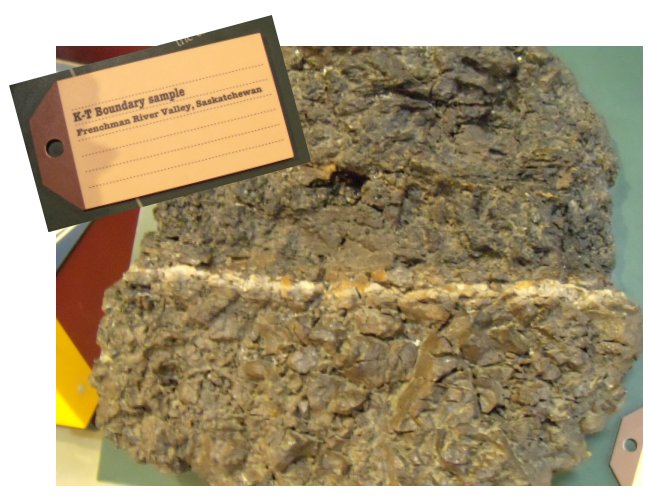
The meteor left its mark around the world, in a layer of light-coloured clay and ash, often rich in the element iridium, which is more common in meteors than in Earth's crust. It's called the K-T Boundary because it marks the end of the geological time called the Cretaceous Period (it starts with a K in German) and the beginning of the Tertiary Period.

And there it was, too! Not just a diagram of rock layers or a photograph, but a chunk of rock from the Frenchman River Valley with the actual K-T Boundary layer running through it. Below that pale line was rock a dinosaur might have stepped on. Above it was rock that might once have carried the footprint of a mammal exploring its new, dinosaur-free world.

When you spend a lot of time reading about the ancient past, looking at pictures or replicas of fossils, and even writing about it, seeing the real thing right in front of you is a thrill.

Can you tell?

Claire Eamer