Showing posts with label books for ages 9 to 12. Show all posts

15 Aug 2013

CONTEST CONTEST CONTEST!!! And a couple of new books.

By Claire Eamer

Free books are on offer at Sci/Why - and free Skype visits by author L. E. Carmichael, if you're a teacher or librarian. Just go to Talk About FOX TALK Contest and leave a comment. Every comment between now and August 20th (12:01 AM, Atlantic Time) will be entered to win an autographed copy of L. E. Carmichael's brand new book, FOX TALK. Everybody who spreads the word gets an extra entry, so share on Facebook, Twitter, or anywhere else. 

Hurry hurry hurry! This deal is too good to miss. Also, there are Foxes of Great Cuteness.


In more new-book news, two Sci/Why bloggers launched their own brand new books at When Words Collide in Calgary last weekend. It was an awesome, multi-genre festival of reading and writing -- consider signing up for next year. In the meantime, you can check out our freshly-launched books.

Claire Eamer launched her new book for Annick Press, BEFORE THE WORLD WAS READY: STORIES OF DARING GENIUS IN SCIENCE. Read about what happened when people weren’t ready to listen to innovators who came up with revolutionary ideas. And about the folks with the amazing ideas. 

And Helaine Becker launched her beloved comic poem ODE TO UNDERWEAR, out in a new, picture-book format from Scholastic. 

As Helaine says, "From boxers to bloomers and briefs to bikinis, whether they're frilly, silly, or saggy, you'll find them all in this silly romp through your top drawers. That's a pun, BTW. Did you get it?"

And if you missed this book launch, watch out for more opportunities to celebrate the arrival of new books by the Sci/Why crew. We'll let you know.

But it will be hard to top Calgary. There were cupcakes. REALLY GOOD CUPCAKES! Honestly, you shoulda been there, folks.


6 Dec 2011

Observing the Night Sky- For All Ages


Looking up at the night sky is a pastime that can provide unlimited entertainment for all ages. Consider making the experience even richer by working storytelling into your night sky plans. Ancient Greeks, Romans, and people from other cultures around the world made up tales to explain many night sky phenomena. You can discover their mythology and lore in the Dot to Dot in the Sky series published by Whitecap Books. A blend of sky science and stories, these books introduce the characters associated with the constellations, planets, and Moon.
Stories in the Stars and Stories of the Zodiac show how to find constellations by leading readers dot-to-dot in the sky from one constellation to another. Begin with Orion, the Hunter. Note that he stays on the opposite side of the sky from Scorpius, the Scorpion, to protect himself from being stung. Look for the giant “W” in the sky and describe how beautiful Cassiopeia, the Queen, is falling off her throne as punishment for a foolish mistake. Maybe you will see Ophiuchus. He sings so endearingly, animals follow him, plants grow in his direction, and rocks roll his way.
Many of the stories explain how ancient characters—gods, goddesses, monsters, and heroes came to be placed in the sky as stars or represented by planets. (Note: these are not “connect-the-dots” drawing/coloring books.)
Young children can look for different colors of stars, make up their own constellations, or look for pictures on the surface of the Moon. Try to find a princess, two frogs sitting on rocks, or a turtle. In Canada, we talk about seeing the face of the man on the Moon or a rabbit (try tilting your head to the right). Dot to Dot in the Sky, Stories of the Moon explores the stories people from around the world have told when gazing up at the Moon.
Older children and adults will enjoy using binoculars to observe Moon craters. The details you can see are quite incredible and may just spark an interest in all things celestial. Remember to pick a night when the Moon is not full so the light  through the lens is not too bright.
You can identify constellations with the naked eye or use binoculars to view star clusters, galaxies, nebulas, the Moons of Jupiter, and the phases of Venus. It’s important to note that because the planets are so bright, you can see them almost as easily from cities as you can from rural areas. Dot to Dot in the Sky, Stories of the Planets reveals the Greek myths associated with each planet. When you look at Mars, remember the red planet is represented by Ares, the god of war. He loved a good argument but had few friends because of his violent nature.
You can also watch the night sky for movement. Look for satellites and meteors—commonly called shooting stars. These bright streaks of light are caused by bits or rock and dust in space, often as small as a grain of rice. A meteor the size of a pebble can make a streak of light brighter than the Full Moon. Light from a large meteor is called a fireball, while a rock from space that actually strikes the Earth is a meteorite.
Meteors are best spotted after midnight, facing east. Showers occur at the same time every year. From about December 4-16 and especially from December 13-14, watch for meteors originating from Gemini. Keep in mind that dates will vary slightly each year. There are many fascinating things to see when you look up. Have fun exploring the night sky!

20 Oct 2011

Why constellations and astronomy are important

by Joan Marie Galat

Astronomy has intrigued me since I was a young girl staring out the window on long drives. At that time, I knew how to find the Big Dipper and Little Dipper but not much else. Curiosity led me to hop on my bike and pedal to the County of Strathcona Library. For reasons no longer remembered, I visited the adult shelves  and took out books far beyond my level of comprehension.

Comparing images in the books to objects in the heavens left me feeling there were too many dots on the page and too many stars in the sky. I imagined constellations all over the place but was never sure I was seeing the same group of stars as in the books. Finally as an adult, I learned to find my way around the night sky. At one point I remember thinking, “if only you could connect the dots in the sky, it would be easier to find the constellations.” And that’s how my Dot to Dot in the Sky series was born.

How to find Cygnus (The Swan)
from Cepheus (The King)
from Dot to Dot in the Sky,
Stories in the Stars
The first and fourth books in the Dot to Dot in the Sky series show how to jump from one star group to the next. Stories in the Stars focuses on 15 easy-to-find star groups. They are easy to locate because they either contain bright stars or are near constellations with bright stars. Stories of the Zodiac explores the 12 constellations that the Sun appears to travel through when viewed from Earth. These books also share the myths, legends, and folklore that ancient cultures told to explain the gods, goddesses, heroes, monsters, and other characters in the sky.

While it's fun to search for constellations, it's also important to note that these star groups are more than pictures in the sky. They represent stories from many different cultures and are also important because they serve as a celestial map. Astronomers refer to zodiac constellations when describing the location of the planets in our solar system. Constellations are also useful for navigation. Just think of the North Star!

You may wonder why it’s important to study astronomy. Does it really matter what’s up there? Yes it does. Here are just a few reasons. Studying the Sun helps scientists understand the life cycles of other stars. This knowledge helps scientist learn how to predict celestial events that could impact Earth. 

Our Sun is the closest star to Earth at only 93 million miles away. It is responsible for life on Earth and provides our energy, our  atmosphere, and all our weather.

Solar flares impact radio transmissions. Activity from the Sun can interfere with Earth-orbiting satellites, power grids, and global positioning system (GPS) measurements. The Sun, as well as the Moon, causes Earth’s tides.

While I've learned a lot since those nights staring out the window on long drives, I still feel the same awe I did as a child—wondering about everything in space. But now the night sky is more familiar. I look up and see characters in the night sky. I know how to use the constellations to locate planets. And thanks to the important work of astronomers and other scientists, I know the Sun is responsible for much more than sunny days and the constellations are even more than a wonderfully entertaining way to enjoy the outdoors.

14 Aug 2011

Book Review: Jurassic Poop by Jacob Berkowitz

Title: Jurassic Poop
Author: Jacob Berkowitz
Publisher: Kids Can Press
ISBN: 9781553378600


Book Source: library

That's right.  It's an entire book about fossil feces - more formally known as coprolites.  And what a book it is.   As the jacket blurb says, "Funny and informative, Jurassic Poop is flush with amazing facts, stories, and activities."

The puns, they write themselves - and I'm pretty sure Berkowitz uses most of them.  His tone throughout is light and funny - I'd call it tongue-in-cheek but under the circumstances that's a pretty disgusting thought - and perfectly suited to his middle-grade target audience.

There's a lot more to this book than scat jokes, however; it's full of wide-ranging and totally fascinating information.  Berkowitz covers everything you never knew about fossil doo - its formation, its discovery, and the identification of its sources.  He then goes on to discuss some of the wealth of information that can be gained by studying it.  The book also contains profiles of scat scientists and several activities - including a recipe for scent-free coprolite crafts.

Still not quite convinced?  Jurassic Poop won the 2007 American Institute of Physics Children's Book Award.  And when I hear giggling in the 9-12 nonfiction section at the bookstore, it's usually a sign this book's getting browsed.

For more information on Jacob Berkowitz and his books, you can visit his website, or watch for his posts right here on Sci/Why!

---

Posted by Lindsey Carmichael.  For more of her children's book reviews, check out her blog, Ten Stories Up.

8 Jul 2011

Seeing the real McCoy... er, McDino

I love really old animals. Really, really old animals! Not just dinosaurs, but ancient mammals and sea monsters and proto-birds and mysterious undersea critters that have left their imprint in ancient rocks... all of them. And I love thinking about how they and their worlds link up with us and our world.

In fact, I love that so much that I've written two books on the subject: Super Crocs and Monster Wings, and Spiked Scorpions and Walking Whales.

So, imagine my delight at visiting the T. rex Discovery Centre in Eastend, a small town in southwestern Saskatchewan.


Although it was named for Scotty, the Tyrannosaurus rex found nearby, the Discovery Centre is a treasure trove of an amazing range of fossils from the area, from giant sea creatures that swam in the great inland sea that once covered most of the Great Plains to the strange-looking mammals that evolved to fill niches left by the disappearance of the dinosaurs 65 million years ago.

Still, Scotty the T. rex is pretty cool. With more than 65 percent of her skeleton complete, she (probably she) is the most complete T. rex found in Canada so far. Scotty was discovered 20 years ago near Eastend. All her fossil bits are in the Royal Saskatchewan Museum's fossil research lab, which is housed in the Discovery Centre. There's something rather amazing about peering through a huge glass window to see a complete set of fossilized dinosaur vertebrae laid out in order on four large shelves. Not replicas. The real thing!

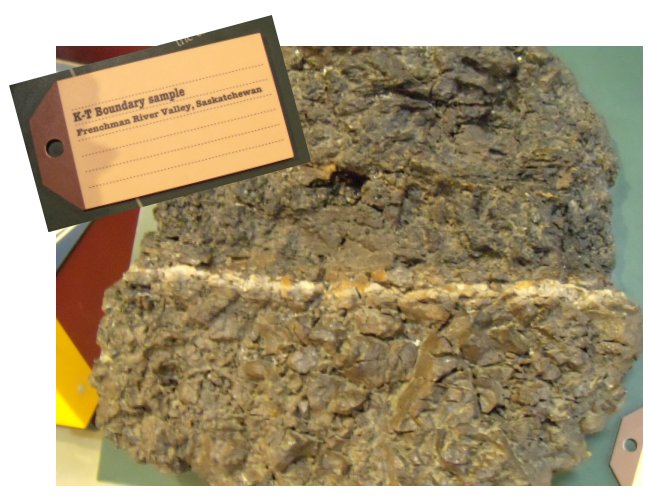
Coincidentally, in the year that Scotty was discovered, 1991, other scientists discovered the impact site of a huge meteor that struck Earth 65 million years ago and hastened the extinction of the dinosaurs, as well as plenty of other animals. In fact, 75 percent of the species on earth became extinct after that impact.

The meteor left its mark around the world, in a layer of light-coloured clay and ash, often rich in the element iridium, which is more common in meteors than in Earth's crust. It's called the K-T Boundary because it marks the end of the geological time called the Cretaceous Period (it starts with a K in German) and the beginning of the Tertiary Period.

And there it was, too! Not just a diagram of rock layers or a photograph, but a chunk of rock from the Frenchman River Valley with the actual K-T Boundary layer running through it. Below that pale line was rock a dinosaur might have stepped on. Above it was rock that might once have carried the footprint of a mammal exploring its new, dinosaur-free world.

When you spend a lot of time reading about the ancient past, looking at pictures or replicas of fossils, and even writing about it, seeing the real thing right in front of you is a thrill.

Can you tell?

Claire Eamer

19 Apr 2011

Book Review: Crime Scene by Vivien Bowers

By L. E. Carmichael

Title: Crime Scene: How Investigators Use Science to Track Down the Bad Guys
Author: Vivien Bowers
Publisher: Maple Tree Press
ISBN: 9781897066560
Book Source: library

There are a ton of children's forensic books on the market - including "bookstore" books and those produced for school libraries, over 100.

I've read more than 30 of them.

Many of the books available are clearly written, well laid out, and accessible to kids.  Many contain enough gruesome details to capture the attention of even the most videogame-jaded twelve-year-old.  Many of them are scientifically accurate.  Many of them read like they've used each other as primary reference sources.

That's why Vivien Bowers' Crime Scene was so refreshing to me.  It's got lots of sidebars to help pull readers into the text.  It's got both illustrations and photos, including some rather creepy step-by-step pictures of a facial reconstruction.  It's error free, and it's full of information I didn't find anywhere else, particularly in the extensive "Computers and Crime" chapter.

Other topics include:
  • trace and toolmarks
  • forgeries
  • fingerprints and DNA
  • forensic dentistry and anthropology
  • entomology 
The book is detailed enough to serve as a reference in report writing, but lively enough to read for fun.  It's even got activities and mysteries kids can solve, using the techniques outlined in the text.  This one gets a definite recommend.

Vivien is one of our contributors - look for her first post next week!

---

Cross-posted at Ten Stories Up.