24 Dec 2015

Deck the Halls With Boughs of Ilex!

Winter can get really cold in Canada!
By Claire Eamer (and the Sci/Why crew)

‘Tis the season to be jolly…. And to take a little time to relax, and maybe dip into a favourite book or website. We thought - as a present from us to you - that we’d tell you about a few of our favourites. And since we’re all science geeks here at Sci/Why, there’s plenty of science involved.

(Speaking of science, did you know that there are about 600 species of the genus Ilex? That’s holly, for those of you who are still decking your halls.)

So, here we go!

From the excellent science book writer and this year's Lane Anderson Award winner, L. E. Carmichael:
Here's a link to my favourite science story of the year – about a cure for a kind of blindness.

I discovered this treatment to cure a form of congenital blindness while researching GENE THERAPY in 2012, and it became the first chapter of the book. At that time, it had only been tested on dogs and a small group of patients, including a young boy named Corey Haas. Now the therapy is about to be approved, offering hope to all the people who suffer from the condition.
(Claire speaking: Actually, Lindsey liked this story so much that she wrote a blog post about it.)

From Margriet Ruurs, who sends in Sci/Why posts from the far corners of the world:
I love YOU ARE STARDUST by Elin Kelsey because of the gentle voice in which this story is told (in the ebook). It is the story of evolution, of how we all came to be here on this planet. There are lots of activities on Elin's site linked to the book. 
(Claire speaking: I love this book too – and the illustrations are beautiful. It really does work for readers of any age, from toddler to senior.)

Sometimes, it's not so cold. This is Canadian shirt-sleeve weather.

From Helen Mason, a recent and welcome addition to the Sci/Why ranks:
Here's my current favourite – an interview with a rock-snot scientist who wasn’t allowed to talk about his work until recently. 
Not only am I happy about Canadian scientists being unleashed, I'm looking forward to learning more about rock snot. A scientist who understands how such a term would interest listeners must have some interesting things to say.
Jan Thornhill couldn’t stop at one favourite. She gave us two:
If Children lose contact with nature they won’t fight for it - an article in the Guardian by George Monbiot about "the collapse of children’s engagement with nature.”

And I loved the mesmerizing video of this amazing deep sea jellyfish.
Joan Marie Galat loves astronomy, so her favourite is not really a big surprise:
Here's my contribution. It was a thrill to see the world's first close-up views of Pluto this year, thanks to the New Horizons spacecraft. Its pictures provide sharp views of breath-taking mountains, icy plains, and impact craters.
Paula Johanson didn’t stop at two favourites. Or three. She has four!
While I've been writing an introduction to the Paleolithic Revolution, it's been fun to find archaeology stories in the news. There was the hiker who found a Viking sword by a path in Norway. And it was fun to go to the Yukon Beringia Interpretive Centre’s website.

But for interesting images of hominid bones, my favourite resource is Morpho Source. MorphoSource is a project-based data archive where researchers store and organize, share, and distribute their own 3-D images of hominid fossil bones. Anyone can register and download 3-D images to use in their own studies. The website is designed to be self-explanatory, but young students will need assistance browsing the archive

And last, but definitely not least, my favourite of the day is the fossil bird found on a beach about five miles from my new home in Sooke, British Columbia.
And sometimes (and some places), it's not cold at all, even at Christmas.

Claire here again. I'm back! And not to be outdone, I have four favourites to offer too.

For an ever-changing set of science stories from around the world – and some wonderful photos and photo collections, try the Science and Environment pages of the BBC.

And for another take on the day’s science stories (also with some great pictures), but with a Canadian perspective, go to CBC Technology & Science pages.

The host of CBC Radio’s great science magazine, Quirks and Quarks, Bob McDonald, writes a weekly blog about a science issue or story that caught his eye – and he’s great at explaining things in a way that all of us can understand.

Finally, if you’re as fascinated as I am by the unseen, unsuspected microscopic world around us, go to Nikon’s Small World and see the beauty, adventure, and high drama visible only through a light microscope.

Now grab a Christmas cookie and hot chocolate, relax, and have a science-y good time.

Falalala la lala la LAAAA!

All photos by Claire Eamer

18 Dec 2015

Solstice Sunrise at Newgrange


by Helen Mason

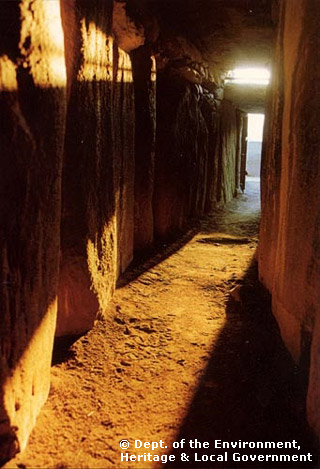
From December 18 until December 23, thousands of people will assemble at sunrise outside the entrance to Newgrange, an ancient Passage Tomb in Ireland's Boyne Valley. Fifty of these people, chosen by lottery from among 30,475 ballots in 2015, will get access to the inner chamber of the tomb.

The winners will enter the east-facing door of the Newgrange mound. They will make their way down a narrow 60-foot passage towards a domed inner chamber. This is where archaeologists believe that cremated bodies were interred. During the Winter Solstice, as part of what is believed to be a celebration of new life, the winter sunrise sun shines down the passage and into that inner chamber.

The sun's rays enter through a roof box located just above the main door to Newgrange. They move down the corridor and gradually illuminate the inner chamber, a process that takes about 17 minutes.

Since the chamber is small, it can accommodate a limited number of people — thus the reason for the lottery. Depending on weather, even these winners may not see the phenomenon.

For what lucky winners do see, go to http://www.newgrange.com/newgrange/winter-solstice.jpg.

Imagine the knowledge and skill needed to build and locate such a structure. Newgrange and the nearby passage tombs at Knowth and Dowth suggest that the farmers of 3000 to 2500 BCE were far from primitive. Ireland's Neolithic peoples had enough architectural knowledge to build Cathedral-sized mounds 500 years before the Great Pyramids and 1000 years before Stonehenge. 


These mounds have vaulted inner chambers with stone slabs and rocks placed so carefully that the upper layers push down on the lower ones, holding them in place. These chambers have remained intact despite 5000 years of neglect. Even more intriguing is the combination of fill, clay, and turf that cover the structures, keeping them water-tight.

The kerbstones that surround the mounds were brought from long distances. Archaeologists hypothesize that workers rafted the giant boulders along the coast and up the Boyne River, before moving them to their current site on rollers.

The stones were decorated with intricate geometric shapes. Archaeologists have been unable to interpret these designs. There are several theories, including that the designs represent the changing of the seasons, maps of the stars or the afterworld, or music.

Whatever the meaning of their artwork, the tombs continue to prove that supposedly primitive farmers were intimate with the changing location and slant of the sun. The structures they built make up Brú na Bóinne, a UNESCO World Heritage Site, a prime venue for tourists, and a great place to be indoors during the Winter Solstice.


27 Nov 2015

Happy Book Birthday!

Post by Helaine Becker


It's a Big Bang Book Bash! I'm delighted to announce the publication of my newest book, Everything Space! (National Geographic Kids). Readers ages 8+ will get blasted into space, where we explore planets, stars, and beyond. This fun book will pull you in like gravity, if I do say so myself. It's full of jaw-dropping facts, first-hand reports from space explorers, detailed maps and fascinating infographics. It also has more than 100 stunning pictures.

25 Nov 2015

Books! Books! Books! - An Addendum

By Claire Eamer

Claire Eamer photo
The online publication, Hakai Magazine, has published an article listing, with short reviews, Eleven New Coastal-Themed Books for Kids. Several of the books are by friends of Sci/Why, whose earlier books are part of our own Science-Themed Books for Children. (And several of these coastal-themed books will doubtless appear in our list after the next revision!)

To quote the article's author, Sheryl McFarlane, who is a children's author herself, "Books reviewed here range in topic from a First Nation salmon ceremony to the voyage of the Mayflower, from a west coast nature alphabet to an east coast whale stranding." They're suitable for early or intermediate readers - and they're lovely!

20 Nov 2015

Books! Books! Books!

By Claire Eamer
Claire Eamer photo

A few months ago, we at Sci/Why put together a list of kids' science books by Canadian writers - ourselves and others. It's a work in progress, which we plan to update as often as we can manage, but it's already pretty lengthy.

The list is organized so that you can find books by topic and see immediately what grade level they're suitable for. That was for the convenience of teachers and librarians. But it's awfully convenient for people who might be looking for presents for their favourite kids at this time of year. Right?

So we thought we'd just mention again that we offer, for your consideration, our list of Science-Themed Books for Children. Just follow the link to a lot of science a lot of fun, and a lot of great ideas!


16 Nov 2015

And the Hits Keep Coming!

By Claire Eamer

It's been an award-laden autumn for Sci/Why bloggers. And here's another.

Our friend, world traveller, and occasional Sci/Why blogger Margriet Ruurs has won the 2015 Information Book Award from the Children's Literature Roundtables of Canada for her beautiful book on Yukon landscape painter Ted Harrison, A BRUSH FULL OF COLOUR: THE WORLD OF TED HARRISON. Margriet co-wrote the book with Katherine Gibson. It was published by Pajama Press.

The 2015 Honour Book is DREAMING IN INDIAN: CONTEMPORARY NATIVE AMERICAN VOICES, edited by Lisa Charleyboy and Mary Beth Leatherdale, and published by Annick Press.

Congratulations to everyone!

12 Nov 2015

Non-fiction impacts students in real-world ways

by Joan Marie Galat

I love a good tale as much as the next person and write stories as well as nonfiction, yet factual texts hold a special place in my heart and on my shelves. I still have my first book on birds and fondly remember the How and Why Book of Astronomy that gave me those first insights into the night sky. All these years later, astronomy is the focus in one of my book series (Dot to Dot in the Sky), and birds get plenty of plugs in my tree book (Branching Out - How Trees are part of Our World). The nonfiction of my childhood steered me toward interests that have lasted through the years, and influenced my writing career.

It turns out fact-based titles offer even more than the "wow" factor. Nonfiction is crucial to preparing young minds for the future. It builds critical academic skills by building vocabulary. With content that is often technical or science-based, nonfiction exposes children to words that are less likely to appear within a fictional text. Facts also teach children about different environments and their place in the world. Nonfiction books often connect to curriculums, building on the content children need to grasp in order to better succeed at school. Nonfiction also encourages reading because children can choose books that relate to their specific interests.

Joan teaching kids to juggle after
reading a nonfiction book on
how to keep three beanbags in the air.
Non-fiction reading in the early years has another perk. It helps children gain an understanding of how information can be accessed. Knowing how to use an index and table of contents are life skills. It is important to become familiar with how headings highlight topics, charts summarize data, and sidebars provide more detail. The report writing called for in future jobs or post-secondary education will be easier to manage for those who have spent time in the world of non-fiction reading.

Next time you're picking out a book for a child, or visiting the library or bookstore together, visit the nonfiction section. Factual books can lead to new interests, skills, and adventures. As you can see in the photo, a book on juggling led me to a new hobby. And there's been a bonus. I bring my star-shaped beanbags to schools during astronomy presentations and demonstrate falling stars!

The facts found in nonfiction books, as well as newspapers, magazines, atlases, and other reference texts, create the foundation young children and students of all ages need to ensure a lifetime of learning. Yes, I'm saying you should even read the dictionary. The Reading Rockets website offers more reasons to read nonfiction.

Joan's next book, Dot to Dot in the Sky, Stories of the Aurora is scheduled for release in 2016.