Showing posts with label dung. Show all posts

5 Aug 2016

Who Knew What Grew on Poo?


pilobolus lentiger growing on dung
A large colony of Pilobolus, also called the
Hat Thrower or Dung Cannon 

I don’t want to offend anyone’s delicate sensibilities (or maybe I do!), but this post is about poo. More specifically, it’s about a secret world that grows on poo, a secret world than can be fascinating and sometimes—of all things!—strikingly beautiful.
cheilymenia stercorea growing on deer dung
This Eyelash Cup (Cheilymenia stercorea) grew on deer droppings.

I'm talking about coprophilous, or dung-loving, fungi. These fungi are our friends, as are all decomposers. They help dispose of what we don't want to see, breaking it down until it's nutritious compost—for the forest floor, the field, the garden. 

Some coprophiles are big. A few, like portobello and button mushrooms are good edibles (you did know that they're grown on a pasteurized substrate that contains manure, didn't you?). But most are so tiny you need a magnifying glass to see them. These are the guys I'm interested in.


ascomycetes growing on deer pellets
This deer pellet has three species growing on it. The tiny white
ones  grew into the smallest gilled mushrooms I've ever seen.

Right now, in fact, I'm trying to grow some of these mini characters on what used to be our dining-room table. 

About a week ago I was given a few samples of dried animal dung that are older than I am. At one time, these bits of dung had been studied, and then dried and stored, because interesting little fungi had been growing on them. The question is, are the spores that this dung holds still viable? Will fresh fungi appear? I have a bit of cow, goat, deer and rabbit dung, each now rehydrated and sitting in a moist chamber. Not much is happening yet, but I have high hopes.
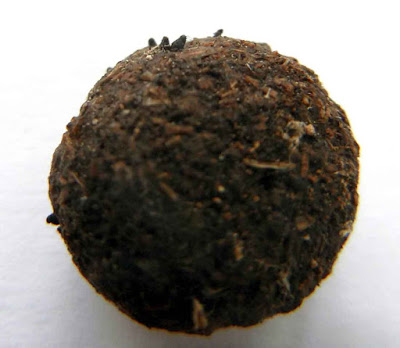
Podospora fungus growing on rabbit pellet
The wee black cones at the top of this rabbit pellet are a kind of Podospora.

These samples I'm nursing originally grew either nondescript lumps called Sporormiella (a Latin genus that when spoken aloud makes you sound drunk) or cuter ones from the genus Podostroma. I found some Podostroma a couple of years ago on a rabbit pellet. Though it's not the prettiest fungus, it has very nifty black spores that sport see-through tails.


podospora spore
Podospora spore—with see-through tails at both ends!

The Royal Ontario Museum's fungarium has an immense collection of fungi, over half a million, a large proportion of which are dung-lovers, because one of the early directors of the collection, Roy F. Cain, was a world-renowned dung-loving fungi lover. But what's to love about about these lowly characters? 
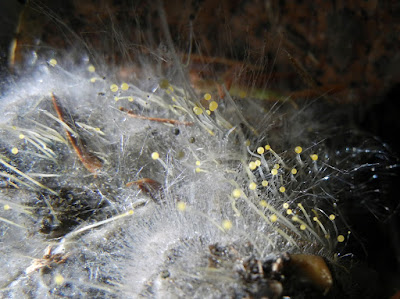

Phycomyces hairy fungus growing on raccoon dropping
I found this amazing furry Phycomyces fungus on raccoon scat.
Well, besides some being pretty, many have adapted to their chosen dung homes in downright astonishing ways.

My favourite is Pilobolus, also known as the hat-thrower or cannon fungus. These sparkling jewels don't look very fungal. Each has a skinny stem that rises only a few millimetres above the cow patty or horse puck it grows on. At the top of the stem there's a bulbous, transparent, fluid-filled "head," a head that wears a black "hat." Clustered beneath the hat are its spores.


Pilobolus lentiger hat thrower fungus dung cannon
Close up of the Hat Thrower or Dung Cannon
So how do the spores of these fungi get into the dung in the first place? They're ingested by the animal. And no, horses and cows don't eat poo. In fact, they shun it just like you do. Pilobolus's brilliant solution to this problem is to blast their spores away from the poo they grow on—up to two metres away. Recent research has determined that their spore-carrying "hats" can reach a speed of 25 metres a second. But the most amazing part is the acceleration, which is the greatest of any living thing! Pretty impressive for something that's less than a millimetre in diameter.


Pilobolus spore capsule
Pilobolus head & spore capsule "hat" under the microscope
Pilobolus lentiger spores
When I squashed it under a slide cover, the spores were released.
Not only do these little guys shoot their spore capsules a distance away, they're capable of aiming with the help of a light sensor inside their stems. On top of that, they also have a sticky coating on the exterior of their black "hats" that makes them stick to nearby plants, where they cling at the perfect height to be eaten by a passing quarter horse or Holstein. 


Pilobolus lentiger on manure
The black dots are Pilobolus spore capsules or "hats" that stuck to
the wall of the plastic container I put the horse dung in. 

How can you not love dung-loving fungi when there are characters like this around?

If you'd like to read more about Pilobolus and other fascinating fungi, (including a couple of other dung-lovers—Eyelash Cups on Moose and Deer Droppings and A Poop and Scoop Cup Fungus), check out my fungi blog, Weird & Wonderful Wild Mushrooms.


6 Feb 2016

The Scoop on Sloth Poop

By Jan Thornhill
Ashley Barron illustration from Kyle Goes Alone
Illustration from Kyle Goes Alone (Illustration: Ashley Barron)
I didn't plan to write a book about pooping sloths—honest, I didn't. What I planned was to write a fairly straight-forward information book about the myriad forms of life that call a rainforest tree "home." I started, as usual, by simply gathering information about likely candidates that I could focus on: snakes; frogs; birds; vines and lianas; insects; fungi; bromeliads and other aerial plants; and, of course, mammals. It was all coming together nicely...but then I hit on sloths.

three-toed sloth Fernando Flores
(Fernando Flores, Wikipedia)

I've always liked sloths, those sleepy-eyed characters that hang upside with goofy grins on their faces, moving unbelievably slowly or not moving at all. I actually emulated sloths in my teens, at least that's what my parents suggested, though they usually just used the word "lazy."  

J.C.D. Schreber, Die Säugthiere in Abbildungen nach der Natur, 1855, sloth
(J.C.D. Schreber, Die Säugthiere in
Abbildungen nach der Natur
, 1855)*

So I started reading about sloths and it wasn't long before I came across the kind of startlingly wonderful information that makes my heart sing: sloths only poop once a week. And why do they only poop once a week? Because sloths really are slow. In fact, not only are they so slow-moving that researchers' motion sensing cameras are sometimes not triggered when they pass, their digestive processes are the slowest of any mammal.


three-toed sloth, Charles Dessalines d'Orbigny, 1849
(Charles Dessalines d'Orbigny, 1849)*

Sloths primarily eat leaves. Tree leaves, particularly thick, long-lasting tropical tree leaves, are not packed with nutrients, nor are they easy to digest since their cell walls are made up of cellulose and lignin—just like a tree's wood, bark and branches. The only way a sloth can digest this tough stuff is with the help of gut bacteria, and this process takes a long time—a single leaf can take a month to travel from one end of a sloth to the other! 


three-toed sloth Schreber, Die Säugthiere in Abbildungen nach der Natur, 1855
(J.C.D. Schreber, Die Säugthiere in
Abbildungen nach der Natur
, 1855)*

I also learned that some sloths add another fascinating bit of behaviour to this slow digestion. Three-toed sloths only poop on the ground, despite the ground being an unbelievably dangerous place to spend time for a creature whose hanging-upsidedown-from-trees anatomy is ill-suited to walking—more than half of all sloth deaths are caused by predation during these weekly excursions. 


three-toed sloth buddha 1776
(1776)*

And then I found this video of baby sloths being "potty trained" at a sloth rescue centre in Costa Rica—just about the cutest thing I've ever seen. And suddenly I wasn't working on the book I thought I was working on anymore. Now I was writing a picture book called Kyle Goes Alone (Owlkids Books, illustrated by the brilliant Ashley Barron), the story of a young sloth's first trip to the ground alone, cheered on by camouflaged rainforest neighbours. I managed to work much of the above sloth poop information into the book, but I didn't have room for the following, even more entertaining information. 


two-toed sloth, Albertus Seba, 18th Century
Two-toed sloth (Albertus Seba, 18th Century)*

Three-toed sloths carry their very own ecosystems in their fur coats. Their hair is grooved, and in the humid rainforests where they live, these grooves are a perfect place for algae to grow, algae that can be plentiful enough in the rainy season that a sloth can appear to be completely green—not a bad colour if you live amongst green leaves. Along with algae, sloth hair also harbours all kinds of fungi, ticks, mites, and insects. Some of the insects are moths that, as adults, live nowhere else other than between the hairs of a sloth's thick coat. Their other life stages—egg, larva, and pupa—are all spent in...drum roll, please...sloth poop.


three-toed sloth, Frederick P. Nodder, 1789
(Frederick P. Nodder, 1789)*

Here's how this works: The adult moths, which have no mandibles, so likely don't eat, hang around on a sloth, seeking out another moth of the opposite sex. Then they do what they're supposed to do, which is procreate. Pregnant females wait until that happy moment when the sloth's weekly urge to "go" drives it slowly down to the ground. Once on the forest floor, the sloth, which often carries around a third of its body weight in waste (imagine!!), uses its tail to carve a little hollow in the ground, then defecates. This is, of course, the moment the female moths are waiting for. They crawl out of the sloth's hair and flutter down to the hard pellets where they lay their eggs. Once the eggs hatch, the larvae have ample food, particularly since they have the advantage of having arrived before any other forest dung-eaters. They eat to their hearts' content and then pupate. When an adult emerges, it flies upwards to search out some sloth fur to take up residence and seek out a potential mate—a sloth that is likely to be the same one its parents lived on since these animals are very fond of certain trees and don't stray far from them.


three-toed sloth, 1889
(1889)
So what do three-toed sloths get out of this relationship? No one yet knows, but one possibility is that the moths somehow fertilize the algae that grows in the fur, which the sloths in turn might eat to supplement their otherwise poor diets. Unfortunately, no one has observed sloths eating algae from their coats, but it's possible they might do this as night when they are notoriously difficult to observe. 


three-toed sloth, Maximilian Wied, Abbildungen zur  Naturgeschichte Brasiliens, 1822
(Maximilian Wied, Abbildungen zur
Naturgeschichte Brasiliens, 1822)
Other researchers are unconvinced that there is a symbiotic relationship between the moths and the sloths. They think that the sloths' habit of pooping on the ground at the base of their favourite tree is more about communication and procreation with other sloths, especially since a female in oestrus will go down to the ground every day. If this is true, the moths might just be opportunistically hitching rides on sloths so they can be "delivered" to the poop their offspring need to survive. 


Ashley Barron cover illustration, Kyle Goes Alone
(Ashley Barron)

Kyle Goes Alone (written by Jan Thornhill, illustrated by Ashley Barron), Owlkids Books, 2015

Baby Sloths get Potty Trained Video


*Many early animal illustrators never saw the animals they depicted, hence some pretty fabulous sloth pictures!