Showing posts with label manure. Show all posts

19 Aug 2021

The Scoop on Poop

 by Anne Munier

The scoop on poop

We all do it, most of us don’t like to talk about it, but perhaps we should get over that, because poop is not only fascinating, it’s also powerful stuff that may be a solution to at least a couple world problems! Let’s start with the basics:

What is it? Poop is waste from our bodies. We eat, our bodies take in nutrients, and then pass out what’s not needed. So poo is basically undigested food, along with bile (more on that in a moment), bacteria, parasites, and dead cells. Other names include stool, faeces, human waste, excreta, bowel movements, and a few more that are somewhat less polite.

Why the brown colour? Poo is usually brown because that’s the colour that bile- a substance our liver produces to help digest fats- becomes as it passes through the digestive system. Fun fact: bile starts out yellow-green. When we have diarrhea (which tends to come out extra quickly), the bile doesn’t have time to change colour as it passes through the intestines, hence diarrhea is often more of a yellow or green colour.

Why are we grossed out by poo? Evolution, of course! We’ve evolved to be disgusted by poo to reduce our chances touching the stuff. This reduces the chances of being infected by disease-causing microbes or parasites that it could be harbouring. The smell, which comes from the bacteria that break down food in our digestive system, probably helps as well. 

A proud manure producer! Photo by Ian Barbour

Is poo useful? Oh, my yes! Agricultural manure is basically livestock poop (often it’s been composted first), which helps crops grow by providing nutrients and bacteria, and by making the soil more rich and fertile. It also improves soil’s ability to hold onto moisture, and can reduce erosion. Yay manure!

Anything else? You bet, now we’re getting to the really exciting part. Let’s talk alternative energy.

But first, let’s recognize that every year we produce hundreds of billions of kg of poo worldwide (yeah, take a moment to think about that. Or…. don’t). Either way, that can be a heaping sanitation problem, particularly in areas that don’t have good quality infrastructure for dealing with human waste. When people are in close contact with poo, they can get sick from the germs and parasites, which can cause diseases like cholera, dysentery, or typhoid.

So- billions of people on Earth producing billions of kg of potentially harmful waste- that’s a problem. Meanwhile we’re looking for ways to make our energy system more ecologically friendly to reduce the impacts of climate change- another problem. A response to both problems: Biogas!

Biogas is produced when organic matter (like food waste, wood, agricultural waste, and yes, human and animal poo) is digested in a sealed container without any oxygen. The gas is then captured and used for energy, like cooking gas, fuel for cars and trucks, electricity, or heat. It doesn’t even smell bad!

The solids that are left behind are a great, high quality fertilizer that can be used in landscaping or farming. Another benefit!


Biogas plan: Organic matter goes in, biogas bubbles out the top, and "digestate" (i.e. fertilizer) is left over


It’s a simple concept, but please don’t try it at home; it’s not *that* simple.

Let’s check out some examples: 

This Sumatran orangutan is contributing to clean energy!

  • The Toronto Zoo recently started putting the 2,000 tonnes of waste that their animals produce every year to good use. They combine it with thousands of tonnes of grocery store waste, and generate enough biogas to power 500 homes! In the process they’re reducing thousands of tonnes of greenhouse gas emissions, those heat-trapping gases that are causing climate change!

  • A primary school in Uganda is now able to cook student lunches thanks to human waste-derived biofuel.

  • Poop power will soon be heating about 600 homes in the Vancouver area!

  • England has “bio-buses” that run entirely on gas from human faeces and food.

Poo-powered buses in England!

And that’s just the start. The United Nations anticipates that human waste could power 138 million homes while improving human and environmental health. Companies investing in the technology to make it happen are popping up all over the world.

Suddenly, a waste problem becomes part of the solution to clean energy! And we certainly won’t be running out of the raw material (that is, human poop) anytime soon.


5 Aug 2016

Who Knew What Grew on Poo?


pilobolus lentiger growing on dung
A large colony of Pilobolus, also called the
Hat Thrower or Dung Cannon 

I don’t want to offend anyone’s delicate sensibilities (or maybe I do!), but this post is about poo. More specifically, it’s about a secret world that grows on poo, a secret world than can be fascinating and sometimes—of all things!—strikingly beautiful.
cheilymenia stercorea growing on deer dung
This Eyelash Cup (Cheilymenia stercorea) grew on deer droppings.

I'm talking about coprophilous, or dung-loving, fungi. These fungi are our friends, as are all decomposers. They help dispose of what we don't want to see, breaking it down until it's nutritious compost—for the forest floor, the field, the garden. 

Some coprophiles are big. A few, like portobello and button mushrooms are good edibles (you did know that they're grown on a pasteurized substrate that contains manure, didn't you?). But most are so tiny you need a magnifying glass to see them. These are the guys I'm interested in.


ascomycetes growing on deer pellets
This deer pellet has three species growing on it. The tiny white
ones  grew into the smallest gilled mushrooms I've ever seen.

Right now, in fact, I'm trying to grow some of these mini characters on what used to be our dining-room table. 

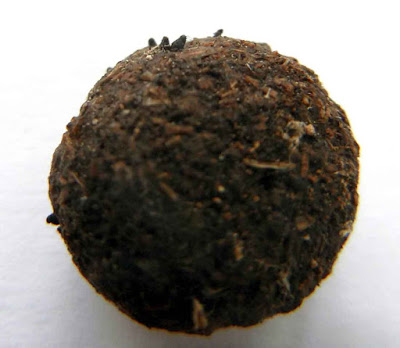
About a week ago I was given a few samples of dried animal dung that are older than I am. At one time, these bits of dung had been studied, and then dried and stored, because interesting little fungi had been growing on them. The question is, are the spores that this dung holds still viable? Will fresh fungi appear? I have a bit of cow, goat, deer and rabbit dung, each now rehydrated and sitting in a moist chamber. Not much is happening yet, but I have high hopes.
Podospora fungus growing on rabbit pellet
The wee black cones at the top of this rabbit pellet are a kind of Podospora.

These samples I'm nursing originally grew either nondescript lumps called Sporormiella (a Latin genus that when spoken aloud makes you sound drunk) or cuter ones from the genus Podostroma. I found some Podostroma a couple of years ago on a rabbit pellet. Though it's not the prettiest fungus, it has very nifty black spores that sport see-through tails.


podospora spore
Podospora spore—with see-through tails at both ends!

The Royal Ontario Museum's fungarium has an immense collection of fungi, over half a million, a large proportion of which are dung-lovers, because one of the early directors of the collection, Roy F. Cain, was a world-renowned dung-loving fungi lover. But what's to love about about these lowly characters? 


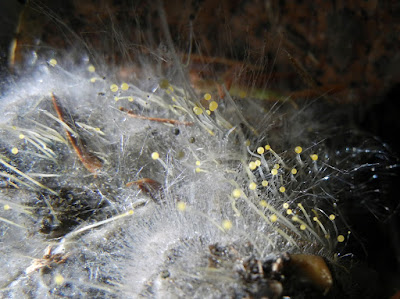
Phycomyces hairy fungus growing on raccoon dropping
I found this amazing furry Phycomyces fungus on raccoon scat.
Well, besides some being pretty, many have adapted to their chosen dung homes in downright astonishing ways.

My favourite is Pilobolus, also known as the hat-thrower or cannon fungus. These sparkling jewels don't look very fungal. Each has a skinny stem that rises only a few millimetres above the cow patty or horse puck it grows on. At the top of the stem there's a bulbous, transparent, fluid-filled "head," a head that wears a black "hat." Clustered beneath the hat are its spores.


Pilobolus lentiger hat thrower fungus dung cannon
Close up of the Hat Thrower or Dung Cannon
So how do the spores of these fungi get into the dung in the first place? They're ingested by the animal. And no, horses and cows don't eat poo. In fact, they shun it just like you do. Pilobolus's brilliant solution to this problem is to blast their spores away from the poo they grow on—up to two metres away. Recent research has determined that their spore-carrying "hats" can reach a speed of 25 metres a second. But the most amazing part is the acceleration, which is the greatest of any living thing! Pretty impressive for something that's less than a millimetre in diameter.


Pilobolus spore capsule
Pilobolus head & spore capsule "hat" under the microscope
Pilobolus lentiger spores
When I squashed it under a slide cover, the spores were released.
Not only do these little guys shoot their spore capsules a distance away, they're capable of aiming with the help of a light sensor inside their stems. On top of that, they also have a sticky coating on the exterior of their black "hats" that makes them stick to nearby plants, where they cling at the perfect height to be eaten by a passing quarter horse or Holstein. 


Pilobolus lentiger on manure
The black dots are Pilobolus spore capsules or "hats" that stuck to
the wall of the plastic container I put the horse dung in. 

How can you not love dung-loving fungi when there are characters like this around?

If you'd like to read more about Pilobolus and other fascinating fungi, (including a couple of other dung-lovers—Eyelash Cups on Moose and Deer Droppings and A Poop and Scoop Cup Fungus), check out my fungi blog, Weird & Wonderful Wild Mushrooms.