Showing posts with label Royal Ontario Museum. Show all posts

14 Dec 2018

Brown Like Me: The Need for Representation in Toys

By Kiron Mukherjee

Note from the Sci/Why team: Kiron Mukherjee is ROMKids Coordinator and Camp Director for the Royal Ontario Museum in Toronto and a science communicator, if not a regular poster on Sci/Why. He recently wrote this article for his own online use. However, representation is just as important in science and children's literature as it is in toys, so he has kindly given us permission to reproduce his column here. CE

Kiron says: "Toby and I, hung on my Mother’s fridge,
probably in the same place since it was put up in the early 90s."
Margaret Cameron photo

Only 80s kids will remember.

Many Christmas moons ago, Cabbage Patch Kids were all the rage -- depending on your generation, they were the original Hatchimals, Tamagotchi, or Tickle Me Elmo. Cabbage Patch Kids were roughly baby in size, with fabric bodies and clothes, plastic heads, and painted eyes that shone with cuteness. Every kid had to have one, and every parent wanted to make a holiday wish come true.

I got my Cabbage Patch doll when I was four. His name was Toby and Toby was brown like me. As a kindergartener, I didn’t understand race or differences in society, but I knew that Toby looked like me in a world of toys that never did.

Toby was patient, understanding, and kind. And as an only child, with my only mom, Toby was family for many of my young years.

***

Margaret Cameron, my mom, is white and the youngest of four children of farmers near Woodstock, Ontario. My father was brown and born in India, and ran away from our family shortly after I was born. I was the child of two widely different backgrounds, but with only one around to raise me.

My mom spent much of my childhood exposing me to diverse cultures and ideas, and, whenever I would let her, my Indian heritage. She was eager to share her side of our family, and I enthusiastically accepted it. But when she would engage me with my father’s side, I pushed back hard -- I was scared. I remember not wanting to be near Indian food or really anything concerning the man I had no memories of. But something I couldn’t run away from was the colour of my skin.

Like most toys, at least when I was young, Cabbage Patch Kids came in a variety of white. White girls and boys, where brown and black was saved for hair.

My mom wanted me to have a doll just like everyone else, but desired it to look like me: “I thought it was important that you saw yourself in the face of Toby, especially as everyone else in your 'blood family' circle was white.”

Beyond simply the colour of Toby’s skin, my mom had another reason for getting me my new friend: “It was still rare at the time to encourage boys to nurture and care for a baby doll. I wanted you to know that you had it in you, even though you only had me as a role model on what a parent was.”

***

Finding Toby wasn’t easy. Shelves weren’t exactly filled with diverse toy options -- most of the dolls were white. My mom was only able to get a brown boy Cabbage Patch Kid after meeting a distributor of the toys and getting it directly from him.

I played with other toys -- my mom likes to bring up the Ernie doll I was in love with as a toddler -- but it was essential to have a diverse cast of characters in my room, just like those in life.

“There were a lot of brown faces surrounding you all day with your caregivers, then you would come home to me. Toby helped populate our place and normalize the notion that there could be other people of colour in our home, even if they were only dolls. I wanted you to feel safe in your identity wherever you were.”

Kiron says: "Ernie and I, twinning."
Margaret Cameron photo
To this day, my mom doesn’t know where the name Toby comes from. I have only the faint sense that I took it from my favourite Thomas the Tank Engine character, Toby. Curiously, that Toby also has their train painted brown.

***

My mom spent so much of my childhood opening my eyes to all sorts of possibilities in the world, and the great diversity of people. But she also wanted me to value who I was as well.

“When kids are very little they look at Bert and Ernie and Elmo… and love them no matter how they look, no matter their differences. But in this case, I wanted you to have someone to look at as the same.”

In many ways, this is one of the first times I felt like I took ownership in my mixed-race identity. Though I would not truly understand the consequences of being brown in a predominantly white society until later in life, this was a small act of solidarity for who I was.

Toby was my friend, and Toby was brown like me.


25 Nov 2016

Canada's Only Great Auk

by Jan Thornhill
museum illustration Jan Thornhill Tragic Tale of Great Auk
"Museum" page from The Tragic Tale of the Great Auk (Jan Thornhill)

While working on my new book about the extinction of the "northern penguin," The Tragic Tale of the Great Auk, I became aware that the Royal Ontario Museum (ROM) in Toronto was in possession of Canada's only stuffed one. Hoping to see it, I visited the ROM's brilliant Schad Gallery of Biodiversity, but was disappointed to find no Great Auk, though there was an equally extinct Labrador Duck on display. How sad, I thought, that the regal bird I sought was not on view, was instead tucked away in some dark cupboard, sealed, perhaps, inside a titanium box, safe, but invisible.


John James Audubon illustration Labrador Duck
The extinct Labrador Duck (John James Audubon)
But a couple of months later, when I arrived at the ROM to talk auks with Oliver Haddrath, the ornithology reasearch technician whose specialty is extinct flightless birds (like the poor Great Auk), I was thrilled to be led out into the same animal diversity gallery where this time—ta da!—behind two layers of glass, there it was, one of the last of the millions of Great Auks that once thrived in the North Atlantic. 


Jan Thornhill with stuffed Great Auk ROM
Me and Canada's only Great Auk (Frankie Thornhill)
There are only 78 stuffed Great Auks in the world, almost all held by museums. American museums own a decent chunk of them—eleven—though that number used to be twelve. The twelfth one was once owned by John James Audubon, the American bird painter famous for his Birds of North America book published as a double-elephant portfolio, "elephant" because it had to be big: Audubon presented all of his subjects life size. Though each page is a huge 39.5 inches tall and 28.5 inches wide, the largest birds—cranes, herons, flamingos—had to be doubled over in his compositions to fit. 


John James Audubon flamingo
Because Audubon painted birds life-size, he had to double
over the biggest ones to make them fit on the pages. 

Audubon included the Great Auk in the book, but he never saw one alive. He had to base his painting on a taxidermy model, a specimen killed in Iceland in 1830 that he bought in London in 1836. 


Great Auk John James Audubon
Audubon's Great Auks

Eventually, Audubon gave has stuffed auk to a birder friend, Jacob Post Giraud Jr., who, in turn, gifted it (along with the rest of his large collection of stuffed birds) to Vassar College in 1867. There, "Audubon's Auk" gathered dust—quite literally—for more than 50 years, until it was found under a lab sink by Dr. L.C. Sanford who had connections to the American Museum of Natural History. Though the college continued to own the bird, Sanford convinced them in 1921 to allow him to send the auk off for renovation and remounting. When it was all spiffy again, it wasn't sent back to Vassar, but was housed instead at the Museum of Natural History in New York, hidden away in a double crate for the next 43 years. 


great auk profile ROM
The friendly face of the Royal Ontario Museum's Great Auk
Though Canada had once been home to the largest Great Auk colony in the world—on Funk Island off the northeast coast of Newfoundland, (there had been no colonies on American soil at all)—by the early Sixties we still had no stuffed Great Auk of our own. The ROM was desperate to find one. Finally, they convinced Vassar to sell them Audubon's auk. In 1965 they paid $12,500 for it (the equivalent of about $100,000 today), and got a stuffed Labrador Duck thrown in for good measure—the same Labrador Duck I had seen on my earlier visit to the museum.


signs royal ontario museum ornithology
Signs on a door in the ROM's ornithology department (Frankie Thornhill)
Oliver explained that, because bird feathers deteriorate more quickly when subjected to light, the museum only shows off its Great Auk for six months of the year. For the other six months, the Labrador Duck is the star. 


illustration Geirguglasker tragic tale great auk jan thornhill
The ROM's Great Auk came from Eldey Island in Iceland,
 the last place these birds nested after 
a volcanic eruption caused safer Geirfuglasker to sink beneath the waves. (Jan Thornhill)
As thrilling as it was to finally see an actual Great Auk, I couldn't exactly get close to it, displayed, as it was, at a height and behind double panes of glass. But then Oliver led me and my sister, (who had the camera—yay!), into the secret storerooms of the bird department. First he showed us the egg room. The ROM has a lot of bird eggs. In fact, it has roughly 12,000 sets, a "set" being the number of eggs normally laid in a nest. There is a bird skin room, too, where thousands of boneless birds from around the world are laid out in drawers. 


egg collection royal ontario museum
A tiny sample of the ROM's 11,715 bird egg collection (Frankie Thornhill)
These collections are kind of shocking to see, since each skin and each egg represents a life cut short, but almost all were collected long before any of us was born, in an era when there were a) way more birds of all kinds, and b) different attitudes towards killing wildlife. 

For a while there was a question about whether or not museums should waste precious space storing so many skins and eggs, especially when some species are represented by multiple specimens. The ROM's collection wasn't culled, which is fortunate because it has become clear that these lovingly stored remains hold a treasure trove of information that no one a hundred years ago could have imagined: DNA. When the DNA from skins of birds of the same species that were collected in different places, or ones collected from similar locations but years apart, is compared, we can learn a lot about how our world has changed, and how it continues to change. 


bird study skins royal ontario museum
Nine of the ROM's 136,350 study skins (Frankie Thornhill)
Similarly, each egg in the collection has documentation of exactly when and where it was collected. These dates, sometimes from more than a hundred years ago, can be compared to the nesting dates of contemporary birds to help us learn how various species are adapting—or not adapting—to climate change. 


extinct bird great auk bones
Great Auk bones collected on Funk Island (Frankie Thornhill)
Though the eggs and study skins were fascinating and often gorgeous, the pièce de résistance of the tour was yet to come. Without saying anything, Oliver opened a drawer and pulled out a small, nondescript cardboard box. He opened it. It was filled with bones. Great Auk bones. Auk bones that included a skull and upper beak. Which Oliver handed to me. 


jan thornhill holding great auk skull and beak
Me giddily holding an extinct Great Auk's skull and beak (Frankie Thornhill)
Maybe that doesn't sound like a big deal. But it was. I'd just spent the better part of a year living with the Great Auk, reading about its amazing and tragic history, its connections to prehistoric and First Nations peoples on both sides of the Atlantic, learning about its anatomy, writing about it, drawing it, painting it, dreaming it. I was so familiar with it it had become my totem animal. And I was holding in my hands the head of one that more than two hundred years ago had swum the North Atlantic. Though you can't tell from the photograph, I was so excited my hands were shaking. 

There's only one thing that could have been better. To see an actual, living Great Auk. But, of course, that would be impossible, since the Great Auk has been extinct since 1844. But,wait! Maybe in the future it won't be impossible. Stay tuned for my next post about efforts to resurrect the Great Auk!


I made Great Auk cookies for my book launch!
great auk egg cookies
great auk cookies


Tragic Tale of Great Auk cover

published by Groundwood Books 


5 Aug 2016

Who Knew What Grew on Poo?


pilobolus lentiger growing on dung
A large colony of Pilobolus, also called the
Hat Thrower or Dung Cannon 

I don’t want to offend anyone’s delicate sensibilities (or maybe I do!), but this post is about poo. More specifically, it’s about a secret world that grows on poo, a secret world than can be fascinating and sometimes—of all things!—strikingly beautiful.
cheilymenia stercorea growing on deer dung
This Eyelash Cup (Cheilymenia stercorea) grew on deer droppings.

I'm talking about coprophilous, or dung-loving, fungi. These fungi are our friends, as are all decomposers. They help dispose of what we don't want to see, breaking it down until it's nutritious compost—for the forest floor, the field, the garden. 

Some coprophiles are big. A few, like portobello and button mushrooms are good edibles (you did know that they're grown on a pasteurized substrate that contains manure, didn't you?). But most are so tiny you need a magnifying glass to see them. These are the guys I'm interested in.


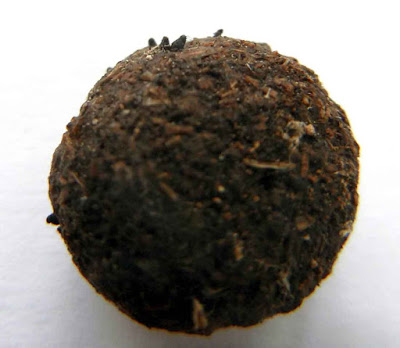
ascomycetes growing on deer pellets
This deer pellet has three species growing on it. The tiny white
ones  grew into the smallest gilled mushrooms I've ever seen.

Right now, in fact, I'm trying to grow some of these mini characters on what used to be our dining-room table. 

About a week ago I was given a few samples of dried animal dung that are older than I am. At one time, these bits of dung had been studied, and then dried and stored, because interesting little fungi had been growing on them. The question is, are the spores that this dung holds still viable? Will fresh fungi appear? I have a bit of cow, goat, deer and rabbit dung, each now rehydrated and sitting in a moist chamber. Not much is happening yet, but I have high hopes.
Podospora fungus growing on rabbit pellet
The wee black cones at the top of this rabbit pellet are a kind of Podospora.

These samples I'm nursing originally grew either nondescript lumps called Sporormiella (a Latin genus that when spoken aloud makes you sound drunk) or cuter ones from the genus Podostroma. I found some Podostroma a couple of years ago on a rabbit pellet. Though it's not the prettiest fungus, it has very nifty black spores that sport see-through tails.


podospora spore
Podospora spore—with see-through tails at both ends!

The Royal Ontario Museum's fungarium has an immense collection of fungi, over half a million, a large proportion of which are dung-lovers, because one of the early directors of the collection, Roy F. Cain, was a world-renowned dung-loving fungi lover. But what's to love about about these lowly characters? 


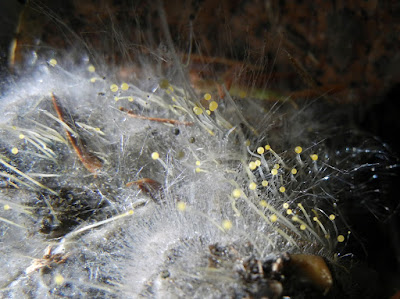
Phycomyces hairy fungus growing on raccoon dropping
I found this amazing furry Phycomyces fungus on raccoon scat.
Well, besides some being pretty, many have adapted to their chosen dung homes in downright astonishing ways.

My favourite is Pilobolus, also known as the hat-thrower or cannon fungus. These sparkling jewels don't look very fungal. Each has a skinny stem that rises only a few millimetres above the cow patty or horse puck it grows on. At the top of the stem there's a bulbous, transparent, fluid-filled "head," a head that wears a black "hat." Clustered beneath the hat are its spores.


Pilobolus lentiger hat thrower fungus dung cannon
Close up of the Hat Thrower or Dung Cannon
So how do the spores of these fungi get into the dung in the first place? They're ingested by the animal. And no, horses and cows don't eat poo. In fact, they shun it just like you do. Pilobolus's brilliant solution to this problem is to blast their spores away from the poo they grow on—up to two metres away. Recent research has determined that their spore-carrying "hats" can reach a speed of 25 metres a second. But the most amazing part is the acceleration, which is the greatest of any living thing! Pretty impressive for something that's less than a millimetre in diameter.


Pilobolus spore capsule
Pilobolus head & spore capsule "hat" under the microscope
Pilobolus lentiger spores
When I squashed it under a slide cover, the spores were released.
Not only do these little guys shoot their spore capsules a distance away, they're capable of aiming with the help of a light sensor inside their stems. On top of that, they also have a sticky coating on the exterior of their black "hats" that makes them stick to nearby plants, where they cling at the perfect height to be eaten by a passing quarter horse or Holstein. 


Pilobolus lentiger on manure
The black dots are Pilobolus spore capsules or "hats" that stuck to
the wall of the plastic container I put the horse dung in. 

How can you not love dung-loving fungi when there are characters like this around?

If you'd like to read more about Pilobolus and other fascinating fungi, (including a couple of other dung-lovers—Eyelash Cups on Moose and Deer Droppings and A Poop and Scoop Cup Fungus), check out my fungi blog, Weird & Wonderful Wild Mushrooms.


28 Jun 2013

Mesopotamia Comes to Canada


This Post by Helaine Becker www.helainebecker.com

In my 2010 book, What's the Big Idea?, I took a look at some of the most important and influential inventions in the history of the world - from the point of view of kids. What was more important - TV, or clocks? Cars, or toilet paper?

Many of the key inventions we rely on today had roots in earlier inventions (like the clock). We take those early items for granted, but without them, we wouldn't have many others. For example, that clock is at the heart of many of our best-loved tools and toys: televisions and computers, airplanes and cars, bicycles and (ahem) school.

The first schools can be traced to Mesopotamia, where scribes needed to be trained for another big league new invention - written language. Mesopotamia, in fact, was home to dozens of these life and culture-changing innovations. (Can anyone say "beer?")

That's why I was so thrilled to learn that the Royal Ontario Museum is hosting a new exhibit, Mesopotamia: Inventing Our World. More than 170 artifacts, most never before seen in Canada, will be on display.

 I'll be going ASAP. If you go, let me know what you think!