by Marie Powell
When we think of
Halloween icons, we often think of screeching black cats, howling
ghosts, and withered witches with tall black hats. But there’s
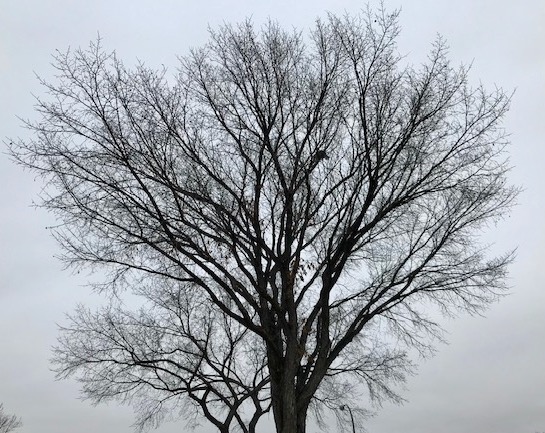
nothing as common -- or as spooky -- this time of year as the bare
branches of a tree against the grey sky, when the wind howls at the
end of the day.
Stories of tree
spirits and the magical properties of each species abound on the
Internet and in books. Stories of spirits and magic were part of the beginnings of science, as people began trying to understand the natural world. Yew trees (Taxus baccata) are often
mentioned in folklore and magical contexts. It’s a favourite
material for everything from wiccan wands to medieval bows, but the
leaves, bark, and seeds contain taxine, which can cause heart
problems [Isabella, 2020].
The
yew tree is also a symbol for protection and longevity. One old folk
tale stars a real tree
known as the oldest
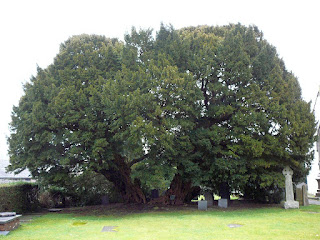
Yew tree in Wales, the Llangernyw Yew near Conwy, North Wales. It’s
estimated to be nearly 5,000 years old, and has a cleft trunk (see
photo) that some say is a portal to the world of the dead. [Atlas Obscura, 2020].
The tree is
associated with a spirit called Angelystor. On Halloween,
this spirit enters the north door of the village church to
announce the names of villagers who will die during the upcoming
year—and from all reports, it’s
not a good idea to test this spirit. One tailor who scoffed heard his
own name announced and was dead within the year. [Owen, 2006].
In a lighter vein,
the yew tree is also among the trees recommended as a habitat for
certain types of birds and animals [BBC]. Trees are
considered sacred in many cultures, and have even been graced with
magical properties in some. The birch tree, for example, has been
connected to creativity and fertility, possibly because it’s one of
the first trees to grow back after a forest fire. The oak is
considered a symbol of endurance and power. [Wigington, 2019].
Each type and
variety of tree has a particular nature. According to The Woodland
Trust, noticing a combination of features is the best way to learn
about the nature and identity of a tree. Trees differ in several
basic elements: the shape, size, and colour of leaves or needles, the
texture of its bark, or the types of buds, fruits, and flowers. The
overall shape or silhouette of the tree provides a clue. Even the
location where the tree can be found helps identify its nature, since
some trees prefer to grow near water, while others prefer woodlands
or scrubland. [The Wooodlands Trust, ND]
Trees play a role in
the lives of many animal and bird species, as a source of food,
nesting sites, and roosting spaces. A natural landscape that includes
trees is recommended for optimum health. [BBC] Anyone who has ever
felt the calming and de-stressing effect of a great old tree could
agree that this in itself is potentially magical [Whitehurst, 2020].
Whether or not trees have spirits, they certainly can lift our
spirits—hopefully in time for
this Covid Hallowe’en!
Marie
Powell’s
castle-hopping adventures in North Wales have led to the publication
of her new series, Last of the Gifted,
including Spirit Sight
and Water Sight
(coming this fall) with Wood Dragon Books (participation made
possible through Creative Saskatchewan’s Book Publishing Grant
Program). Marie is the author of more than 40 children’s books
published by Scholastic Education, Amicus, Learner/Lightning Bolt,
and others. Find her at https://mariepowell.ca
Photo credits:
-
Spooky trees
- Photo by Marie Powell
-
The Split
trunk section of the Llangernyw Yew - Photo by Emgaol on Wikipedia
(Creative Commons license)
-
The
Llangernyw yew tree in Llangernyw Village, Conwy, Wales - Photo by
Emgaol on Wikipedia (Creative Commons license)
Bibliography and Further Reading:
Atlas Obscura.
(2020). Llangernyw Yew.
Retrieved from Atlas Obcura:
https://www.atlasobscura.com/places/llangernyw-yew
BBC. (n.d.). "Planting
a tree helps wildlife". Retrieved
from BBC Breathing Spaces:
http://www.bbc.co.uk/breathingplaces/plant_tree/
Botanical Society of Britain and Ireland. (ND).
Mapping the flora of the British Isles.
Retrieved from Botanical Society of Britain and Ireland:
https://bsbi.org/maps-and-data
Isabella. (2020, 10 21). The
Magic of Yew. Retrieved from Speaking
of Witch Wands & Magickal Things:
https://speakingofwitchwands.net/2017/09/05/the-magic-of-yew/
Owen, E. (2006, December 12). Welsh
Folk-Lore: A Collection of the Folk-Tales and Legends of North Wales.
Retrieved from Welsh Folk-Lore:
http://www.gutenberg.org/files/20096/20096-h/20096-h.htm#page170
The Woodland Trust. (ND). "How
to identify trees". Retrieved from
The Woodland Trust:
https://www.woodlandtrust.org.uk/trees-woods-and-wildlife/british-trees/how-to-identify-trees/
Whitehurst, T. (2017). The
Magic of Trees: A Guide to Their Sacred Wisdom & Metaphysical
Properties . Llewellyn Publications.