Showing posts with label kids can press. Show all posts

21 Sept 2018

A Frozen World Returns

By Claire Eamer

The wolf pup cleaned, preserved, and ready for display.
Yukon Government photo.
More than 50,000 years ago, when most of Canada was buried under kilometres-thick ice sheets, a wolf pup was born in one of the few places untouched by the ice -- a dry, grassy plain that extended across most of what is now the Yukon. No more than eight weeks later, the little wolf died, probably buried in a landslip and smothered while it slept in its den. The cold muck froze around it and stayed frozen, summer and winter, preserving the small body.

Just over two years ago, on July 13, 2016, gold miners on Last Chance Creek near Dawson City washed away some frozen sediment and found the little pup. It was frozen and dried but still remarkably well preserved. The miners immediately called in palaeontologist Grant Zazula and his colleagues in the Yukon government's Palaeontology Program. They were delighted with the find. To his knowledge, it's the only ice-age wolf ever found, Zazula says.

Only half of the caribou calf's body was found.
Yukon Government photo.
That was the second spectacular find of the 2016 summer. Six weeks earlier, miners on Paradise Hill -- another famous location in the historic Klondike Goldfields -- had discovered the frozen and mummified remains of a caribou calf. It wasn't as complete as the wolf pup, but nearly all of the front half of the body had survived, with skin, muscle, and hair intact.

Zazula and his colleagues knew they had something special, but they didn't realise quite how special until the results of radiocarbon dating came back. Both animals lived more than 50,000 years ago, the limit for radiocarbon dating. And the caribou calf had been found in association with a layer of volcanic ash that had settled to the ground about 80,000 years ago.

Yukon government palaeontologists Grant Zazula and Elizabeth Hall excavate
the caribou calf from the frozen muck of Paradise Hill near Dawson City, Yukon.
Yukon Government photo
Specimens that old are rare anywhere, and especially in the Yukon where the undulating landscape left few places for dead animals to lie and freeze undisturbed. There was no rush to preserve the bodies, Zazula says.

"We had them kicking around in our deep freeze for a couple of months. They were very well freeze-dried already."

The wolf pup's head before preservation, ice crystals visible.
Yukon Government photo
However, if anyone other than experts was going to see them, more work was required. Yukon Heritage applied for help from the experts at the Canadian Conservation Institute. And they got it. Today, both small bodies have been carefully thawed and preserved in a way that will make it possible to display them to the public. They are currently on display in Dawson at the Dänojà Zho Cultural Centre of the Tr’ondëk Hwëch’in First Nation, in whose traditional territory they were found. Later this fall, they will be moved to Whitehorse and a permanent display at the Yukon Beringia Interpretive Centre.

Meanwhile, scientific interest is building. Zazula is fielding calls from Pleistocene scholars around the world and brainstorming with them and his Yukon colleagues about what kind of questions the little corpses might answer. Is the wolf pup related to the wolves that live in the Yukon today, or did the Pleistocene wolf disappear to be replaced by a new population? Does the caribou calf have relatives living today? If so, which of the many caribou herds do they belong to? And that's just the beginning.

The thawing permafrost and melting ice of the world are revealing more and more clues to the past, both animal and human. That's the subject of my latest book, Out of the Ice: How Climate Change is Revealing the Past. The Yukon pup and calf are too recent to make it into the book, but it contains plenty of other fascinating evidence of lost or forgotten worlds.

27 Jan 2017

Of Truth and Lies and Getting It Right

By Claire Eamer

In June 2016, a Scottish Facebook site posted a couple of photographs of the gory remains of some strange animal sprawled on a beach. The post text read: "A dog walker out on the shores of Loch Ness has just stumbled across this. Has Nessy been found? Or someone playing a fascinating prank?"

That original post was shared 1,468 times, spreading it far across the Internet. A thousand or more comments piled up below the post. Some people thought it was proof that the Loch Ness monster existed, some spent time and energy pointing out why it wasn't the Loch Ness monster, some got into arguments about the photographs, and lots of people came away from the discussion frustrated and even angry. Some doubtless still believe that the corpse of a mythical monster washed up on that Scottish beach.
A model of Nessie, the Loch Ness monster, gets a scrub.
This Nessie floats in a pond beside a Loch Ness hotel.
Claire Eamer photo

It didn't. The tireless fact checkers at Snopes.com (a great place for hoax-busting) investigated and reported that the monster on the beach was created for a television program. In fact, the original poster admitted as much in the comment thread, but too late. Bad information - essentially, a lie - had already been spread.

The Nessy-on-the-beach post wasn't made maliciously - but this kind of misinformation has consequences. People who want to believe in Nessy won't be deterred by the Snopes explanation or the decades of scientific research that have failed to find any evidence of monsters in Loch Ness. In fact, they're likely to think the photos and text are reasons not to trust science.

And most of those people were almost certainly adults. Plenty of grown-ups have trouble separating fact from fancy, so imagine how hard it is for kids. They don't have years of experience and accumulated knowledge to help them sort it out.

We at Sci/Why are very aware of how important it is to tell kids the truth, to give them facts, to provide information as accurate and understandable as we can make it. That's the information that will help them figure out, now and in the future, what is true and what is not.

We not only think about getting it right. We write about it too - especially now, when the news is full of people debating issues of truth and lies. Here are links to some of our thoughts.

Lindsey Carmichael, Sci/Why's favourite fox-fancier, is both a scientist and a science writer. Recently, on her own blog, she wrote a post - Where Do Facts Come From? - describing the lengthy process scientists go through to discover new information and tell the world about it. Several years earlier, Lindsey wrote another post - Reduce, Reuse, Recycle Does Not Apply to Research - this time on how science writers (rather than scientists) tackle getting the information right.

Our resident fungus-enthusiast, award-winning author Jan Thornhill wrote a post about how easy it is to absorb wrong information and how you can go about finding the truth - The Truth, the Internet, and the Number of Bacteria on Your Body.

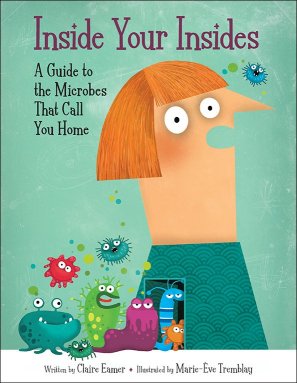
That bit of wrong information almost made it into my own book on the human microbiome - Inside Your Insides: A Guide to the Microbes That Call You Home. Fortunately, the article Jan refers to was published just as my book reached the final design stage, and I was able to sneak in a correction. Publishers don't like making changes that late in the process, but Kids Can Press didn't even quibble. Children's publishers care just as much as we do about getting it right for the kids.

Finally, the alarmingly prolific Helaine Becker wrote a post - On Books - and "Real Books" - about how the "facts" you know might not be facts at all. And what to do about it.

If you want to know whether a fact is truly a fact, just follow Helaine's example. And Lindsey's. And Jan's. Then we can all get it right, for the kids and for ourselves.


2 Sept 2016

I wrote an illustrated book - about invisible stuff!

By Claire Eamer
Cover art by Marie-Eve Tremblay.
Published by Kids Can Press.

My latest kids' science book - Inside Your Insides: A Guide to the Microbes That Call You Home - hits the bookstore shelves on Tuesday, September 6. And I'm thrilled.

I know, I know - I've been here before. After all, this is my seventh kids' book. But the launch of a new book never loses its charm. There's a long and sometimes painful road from the first exciting bit of research to the finished object - all shiny and glossy and colourful, and just waiting to delight fresh eyes.

This time there's an extra level of delight, at least for me. The topic of the book is the invisible menagerie of tiny critters that make up the human microbiome. The key word here is "invisible." And a key aspect of kids' books is illustration. So, how do you illustrate the invisible?

One solution might have been photographs. Microbes aren't really invisible - just really, really small. You can see some of them through a light microscope and more through an electron microscope, but some are barely visible even with the best equipment. And they....well....they look a bit boring. (Sorry, microbiologists! I know you love them all.)

EHEC bacteria, O104:H4 outbreak strain. Scanning electron microscopy. Bar: 1 µmSource: Gudrun Holland, Michael Laue/RKI
The better solution is an artist - in this case, the marvellous Quebec artist and illustrator Marie-Eve Tremblay.

I should explain that the publisher, Kids Can Press, came up with this solution. I just sent them words and then sat back and crossed my fingers, hoping they'd find a way to bring the book to visual life.

And they certainly did. Marie-Eve's microbes have character, humour, colour, emotion. Not bad for mostly-single-cell organisms. They might not be exactly what a microbiologist sees, but they get some fairly difficult information across in a way that will engage the kids reading the book.

And, who knows? Some of those kids might be the next generation of microbiologists. I hope so!

Thanks, Kids Can Press and Marie-Eve Tremblay, for making my words come to colourful and entertaining life.

If you want to know what reviewers think of the book, check out the reviews in Quill & Quire, School Library Journal, and Kirkus Reviews.

And for some cool information about researching the human microbiome - and keeping your research up to date - see Jan Thornhill's Sci/Why post from March of this year.

1 Jul 2016

On Books - and "Real Books"


Writing for kids can be a monstrously thankless job. I can’t tell you how many times people have asked me, “When are you going to write a ‘real’ book?” Grrrr.

Kids’ books are real books. The level of material they contain is often superior to material aimed at adults.  With good reason:  What we read when we’re young will stick with us for a lifetime. And if the ‘facts’ we learn are wrong….

Let’s pause for a moment and think about pearls. Do you, by any chance, think they form when a bit of grit gets into the oyster? So sorry. Not so.
I only learned the true story of the pearl while researching The Big Green Book of the Big Blue Sea (Kids Can Press). I fact-checked a ‘fact’ that I ‘knew’ was true: that oyster tidbit. I thought doing so was a formality; a waste of time even.

Yet when I looked for a good source to cite for the snippet, I couldn’t find one. I found lots of cut-and-paste text saying the same thing (grit, grit, grit). But no reliable data. I spent countless hours digging deeper. When I finally burrowed down to some solid research, I was shocked. Pearls, it turns out, are formed when a parasite, not a bit of grit, gets into the oyster’s gut.  

Because of ‘gems’ (read: booboos) like this, I always take extra care to get the facts in my books right. That’s easier said than done. In my latest science book, Monster Science (Kids Can Press), I planned to describe Gregor Mendel’s famous pea experiment. When I fact-checked the basics, I wound up with questions about the number of pea plants he grew. The figures repeated most often in reference material were 28- or 29,000. But where, exactly, did these figures come from? Could it be verified?
I spent a solid week looking for answers. There were none. It seems the numbers were fabricated and repeated again and again, just like the pearls-are-made-by-grit “fact.”
So I got to work. To compute a more reliable answer, I sourced Mendel’s own data and google-translated it from German. When I added up his own tallies for the pea plants he grew, it was significantly closer to 20,000 than 29,000. But that figure, too, was just a best guess: Mendel's data was incomplete. So no one really knows how many pea plants he grew! 
“10-20,000 plants” went into the manuscript.Unsurprisingly, the copy editor flagged it as an error, because she was comparing it to all the widely published – but wrong – numbers on the web! 
That could become a big problem. A book’s saleability can be hampered if reviewers think the research is sketchy. So my “10-20,000 plants” phrase couldn’t stand either.
So what to do? Long, detailed backs-and-forths transpired as we parsed the data and experimented with language. We finally came up with a phrase that delicately bridged the gap between what we knew was dead-accurate (“who knows?”)  and what sounded right  (29,000).

In the end, we spent over two weeks working on one ‘minor’ phrase. Why? Because we respect our readers.  And that’s why kids’ books are real books. They contain the best possible information available today, presented in clear, easy-to-understand language. Easy enough, that is, for even grown-ups to understand. 

14 Apr 2015

CSWA 2014 Book Awards Short List Announced!

Post by Helaine Becker


We here at Sci-Why are pleased to interrupt our regular publishing schedule (which is normally on every Friday) to post the short list for this year's:

CSWA 2014 Book Awards


And yes, I'm pleased as punch to point out that my own book, Zoobots, is on the Children's Book Short List. 


Best of luck to all the nominees! If you are a reader, you won't need luck to pick a winner from these lists - are all guaranteed to inform and delight. 

Short List for the 2014 Science in Society Children/ Middle Grades Book Award competition:
Zoobots by Helaine Becker, Kids Can Press.
Starting from Scratch by Sarah Elton, Owl Kids Books.
It’s Catching by Jennifer Gardy, Owl Kids Books.
The Fly by Elise Gravel, Penguin Random House.
If by David J. Smith, Kids Can Press.

Short List for the 2014 Science in Society General Book Award competition:
The End of Memory by Jay Ingram, Harper Collins Publishers Ltd.
Canadian Spacewalkers: Hadfield, MacLean and Williams Remember the Ultimate High Adventure by Bob McDonald, Douglas & McIntyre.
Pain and Prejudice: What Science can Learn about Work from the People Who Do It by Karen Messing, Between the Lines (BTL).
Is that a Fact? by Dr Joe Schwarcz, ECW Press.
Bee Time by Mark L. Winston, Harvard University Press.

The winners in each category will be announced on Canada Book Day, 23 April 2015. Winners will each be presented with a plaque and $1000 cash prize during an awards dinner held in conjunction with the CSWA ‘s 44th annual conference in Saskatoon, SK, held at the University of Saskatchewan 18-21 June 2015.

12 Apr 2015

Our Science Book List Hits its First Update!

By Claire Eamer

There's nothing like publishing a list of books to make more books and authors pop out of the woodwork! (Well, actually, we missed a few the first time.)

Anyway, our amazing and awesome and Really Long list of great science books for kids has already received its first update. Click the link for more science-y goodness!

This update courtesy of Sci/Why's perpetual motion machine, Helaine Becker. Thanks!

15 Aug 2014

Wild about Robots

Post by Helaine Becker

Ok, so I'm crazy about robots. Bug-shaped robots. Bat-shaped robots. Ameba robots. You name it, I love it.

So without further ado, here are my top 5 wildest, craziest, coolest robots under development today. You can find even more cool robots in my book Zoobots (Kids Can Press).

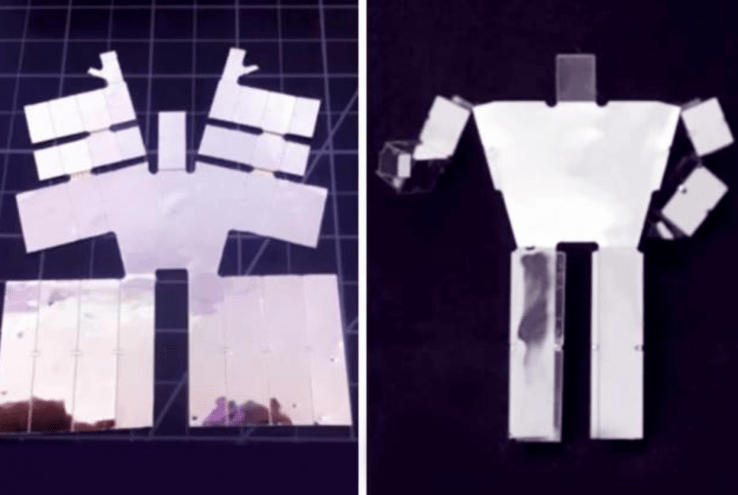
5.  Origami Robots.  These self-folding bots have hinges that change shape when you heat them. I don't even want to know how these might be used.  More deets: Science News.


4. Pop'n'Fresh Robots. Easy Bake Ovens could be even more fun if you could slide in your preformed bot and POP! Impress your guests with functioning 3D robots. Shape-changing polymers that morph under heat are the secret of this hot robo-recipe. More deets: Tech Crunch.


3. DNA Machines. Nanorobots based on DNA are inserted into cockroaches, where they can then be programmed to deliver meds and do other nano-tasks. Gross in so many ways, no?  More deets: PopSci and New Scientist. 


2. TERMES. And while we're on the subject of bugs, these termite-inspired robots work together to build all kinds of modular stuff. Preferably not Mies van der Rohe inspired nests in your post-modern home. More deets: CBS News.


1. Knit Your Way to the Future. Saving the best bot for last, Agnes the Knit Bot takes all the grunt work out of making next season's holiday gifts. More deets: Makezine.


28 Mar 2014

Robot Animals? GadZOOks!!!!

Post by Helaine Becker

I'm delighted to announce my newest STEM-related book, Zoobots, has just been released by Kids Can Press. It's a pretty exciting (if I do say so myself) survey of the latest developments in robotic research. Glorious, hyper-realistic illustrations by Australian Alex Ries are totally wow-worthy whether you're a transformer-transfixed kid or a formerly jaded grown-up.


I'm just as happy to announce that the book has already been picked up by the Junior Library Guild, and nominated by Capitol Choices for its Noteworthy Books for Children and Teens list.

If robotic animals fascinate you - and really, how can they not?  -  check out my Pinterest board, Cool Robots, where I've posted lots of links to articles about all kinds of amazing mechatronics.

And don't forget to watch out for cockroach-bot overlords. They're on their way to a kitchen counter near you.

19 Apr 2013

Humpty Dumpty Coral?


What happens to creatures that live in the ocean if seawater becomes more acidic? This fun activity, excerpted from The Big Green Book of the Big Blue Sea (Kids Can Press), is an easy to do, seeing-is-believing demonstration.


Humpty Dumpty Coral

Excess carbon dioxide from burning fossil fuels, is gradually making the oceans more acidic. How might more acidic waters affect coral reefs? See for yourself.

You Will Need
an egg
500 ml (2 c.) white vinegar
a large glass container (to hold the vinegar)
plastic wrap


1.     Break the egg neatly in half. Reserve the egg white and yolk for another purpose (like breakfast!).
2.     Measure the vinegar into your container. Place the two halves of the eggshell in the vinegar. Cover the container with plastic wrap.
3.     Watch what happens when you place the shells in the vinegar. Do you see bubbles forming around the shells?
4.     Leave the container in an area where it won’t be disturbed. Then check on your eggshells three days later. Where did they go?

What’s Going On?

Eggshells are made out of calcium carbonate, the same mineral that coral polyps use to make their shells. Vinegar — an acid — reacts with the calcium carbonate, removing the carbon from the shell. The carbon combines with oxygen to make the gas carbon dioxide. Those are the bubbles you saw rising from the egg.

With no carbon left in the shell, the shell literally dissolves and disappears. What you see floating in the vinegar is just the soft membrane that lines the eggshell. It is similar to the soft bodies of the corals. Like the egg membranes, the coral bodies would float off without their calyces. They’d be totally vulnerable to predators.

What’s Happening Now?

Despite their tiny size, corals build structures that are so gigantic they can even be seen from space! To do so, they need just the right conditions. They need water that is the right temperature, clarity and acidity. They need to remain undisturbed. And they need the right kind of base to lay the foundation for the reef.

Today, reefs are at risk all over the world. Global warming, ocean acidification, pollution and habitat destruction are all taking their toll. So people are lending corals a helping hand. The Reef Ball Foundation, for example, is a non-profit organization dedicated to building artificial reefs.

The foundation makes ball-shaped, concrete structures. They lower them in waters where an existing reef has been damaged. Teams of scientists hand “plant” about 500 corals per day onto each structure. The scientists then monitor the growth and health of the corals until the reefs re-establish themselves. The process can take 3–5 years. Since their founding in 1993, the Reef Ball Foundation has helped rebuild coral reefs in more than 70 countries.

 
The Big Green Book of the Big Blue Sea has been longlisted for the Information Book Award from the Vancouver Children's Roundtable.

16 Nov 2012

What Makes an Octopus Blush - and How Exactly Do They Do It?

Posted by Helaine Becker

We've all heard about octopi that can change color to mimic their environment. But how do they do it? I discovered the answer when writing The Big Green Book of the Big Blue Sea for Kids Can Press.

The book is designed to present information to kids ages 8-12, but also to engage them with cool hands-on (or do we call that "experiential" now?) activities. Most people learn best by doing, and doing stuff that involves splashing water is pretty well a can't-fail learning opportunity.

The problem with octopi, though, was that I couldn't find a good activity anywhere out there to explain color-changing skin. I had to invent one.

Coming up with ideas is pretty easy for me. But coming up with ideas that any klutz, I mean kid, can do (And I am the klutz in question; if I can't do it successfully, it won't go in the book) wasn't a piece of cake. Luckily, cake was not required. Waxed paper and food coloring, however, were.

For all you lucky readers, here, in it's entirety, is the activity I invented. You'll find it, and many other fun and kooky things to try and do in The Big Green Book of the Big Blue Sea. Check it out, please!


 Seeing Spots?

Make your own octopus skin in less time than it takes an octopus to blush.

Image courtesy Pamsclipart.com
You Will Need
a large sheet of newspaper 
2 sheets of waxed paper about 30 cm (12 in.) square
yellow food coloring

1.     Lay the newspaper on your work surface to protect it.
2.     Lay down one sheet of waxed paper. Can you see the grayish newspaper through it? That’s the color of your octopus skin.
3.     Staying away from the edges of the waxed paper, carefully place 10–20 drops of food coloring on the waxed paper about 1 cm (½ in.) apart. Can you still see the gray newspaper between the colored dots?
4.     Hold the second sheet of waxed paper above the first sheet. Gently place it on top of the first sheet. See how the spots seem to spread out? Gently press on them with your thumb to spread them out even more. Can you still see the gray newspaper? Or does your octopus skin look yellow?
5.     Lift the top sheet of waxed paper off the bottom sheet. Do the dots return to their original size?


What’s Going On?
An octopus can change color to hide from prey or predators by blending into its surroundings. Many scientists think octopus also use color to communicate and express emotions, such as fear or dominance.

But how do our wriggly friends achieve this tint-o-riffic trick? Octopus skin contains microscopic pigment-filled structures called chromatophores, represented here by the dots of food coloring. Real chromatophores are so small, you can’t usually see them.

When an octopus wants to change its hue, it changes the size and shape of its chromatophores. Your thumb, forcing the dots to expand, acts like the small muscles in the octopus’s skin. They pull on the chromatophores to widen them. Now the skin they’re in is filled with color!

When the octopus relaxes, the chromatophores shrink back to their normal size. The octopus’s skin returns to its original color.*

*Excerpted from The Big Green Book of the Big Blue Sea, Copyright 2011 by Helaine Becker, Kids Can Press, Publisher. All rights reserved.