Showing posts with label robots. Show all posts

4 Sept 2015

Robert Ballard, science explorer

By Paula Johanson

It's good to have heroes. There are science heroes for us all to admire and aspire to imitate. One of the greats is Robert Ballard.

There's plenty to read about Robert Ballard in September 2015's issue of Popular Mechanics. Or on the CBC's website where he was profiled in August. I heard him on CBC Radio One's show All Points West, talking about his youth and his entry into ocean science. When he was a child, he wrote to Scripps Institute saying he wanted to be an oceanographer. They gave him a scholarship when he was old enough to study there. It took years, but he became part of that world of wonders.

The name Robert Ballard might not be recognised right away. You've heard of the black smoker vents at the bottom of the ocean? Ballard discovered them in 1977. But you might know of him as the person who found the Titanic. Remember him now?

This photo is borrowed from Popular Mechanic's Sept 2015 issue.
Now his exploration vessel Nautilus (of course. it's named the Nautilus for the amazing vessel in Jules Verne's book Twenty Thousand Leagues Under The Sea!) is run by the Ocean Exploration Trust, of which Ballard is president. Most of his corps of scientists are university students and graduate students in oceanography, geology, biology, archaeology, engineering, or film-making. And like most students, more than half of them are women. When Ballard is not on board the Nautilus, he is connected to its amazing technology by phone and the internet. So are dozens of experts all over the world, consulted at any hour of the day or night by the intrepid crew of the Nautilus during its explorations.

The scientists make use of two submersibles that are essentially robot submarines with cameras and tools that can be controlled from on board the ship. At the end of August 2015, the ship was off Vancouver Island, assisting with the NEPTUNE and VENUS programs, which you can read about at this link. Or check out the interesting photos of sea life swimming by NEPTUNE's monitors on the sea floor, thousands of metres underwater, at this article about the robot submersibles.

The educational element alone of the Ocean Exploration Trust is amazing. Over 500 educational videos are created a year by this team, sharing their day-to-day work and discoveries. If you're interested in ocean science and citizen science, these are people to know. It's easy to see Ballard as a superhero for science learning for youth. You can follow the adventures of the Nautilus and its explorers at nautilus.org or oceannetworks.ca.

14 Apr 2015

CSWA 2014 Book Awards Short List Announced!

Post by Helaine Becker


We here at Sci-Why are pleased to interrupt our regular publishing schedule (which is normally on every Friday) to post the short list for this year's:

CSWA 2014 Book Awards


And yes, I'm pleased as punch to point out that my own book, Zoobots, is on the Children's Book Short List. 


Best of luck to all the nominees! If you are a reader, you won't need luck to pick a winner from these lists - are all guaranteed to inform and delight. 

Short List for the 2014 Science in Society Children/ Middle Grades Book Award competition:
Zoobots by Helaine Becker, Kids Can Press.
Starting from Scratch by Sarah Elton, Owl Kids Books.
It’s Catching by Jennifer Gardy, Owl Kids Books.
The Fly by Elise Gravel, Penguin Random House.
If by David J. Smith, Kids Can Press.

Short List for the 2014 Science in Society General Book Award competition:
The End of Memory by Jay Ingram, Harper Collins Publishers Ltd.
Canadian Spacewalkers: Hadfield, MacLean and Williams Remember the Ultimate High Adventure by Bob McDonald, Douglas & McIntyre.
Pain and Prejudice: What Science can Learn about Work from the People Who Do It by Karen Messing, Between the Lines (BTL).
Is that a Fact? by Dr Joe Schwarcz, ECW Press.
Bee Time by Mark L. Winston, Harvard University Press.

The winners in each category will be announced on Canada Book Day, 23 April 2015. Winners will each be presented with a plaque and $1000 cash prize during an awards dinner held in conjunction with the CSWA ‘s 44th annual conference in Saskatoon, SK, held at the University of Saskatchewan 18-21 June 2015.

15 Aug 2014

Wild about Robots

Post by Helaine Becker

Ok, so I'm crazy about robots. Bug-shaped robots. Bat-shaped robots. Ameba robots. You name it, I love it.

So without further ado, here are my top 5 wildest, craziest, coolest robots under development today. You can find even more cool robots in my book Zoobots (Kids Can Press).

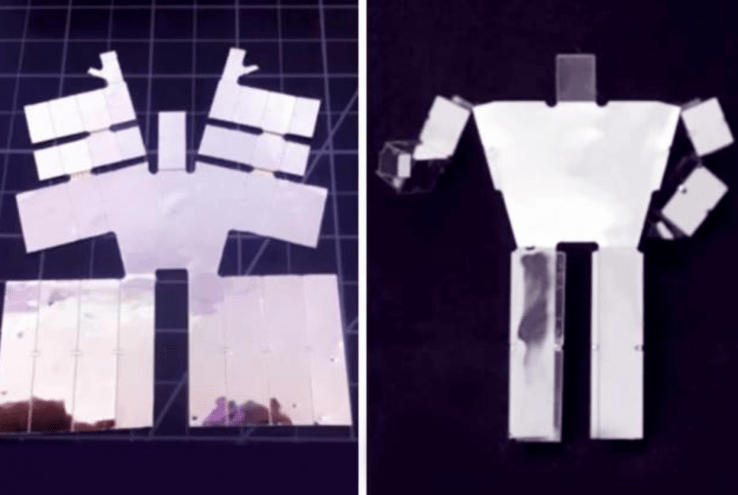
5.  Origami Robots.  These self-folding bots have hinges that change shape when you heat them. I don't even want to know how these might be used.  More deets: Science News.


4. Pop'n'Fresh Robots. Easy Bake Ovens could be even more fun if you could slide in your preformed bot and POP! Impress your guests with functioning 3D robots. Shape-changing polymers that morph under heat are the secret of this hot robo-recipe. More deets: Tech Crunch.


3. DNA Machines. Nanorobots based on DNA are inserted into cockroaches, where they can then be programmed to deliver meds and do other nano-tasks. Gross in so many ways, no?  More deets: PopSci and New Scientist. 


2. TERMES. And while we're on the subject of bugs, these termite-inspired robots work together to build all kinds of modular stuff. Preferably not Mies van der Rohe inspired nests in your post-modern home. More deets: CBS News.


1. Knit Your Way to the Future. Saving the best bot for last, Agnes the Knit Bot takes all the grunt work out of making next season's holiday gifts. More deets: Makezine.


11 Nov 2011

Robots Instead of Rats?

Every day we come in contact with products that have the potential to harm human health. Food additives, adhesives, paints, fuel, pharmaceuticals and so on. Even the plastic toy that a baby might gnaw can be cause for concern. In North America, consumer products are tested for toxicity. This takes time, money, and, in many cases, the use of lab animals. But this is not a post about the ethics of using lab animals, which is a complicated issue that can quickly get heated, rather it is to talk about one alternative to toxicity testing that saves time and, yes, lab animals. (I’m not sure about money, but I suspect so.)

Last month, as part of an assignment with educational publisher, I was introduced to Tox21. This lab equivalent of Big Bird – an oversized bright yellow mechanical arm – is being used in the United States to test the toxicity of a wide variety of products, from food additives to pharmaceuticals to the chemicals used to disperse oil from the Deepwater Horizon disaster. And it works quickly. In just one day, the robot can run a number of tests that would take a human lab technologist a year. Rather than using animals, the Tox21 system tests how chemicals react with lab preparations of living cells. Tests show how chemicals in the products react with chemicals already present in living things.

Here’s a video of Tox21 at work.