Showing posts with label Fuzzy Forensics. Show all posts

30 Jun 2021

Forensics and Justice

 by Paula Johanson

The news in Canada this summer is troubling, with stories of unmarked graves on the sites of former Indian Residential Schools. Searches are being done on other former school sites, and in the United States as well. The little that was ever taught in public schools about the Residential School system is not enough, and people are looking to learn more.

Forensics is the science of examining physical evidence. There can be a forensic audit of paperwork and records, but forensic science is commonly used to study physical evidence of a crime.

Here are some books on forensic science  which you can request at your public library, or order online. If you take this list to a library or bookstore, they will help you get a copy. There are other books as well available on this topic, and referenced in the back of these books.
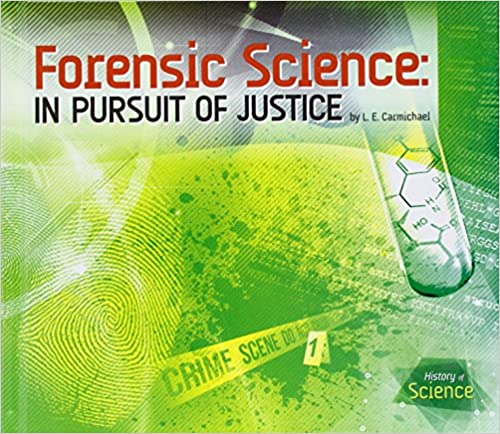


Forensic Science: In Pursuit of Justice written by Sci/Why's own member L.E. Carmichael

ISBN:  978-1624035616 Essential Library Publishing

https://www.amazon.ca/Forensic-Science-Pursuit-L-Carmichael/dp/1624035612/

This title presents the history of forensics. Vivid text details how early studies of toxic chemicals and firearm analysis led to modern scientific crime solving techniques. It also puts a spotlight on the brilliant scientists who made these advances possible. Useful sidebars, rich images, and a glossary help readers understand the science and its importance. Maps and diagrams provide context for critical discoveries in the field. Aligned to Common Core Standards and correlated to state standards. Essential Library is an imprint of Abdo Publishing.


Look on the author L.E. Carmichael's website at https://www.lecarmichael.ca/books/ and scroll down to find among covers for her many books, the covers for these books on forensics.

Forensics in the Real World by L.E. Carmichael

ISBN: 9781680784794

https://abdobooks.com/shop/show/9632 


Fuzzy Forensics: DNA Fingerprinting Gets Wild by L.E. Carmichael

ISBN:9780994817716

https://www.chapters.indigo.ca/en-ca/books/fuzzy-forensics-dna-fingerprinting-gets/9780994817716-item.html

Focusing on forensic science to protect endangered animals, this book is winner of the 2014 Lane Anderson Award for exceptional children''s science writing. 


Discover Forensic Science by L.E. Carmichael

https://lernerbooks.com/shop/show/14712 


Bones Never Lie: How Forensics Help Solve History's Mysteries by Elizabeth MacLeod

ISBN: 978-1554514823 Annick Press

https://www.amazon.ca/Bones-Never-Lie-Forensics-Mysteries/dp/1554514827

This book collects seven mysteries about historic royal figures whose deaths were under suspicious circumstances. Hard scientific facts about crime-solving techniques make this book highly recommended by Sci/Why author L.E. Carmichael.

15 Jan 2016

Six Reasons (Science) Writers Should Be in Schools

by L. E. Carmichael

I attended junior high in Yellowknife, which is not the most isolated place in Canada, but definitely felt like it sometimes. Fortunately, the school library was huge, and offered a portal to endless worlds I couldn't visit in the flesh.

And then there was the time Sheree Fitch came to visit.

To this day, I vividly remember watching in awe as she recited parts of her work-in-progress to us - a work that later became There Were Monkeys in My Kitchen. It was the first time I'd really understood that the books I loved were written by actual human beings. From there, it was a very short leap to the notion that I could write books, too.

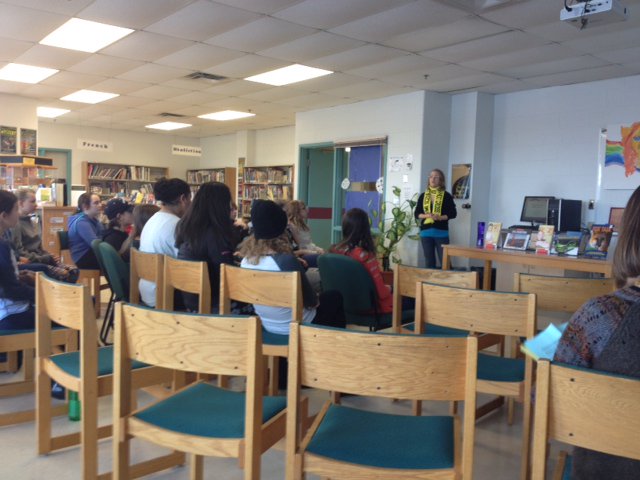
I was thinking about that moment yesterday as I stood in the library of Ridgecliff Middle School, waiting for the first class of grade 7s to file in for their author visit. I was also thinking, I am the author they are coming to see. How weird and awesome is that? And what an incredible gift, to be given the opportunity to inspire a child the way I was inspired so long ago.

That's me in the crime scene scarf. Several kids asked me where to buy one!

After four back-to-back renditions of my Forensic Science: Digging Into DNA presentation, I finished the day both exhausted and exhilarated. The kids were alert and engaged, asking great questions. When I told them that Alec Jeffreys, who discovered DNA fingerprinting, simulated crime scene stains by cutting himself and smearing his own blood around the lab for later testing, they were so caught up in discussing his scientific bad-assery, I had a hard time reigning them back in for the rest of the talk.

The librarian said she'd never seen the students so excited about an author visit. While I'd love to take the credit for that, the real reason for their response wasn't me - it was the science. Because science, as all Sci/Why readers know, is COOL.

Teacher and librarian friends, if you haven't considered bringing a science writer in to talk to your classes, here are my favourite reasons why you should think about it next time you book guest speakers:


  • Science is cool (bears repeating!)
  • Kids who say they don't like to read might just be kids who don't like fiction. Once those kids discover fact-based books, however, they can become some of the most avid readers around
  • Science writers support both the Language Arts curriculum (because writing), and the science curriculum, making them a great bargain - two for the price of one!
  • We can talk about research skills, too.
  • With small classes, we can lead experiments
  • Like any author, we can inspire kids to think about becoming writers. But the topics we present might also inspire them to become scientists. And how great would that be?
Check your provincial Writers in the Schools program, the CCBC Author Directory, or the Writer's Union's National Public Reading Program for listings of science writers who do presentations. If you can't afford speaking fees, most authors will be able to direct you to funding sources that will cover the cost of bringing a guest speaker into the classroom or library.

Your turn, fellow science writers - what great experiences have you had giving school presentations? Teachers and librarians, have you ever booked a science writer for a presentation? What impact did you notice on the kids?


--

My forensics presentation is based on two of my books for junior high and high school readers - Forensic Science: In Pursuit of Justice, and Fuzzy Forensics: DNA Fingerprinting Gets Wild. I'm currently offering deep discounts on first-edition copies of Fuzzy Forensics for educational use. Check out my website and contact me for details.


26 Oct 2015

16 Oct 2015

Ladies and gentlemen, we have a winner!! (Well, several winners, actually.)

By Claire Eamer

Every now and then, we have to boast about the amazing awesomeness of the Sci/Why crew. After all, somebody's gotta do it. Why not one of us?

So - without further ado - let me announce that my colleague, L.E. Carmichael has won this year's Lane Anderson Award for the best Canadian youth science book published in 2014. Ta da! She earned the award with her book Fuzzy Forensics: DNA Fingerprinting Gets Wild.

Part mystery and part scientific guidebook, Fuzzy Forensics tells the story of cutting-edge science put to work to solve a wildlife crime, how the science works, and why wildlife crime is important. It's both fascinating and fun.

9780994817716-Perfect.indd

Pretty impressive, eh? But that's not the end of our amazing accomplishments.

In September, Sci/Why blogger and Science Lady, Shar Levine, was presented with a 2015 Alumni Honour Award by her alma mater, the University of Alberta, for her work in advocating for children's science literacy.

Shar's writing partner, Leslie Johnstone, is no slouch either. While Shar was being honoured at the University of Alberta, Leslie was named one of the 100 leaders in education in British Columbia by the University of British Columbia. Besides writing dozens of entertaining science books for kids, in partnership with Shar, Leslie has taught science at Point Grey Secondary School in Vancouver since 1988 and is currently acting vice principal and head of the science department there.

Congratulations to all of our winners!

28 Aug 2015

Firing the Confetti Cannons!

by L. E. Carmichael

Several members of the Sci-Why blogging team are celebrating big news, so we thought we'd bring the celebration to you. Join us as we pour umbrella drinks and dance in a rain of glitter!

L. E. Carmichael's book FUZZY FORENSICS: DNA FINGERPRINTING GETS WILD has been shortlisted for the 2014 Lane Anderson Award, along with Daniel Loxton's PLESIOSAUR PERIL and Maria Birmingham's TASTES LIKE MUSIC; 17 QUIRKS OF THE BRAIN AND BODY. The winner will be announced later in September.


Joan Marie Galat's book BRANCHING OUT: HOW TREES ARE PART OF OUR WORLD just won the 2015 Santa Monica Public Library Green Prize for Sustainable Literature Award. Check out the trailer for the book here. Joan's next book, DARK MATTERS; NATURE'S REACTION TO LIGHT POLLUTION is coming out next year, but she's already talking it up on CBC.


Paula Johanson put her research skills to work writing KING KWONG, a biography of Canadian hockey player Larry Kwong. She found hockey statistics available online for every professional league in North America! King Kwong was reviewed on page 3 of the Vancouver Sun by Stephen Hume. As he says in his August 5 columnB.C. writer and self-described lifelong hockey fan Paula Johanson reminds us of the ephemeral nature of sports history in King Kwong, her marvellous little biography of the whirlwind on skates who blew out of the dusty interior 75 years ago.


Shar Levine will receive an Alumni Honour Award from the University of Alberta Alumni Association for her contributions to children's literature and science education. There will be a free ceremony with reception to follow at 7 pm, Thursday, Sept. 24, 2015 Northern Alberta Jubilee Auditorium (11455 87 Ave), Edmonton Alberta. For info and tickets, click here.


Five Rivers launched Marie Powell's young adult historical fantasy HAWK at When Words Collide in August. The first review is 5-star, calling it "a spell-binding, riveting YA historical fiction alive with character, conflict and action. Definitely a blow-your-mind debut novel."


Jan Thornhill's latest book KYLE GOES ALONE has just been released! Kyle has to go. There’s just one problem: as a young three-toed sloth, he lives high in the rainforest canopy with his mom, and it’s a LONG way down to the forest floor. Like other sloths, Kyle only goes down to the ground once a week when he has to do his “business.” And he’s never made the journey by himself before.
Kyle’s mom says he’s old enough to go alone, but Kyle isn’t sure he’s ready. It’s so far! And won’t it be lonely? Unfortunately, he doesn’t have much time to decide. Check it out!


7 Aug 2015

Chimeras, Heterochromatism, and Halfsider Parakeets

by L. E. Carmichael


Cool bird, right? I did some research on chimerism while working on Fuzzy Forensics and Forensic Science: In Pursuit of Justice. A couple of different kinds have been found in humans. The type described in the video, where two embryos with different sets of DNA merge during early development, is thought to be the rarest. There's not a lot of data on chimeras in humans (and even less in animals), because the condition is undetectable unless it causes health problems... or, as in the CSI episode Bloodlines (S4E23), a criminal's blood and hair have different sets of chromosomes. Every forensic scientist's nightmare!

Coming back to the birds, though, there may be another explanation. I haven't done any research, so this is pure speculation. But the process of going from a single-celled embryo to a fully-formed animal with billions of cells involves (surprise!) cell division, the process whereby one cell produces two daughter cells. Each daughter cell has to have a complete set of DNA, meaning the chromosomes get copied billions of times. Occasionally, the copying machinery makes a mistake, and a gene mutates during development. Every cell that descends from that cell carries the mutation. In many cases, the mutation has no effect on the cell or its characteristics. But in other cases, the change in the DNA causes a detectable change - like the cell's colour. The most familiar example of this is heterochromatic eyes - one eye of each colour, or one eye with multiple colours, like one of my family's sheltie Deacon used to have.

Puppy Deacon - his eye was half blue, half brown


Sometimes, the mutation happens in a gene that's involved in cell determination - a gene that helps tell the cell whether it's going to be a liver cell or a lung cell or a hair cell. Or, in the case of this totally awesome tulip that grew in my yard one year, a leaf or a petal!

The same bulb produced an ordinary tulip the following year.  That's how you can tell that the mutation was not in the original "embryo," but happened during the plant's development.

Stuff like this is one of the reasons I spent 11 years in university studying genetics. DNA is just SO darn cool.

Thanks to Paula Morrow for the video! And for more about chimeras, check out one of my books on forensics.