Showing posts with label CRISPR. Show all posts

18 Sept 2020

CRISPR and Kids

 by Yolanda Ridge

CRISPR and KIDS


When I say my new book is about CRISPR, most people look confused. Going on to explain that CRISPR is a biotechnology used to edit DNA doesn’t help much. Sometimes, people make reference to GMOS—which are not quite the same—but mostly it’s just:


The first two chapters of CRISPR: A Powerful Way to Change DNA  aim to clear up this confusion. The first chapter provides an overview on chromosomes, genes and DNA. This information’s targeted at 10th grade readers to tie in with the high school curriculum. Chapter two gets into detail about how gene editing with CRISPR/Cas9 actually works.


The rest of the book explores the potential applications of CRISPR technology. I ask a lot of questions and encourage readers of all ages to consider the pros and cons of gene editing on everything from mosquitoes to potatoes to humans. To give readers a preview of this, I wrote a set of articles on how CRISPR can be used to change:


Coffee


Cats


Vision


Space Travel


Coronavirus


Before writing CRISPR: A Powerful Way to Change DNA, I didn’t know much about gene editing despite my background in genetics. I hadn’t given much thought to how CRISPR could be used, how it should be used, or how it should be regulated either.


My opinions are still mixed on this. But one thing is clear to me: it’s important that we all understand just how much CRISPR has the power to change… everything.


Yolanda Ridge is a middle grade author and science writer from Rossland, BC. Visit her website at www.yolandaridge.com to find out more.


Photo credits:

Confused Smiley Clipart by Alexas_Fotos on Pixabay


3 Apr 2020

Testing for COVID-19

By Yolanda Ridge

It’s hard to write about the science of COVID-19 right now because our understanding of the virus is still evolving. But it’s also hard to think about anything else.

One thing everyone wants to know is how and when this pandemic will end. In the best-case scenario, a vaccine becomes available and life goes on as normal. The problem is that it will take at least a year – even with international cooperation, dedication and determination – to develop, test, and then distribute the vaccine worldwide.

To find out more about viruses and vaccines, click on this link to read Virus VS Bacteria – Know Your Enemy on Sci/Why, written by our own Adrienne Montgomerie.

In the meantime, everyone will have to stay at home unless we can find a way to quickly and accurately identity who has the virus and who doesn’t. Unfortunately, testing for COVID-19 has been difficult.

There are two main steps to testing a person to see if they’ve been infected with COVID-19.

Step One: Collect the Sample

The sample must be collected by someone wearing a mask that can protect them from getting infected. It’s done with a nasopharyngeal swab, which is basically a long cotton swab that goes into the nose. 

Photo by cottonbro from Pexels
Unfortunately, both face masks and swabs have been in short supply due to huge demand and manufacturing disruptions. One of the largest makers of nasopharyngeal swabs is in Lombardy, Italy where a lot of people are affected with COVID-19.

Step Two: Test the Sample

Getting enough lab space to do the testing has been difficult as well, since the lab has to be specially designed so the virus won’t spread. The test itself requires specific chemicals and machines, which have also been in short supply.

To find out whether there’s any COVID-19 virus in the sample, scientists look for its RNA. Like DNA in humans, RNA is a set of instructions that makes each type of virus unique. To cause an infection, the COVID-19 virus injects this genetic material into a human cell (it really likes lung cells) along with instructions on how to make copies of it. This allows the RNA to be copied over and over again until the cell dies. Then all those copies of RNA are released in the form of new COVID-19 viruses that can attack other cells.

To find out more, click on this link to watch The Coronavirus Explained & What You Should Do on Kurzgesagt – In a Nutshell.

If someone has the COVID-19 virus, there will be pieces of its RNA in the sample collected during step one. The most common way to test a sample for viral RNA is by something called polymerase chain reaction (PCR). It sounds complicated but PCR is really just way of making more RNA using the virus’s genetic material as a template – not that different to what the virus does itself when it causes an infection. If the virus is in the sample, PCR will produce enough RNA to been seen using a special microscope.

Artist's image of DNA, from the National Institute of Health
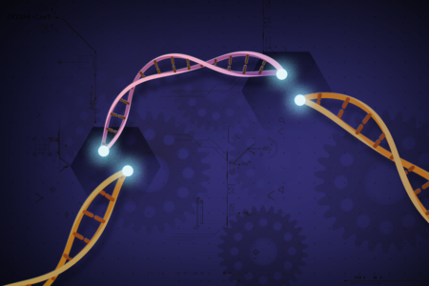
Scientists all over the world are trying to find different ways of making step two faster and more efficient. One way is to use CRISPR, a gene editing tool that works like the find and replace function in a word document to change DNA in ways that have never been possible before. With cool names like SHERLOCK and DETECTR, these tests could get results in as little as 5 to 10 minutes by a process that may eventually be used to not only detect the virus but destroy its genetic material as well.

My book, CRISPR: A Powerful Way to Change DNA, comes out this fall from Annick Press. It will go to press before we know how much CRISPR will be used in the fight against COVID-19.

It’s exciting to think about how new technologies might stop future viruses through testing, treating and even developing vaccines. But the current pandemic is teaching us that the supply of basic stuff - masks, swabs, lab space and equipment – is really the most important thing of all.

8 Dec 2017

Gene Therapy: Embryonic Engineering and the Future of Human Evolution

by L. E. Carmichael

Welcome to Part 3 of my series on gene therapy and genetic engineering. If you haven't already, I'd suggest reading Parts 1 and 2 before you continue:

Introduction to Gene Therapy: It Sounds Simple, But It's Sure Not Easy

Gene Therapy: Vectors, Viruses, and Why CRISPR Will Change Everything

Today, we're talking about the second major challenge with gene therapy - getting replacement DNA into EVERY affected cell in a patient's body - and why that problem leads to the central ethical debate in this field.

Who Are the Patients?

Gene therapy is designed for patients with genetic diseases. The word "patient" implies a couple of things. First of all, a child or adult that has multiple cells... hence the crux of the gene delivery problem we discussed earlier.

The second critical implication is that patients are autonomous human beings who are capable of understanding the treatment, including its risks and benefits, and are also capable giving their informed consent. Many genetic diseases strike during childhood, and in those cases, parents or guardians are legally permitted to give consent for their children's care.

Carry that thought to its logical extension, and it implies that parents could also have the right to consent to gene therapy on behalf of unborn babies - and specifically, single-celled embryos.

Embryonic Gene Therapy

In September, Chinese scientists announced that they had used CRISPR technology to edit a disease gene in human embryos. If those embryos had been implanted and allowed to develop, they would have been born as disease-free humans. It was an incredible breakthrough... and it opens up a lot of questions.

From a technological standpoint, embryonic gene therapy is absolutely the way to go:
  1. If you're doing gene therapy on a fertilized egg - by definition a single cell - the whole problem of delivering functional genes to every affected cell just goes away. Because "every" is now "one."
  2. Every cell in the eventual human body descends from that fertilized egg. So every cell in the human being that egg becomes carries the therapy gene. The cure is permanent.
  3. That human being's own eggs or sperm will also carry the functional gene. In other words, the cure is not just permanent, but heritable. It will be passed down to the person's own children, meaning one treatment could wipe out the disease from an entire future family tree.
Now We Know We Can... Does That Mean We Should?

The heritability of embryonic gene therapy is the reason that the vast majority of scientists have long considered such procedures unethical - or at the very least, warranting serious discussion. It is one thing to permanently alter the health of an existing human being - we've been doing that for centuries, using medical treatments as diverse as vaccines and surgeries. And indeed, if we have the power to improve someone's life and relieve their suffering, don't we have a moral obligation to at least try?

Altering the genomes of theoretical future humans is another thing entirely. First, because it's much harder to predict the consequences of actions on that scale, and second, because theoretical humans cannot consent to the alteration of their DNA when they do not yet exist. What right do we have to take those choices away? And while it's hard to imagine why someone would want to live with a disease when they didn't have to, our potential to impact the human genome, and therefore the course of human evolution, doesn't stop there.

After all, DNA is DNA. And CRISPR works on ALL the genes, not just the ones that can cause disease.

Embryonic Engineering and "Designer Babies"

Thanks to the Human Genome Project, we have a better understanding of our DNA than ever before. We're finding genes linked to all kinds of interesting traits, like eye colour and height and muscle development and intelligence...

Chinese scientists have genetically engineering dogs with over-developed musculature. Want your kid to be an Olympic power lifter, a soldier, a firefighter? Why bother building the necessary physique with diet and exercise when you could hard-wire their DNA? Ditto if you want your kid to get into Harvard or win a Nobel Prize.There have already been stories about parents undergoing IVF treatments who choose traits like the sex of their unborn child. With genetic engineering, the possibilities are truly becoming limitless.

The Ethics of Gene Therapy and Genomic Engineering

Just because a technology is potentially limitless, doesn't mean it has to be used to its full potential. We have an obligation to decide what uses of gene editing techniques are acceptable and what uses are not, and a further obligation to enforce whatever standards we agree upon.

The ethics of genetic engineering have been debated since the 1970s, when it became possible to manipulate DNA directly for the first time (before that, we had to do it the old fashioned way, using selective breeding). The debates will continue, and in light of these recent Chinese studies, likely intensify. And that's as it should be. Like so many technologies before them, gene therapy and genetic engineering have enormous potential for good, and enormous potential to be abused.

The choice will be up to us.

I hope you've enjoyed learning more about these topics, and I hope you'll continue following news reports about CRISPR and genetic engineering in the news. In the meantime, I'd love to know your thoughts on these issues. Please share and comment!

1 Dec 2017

Gene Therapy: Vectors, Viruses, and Why CRISPR Will Change Everything

by L. E. Carmichael

Welcome to Part 2 of my series on gene therapy! If you haven't already, I recommend that you read Part 1, Introduction to Gene Therapy: It Sounds Simple, But It's Sure Not Easy, before continuing with this post.

Ready? Here we go.

Viruses: FedEx For Genes

Gene therapy involves repairing or replacing a faulty gene that has led to disease. In order to do that, one major hurdle must be overcome: getting new DNA into the patient's cells. Cells, however, are designed to keep things out. That's why they have wrappers, called cell membranes. Scientists needed vectors: gene delivery systems capable of crossing the membrane.

In the early days of gene therapy research (by which I mean the 80s), the obvious way to cross the membrane was to use a virus. Viruses are highly efficient invaders - they have to be, because they are not capable of copying their own DNA. In other words, the only way a virus can reproduce and spread is to invade a host cell, hijack its equipment, and force the cell to package new viruses that can carry on the cycle of infection.

But what if scientists could replace some of the virus's DNA with a therapy gene? The virus would invade a patient's cells as per usual, but instead of causing infection, deliver some healthy human DNA. Sort of like molecular FedEx. Some viruses even contain DNA sequences that match sequences found in human DNA. These complementary sequences would prompt the host cell to incorporate the therapy gene into its own genome. Not only would the patient be cured, but the cure would be permanent.

What's that line about how it seemed like a good idea at the time?

The Problem With Viruses

For starters, they are viruses. The human immune system is designed to find and destroy viruses, before they invade the body's cells. This happens all the time, without our even realizing it. But sometimes, the immune system gets a little carried away.

That's exactly what happened to Jesse Gelsinger in 1999. The 18-year-old was part of a clinical trial of a gene therapy for a genetic disease known as OTC. When he received the treatment, his immune system had a massive over-reaction to the viral vector and began attacking his own cells. He died just a few days later.

The Other Problem With Viruses

Remember I said that some viruses can insert their own DNA - or therapy DNA - into the human genome, making a therapy permanent? Early gene therapy research occurred before we sequenced the entire human genome. Scientists didn't realize that complementary DNA sequences could occur in more than one location in a person's DNA... or that some of those locations were inside other genes. No good providing DNA to cure one genetic disease if your cure is going to knock out another gene. Especially if that gene helps to controls cell division... because uncontrolled cell division leads to cancer.

That's what happened to a number of young patients during an early clinical trial for the immune system deficiency SCID. And since those kids had compromised immune systems, they had no natural defences against the cancer their cure had created.

A Light at the End of the Tunnel

After these tragedies, scientists spent a lot of time searching for viral vectors that would NOT cause such horrific side effects. One type belongs to a family of viruses known as AAV. A gene therapy for Leber congenital amaurosis is built around AAV. It replaces a faulty gene in retina cells that causes children to go blind. And after decades of research, it looks as though this therapy will soon be available to the public. Developed by Spark Therapeutics, the treatment just received a unanimous endorsement from an FDA review panel, meaning approval for the therapy could be just around the corner - a literal light at the end of the tunnel for these patients.

So What is CRISPR, and Why Is Everyone So Excited About It?

A major downside of AAV viruses is that they do not incorporate their genetic package into the patient's existing genome. Which means they don't cause cancer, but also that the therapy gene can't be reliably passed on to daughter cells. That's OK for retinal cells, which don't divide. It's a lot less useful for treating diseases in other parts of the body.

CRISPR, on the other hand, works in all types of cells. It allows scientists to edit a patient's existing genes - correcting the typos that cause disease - and the changes are permanent. Here's how it works and why it's such a big deal.


Here's another really great video explaining CRISPR and its applications that unfortunately I was not able to embed.

And yes. You still have to get the components for CRISPR into the cell in the first place. One group of scientists has just found a way to do this without using viruses. They used gold particles instead.

As you can see, CRISPR could lead to incredible breakthroughs, and not just in gene therapy. But there are concerns as well. Stay tuned for Part 3, where I will explore what's perhaps the biggest one.

24 Nov 2017

Introduction to Gene Therapy: It Sounds Simple, But It's Sure Not Easy

by L. E. Carmichael

Muscular dystrophy, hemophilia, Leber congenital amaurosis (LCA), cancer... they all have one thing in common. They are genetic diseases, ultimately caused by missing or malfunctioning genes in the patient's DNA. Until recently, we could treat the symptoms of many genetic diseases, but not the causes. There was no way to reach inside a person's genes and repair the faulty code that started the whole problem.

Research into gene therapy aims to change that.

What is gene therapy?

Genes are blueprints for proteins. A complete set of working proteins makes a working human. In contrast, missing or malfunctioning proteins sometimes lead to disease. Many genes and proteins have to be affected to lead to diseases like cancer. Other diseases, like LCA and Lesch-Nyhan syndrome, result from a single broken gene.

The logic behind gene therapy is very simple: if a missing or malfunctioning gene is causing disease, a working copy of the gene could cure the patient. There are two ways to provide a working copy:
  1. Fix the gene that's already in the patient's DNA. This is easiest when the malfunction is caused by what's known as a "point mutation," which is basically a typo in the genetic code. Not all such typos are dangerous, but the right typo in the wrong place can knock out the entire gene.
  2. Provide a new copy of the entire gene. This strategy applies for genes with larger insertions - extra code - or deletions - missing code.
Once a working gene is present in the patient's cells, his or her body can make a functional protein... and in some cases, that may be enough to cure the disease.

That Does Sound Simple... So Why Is Gene Therapy So Hard?

Lots of reasons, but we're going to focus on two:
  1. Cells have lifespans. Dying cells are replaced by new cells, which are created by cell division. During this process, the cell's genome (all the DNA a person was born with) is copied so that each new daughter cell gets a complete set of instructions. There is no guarantee that a therapy gene that's simply floating around in the cell will end up in both daughters - to ensure that the shiny new gene will always be passed on, making the cure permanent, that gene has to become part of the original genome. Which means that, either
    1. the patient's original gene has to be edited in place, or
    2. the complete new gene has to embed itself into the patient's existing DNA.
  2. According to one estimate, there are 37.2 TRILLION cells in the human body. Not every disease affects every cell in the body. For example, LCA is a form of blindness caused by a faulty gene in the cells of the retina. To cure LCA, only retina cells would need to be treated. Far fewer than the whole 37.2 trillion, but still enough that getting a working gene into EVERY retinal cell is still a huge challenge.
So How Do Scientists Solve These Problems?

Stay tuned! In Part 2, I will explain what CRISPR is and why scientists are so excited about it. In Part 3, we'll tackle the "every cell" problem... and some awesome/scary breakthroughs that have recently hit the news.

In the meantime, you or your teenager might want to check out my YA science book, Gene Therapy. It's a couple years old now, but is still a solid introduction to the history and science of this cutting edge medicine.