Showing posts with label nanotechnology. Show all posts

13 Mar 2018

Nanotennis

By Simon Shapiro

Nanotechnology deals with particles ranging in size from 1 to 100 nanometers. A nanometer is one millionth of a meter. That's very small: a newspaper page is about 100,000 nanometers thick. Atoms are about .1 to .5 nanometers in diameter, so nanotechnology works at a molecular level.

Materials start behaving differently at nano scale and scientists are learning about this behaviour and finding uses for nano materials. One of the success stories has been graphene and carbon nanotubes.

Graphene
Image by AlexanderAlUS

 Graphene consists of a lattice of carbon atoms in a hexagonal pattern. It's a sheet of carbon one atom thick. And it's the strongest material ever discovered – 200 times stronger than steel, but also very light and flexible.
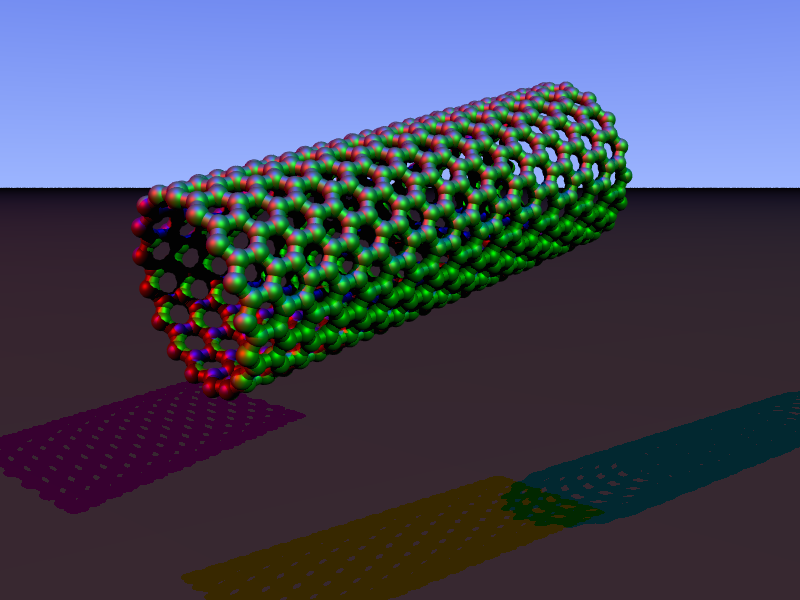
Carbon Nanotube
By Arnero - Own work, Public Domain
Graphene can be formed into a cylindrical shape, which is call a nanotube. It's light, strong and stiff.

 So what does nanotechnology have to do with tennis? Would you believe tiny tennis players hitting electrons across a 1 nanometer high net? No, me neither.

In the early 1970s an aeronautical engineer by the name of Howard Head, revolutionized tennis by inventing a racket with a much bigger face. It was a huge improvement over existing rackets especially for average players. Head did this by making the frame out of aluminum, instead of wood, which wasn't strong enough for larger rackets. (This was Head's second sports revolution: 25 years earlier he had developed plywood/aluminum/steel/plastic skis which blew away the existing solid hickory ones. You can read about this story in my book Faster, Higher, Smarter.)

Head's idea of a larger racket face is still the dominant design, but technologists have been working away to improve the materials used. And the most advanced rackets today all use graphene sheets or nanotubes to make portions of the racket lighter, stronger and more rigid.

Silica (silicon dioxide) is another nanotechnology material used in tennis rackets. Silica nanoparticles are used to fill the gaps in other materials, for example between nanotubes. The silica adds stability and strength, without adding much weight.

Clay Nanoparticles
Silicon atom at the centre and four
oxygen atoms at the vertices

Still with tennis, balls use clay nanoparticles on the inside membrane. These silicon oxide particles are tetrahedral shaped molecules which form a barrier to gas. No gas leaking out gives the ball a longer life.

Fullerenes (or Buckminsterfullerenes, or just "Buckyballs") are carbon molecules made up of 60 carbon atoms linked into pentagons and hexagons, forming a structure that looks exactly like a soccer ball. It also looks like a geodesic dome. (The American architect, Buckminster Fuller, popularized the geodesic dome, earning him the nano-homage).  While we're on the subject of appropriate names, one of the three Nobel laureates for discovering Fullerenes was Richard Smalley!


Soccer ball 
By Pumbaa80 (Self-published work
by Pumbaa80) via Wikimedia Commons

Buckminsterfullerene
By Mstroeck at English Wikipedia

Buckyballs are also used in tennis rackets, to make them lighter and more resistant to twisting.

Nanotechnology is used in lots of other sports equipment.
  • Golf clubs: carbon nanotubes are used for strength and lightness. Buckyballs are used for flexibility.
  • Fishing rods: use silica nanoparticles to fill spaces between carbon fibres, strengthening the rod without increasing the weight. 
  • Kayaking: carbon nanotubes are used to enhance resistance to abrasion and cracks; nanoclay is used to reduce weight and resistance, making it easier to paddle.
  • Archery: carbon nanotubes reduce vibration in arrows.
  • Bowling: buckyballs reduce chipping and cracking on bowling balls.
  • Cycling: graphene and carbon nanotubes are used to build very strong and light bicycle frames. 
Nanotechnology is really important in other industries, of course: electronics, pharmaceuticals, textiles, food ... More to come in future blogs.


5 Nov 2017

Nanotechnology: Corneal implants

By Simon Shapiro

A quick summary of how our eyes work: they refract (bend) light and focus it on the retina. The job of doing the refraction is split between the cornea and the lens. Two thirds of the refraction is done by the cornea, so it's critical in enabling vision. After light passes through the cornea, it passes through the pupil (in the centre of the iris) to reach the lens. Muscles in the eye (the ciliary muscle) can change the shape of the lens and allow the eye to focus nearer or further. The lens focuses light on the retina, which passes signals to the brain via the optic nerve.


It's all pretty neat, but some things can go wrong, especially as you get older. Common problems are that the lens and/or the cornea can become cloudy.

Cloudy lenses

When this happens to the lens, it's called a 'cataract'. Medical science has done an incredible job of fixing this problem. It sounds pretty radical and perhaps icky, but here's what ophthalmologists do: they make a tiny incision in the eye, suck the lens right out with a tiny 'vacuum cleaner', and put a plastic replacement lens in place. If you needed glasses before the surgery, the new lens will be the same prescription as your glasses and you won't need glasses after the operation. While it sounds complicated, the surgery takes less than 30 minutes and is done on an outpatient basis – no hospital stay is needed! Tens of millions of these operations are done every year, with a success rate of 98%.

Cloudy corneas

But when it's the cornea that gets cloudy, it's not that easy. It's possible to do a corneal transplant. A section of the cloudy cornea is removed, and replaced with a section of cornea from a donated eye from someone who has died. This surgery is much more difficult than cataract surgery, and of course it's dependent on having a suitable donor. Only tens of thousands of these operations are done, and the success rate is around 80-90%. More corneal replacements would be done, but there just aren't enough donated eyes.

So all of this means that a new idea for treating cloudy corneas is very exciting. Instead of transplanting human corneal tissue, a company called Corneat Vision has developed a synthetic cornea. The procedure is to remove a disc of the cloudy cornea and implant in its place a nanofiber 'skirt' with a clear lens at the centre. The skirt is made up of a sort of a nanofiber skeleton which corneal cells will grow into. The 'magic' of this device is the nanotechnology fiber and how cells grow right into the skeleton, making the implant really part of the eye.


Nanotechnology is becoming a very important field. It deals with particles ranging in size from 1-100 nanometers. A nanometer is one millionth of a meter. That's pretty small: a newspaper page is about 100,000 nanometers thick. When you get to the nano scale, materials start behaving differently, because you're getting to the scale of individual atoms and molecules. Atoms are about .1 - .5 nanometers in diameter, and molecules are over a nanometer across.  Finding out how materials behave differently on a nano scale and finding uses for that, is what makes the field so exciting.

More on nanoscience and nanotechnology in future blogs.

15 Aug 2014

Wild about Robots

Post by Helaine Becker

Ok, so I'm crazy about robots. Bug-shaped robots. Bat-shaped robots. Ameba robots. You name it, I love it.

So without further ado, here are my top 5 wildest, craziest, coolest robots under development today. You can find even more cool robots in my book Zoobots (Kids Can Press).

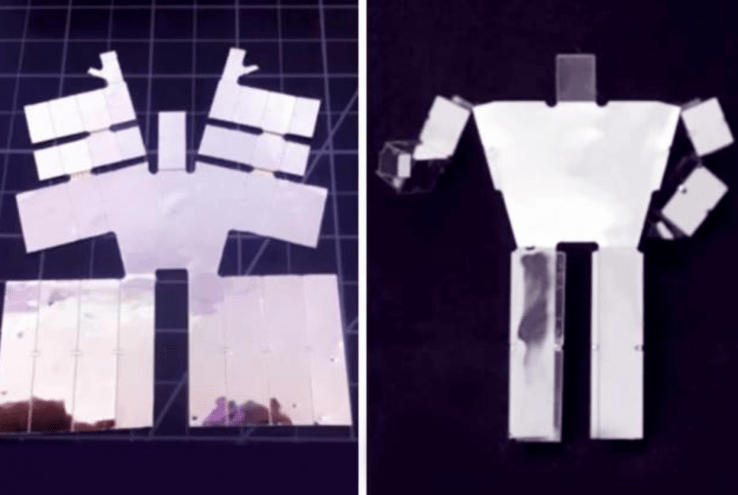
5.  Origami Robots.  These self-folding bots have hinges that change shape when you heat them. I don't even want to know how these might be used.  More deets: Science News.


4. Pop'n'Fresh Robots. Easy Bake Ovens could be even more fun if you could slide in your preformed bot and POP! Impress your guests with functioning 3D robots. Shape-changing polymers that morph under heat are the secret of this hot robo-recipe. More deets: Tech Crunch.


3. DNA Machines. Nanorobots based on DNA are inserted into cockroaches, where they can then be programmed to deliver meds and do other nano-tasks. Gross in so many ways, no?  More deets: PopSci and New Scientist. 


2. TERMES. And while we're on the subject of bugs, these termite-inspired robots work together to build all kinds of modular stuff. Preferably not Mies van der Rohe inspired nests in your post-modern home. More deets: CBS News.


1. Knit Your Way to the Future. Saving the best bot for last, Agnes the Knit Bot takes all the grunt work out of making next season's holiday gifts. More deets: Makezine.