Nanotechnology deals with particles ranging in size from 1 to 100 nanometers. A nanometer is one millionth of a meter. That's very small: a newspaper page is about 100,000 nanometers thick. Atoms are about .1 to .5 nanometers in diameter, so nanotechnology works at a molecular level.
Materials start behaving differently at nano scale and scientists are learning about this behaviour and finding uses for nano materials. One of the success stories has been graphene and carbon nanotubes.
 |
| Graphene Image by AlexanderAlUS |
Graphene consists of a lattice of carbon atoms in a hexagonal pattern. It's a sheet of carbon one atom thick. And it's the strongest material ever discovered – 200 times stronger than steel, but also very light and flexible.
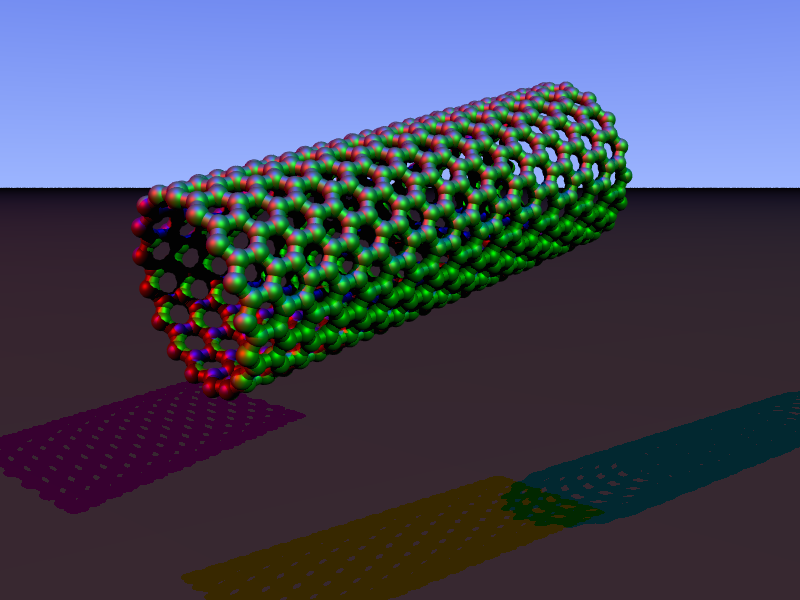 |
| Carbon Nanotube By Arnero - Own work, Public Domain |
So what does nanotechnology have to do with tennis? Would you believe tiny tennis players hitting electrons across a 1 nanometer high net? No, me neither.
In the early 1970s an aeronautical engineer by the name of Howard Head, revolutionized tennis by inventing a racket with a much bigger face. It was a huge improvement over existing rackets especially for average players. Head did this by making the frame out of aluminum, instead of wood, which wasn't strong enough for larger rackets. (This was Head's second sports revolution: 25 years earlier he had developed plywood/aluminum/steel/plastic skis which blew away the existing solid hickory ones. You can read about this story in my book Faster, Higher, Smarter.)
Head's idea of a larger racket face is still the dominant design, but technologists have been working away to improve the materials used. And the most advanced rackets today all use graphene sheets or nanotubes to make portions of the racket lighter, stronger and more rigid.
Silica (silicon dioxide) is another nanotechnology material used in tennis rackets. Silica nanoparticles are used to fill the gaps in other materials, for example between nanotubes. The silica adds stability and strength, without adding much weight.
 |
| Clay Nanoparticles Silicon atom at the centre and four oxygen atoms at the vertices |
Still with tennis, balls use clay nanoparticles on the inside membrane. These silicon oxide particles are tetrahedral shaped molecules which form a barrier to gas. No gas leaking out gives the ball a longer life.
Fullerenes (or Buckminsterfullerenes, or just "Buckyballs") are carbon molecules made up of 60 carbon atoms linked into pentagons and hexagons, forming a structure that looks exactly like a soccer ball. It also looks like a geodesic dome. (The American architect, Buckminster Fuller, popularized the geodesic dome, earning him the nano-homage). While we're on the subject of appropriate names, one of the three Nobel laureates for discovering Fullerenes was Richard Smalley!
 |
| Soccer ball By Pumbaa80 (Self-published work by Pumbaa80) via Wikimedia Commons |
 |
| Buckminsterfullerene By Mstroeck at English Wikipedia |
Buckyballs are also used in tennis rackets, to make them lighter and more resistant to twisting.
Nanotechnology is used in lots of other sports equipment.
- Golf clubs: carbon nanotubes are used for strength and lightness. Buckyballs are used for flexibility.
- Fishing rods: use silica nanoparticles to fill spaces between carbon fibres, strengthening the rod without increasing the weight.
- Kayaking: carbon nanotubes are used to enhance resistance to abrasion and cracks; nanoclay is used to reduce weight and resistance, making it easier to paddle.
- Archery: carbon nanotubes reduce vibration in arrows.
- Bowling: buckyballs reduce chipping and cracking on bowling balls.
- Cycling: graphene and carbon nanotubes are used to build very strong and light bicycle frames.


