Showing posts with label zoology. Show all posts

22 Dec 2020

Merry Christmas! The Twelfth Dredge of Biomass


The Twelfth Dredge of Biomass
by Raymond K. Nakamura

For these taxing times, I tried a taxonomic take on an old favourite. Here is an annotated list of animal phyla, chosen for matching the number of syllables in the gifts mentioned in the song The Twelve Days of Christmas.

On the twelfth dredge of biomass, my true love gave to me —
This is supposing that you and your true love are fans of invertebrate zoology.

12 Annelida
Annelids are segmented worms, which include earthworms, as well as some marine ones called Christmas tree worms.


11 Platyhelminthes
Platyhelminthes are flatworms such as planarians, known for their ability to regenerate after being cut in half. 


10 Loricifera
Loricifera are relatively new in their discovery (1983). They would make fancy ornaments if they weren’t so tiny.


9 Cnidarians
Cnidarians include jellyfish, sea anemones, and coral, not to be confused with A Christmas Carol (a Charles Dickens story that can be read here on Project Gutenberg, a website sharing stories too old for copyright, or you can read about it on Wikipedia).


8 Nematoda
Nematoda are mostly tiny worms found in so many places that American nematodologist Nathan Cobb said in 1915,
 “If all the matter in the universe except the nematodes were swept away, our world would still be dimly recognizable ... we should find its mountains, hills, vales, rivers, lakes, and oceans represented by a film of nematodes."


7 Arthropoda
Arthropoda include all the insects and all the crustaceans. I studied barnacles, which are arthropods, and so did Charles Darwin so they must be cool.


6 Priapulids
Priapulids are unsegmented marine worms also sometimes call “penis worms” for their approximate similarity in shape and sometimes size. Perhaps not appropriate for a true love to send.


5 Chordata
Chordata are the phylum to which all the gifts in the original 12 Days of Christmas song included, except for the pear tree. 


4 Chaetognaths
Chaetognaths are tiny creatures that would look like nice ornaments or awesome dragons if they were bigger.


3 Molluscs
Molluscs are a diverse group that include clams, mussels, oysters, escargot, calamari and other items that go well with garlic butter. The creature I drew is a Nautilus, Greek for sailor, and the name of Captain Nemo’s submarine in Twenty Thousand Leagues Under the Sea (a Jules Verne book you can read at Project Gutenberg).


2 Tardigrades
Tardigrades are tiny creatures also known as “water bears.” They are remarkably resilience creatures capable of living in many places. They were even spilled on the moon, although we don’t know if they survived that.
 

1 Echinodermata
Echinodermata include sea stars, sea urchins, sand dollars, sea cucumbers, brittle stars, and feather stars. I got interested in marine biology because of sea urchin gonads and ended up doing a doctorate on of the hydrodynamics sand dollars. Please don’t use them as tree ornaments no matter how perfect they seem for the task.


Whatever your inclination, I hope you have a maritime merry time this winter solstice, trying out these alternatives for all the verses and putting the “sea” back in Season’s Greetings.

9 Oct 2020

POST NUMBER 500!! Pros and Cons of Studying Elsewhere

Here's our latest post, and it's a real milestone. Welcome to the FIVE HUNDREDTH post on our science writing blog! This one's a trip down memory lane.

Pros and Cons of Studying Elsewhere

by Raymond Nakamura

Ecology is a science in which place makes a big difference to what you study. During the pandemic, travel is not advised, so I thought I'd share some memories of when I went to Japan to study, as a kind of thought experiment.

As an undergraduate, I studied zoology as my specialist subject and Japanese language as my minor. I found out from studying French in high school, that if you don't use it, you lose it. One of my Japanese professors told me studying language would be boring, so I should learn it while studying something I was interested in. I figured that since Japan was an archipelago, it would be a good place to study marine biology. Never mind that my lowest grades were in Japanese language and marine biology.

This was back before the Internet, so finding Japanese professors took a bit of effort. I had to go through the library and scour the papercut delivering pages of scientific journals. Eventually, Professor Taiji Kikuchi at the Amakusa Marine Biological Laboratory of Kyushu University accepted me.

So I left my family home in the city of Toronto and packed up to live on my own in a little village in southern Japan. I ended up studying the population ecology of a stalked barnacle, Capitulum mitella. 


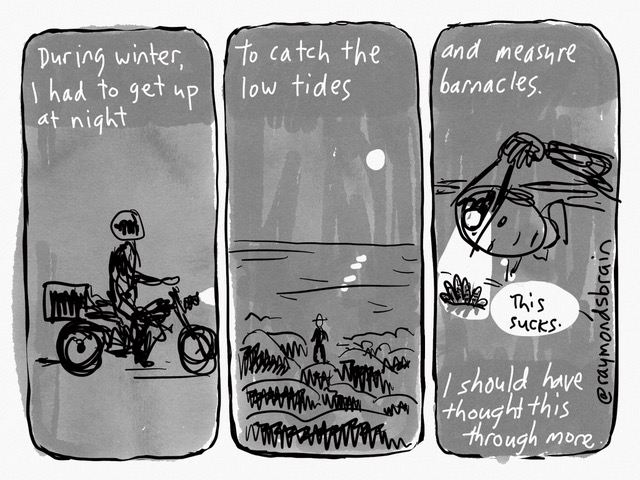
This meant marking more than a hundred individuals that I would measure during every low tide cycle. 

During the winter, that meant going out in the middle of the night.


Sometimes I went further afield to help with studies on endangered species...


...or surveys of less studied habitats, such as Zamami Island in Okinawa.


Sometimes I came across different creatures while doing research or during the course of my travels.


I also had the opportunity to find life in my own home. 
 

I found that studying disagreeable things is a way to cope with their existence. 


Others were more occasional visitors, such as land crabs, mice, spiders, and centipedes.


I realized I preferred my wildlife outdoors.

That was all many tide cycles ago. I now live in Vancouver, where I am a lapsed biologist, more interested in sharing discoveries by other people than working out my own. I practise Japanese on an app called Duolingo. And when the moon is full, I just think, "Isn't that pretty," instead of, “Gosh, these rocks are cold."  

13 Apr 2018

The Littlest Mummy

Brooklyn Museum, 30 B.C.E. – 50 C.E.

Even people who really love Egyptology and know a lot about ancient mummies might be curious about this little bundle of linen. It's only about nine inches (21 centimeters) long, and less than two inches (3.5 centimeters) at its thickest point. What in the world could be mummified in such a small package?

The answer to this question can be found using modern technology! Modern scientists prefer to use non-destructive methods to learn more about mummies from the past. Instead of cutting or damaging their wrappings, they instead put them into a medical scanner.

Here's another mummy bundle with a very similar size, shape and date. When we look inside...what do we see?

Penn Museum, E12435: mummy from the side, paired with radiograph
It's a tiny animal! Even though the radiograph might seem a little hazy, this is obviously a small mammal skeleton. You can clearly make out the teeth and the long tail.

Most of us are not experts when it comes to mummies OR small mammals, but zooarchaeologist Kate Moore had the answer. It was the teeth that were the real give-away--this was a mummy of one of the world's smallest mammals, the Egyptian sacred shrew.

Dr. Moore and a shrew skull
Of course, this answer leads to more questions. What did a live Egyptian shrew look like, for example? And why would you make one into a sacred mummy?

The Egyptian pygmy shrew (Image Bibliotheca Alexandrina)
The answer to the first question is simple--an Egyptian sacred shrew was pretty adorable! It was a very tiny creature, which could easily fit into the palm of your hand. It was very similar in size and appearance to one of its close living relatives today, the Etruscan shrew.

Wikipedia image of Etruscan shrew.
The answer to the second question is a bit more complicated. The important thing to understand is that many animal mummies in ancient Egypt were made as votive offerings--they were gifts to be offered to the gods. The links between animals and the gods were symbolic.

Shrews, although they are very tiny, are incredibly fierce animals! And because they are such mighty mites, they are capable of killing snakes and destroying their eggs. In ancient Egypt, the shrews were representatives of the god Horus, the protector of the Sun. By day, Horus has the form of a Falcon, but by night, Horus takes the form of a shrew or an Egyptian mongoose, to keep up His eternal battle against the cobras and crocodiles that threaten the Sun on its cosmic journey.

___
WANT TO LEARN MORE?

Animal mummies are a fascinating topic, and there are lots of great resources where you can learn more about them.

SOULFUL CREATURES: ANIMAL MUMMIES OF ANCIENT EGYPT is available on Amazon. But if you can't afford your own copy, you might find it in your library. If your library doesn't have a copy--you could always ask them to buy one for the collection!

National Geographic Magazine also has a gallery of ancient Egyptian animal mummies, which has beautiful images. It is connected to an article which was published in the magazine in November 2009. Does your library have back issues of National Geographic?

The Penn Museum Artifact Lab has a blog where scientist Molly Gleeson publishes posts about the lab's study of animal mummies using modern scanning technology.

The New York Times ran an interesting article about the Soulful Creatures Exhibit at the Brooklyn Museum, which includes facts and interviews with scientists who study Egyptian animal mummies.

___
ABOUT THE AUTHOR

Arinn Dembo is a professional science fiction writer and software developer working in Vancouver, BC. She has degrees in Anthropology and Classical and Near Eastern Archaeology, and volunteers as a science educator at Vancouver's The Learnary, where she teaches an ongoing series of workshops called Gothic Science.

20 Oct 2017

Lane Anderson Award Winner Is Life-long Giraffe Fan

The winner of the 2016 Lane Anderson award for excellence in Canadian science writing for youth is Anne Innis Dagg, for her book 5 Giraffes, published by Fitzhenry & Whiteside. This is her account of how she came to study giraffe. -CE

By Anne Innis Dagg

When I was three years old, my mother took me on a trip from our home in Toronto to Chicago where we visited the Brookfield Zoo. I was mesmerized by the giraffe! So much so that I decided I would study them in Africa when I grew up.

At the University of Toronto, I enrolled in biology and for four years learned a great deal, but nothing about my favourite animal. When I graduated I wrote to as many sources as I could think of in Africa to see if anyone would like a young woman to come and watch giraffe near them, but with no success. I then decided to do a year of graduate work and try again the following year, in 1956.

This time I was successful! I was able to live on the grounds of a huge cattle farm that had 95 giraffe on its property, coming and going as they wished. By watching them from the tiny second-hand car I had bought, I was able to document what they did each day. The extensive scientific paper I wrote was apparently the first to be published about the behaviour of any wild animal living in Africa.

Since then I have been able to study giraffe in many other ways, such as their gaits, their spotting, and their behaviour in zoos. I have also written books about giraffe and about my adventures with them. In 2018, there should be a movie about my life with this wonderful animal!

For my book 5 Giraffes, of course, I had to choose individuals from a variety of different backgrounds and places. I belong to a group of scientists who are devoted to this animal, which is in danger of extinction, so this was easily done. They gave me lots of possibilities, from which I chose the five – three of the giraffes lived in zoos, one is a dominant male in Kenya, and the last is a female of another race, also in Kenya, who grieved for days when her youngster died.

Then I added other chapters that deal with a variety of ways in which giraffe differ from other animals. For example, their legs are so long that they have unusual gaits. The females are sociable, moving usually in small groups, while the large males are more likely to be solitary. Giraffe have evolved ways to “beat the heat” on hot days and to obtain moisture from leaves where there is no water.

Writing 5 Giraffes was a wonderful chance for me to recall the amazing way in which giraffe have evolved to live in Africa.

Photos courtesy of Anne Innis Dagg.