Showing posts with label Halloween. Show all posts

30 Oct 2020

Spooky trees: A Hallowe'en Symbol?

 by Marie Powell

When we think of Halloween icons, we often think of screeching black cats, howling ghosts, and withered witches with tall black hats. But there’s nothing as common -- or as spooky -- this time of year as the bare branches of a tree against the grey sky, when the wind howls at the end of the day.
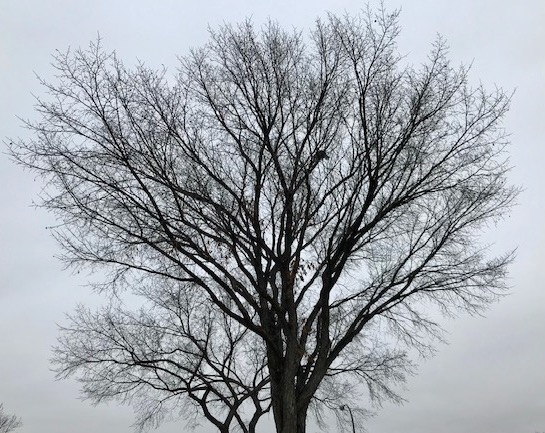
 

Spooky trees by Marie Powell

Stories of tree spirits and the magical properties of each species abound on the Internet and in books. Stories of spirits and magic were part of the beginnings of science, as people began trying to understand the natural world. Yew trees (Taxus baccata) are often mentioned in folklore and magical contexts. It’s a favourite material for everything from wiccan wands to medieval bows, but the leaves, bark, and seeds contain taxine, which can cause heart problems [Isabella, 2020].

The yew tree is also a symbol for protection and longevity. One old folk tale stars a real tree known as the oldest Yew tree in Wales, the Llangernyw Yew near Conwy, North Wales. It’s estimated to be nearly 5,000 years old, and has a cleft trunk (see photo) that some say is a portal to the world of the dead. [Atlas Obscura, 2020]. 

Split trunk of Llangernyw Yew photo by Emgaol

The tree is associated with a spirit called Angelystor. On Halloween, this spirit enters the north door of the village church to announce the names of villagers who will die during the upcoming year—and from all reports, it’s not a good idea to test this spirit. One tailor who scoffed heard his own name announced and was dead within the year. [Owen, 2006].

In a lighter vein, the yew tree is also among the trees recommended as a habitat for certain types of birds and animals [BBC]. Trees are considered sacred in many cultures, and have even been graced with magical properties in some. The birch tree, for example, has been connected to creativity and fertility, possibly because it’s one of the first trees to grow back after a forest fire. The oak is considered a symbol of endurance and power. [Wigington, 2019].

Each type and variety of tree has a particular nature. According to The Woodland Trust, noticing a combination of features is the best way to learn about the nature and identity of a tree. Trees differ in several basic elements: the shape, size, and colour of leaves or needles, the texture of its bark, or the types of buds, fruits, and flowers. The overall shape or silhouette of the tree provides a clue. Even the location where the tree can be found helps identify its nature, since some trees prefer to grow near water, while others prefer woodlands or scrubland. [The Wooodlands Trust, ND]

The Llangernyw Yew by Ermgaol

Trees play a role in the lives of many animal and bird species, as a source of food, nesting sites, and roosting spaces. A natural landscape that includes trees is recommended for optimum health. [BBC] Anyone who has ever felt the calming and de-stressing effect of a great old tree could agree that this in itself is potentially magical [Whitehurst, 2020]. Whether or not trees have spirits, they certainly can lift our spirits—hopefully in time for this Covid Hallowe’en!


Marie Powell’s castle-hopping adventures in North Wales have led to the publication of her new series, Last of the Gifted, including Spirit Sight and Water Sight (coming this fall) with Wood Dragon Books (participation made possible through Creative Saskatchewan’s Book Publishing Grant Program). Marie is the author of more than 40 children’s books published by Scholastic Education, Amicus, Learner/Lightning Bolt, and others. Find her at https://mariepowell.ca

Photo credits:

  1. Spooky trees - Photo by Marie Powell

  2. The Split trunk section of the Llangernyw Yew - Photo by Emgaol on Wikipedia (Creative Commons license)

  3. The Llangernyw yew tree in Llangernyw Village, Conwy, Wales - Photo by Emgaol on Wikipedia (Creative Commons license)


Bibliography and Further Reading:

Atlas Obscura. (2020). Llangernyw Yew. Retrieved from Atlas Obcura: https://www.atlasobscura.com/places/llangernyw-yew

BBC. (n.d.). "Planting a tree helps wildlife". Retrieved from BBC Breathing Spaces: http://www.bbc.co.uk/breathingplaces/plant_tree/

Botanical Society of Britain and Ireland. (ND). Mapping the flora of the British Isles. Retrieved from Botanical Society of Britain and Ireland: https://bsbi.org/maps-and-data

Isabella. (2020, 10 21). The Magic of Yew. Retrieved from Speaking of Witch Wands & Magickal Things: https://speakingofwitchwands.net/2017/09/05/the-magic-of-yew/

Owen, E. (2006, December 12). Welsh Folk-Lore: A Collection of the Folk-Tales and Legends of North Wales. Retrieved from Welsh Folk-Lore: http://www.gutenberg.org/files/20096/20096-h/20096-h.htm#page170

The Woodland Trust. (ND). "How to identify trees". Retrieved from The Woodland Trust: https://www.woodlandtrust.org.uk/trees-woods-and-wildlife/british-trees/how-to-identify-trees/

Whitehurst, T. (2017). The Magic of Trees: A Guide to Their Sacred Wisdom & Metaphysical Properties . Llewellyn Publications.

14 Oct 2016

Just in Time for Halloween - Monster Science!

Post by Helaine Becker

Science isn't scary. Or is it?

I'm pleased to announce that my latest book, Monster Science (Kids Can Press) is out, and the reviews are in!

Here are two:

"From Frankenstein’s creation to Nessie, Becker uses the creatures of our scariest stories as a springboard for an introduction to the scientific understandings that might make such creatures possible—or impossible. In addition to man-made monsters and legendary sea creatures, she covers vampires, zombies, werewolves, and wild, humanlike creatures like Bigfoot. Chapter by chapter, she provides references from literature, film, and popular culture, including a bit of science, a bit of history, and a plentiful helping of humor. She includes numerous monster facts, suggests weapons of defense, and concludes each section with a test-yourself quiz. Science topics covered range widely: electricity, genetic engineering, “demonic diseases,” the nature of our blood and the circulatory system, the possibility of immortality, animal classification, evolution, cannibalism, optical illusions, heredity, hoaxes, and the very real profession of cryptozoology, or the search for hitherto unidentified creatures. Explanations are clear though sometimes oversimplified; they’ll provide readers with an acquaintance with the topic and its vocabulary but probably not real understanding. Lively design and zany cartoon illustrations add to the appeal. There is an index but, sadly, no sources or suggestions for further explorations by readers who will be wanting to know more.Book bait of the best sort, this is a winning combination of fancy and fact." - Kirkus

"A highlight of this work is its exploration of the often symbiotic relationship between culture and science; figures such as Shelley, John Polidori (The Vampyre), and filmmaker George Romero (Night of the Living Dead) merged cultural fascination with scientific development to create truly inspiring works and further public interest in science...VERDICT: The connection between pop culture and science is intriguing; this title will appeal to science educators as a supplemental resource for classroom activities. - School Library Journal


Want a sneak peek? Find out your Vampire IQ with this science-sharp quiz from Chapter 2!


25 Oct 2013

Creepy, Eerie, Macabre Fungi for Halloween


(This is a repost of the October 2013 one that somehow disappeared.)

Picture this: You’re in an unfamiliar part of the woods, alone. It’s spooky and dark. A storm is brewing. You hear something, stop dead in your tracks. Was it a howling wolf? Or just the wind? You’re alert now, all your senses are alive. And then you get a whiff of something—something so awful it makes your nose curl: the stench of rotting flesh, a nearby corpse. But where is it?
And then you see something…but it's not a corpse, though it's almost as grotesque. What you’ve found is a stinkhorn.
Two stinkhorns—Phallus ravenelii, with feasting slugs,
and Clathrus archeri (photos: Jan Thornhill; Wikipedia)
Stinkhorns are one of the more wondrous fruits of the fungi kingdom. They come in a bizarre variety of shapes, ranging from cage-like structures to tentacled stars that look like space aliens to rude-looking columns, some of which are dressed in lacy hoop skirts. Whatever their form, they all erupt—sometimes overnight—from an “egg,” and they all, at some point in their development, are covered in gross-smelling slime.
More traditional fungi rely on air currents to disperse their minute spores. Not the stinkhorn. A stinkhorn’s spores are imbedded in its stinky slime, disgusting muck that so closely mimics the smell of a decomposing cadaver it quickly attracts flies and other insects. When these insects take off again, they unwittingly carry away the stinkhorn’s spores stuck to their mouth parts and their tiny insect feet, spreading them far and wide. 
Stinkhorns are not the only macabre fungi you can come across in the woods. Walk farther and you might stumble upon some aptly named “Dead Man’s Fingers.” 
Dead Man's Fingers—Xylaria polymorpha (photo: Ulrike Kullik)
Properly called Xylaria polymorpha, these fungi are hardwood decomposers. They’re most often found on rotting logs, but when they grow from buried wood they can eerily resemble the blackened fingers of a corpse struggling to dig its way out from a forest grave. Unlike stinkhorns, which can pop up and then deteriorate in a couple of days, Dead Man’s Fingers are so horny and tough they can persist for months, or even years. 
And then there’s the Bleeding Tooth fungus.  
The spores of the Bleeding Tooth Fungus, Hydnellum peckii, are produced
on tooth-like projections beneath the cap. (photo: Darvin DeShazer)
The first time I stumbled upon one of these, it was so covered in “blood” I thought I’d found something recently killed. Though Hydnellum peckii, when fresh and moist, exudes something that looks shockingly like what oozes out of a slaughtered animal’s veins, the globules of pigment-filled liquid are nothing like animal blood. There is, however, a compound in these fungi that can affect blood. This compound, called atromentin, has anticoagulant properties similar to those of heparin, a medication used to prevent blood clots. Ominously, though, an overdose of these anticoagulants can cause a patient to bleed to death.

Some Omphalotus species, or Jack-O'-Lantern mushrooms,
glow in the dark. (photos: Thomas Schoch; Noah Siegel)
The fungi world provides even more Halloween-appropriate characters. In daylight, some of these look like perfectly normal mushrooms. But if you happen to be out for a midnight woodland stroll without a flashlight, you might be frightened by an eerie glow emanating from the base of tree—a glow produced by bioluminescent fungi. Scientists don't yet know why more than 70 species glow in the dark, but one idea is that their light might attract nocturnal insects that could help spread the mushrooms' spores. 
But the prize for the most frightening, the most macabre, the most fiendishly devious fungi has to go to the Zombie Ant Ophiocordyceps. 
The fruiting body of a Zombie Ant Ophiocordyceps protruding
from the head of a dead ant. The white nodules are another
parasitic fungus—a parasite of a parasite! (photo: David Hughes)
The Cordyceps family of fungi are parasites, and their chosen victims are often insects. But what makes Ophiocordyceps so unforgettable, and so nasty, is that after it has worked its way inside an ant's body, it travels to its brain, where chemicals are released that control the ant's actions. The now "zombified" ant is compelled to walk a distance from its colony, and eventually latches tightly onto a leaf with its mandibles. It will never let go. The fungus continues to grow, killing the ant and producing a fruiting structure that sprouts straight up out of the insect's head. The fungus then produces spores that are dispersed by air currents, so the fiendish cycle of Zombie Ants can continue. But, wait! There's some comeuppance for the dastardly Omphiocordyceps: a completely different parasitic fungi preys on it, reducing its ability to produce mature spores!    

For more information about fungi in general: http://www.mushroomexpert.com/
For more information about Zombie Ant Fungi: http://ento.psu.edu/directory/dhughes