Showing posts with label tree. Show all posts

30 Oct 2020

Spooky trees: A Hallowe'en Symbol?

 by Marie Powell

When we think of Halloween icons, we often think of screeching black cats, howling ghosts, and withered witches with tall black hats. But there’s nothing as common -- or as spooky -- this time of year as the bare branches of a tree against the grey sky, when the wind howls at the end of the day.
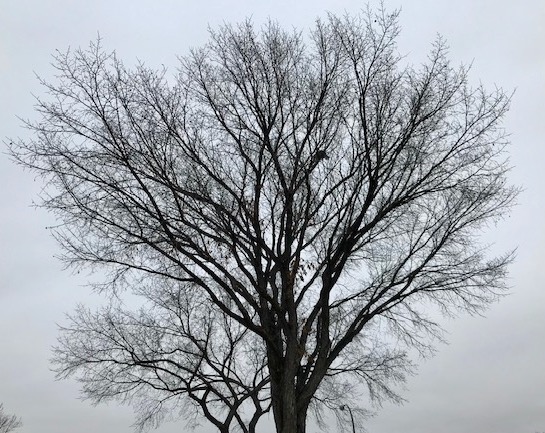
 

Spooky trees by Marie Powell

Stories of tree spirits and the magical properties of each species abound on the Internet and in books. Stories of spirits and magic were part of the beginnings of science, as people began trying to understand the natural world. Yew trees (Taxus baccata) are often mentioned in folklore and magical contexts. It’s a favourite material for everything from wiccan wands to medieval bows, but the leaves, bark, and seeds contain taxine, which can cause heart problems [Isabella, 2020].

The yew tree is also a symbol for protection and longevity. One old folk tale stars a real tree known as the oldest Yew tree in Wales, the Llangernyw Yew near Conwy, North Wales. It’s estimated to be nearly 5,000 years old, and has a cleft trunk (see photo) that some say is a portal to the world of the dead. [Atlas Obscura, 2020]. 

Split trunk of Llangernyw Yew photo by Emgaol

The tree is associated with a spirit called Angelystor. On Halloween, this spirit enters the north door of the village church to announce the names of villagers who will die during the upcoming yearand from all reports, it’s not a good idea to test this spirit. One tailor who scoffed heard his own name announced and was dead within the year. [Owen, 2006].

In a lighter vein, the yew tree is also among the trees recommended as a habitat for certain types of birds and animals [BBC]. Trees are considered sacred in many cultures, and have even been graced with magical properties in some. The birch tree, for example, has been connected to creativity and fertility, possibly because it’s one of the first trees to grow back after a forest fire. The oak is considered a symbol of endurance and power. [Wigington, 2019].

Each type and variety of tree has a particular nature. According to The Woodland Trust, noticing a combination of features is the best way to learn about the nature and identity of a tree. Trees differ in several basic elements: the shape, size, and colour of leaves or needles, the texture of its bark, or the types of buds, fruits, and flowers. The overall shape or silhouette of the tree provides a clue. Even the location where the tree can be found helps identify its nature, since some trees prefer to grow near water, while others prefer woodlands or scrubland. [The Wooodlands Trust, ND]

The Llangernyw Yew by Ermgaol

Trees play a role in the lives of many animal and bird species, as a source of food, nesting sites, and roosting spaces. A natural landscape that includes trees is recommended for optimum health. [BBC] Anyone who has ever felt the calming and de-stressing effect of a great old tree could agree that this in itself is potentially magical [Whitehurst, 2020]. Whether or not trees have spirits, they certainly can lift our spiritshopefully in time for this Covid Hallowe’en!


Marie Powell’s castle-hopping adventures in North Wales have led to the publication of her new series, Last of the Gifted, including Spirit Sight and Water Sight (coming this fall) with Wood Dragon Books (participation made possible through Creative Saskatchewan’s Book Publishing Grant Program). Marie is the author of more than 40 children’s books published by Scholastic Education, Amicus, Learner/Lightning Bolt, and others. Find her at https://mariepowell.ca

Photo credits:

  1. Spooky trees - Photo by Marie Powell

  2. The Split trunk section of the Llangernyw Yew - Photo by Emgaol on Wikipedia (Creative Commons license)

  3. The Llangernyw yew tree in Llangernyw Village, Conwy, Wales - Photo by Emgaol on Wikipedia (Creative Commons license)


Bibliography and Further Reading:

Atlas Obscura. (2020). Llangernyw Yew. Retrieved from Atlas Obcura: https://www.atlasobscura.com/places/llangernyw-yew

BBC. (n.d.). "Planting a tree helps wildlife". Retrieved from BBC Breathing Spaces: http://www.bbc.co.uk/breathingplaces/plant_tree/

Botanical Society of Britain and Ireland. (ND). Mapping the flora of the British Isles. Retrieved from Botanical Society of Britain and Ireland: https://bsbi.org/maps-and-data

Isabella. (2020, 10 21). The Magic of Yew. Retrieved from Speaking of Witch Wands & Magickal Things: https://speakingofwitchwands.net/2017/09/05/the-magic-of-yew/

Owen, E. (2006, December 12). Welsh Folk-Lore: A Collection of the Folk-Tales and Legends of North Wales. Retrieved from Welsh Folk-Lore: http://www.gutenberg.org/files/20096/20096-h/20096-h.htm#page170

The Woodland Trust. (ND). "How to identify trees". Retrieved from The Woodland Trust: https://www.woodlandtrust.org.uk/trees-woods-and-wildlife/british-trees/how-to-identify-trees/

Whitehurst, T. (2017). The Magic of Trees: A Guide to Their Sacred Wisdom & Metaphysical Properties . Llewellyn Publications.

24 Mar 2017

The Undead of Winter

 By Jan Thornhill
Ruby LOVES to "play dead" so we can will bury her in snow!
I love early spring! And no – I’m not talking about tulips and the return of migratory birds, though I have nothing against those things. I’m talking about earlier, in the first weeks of March, when there’s still plenty of snow on the ground, when, for all intents and purposes, it’s still the dead of winter.

Except it’s not dead.


Minute snow fleas appear on warm days in late winter.
In fact, there’s a surprising amount of life in the late winter forest here in Ontario – especially when the temperature squeaks a few degrees above the freezing mark. By early March, tree sap has begun to flow. Within a few days, deciduous crowns in the distance have taken on a haze, as if someone has smeared wet watercolour across the tips of their sharp branches. Their leaf buds are plumping. Male chickadees start using their “Hey, sweetie,” song, which, I think, is self-explanatory. Skunks wake from their winter torpor and amble about briefly – possibly just to stretch their legs – before returning to their dens to wait for real spring to come. On sun-warmed snow patches at the base of trees, snow fleas congregate, sometimes by the tens of thousands (see my post about snow fleas here).


This perennial Red-belted Polypore (Fomitopsis pinicola)
will drop spores on warm winter days.
And, all over the forest—believe it or not—fungi are procreating like crazy.


Amanita frostiana has a mycorrhizal relationship
with oaks and conifers.
These are not your basic ground mushrooms with caps and stems that you see in summer and fall. Most of those are mycorrhizal, and have a mutualistic relationship with trees, trading underground water and nutrients for the sugars that trees produce. But trees shut down sugar production in the late fall, so the underground networks of mycelia of mycorrhizal fungi also shut down during the frozen months.


The Violet-toothed polypore (Trichaptum biforme) is an annual saprobe.
But there are all kinds of other fungi that have a different kind of relationship to trees. They rot them. Many of these tree decayers, or saprobes, are polypores. Polypores develop their spores inside tiny tubes instead of on gills like store-bought mushrooms. 


The Hexagonal-pored Polypore (Neofavolus alveolaris)
 
has—surprise!—hexagonal pores.
The most commonly noticed polypores are shelf fungi or conks. Many are perennial – they have skeletal hyphae—tissue than can withstand freezing and thawing—and just keep growing and growing, sometimes for 70 years or more. And during that time, whenever the temperature goes above freezing for a couple of days, these fungi produce spores. 


Yearly growth layers are obvious on this Phellinus that grows
new spore-producing tubes on its underside each year. 
But, why, you might wonder would they send out spores so much earlier than the birds start doing it and the bees start doing it—when the forest is still, in effect, asleep?
The Gilled Polypore, Lenzites betulina, has elongated tubes that almost look like gills.
They do it early because polypores, like all fungi, are opportunistic. Polypores that grow on living trees usually inhabit the heartwood that runs up the core of a tree trunk. To set up shop in this deadwood, a polypore has to get past a tree’s sapwood, the living layer below the tree’s bark. In the winter, deep freezes cause fractures in tree bark. These frost cracks are perfect for catching passing spores. When spring rains moisten the crevices, and before the tree has time to seal these cracks, the spores germinate and their mycelia work their way into the core. Once past the tree's defences, the fungus sets up shop, spreading its mycelia up and down and around. A fungus can secretly live inside a tree—gradually breaking down lignin and cellulose—for many years before it gives us humans a clue of its presence—by producing reproductive organs (shelf fungi, or conks) on the tree’s exterior.

Fomes fomentarius, is commonly called the Hoof Fungus
 (its shape)  or Tinder Fungus (used to carry fire from place to place
before matches were invented; Ötzi was carrying some).
The Cinnabar Polypore (Pycnoporus cinnabarinus) is the colour of dragon's blood!
The common name for Trametes versicolor is Turkey tails—for good reason
Chicken-of-the-Woods is an excellent edible polypore
 that has the unmistakable texture of overcooked
chicken if you miss its succulent stage.
This Artist's Conk (Ganoderma applanatum) is exhibiting geotropism
— the fungus first grew while the tree was still standing, then, after the tree 

fell, added new growth with its pore surface—once again—facing down.


12 Jun 2015

Gifts from the Golden Wattle - chewing gum, pom-pom flowers, and glue

by Joan Marie Galat


The golden wattle (Acacia pycantha) is the most widespread of all Australian plants and one of more than 900 species of wattle in the country. An evergreen, it may grow as a bushy shrub up to 16 feet (5 meters) high and sport a multitude of slightly droopy branches, or grow as a tree with a single trunk up to 32 feet (10 meters) high. 

As a seedling, golden wattles grow tough, water-saving leaves that help it survive Australia’s dry regions. But adult trees do not have true leaves. Instead, they grow shiny flattened leaf stalks without blades. These blades, called phyllodes, do the work of leaves.

When the tree is three years old, flowers erupt, looking like clusters of fluffy gold pompoms. Each flower head contains up to eighty tiny sweet-smelling blossoms. 
After pollination, flowers form pods that look like long, green string beans. 

Under the hot Australian sun, pods turn dark brown as they mature and split open on one side to release their seeds. These remarkable seeds can still sprout after spending decades in the soil, and trees often appear soon after a bushfire because heat enables the seeds to germinate.

Golden Wattle Chewing Gum
Long before you could buy chewing gum at a store and well before British settlers arrived in Australia, Aborigine people ate gum. Where did they get it? From the sap that oozed out of golden wattle trees. They made notches in the bark to collect gum more easily and ensure a regular supply. They also found the gooey sap could be used as an adhesive and mixed it with other ingredients to make objects stick together. 

Sugar gliders like the gum too. They make golden wattle sap flow by chewing holes into tree trunks and branches. The tree produces gum to heal the injury and the sugar glider gets a tasty snack. Sugar gliders also eat golden wattle seeds before they ripen.

In Australia, September 1 marks the first day of spring and National Wattle Day—a special time to honor the spirit and resilience of Australian people. With bright yellow flowers and deep green leaves, the famous golden wattle’s image adorns Australia’s coat of arms, postage stamps, and awards of merit.

You can discover how people, animals, and the planet needs 11 different species of trees from across the globe in Branching Out - How trees are part of Our World published by Owlkids. Watch this 62 second book trailer for details.