Showing posts with label caterpillar. Show all posts

6 May 2022

Woolly Bears in the Mountains

By Claire Eamer 

No! Not those bears! I'm talking caterpillars.

Woolly bears are those fluffy, hairy caterpillars that look a bit like tiny plush toys. They're common from Mexico to northern Canada. You might have seen a woolly bear trundling along a warm sidewalk in summer or climbing a plant stem to munch on leaves. Eventually, the caterpillar will pupate and emerge as a moth.

So what's so special about woolly bears in the mountains? Actually, it's one particular species -- the arctic woolly bear, Gynaephora groenlandica. Arctic woolly bears weren't supposed to be crawling around in the Yukon mountains, but that's where Isabel Barrio found them during the summer field season of 2010.

Alpine tundra in the Kluane Range, Yukon. D. Hik photo

Until then, arctic woolly bears had been found only on the tundra along the edge of the Arctic Ocean, almost entirely in Canada's Arctic Archipelago and on the shores of Greenland. They emerge from hibernation for about three weeks in June, munch mainly on Arctic willow, and go dormant again until the next June, spending much of their lives tucked away among the tundra stones, frozen solid. They spend so little time active that it takes them a seven years to develop from egg to moth -- the longest of any butterfly or moth.

There's no way a caterpillar not much bigger than a jelly bean could travel from the Arctic Ocean to the southern Yukon in that short period of activity. And yet -- there they were, arctic woolly bears, crawling around an alpine research camp in the Kluane Range, fully 900 kilometres south of where they were supposed to be.

"Caterpillars are relatively common in the alpine and I had been watching them for years," David Hik, the leader of the research group, wrote in an email, "but Isabel was the one who really started looking at them more closely."
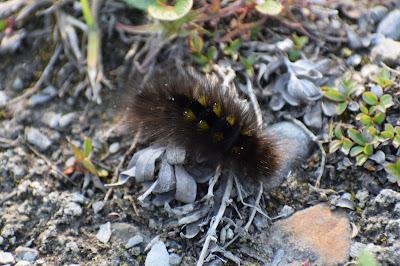
A Yukon arctic woolly bear in search of dinner. Syd Cannings photo.

Today, Isabel Barrio is a professor at the Agricultural University of Iceland, but in 2010 she was working on her doctorate under the direction Hik, a specialist in the alpine ecosystems of the southwestern Yukon. And she had a sharp eye for caterpillars.

Hik explained that there are two arctic species of woolly bear caterpillar -- Gynaephora groenlandica and Gynaephora rossii (the larval form of Ross' tussock moth) -- and they are easy to confuse. G. rossii, however, has a wide range all around the Arctic and in the high mountains farther south, so it was logical to assume the Kluane Range caterpillars were G. rossii.

When Barrio looked closely at the older caterpillars, however, she realized they weren't G. rossii. As improbable as it seemed, they appeared to be arctic woolly bears. The research group collected 30 caterpillars that summer to confirm the identification and to learn more about them.
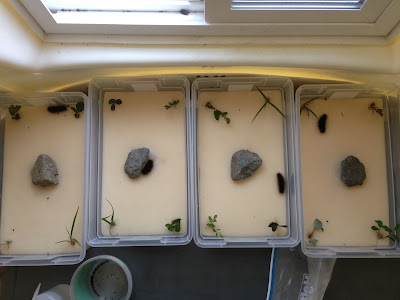
What's your favourite? An experiment to see what the Yukon caterpillars like to eat. D. Hik photo.

That led to another surprise. Analysis of the caterpillars' genetic code showed that the Yukon woolly bears were slightly different from other arctic woolly bears. They were, in fact, a newly discovered subspecies: Gynaephora groenlandica beringiana.

That last word is important. It refers to the fact that they were found in Beringia, the area of northwestern North America that remained ice-free during the last major glaciation. That probably explains their presence in the alpine valley. These fuzzy little beasts were likely crawling over the tough tundra vegetation of Beringia when most of Canada was buried under kilometres of ice -- and they're still there.
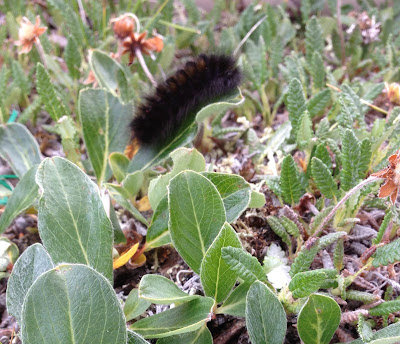
G. groenlandica beringiana perched on top of its supper. D. Hik photo.

Since Barrio's first identification of them, the caterpillars have been found in a few other locations in the Yukon. David Hik suspects they are widespread throughout the alpine areas of Beringia. He hopes that new research projects in the region will turn up more confirmed identifications -- and more information.

"They are very cool, and there is so much more to learn about them," he wrote.

5 Apr 2013

Help Save the Monarch Butterfly!

What’s not to like about monarchs? Their caterpillars are gorgeously striped. Their chrysalises are an otherworldly green bejeweled with glimmering gold. The adults weigh only half as much as a paperclip, yet can migrate thousands of kilometres—and if you’re lucky enough to be in the right place at the right time you can see congregations of thousands. Monarchs can also make blue jays throw up—a delightful tidbit I learned while researching my new book about migration, Is This Panama? (beautifully illustrated by Soyeon Kim!). Sadly, just as the book went to press, bad news arrived: the over-wintering monarch population in Mexico was the lowest ever recorded.
Roosting monarchs (Agunther)
Hundreds of millions of monarchs migrate each fall to warmer areas. Adults that originate in southern Canada can fly more than 4,000 kilometres (2,500 miles) to reach their hibernation grounds in Mexico. It’s a treacherous journey for a delicate butterfly and many die on the way, but every year millions arrive in a mountain forest near Mexico City. Because it would be too difficult to actually count such large numbers, scientists have been measuring the area of forest each year that the butterflies occupy. In 2011 monarchs covered the trees in 2.89 hectares of forest. This past winter they occupied only 1.19 hectares (5 sq. miles)—a drop of 59%!

Though adult monarchs sip nectar from a variety of flowers, their caterpillars are specialist herbivores, which means they depend on a single type of plant for food. In the monarch’s case, these plants all belong to the milkweed family.
Between hatching and forming a chrysalis, monarch caterpillars increase 3,000 times in size. These two caterpillars are in their second and third stages of growth, called instars. (Jan Thornhill)
Milkweeds have evolved elaborate defenses to prevent themselves from being eaten, including uncomfortably hairy leaves, sticky white latex that bleeds from injured tissues, and toxins called cardenolides. Because of the cardenolides, most insects, as well as vertebrates, avoid eating milkweed, but the monarch has evolved to not only tolerate the toxins, it also uses those very poisons to its own advantage by storing them in its own body, which makes even an adult butterfly just as toxic as the plant. The first time a bird, such as a blue jay, eats a monarch, it will vomit a short time later. Though this is of no benefit to the monarch that was eaten, the bird will remember its bad experience and will avoid eating black-and-orange butterflies from then on.

Meanwhile, milkweed plants are continuing to evolve in response to being eaten by caterpillars. Recent genetic research is showing that there is an evolutionary trend in milkweeds towards healing themselves faster than they can be eaten, instead of producing more toxins that might eventually deter caterpillars. 
Monarch caterpillar on milkweed flowers (Jan Thornhill)
Though milkweeds can get along perfectly well without monarchs, monarchs cannot survive without milkweeds. Unfortunately, milkweeds of all varieties are disappearing. Their grassland habitats have been steadily eroding for more than a century due to human development, and recent severe droughts in Texas and the American Southwest have also taken their toll. But another much greater threat has arrived: farmers across North America are now growing corn and soybeans that are genetically engineered to be herbicide resistant. When these “Roundup Ready” crops, developed by a company called Monsanto, are sprayed with glyphosate-based herbicide, almost any plant—other than the corn and soybeans—is killed. The plants that once grew alongside these crops include milkweed, which, until now, had always been plentiful, as well as a multitude of wildflowers that provide nectar for adult butterflies while they’re migrating. One study has shown that between 1999 and 2009 there has been a 90% loss of common milkweeds in the fields treated with these herbicides.* Soon there may be no milkweed in these croplands at all. And no monarchs.


So What Can We Do To Help?

Grow milkweed in your backyard or in your schoolyard:

Grow a “butterfly garden” with plants that provide food for caterpillars and/or nectar for butterflies:

 Learn more about monarchs and share what you learn: http://www.monarchwatch.org

 
Lobby your political representatives to have products made with genetically modified (GM) crops labeled.

*Pleasants, J.M and Oberhauser, K.S.. 2012. Milkweed loss in agricultural fields due to herbicide use: Effect on the Monarch Butterfly population. Insect Conservation and Diversity (March 12, doi: 10.1111/j.1752-4598.2012.00196x)