Showing posts with label Yukon. Show all posts

6 May 2022

Woolly Bears in the Mountains

By Claire Eamer 

No! Not those bears! I'm talking caterpillars.

Woolly bears are those fluffy, hairy caterpillars that look a bit like tiny plush toys. They're common from Mexico to northern Canada. You might have seen a woolly bear trundling along a warm sidewalk in summer or climbing a plant stem to munch on leaves. Eventually, the caterpillar will pupate and emerge as a moth.

So what's so special about woolly bears in the mountains? Actually, it's one particular species -- the arctic woolly bear, Gynaephora groenlandica. Arctic woolly bears weren't supposed to be crawling around in the Yukon mountains, but that's where Isabel Barrio found them during the summer field season of 2010.

Alpine tundra in the Kluane Range, Yukon. D. Hik photo

Until then, arctic woolly bears had been found only on the tundra along the edge of the Arctic Ocean, almost entirely in Canada's Arctic Archipelago and on the shores of Greenland. They emerge from hibernation for about three weeks in June, munch mainly on Arctic willow, and go dormant again until the next June, spending much of their lives tucked away among the tundra stones, frozen solid. They spend so little time active that it takes them a seven years to develop from egg to moth -- the longest of any butterfly or moth.

There's no way a caterpillar not much bigger than a jelly bean could travel from the Arctic Ocean to the southern Yukon in that short period of activity. And yet -- there they were, arctic woolly bears, crawling around an alpine research camp in the Kluane Range, fully 900 kilometres south of where they were supposed to be.

"Caterpillars are relatively common in the alpine and I had been watching them for years," David Hik, the leader of the research group, wrote in an email, "but Isabel was the one who really started looking at them more closely."
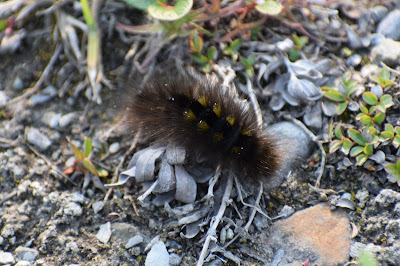
A Yukon arctic woolly bear in search of dinner. Syd Cannings photo.

Today, Isabel Barrio is a professor at the Agricultural University of Iceland, but in 2010 she was working on her doctorate under the direction Hik, a specialist in the alpine ecosystems of the southwestern Yukon. And she had a sharp eye for caterpillars.

Hik explained that there are two arctic species of woolly bear caterpillar -- Gynaephora groenlandica and Gynaephora rossii (the larval form of Ross' tussock moth) -- and they are easy to confuse. G. rossii, however, has a wide range all around the Arctic and in the high mountains farther south, so it was logical to assume the Kluane Range caterpillars were G. rossii.

When Barrio looked closely at the older caterpillars, however, she realized they weren't G. rossii. As improbable as it seemed, they appeared to be arctic woolly bears. The research group collected 30 caterpillars that summer to confirm the identification and to learn more about them.
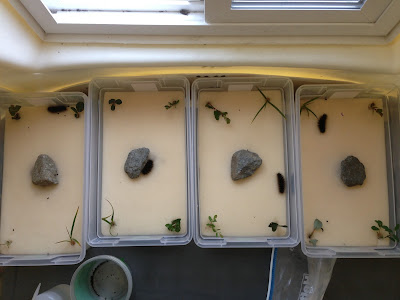
What's your favourite? An experiment to see what the Yukon caterpillars like to eat. D. Hik photo.

That led to another surprise. Analysis of the caterpillars' genetic code showed that the Yukon woolly bears were slightly different from other arctic woolly bears. They were, in fact, a newly discovered subspecies: Gynaephora groenlandica beringiana.

That last word is important. It refers to the fact that they were found in Beringia, the area of northwestern North America that remained ice-free during the last major glaciation. That probably explains their presence in the alpine valley. These fuzzy little beasts were likely crawling over the tough tundra vegetation of Beringia when most of Canada was buried under kilometres of ice -- and they're still there.
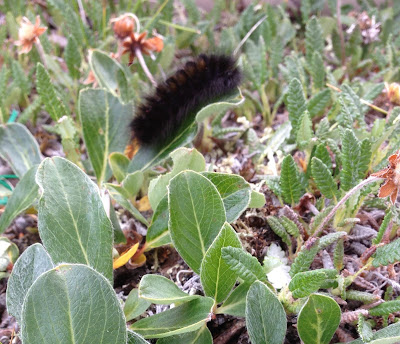
G. groenlandica beringiana perched on top of its supper. D. Hik photo.

Since Barrio's first identification of them, the caterpillars have been found in a few other locations in the Yukon. David Hik suspects they are widespread throughout the alpine areas of Beringia. He hopes that new research projects in the region will turn up more confirmed identifications -- and more information.

"They are very cool, and there is so much more to learn about them," he wrote.

28 Feb 2020

Everything Old is New Again

By Claire Eamer

An atlatl is a throwing stick. It’s a tool used to extend the reach and flexibility of a hunter’s arm so that he or she can throw a light spear farther, harder, and faster. And very accurately. The word atlatl comes from the Nahuatl language of the Aztecs, who used atlatls in hunting and war.

A model at the Natural History Museum in Vienna, Austria, shows an ancient
hunter using a simple atlatl and dart. Photo by Wolfgang Sauber.
At its simplest, an atlatl is a stick with a hook at one end. The hook fits into a dimple in the base of the spear – usually called a dart. The hunter holds the atlatl and dart in one hand, sweeps both forward in a throwing motion, and lets the dart fly.

Atlatl throwing. Illustration by Drew Shannon for
Out of the Ice: How Climate Change is Revealing the Past (Kids Can Press, 2018)
Sounds simple, but it’s so effective that people on all continents have used atlatls for thousands of years, and many still use them. Although it has been overshadowed in most cultures by the bow and arrow and by firearms, an atlatl is still a cheap, easy-to-make, and easy-to-use hunting weapon. All you really need to make one is a small knife and a straight-ish stick.

These two atlatls, currently in the Houston Museum of Natural Science, are
between 12,000 and 17,000 years old. They were found in caves or rock shelters in France.
The animal carved on the lower atlatl has been identified as a hyena. Claire Eamer photo.
Of course, not all atlatls are simple sticks. Humans like to embellish their tools. A couple of atlatls found in dry caves in France have carved images of animals that have been extinct in Europe for thousands of years. An Aztec atlatl in the British Museum is elaborately carved with images of warriors or gods and covered with gold.

I first heard about atlatls in the late 1990s, when I lived in the Yukon. A friend, Environment Canada caribou biologist Don Russell, was asked to confirm discovery of what appeared to be huge quantities of caribou droppings melting out of a high alpine ice patch near Whitehorse. (For the full story, see my book Out of the Ice: How Climate Change is Revealing the Past.)

Dimples in the ends of atlatl darts.
Illustration by Drew Shannon for
Out of the Ice: How Climate Change is
Revealing the Past
(Kids Can Press, 2018)
Don spotted something odd lying on the rocks beside the ice patch. It was a stick. Far above treeline, with no other wood around, he found a stick – with what looked like string wrapped around it and a tattered bit of feather.

“Cool,” said the archaeologists (more or less), when presented with the stick. “Part of an arrow, maybe even a century old. Very rare.” But testing showed it was even cooler. The stick was 4300 years old, and it wasn’t an arrow. The tell-tale dimple at one end showed that it was the remains of an atlatl dart. Long ago, around the time that ancient Britons were building Stonehenge, a hunter in the Yukon mountains flung a dart at a caribou – and missed. The dart disappeared into the snow and ice where the cold preserved it.

That was the first direct evidence of atlatl use in the Yukon. Wood normally disintegrates in a few years unless it’s preserved in some way – usually by extreme dryness or extreme cold. Cold is what saved the Yukon atlatl dart, and it has preserved other things too. Lots more wooden artifacts, including the rest of the dart Don found, have been discovered in the ice patches, as well as bone, antler, leather, and other materials that normally don’t survive for thousands of years. 
Kids choose their weapons at the atlatl range at the
Yukon Beringia Interpretive Centre in Whitehorse.
Yukon Government photo.
Today, most school kids in the Yukon know about atlatls and might even have tried their hand at them. Elsewhere, too, people are experimenting with atlatls. There are even formal atlatl competitions and modern atlatl hunters. It is, indeed, a case of “Everything old is new again.”

Ready to throw at the Yukon Beringia Interpretive Centre's atlatl target range.
Yukon Government photo
If you want to know more about the Yukon Ice Patches and see some of the finds, check out The Frozen Past, an illustrated booklet produced by the Yukon Government and the First Nations involved in the ice patch research.

If you'd like to see video of people throwing atlatls, here is the 2012 Atlatl Competition at Anasazi State Park Museum in the United States.


And, of course, you can always consult my own book -- Out of the Ice: How Climate Change is Revealing the Past (Kids Can Press, 2018) -- for the story of the Yukon discoveries and frozen discoveries elsewhere in the world.

30 Aug 2019

When Did Humans Reach the Americas?

By Claire Eamer

Now there's a question that opens a can of worms!

A couple of years ago, I wrote a short news article -- Archaeological Find Puts Humans in North America 10,000 Years Earlier Than Thought -- for Hakai Magazine. It was about a new analysis of bones found 40 years ago in the Bluefish Caves in the northern Yukon by Canadian anthropologist Jacques Cinq-Mars. The magazine followed it up with a lengthy and fascinating piece by Heather Pringle: From Vilified to Vindicated: the Story of Jacques Cinq-Mars.

Doctoral student Lauriane Bourgeon's analysis of the bones, particularly a horse jawbone with cut marks on it, appears to confirm Cinq-Mars's original conclusion -- that human hunters were using the Bluefish Caves at least 24,000 years ago, at the height of the last glaciation. At that time sea levels were much lower than today, and people could have crossed to North America from Siberia on the wide, dry, windswept plains of Beringia, a route now blocked by the waters of the Bering Strait.
Beringia land bridge-noaagov

At the time Cinq-Mars published his first account of the excavation, the prevailing theory said humans arrived in North America from northeastern Siberia about 14,000 years ago at a time when the glaciers were finally disappearing, but when there was still a dry-land link between Asia and North America. They then followed an ice-free corridor between glaciers that led them south to the rest of the Americas. The problem with that theory is the growing body of evidence that no such corridor existed or was inhabitable at that time, as well as another growing body of evidence that people were living well south of the glaciated lands before the glaciers disappeared.

Cinq-Mars's find and Bourgeon's re-analysis of it support another theory: the Beringian standstill hypothesis. According to that theory, humans moved into the dry region linking Asia and North America 10,000 years or more before the great ice sheets melted and the sea level rose. And there they stayed, making a decent living from the animals -- both large and small -- that shared their giant refuge from the ice.

But what about those people living farther south when the ice was still melting? Current thinking suggests they might have arrived by sea, travelling down the west coast of North America, with its rich resources of shellfish and other coastal foods. A report just released dates a cache of artifacts found in Idaho to 16,000 years ago. A joint research effort by Western scientists and First Nations in British Columbia recently found even more startling evidence to support the coastal theory -- 29 footprints left, probably, by a small family walking along a beach 13,000 years ago.

Unravelling the mystery of humans in the Americas is no easy task. Much of the evidence was ground to dust by kilometres-deep ice or flooded by rising seas as the ice melted. But scientists and Indigenous peoples are working on it. It's still a can of worms, but each worm that emerges changes the picture slightly and makes it a little clearer. And a lot more interesting.

Claire Eamer's most recent book is Out of the Ice: How Climate Change is Revealing the Past (Kids Can Press, 2018).

21 Sept 2018

A Frozen World Returns

By Claire Eamer

The wolf pup cleaned, preserved, and ready for display.
Yukon Government photo.
More than 50,000 years ago, when most of Canada was buried under kilometres-thick ice sheets, a wolf pup was born in one of the few places untouched by the ice -- a dry, grassy plain that extended across most of what is now the Yukon. No more than eight weeks later, the little wolf died, probably buried in a landslip and smothered while it slept in its den. The cold muck froze around it and stayed frozen, summer and winter, preserving the small body.

Just over two years ago, on July 13, 2016, gold miners on Last Chance Creek near Dawson City washed away some frozen sediment and found the little pup. It was frozen and dried but still remarkably well preserved. The miners immediately called in palaeontologist Grant Zazula and his colleagues in the Yukon government's Palaeontology Program. They were delighted with the find. To his knowledge, it's the only ice-age wolf ever found, Zazula says.

Only half of the caribou calf's body was found.
Yukon Government photo.
That was the second spectacular find of the 2016 summer. Six weeks earlier, miners on Paradise Hill -- another famous location in the historic Klondike Goldfields -- had discovered the frozen and mummified remains of a caribou calf. It wasn't as complete as the wolf pup, but nearly all of the front half of the body had survived, with skin, muscle, and hair intact.

Zazula and his colleagues knew they had something special, but they didn't realise quite how special until the results of radiocarbon dating came back. Both animals lived more than 50,000 years ago, the limit for radiocarbon dating. And the caribou calf had been found in association with a layer of volcanic ash that had settled to the ground about 80,000 years ago.

Yukon government palaeontologists Grant Zazula and Elizabeth Hall excavate
the caribou calf from the frozen muck of Paradise Hill near Dawson City, Yukon.
Yukon Government photo
Specimens that old are rare anywhere, and especially in the Yukon where the undulating landscape left few places for dead animals to lie and freeze undisturbed. There was no rush to preserve the bodies, Zazula says.

"We had them kicking around in our deep freeze for a couple of months. They were very well freeze-dried already."

The wolf pup's head before preservation, ice crystals visible.
Yukon Government photo
However, if anyone other than experts was going to see them, more work was required. Yukon Heritage applied for help from the experts at the Canadian Conservation Institute. And they got it. Today, both small bodies have been carefully thawed and preserved in a way that will make it possible to display them to the public. They are currently on display in Dawson at the Dänojà Zho Cultural Centre of the Tr’ondëk Hwëch’in First Nation, in whose traditional territory they were found. Later this fall, they will be moved to Whitehorse and a permanent display at the Yukon Beringia Interpretive Centre.

Meanwhile, scientific interest is building. Zazula is fielding calls from Pleistocene scholars around the world and brainstorming with them and his Yukon colleagues about what kind of questions the little corpses might answer. Is the wolf pup related to the wolves that live in the Yukon today, or did the Pleistocene wolf disappear to be replaced by a new population? Does the caribou calf have relatives living today? If so, which of the many caribou herds do they belong to? And that's just the beginning.

The thawing permafrost and melting ice of the world are revealing more and more clues to the past, both animal and human. That's the subject of my latest book, Out of the Ice: How Climate Change is Revealing the Past. The Yukon pup and calf are too recent to make it into the book, but it contains plenty of other fascinating evidence of lost or forgotten worlds.

24 Jul 2015

Longing for the Giants

By Claire Eamer

In the long and complex story of evolution, organisms emerge and then disappear, never to be seen again. I understand and accept that. Honest. But, fair or not, I regret the loss of some organisms more than others.

I admit it. I miss giant ground sloths.

Don’t get me wrong. I’m not old enough to have met a giant ground sloth face to face. None of us is. The last lingering remnants of a great bunch of animals perished about 5,000 years ago, probably on a small Caribbean island.

Fossil foot of a Jefferson's ground sloth beside my shoe. C. Eamer photo.

While they were here, though, they were amazing. And really, really big. Well, some of them were big. Some species were as small as house-cats, but the largest ground sloths – Megatherium and Eremotherium – were the size of elephants. Hairy elephants, with thick hides dotted with bony plates, claws the size of bananas, and a propensity to stand up on their hind legs and maul substantial trees.

If it’s any comfort, they were vegetarian. Mostly. Some scientists think that Megatherium, at least, might have used those giant claws to grab a bite of meat to go with the veggies, especially when climate change dried the local landscape and thinned out the forests it relied on.

Greg McDonald, senior curator of natural history for the US National Park Service, is another sloth enthusiast. He recently delivered a talk on ground sloths, via Skype, to an appreciative audience in Whitehorse, Yukon.

The Yukon is, surprisingly, ground sloth territory. It’s actually where I first met a ground sloth – if not face to face, then at least face to skull. It was a Jefferson ground sloth, a member of the genus Megalonyx, and its ox-sized skeleton looms over visitors to the Beringia Interpretive Centre in Whitehorse.

For hundreds of thousands of years, Megalonyx ranged from southern Mexico to as far as Alaska and the northern Yukon. Megalonyx was unique, McDonald said, in being a wholly North American sloth. Although its ancestors came from South America, Megalonyx itself evolved in North America and never spread south of Mexico.
A sloth skeleton towers over visitors to the Beringia Interpretive Centre. C. Eamer photo.

That made it a late-comer in the sloth world. Like many other strange and wonderful mammals, sloths evolved in South America, in splendid isolation.

“For most of the age of mammals,” said McDonald, “South America was an island continent, much as we think of Australia today.”

The giant Megatherium roamed the ancient forests of South America in those days. And it had a curious assortment of cousins: anteaters, giant armadillos, and a bizarre creature called a glyptodont that looked like an ambulatory bone igloo. They all belonged to a group called Xenarthrans, which evolved exclusively in South America.

Once thought to be an odd evolutionary offshoot, Xenarthrans are now recognized as one of the major subdivisions in mammalian evolution, McDonald said. They prospered for tens of millions of years in South America and moved on to North America when the Isthmus of Panama began to form and link the two continents, just a few million years ago. (Or maybe more than a few million years ago, according to some recent studies.)

That was a momentous time in evolution, said McDonald. It’s called GABI: the Great American Biotic Interchange. Released from isolation, the Xenarthrans drifted northward, along with other distinctly South American animals, such as giant flightless birds with the hooked beaks of meat-eaters and the ancestor of the humble porcupine. At the same time, animals that had evolved in North America moved southward, including hunting cats with dagger-like fangs and those members of the camel family that became South America’s llamas and alpacas.

Ground sloths spread and adapted and changed on both continents for several more millions of years. They even took to the sea. Marine deposits in southern Peru have turned up a wealth of ancient fossil whales, seals, and sea lions – and entire skeletons of giant sloths. The sloth skeletons show clear evidence of adaptation to an aquatic environment. McDonald said it appears that the aquatic sloths were evolving into animals that went into the sea to eat sea grasses. Like the whales, they were reversing the classic sea-to-land journey of most mammals.

But that’s as far as they got. The aquatic sloths died out about 4 million years ago, and most of the rest of the ground
sloths didn’t survive the great megafauna die-off at the end of the last glaciation, about 12,000 years ago. A few small ground sloths lingered on isolated Caribbean islands, where 5,000-year-old sloth bones have been found in caves.

Today, the much-diminished sloth tribe has been reduced to the endangered tree sloths – a mere six species in two genera – eking out an existence in the shrinking rainforests of South and Central America.

The giants are gone. And, even though I never shared the world with them, I miss them. In fact, they inspired me to write my first kids' science book, Super Crocs & Monster Wings: Modern Animals' Ancient Past.

30 Jan 2015

Old Fossils, New Knowledge – and the Case of the Misplaced Mastodons

By Claire Eamer

About 18,000 years ago, during the last ice age, the Yukon was a menagerie of exotic animals – scimitar cats, giant short-faced bears, and huge, lumbering woolly mammoths, among many others. Until recently, scientists thought those “others” included the mammoth’s distant cousins, mastodons.
Mastodon, by George Teichmann. Courtesy of Yukon Palaeontology Program.

And they had the radiocarbon dates to prove it. Two mastodon teeth from the Yukon had been reported in the scientific literature as dating from 18,000 years ago and 24,000 years ago, respectively.

But, increasingly, the dates didn’t sit right with Yukon government palaeontologist Grant Zazula. The more scientists learned about the ecology of the Yukon 18,000 years ago, the more puzzling the presence of mastodons became.

You see, mastodons were common in the mid-latitudes of North America, where they roamed the conifer forests, grazing on forest plants and browsing the twigs and needles of the trees. But both reported dates put mastodons in the Yukon at the height of the last glaciation. And there were no trees.

At that time, when most of Canada was buried in ice, the Yukon lay along the eastern edge of a vast, cold, dry, grassy plain that reached all the way to Siberia. It was perfect for grass-eaters, such as the woolly mammoth, but the cold and the lack of trees wouldn’t have suited mastodons.

What were tree-chomping cousins of elephants doing in a landscape virtually without trees? Actually, Zazula wondered, were they there at all? The teeth were the real deal, but what about the dates?

In the years since the teeth were dated, scientists have improved dating technology and learned a lot about the materials they’re working with.

And more mastodon fossils have turned up. A truckload of them, in fact – courtesy of Yukon gold miner Earl Bennett. Zazula met Bennett a few years ago, not long after he started his job as Yukon palaeontologist. Bennett told him he’d found a partial mastodon skeleton in the Klondike goldfields, where so many Yukon fossils have been discovered. The next day, he showed up at the palaeontology lab with a pickup truck full of giant bones.
Mastodon tooth. Courtesy of Yukon Palaeontology Program

So – with more bones and with new approaches to dating them, Zazula set out to see if mastodons really had adapted to life on a dry plain.

First, the original teeth were re-dated, using new techniques. This time, both showed as more than 50,000 years old. Radiocarbon dating only goes back reliably to about 50,000 years, so they could well be older.

To check the new dates, Zazula decided to date as many mastodon fossils as he could find. Altogether, he and his team (there are 15 named authors on the paper reporting the findings) managed to get 53 new dates on 36 fossils. The dates consistently came back near the 50,000-year limit of radiocarbon dating.

Ultimately, the scientists concluded that mastodons last lived in the Yukon about 75,000 years ago, when a warm period between glaciations (called an interglacial) lasted long enough for forests to grow and forest creatures, such as the mastodon, to move into them. Then the ice came back and the forests died – and so did the mastodons.

But how could those first reported dates be so wrong?

It’s easy. The samples were contaminated by carbon from much younger sources – humic (organic) acids in the soil and even the materials museums put on fossils to preserve them, Zazula said in an email interview..

The error wasn’t due to carelessness on the part of the first dating labs. Only recently have scientists developed ways to separate old carbon from new. Zazula’s tests were done with a technique that isolates a single amino acid, hydroxyproline, that occurs in collagen – a protein in bones and teeth.

“Probably 99.9% of the hydroxyproline in the natural world only occurs in collagen,” Zazula said. “So, by isolating this single amino acid, we can be confident that the carbon that is radiocarbon dated, only comes from the fossil itself, not from these darn humic acids from soils which can bind themselves to bone collagen.”
Grant Zazula takes a sample of mastodon bone for dating.

Museum specimens can be contaminated too, he said.

“The problem is that museums have been putting 'stuff' on fossils for centuries to preserve their collections. In most cases, records were not kept in regards to what they actually put on the fossils. So, who knows what is on these bones sometimes?”

With younger specimens, around 10,000 years, it’s not such a problem, because they still contain plenty of radioactive carbon, Zazula said. But by the time a fossil is 50,000 years old or more, there’s almost nothing left to sample.

“Introducing even the smallest molecule containing 'young' carbon-14 into the sample can completely change the radiocarbon date because you are essentially only measuring the contaminant then.”

Separating a few molecules of old carbon from the mass of newer material sounds – and is – technically difficult and frustratingly fiddly. But the resulting information has rewritten thousands of years of history and solved the lingering mystery of the misplaced mastodons.


Here are a couple of news stories on the mastodon research: at CBC and in the Globe and Mail.

You can listen to Grant Zazula talk about mastodons on the Dec. 6, 2014 episode of the CBC radio program, Quirks & Quarks.

Here’s a lengthy and well-illustrated set of posts about Yukon palaeontology and mastodons on the Mostly Mammoths, Mummies and Museums blog: Part 1 and Part 2. Part 3 is still to come, so keep your eyes open!

The article setting out the results of the project was “American mastodon extirpation in the Arctic and Subarctic predates human colonization and terminal Pleistocene climate change” in Proceedings of the National Academy of Sciences, Vol. 111 No. 52, which was published online (but behind a pay wall) on Dec. 1, 2014. The full list of authors is Grant D. Zazula, Ross D. E. MacPhee, Jessica Z. Metcalfe, Alberto V. Reyes, Fiona Brocke, Patrick S. Druckenmiller, Pamela Groves, C. Richard Harington, Gregory W. L. Hodgins, Michael L. Kunz, Fred J. Longstaffe, Daniel H. Mann, H. Gregory McDonald, Shweta Nalawade-Chavan, and John R. Southon.

13 Sept 2013

Great White (Northern) Science – LINKS and a CHALLENGE

By Claire Eamer

There’s lots of great science happening in the Great White North. (Actually, it’s not very white today – gorgeous fall colours instead – but you know what I mean.) And a lot of that science is being done by Northerners themselves. So I decided to spread the word.

Here’s the LINKS bit: I’ve dug out a few kid/teacher/librarian-friendly links for you. You’ll find them below, with short notes about where they lead.

And here’s the CHALLENGE bit: Hey, all you Northerners, scientists, science freaks (that’s me!), geeks (young and old), and wizards of Google-fu - let’s find some more! If you have a favourite science link to something that’s taking place in northern Canada, post it in the Comments section at the bottom. We can build something here.

So, here’s my first kick at the can - a mostly-but-not-entirely Yukon contribution.

This scimitar cat once roamed the Yukon grasslands. Today,
it snarls at visitors to the Yukon Beringia Interpretive Centre
in Whitehorse. Claire Eamer photo
Would you like to learn about the amazing animals that roamed the Yukon 20,000 years ago, when most of Canada was buried under kilometres of ice? Check out the Yukon Beringia Interpretive Centre's Education Corner. There's everything from educational materials for senior grades to colouring sheets for the little kids. And check back regularly. I was talking to the Beringia Centre folk yesterday, and they're planning some great new additions to the site.

If I've got you hooked on mammoths, giant sloths, and scimitar cats, there's more information about the latest research (and lots of cool photos) in the online (pdf) booklets Ice Age Klondike and Ice Age Old Crow, published by the Yukon Government.

By the way, if you want to know what life is like today at Old Crow, the Yukon's most northerly community and home of the Vuntut Gwitchin First Nation, check out the community website. It offers a sampler of the Gwich'in language, traditional stories, culture, history, cooking (lots of caribou recipes!), and a whole lot of other entertaining bits and pieces of information, including a collection of videos made by Old Crow students.

Back to ice ages and climate: how about climate change? The climate is warming faster in the North than anywhere else in Canada. What do northerners think about that? In 2000, the Inuvialuit people of Banks Island talked about their lives and how climate change is affecting them in a video called Inuit Observations of Climate Change, which is online in both a short version and a long version.

All that warming has turned up a few surprises. High in the  mountains of the Yukon and the Northwest Territories, there are patches of permanent ice, too small to be glaciers but too big to melt over the short summer. Until recently. Now many of them are melting and revealing a record of plant, animal, and human life going back thousands of years. I blogged about the ice patch discoveries here last year. The online (pdf) booklet The Frozen Past has both information and photos of Yukon finds. And Archaeology magazine has an online article about ice patch finds in other parts of the world.

For first-hand accounts at what it's like to live and do research at the northwest edge of Canada, check out this series of podcasts produced by the Wildlife Management Advisory Council (North Slope). You'll find everything from elder Danny C. Gordon's account of a lifetime of travel across the Yukon North Slope and park ranger Richard Gordon's song in praise of Herschel Island to permafrost researcher Chris Burn's musings on using both scientific and traditional knowledge to understand the land and its future.

Okay, that's my contribution - for now. I won't promise not to come back and add more links in the Comments section, but I'll let you guys have a chance first. What's your favourite science link for the North? And don't think just about the northern territories. Besides the Yukon, the Northwest Territories, and Nunavut, there's Labrador, Nunavik, and the northern regions of most of the provinces. Have I left anyone out? If so, add it in below.


23 Nov 2012

Clues in the Rocks

By Claire Eamer

“The role of a geologist is much like the role of a crime scene investigator,” says Joel Cubley, geology instructor at Yukon College in Whitehorse. Geologists try to figure out what happened long ago in Earth’s history from small, fragmentary clues, he explains. But what took place long ago was certainly not small.

Cubley’s specialty is tectonics, and that’s just about as big as it gets. It’s the study of the movements of the great plates that carry the continents slowly over the face of Earth, pushing up mountains and excavating oceans as they go.
Out there, beyond the east coast of Newfoundland,
the Atlantic Ocean is slowly getting wider.
Claire Eamer photo

Tectonics is a relatively new field. About a century ago, German scientist Alfred Wegener suggested that the continents move, but most geologists thought he was talking nonsense. It wasn’t until well into the 1950s that American scientists using sound waves to map the ocean floors found proof of Wegener’s theory. Marie Tharp, one of the few women working in geology at the time, spotted what looked like a rift valley on the floor of the North Atlantic Ocean. It turned out to be exactly that — a place where two parts of Earth’s crust are pulling apart, widening the ocean and pushing Europe and North America away from each other about as quickly as your fingernail grows.

Even that slow movement, over time, can create huge changes. On the west side of North America, tectonic movement has thrown up range after range of mountains between the eastern slopes of the Rockies and the Pacific Coast. Cubley is particularly interested in gap between a couple of those ranges, a place where two sections of crust have moved in a way that stretches the surface rock. It’s a 200-kilometre-wide zone of jumbled ridges and valleys called the Grand Forks Complex, lying roughly between Castlegar and Revelstoke in southern British Columbia and extending down into Washington State.
The snow-capped St. Elias Mountains, the highest
in Canada, were created by slow tectonic movement.
Claire Eamer photo

A feature of the Grand Forks Complex is occasional outcrops of metamorphic rocks, hundreds of millions of years older than the surrounding rock. How did they get there? That, in simple terms, was the subject of Cubley’s doctoral research.

“Metamorphic rocks are just rocks that have been cooked,” he says. Where Earth’s crust is pulling apart strongly enough to create a crack or fault, super-hot “cooked” rock can well up from far below the surface. Cubley suspected that the metamorphic rock in the Grand Forks Complex was evidence of a fault. But where?

In places like the Great Rift Valley in Africa, the fault is obvious – and huge. But the fault associated with the metamorphic rocks of the Grand Forks Complex would be much smaller and harder to spot. Cubley tackled the problem in the traditional geologist’s way, by sampling and mapping rocks on foot.

He spent several summers bushwhacking across the rough, wild landscape of south-central British Columbia, camping, hauling gear, and swatting bugs. When he finally found the fault, it was a bit of a let-down.

“It was a shallow ravine full of scrubby trees,” says Cubley. “That was kind of soul-destroying!”

But not for long. Cubley’s soul bounced back, and he’s well on his way to understanding how that modest ravine is linked to the unusual rocks of the Grand Forks Complex.

What he knows at this point is that the metamorphic rocks were formed at a depth of about 20 kilometres and a temperature of about 750 degrees C. Roughly 50 million years ago (almost yesterday in geologic terms), they welled all the way up to the surface and then cooled very quickly.

“I still can’t explain how they got to the surface that quickly,” Cubley says. But, with the help of a great deal of modern technology (and some more bushwhacking), he’s working on it.

2 May 2012

Palaeo-Yukon Rocks!

By Claire Eamer

A couple of weeks ago, I posted a blog entry here about archaeological and palaeontological discoveries high in the Yukon mountains. Well, we're at it again! But this time, the big find is in a suburban Whitehorse basement.

Craig Duncan and Sandy Murphy just wanted to lay a new power line into their home in the Whitehorse suburb of Porter Creek, so last week they started digging a trench through their basement -- and struck bone! Before you say "haunted house" and "horror movie" though, relax. This bit of bone was attached to a hoof.

They stopped digging, collected as many bits of bone as possible, and took them to Grant Zazula, the Yukon Government Palaeontologist. He was -- and is -- thrilled. It's the remains of a bison. In fact, when the palaeontologists went back to Porter Creek and excavated further, they found an almost-complete skeleton of a bison.

Bison disappeared from the Yukon about four centuries ago, and no one knows why. The bison here now were introduced just a few decades ago. This skeleton might provide clues about the animals that lived here in the past and why they disappeared.

And how far in the past? The skeleton will be carbon-dated, but in the meantime, the palaeontologists are making bets. It could be as much as 10,000 years old!

For more detail about the find, see the Whitehorse Star story or this story that appeared in the Globe and Mail.

13 Apr 2012

Archaeology on Ice

By Claire Eamer

In 1997, as aspen leaves glowed golden and fireweed burned dark red in the early Yukon autumn, Gerry Kuzyk climbed the steep side of a mountain west of Whitehorse. Kuzyk had taken time off his job as a Yukon government biologist for a few days of sheep hunting, and the high bare slopes are where you find mountain sheep. If you’re lucky.

Kuzyk was lucky that day, but not quite in the way he expected. He made his way towards one of the pockets of permanent ice that nestle on the shady sides of Yukon mountains. Ice patches are made by season after season of snow that never quite melts, but compresses into layers of ice. The ice patches aren’t massive enough to flow like glaciers, but they are big enough to cool the air around them and provide animals like sheep and caribou with welcome relief from summer heat and insects.

As Kuzyk got closer to the ice, he saw something dark spilling from its edges. And he smelled it. Caribou dung, he thought, and lots of it. The ice patch was melting, releasing a huge quantity of half-frozen caribou poop. Kuzyk was puzzled because caribou hadn’t been seen in that area for the better part of a century.

A few days later, Kuzyk went back to the ice patch, this time accompanied by caribou biologist Don Russell. Russell confirmed that the dung had come from caribou. Then he bent over, pulled a stick from the mess, and asked, “What’s this?”

That was the beginning of a new chapter in archaeology: ice patch archaeology. The stick was a dart, a sort of short spear launched by a throwing stick called an atlatl. It still had the remains of three feathers bound to it with sinew, probably by the hunter who lost it about 4,300 years ago. The caribou dung itself had accumulated over even more thousands of years, frozen and preserved in the ice, just like the dart.

Ice patch archaeology is one of the unexpected consequences of global warming. Around the world, ice of all kinds is melting and revealing treasures from the ancient past, from pristine projectile points to lost bits of ancient clothing—not to mention the bones, horns, antlers, and droppings left by a variety of animals over more than 10,000 years.

This year, ice patch archaeologists are coming back to where it all started. Frozen Pasts – the 3rd International Glacial Archaeology Conference will be held June 3 to 8, 2012, in Whitehorse, Yukon, Canada. One of the conference hosts is the Kwanlin Dun First Nation, some of whose members might well be descended from the hunter who lost his atlatl dart so long ago.

For more information about Yukon ice patch archaeology, click here or here.

And here are a few other places where ice patches have revealed treasures: the Northwest Territories, the American Rockies, and Norway.

2 Dec 2011

Rocks on the Move

By Claire Eamer

Whitehorse, where I live, is in the middle of the southern Yukon. It lies in a broad valley cut through thousands of years’ worth of glacial till by the mighty Yukon River.

To the east, hundreds of kilometres of rocky outcrops, pothole lakes, rivers, and boreal forest stretch all the way to the Mackenzie Mountains.

To the west, a half-day’s drive through dry, patchy forest, across rivers and streams, and around the southern end of a huge lake will take you to the Kluane Range, steep mountains weighed down by massive icefields.

Still farther west are the peaks of the St. Elias Range, the highest mountains in Canada. Only beyond them might you finally reach the Pacific Ocean.

Things were very different 500 million years ago. A peaceful sea lapped against the shore of North America, on the eastern edge of today’s Yukon. The rock beneath my feet, here in Whitehorse, was probably part of an island arc somewhere off the coast of China. And the St. Elias Mountains, well…

The rocks that make up the St. Elias Mountains are weird, says JoAnne Nelson of the British Columbia Geological Survey. “It would be like coming around the corner and seeing a flock of penguins.”

The St. Elias Mountains are a dramatic example of plate tectonics, the combination of forces that sends Earth’s land masses drifting around the globe, combining and recombining in new patterns like a giant kaleidoscope. For a long time, the St. Elias rocks were a puzzle, Nelson says. Recently, however, clues from an ancient sea bottom hint at a journey almost beyond belief.

The clues are fossils, the remains of some odd sea-bottom creatures that once lived in only one small bit of ocean, nowhere near the modern Yukon. Based on that evidence, 430 million years ago the rocks of the St. Elias Range lay beneath the Atlantic Ocean (or its ancestor) between Scandinavia and Russia.

What brought them almost half a world away? The lithosphere, the outer layer of the planet we live on, is constantly moving. Bits of it slide over or under other bits or jam up against them, squeezing rocks together like an accordian or pushing bits of seabed into towering mountains. What we now call the Yukon was created and moulded by those processes.

“The entire lithosphere of the Yukon is being picked up and pushed on top of the Northwest Territories,” explains Nelson.

That’s the kind of pressure that drove a bit of ocean bottom across the top of the world, shoved it against an island arc from the China Sea, and jammed both against the Pacific shores of ancient northern North America with a force that flung up immense mountains.

But, dramatic as they are, the mountains won't last. “These landscapes are fleeting,” Nelson says. “It’s only that we, the living, are so much more fleeting than they.”

For information on plate tectonics, and some great animations, go to http://www.ucmp.berkeley.edu/geology/tectonics.html

6 May 2011

Asking questions for fun and profit. Especially fun!

Since I’m the one getting blamed for this blog in the Welcome message, I should probably introduce myself.

Hi, everyone! I'm Claire, and it’s great to be here.

I’m the blogger in the upper left-hand corner. I live in the Yukon, the most northwestern bit of Canada, and – in a way – it’s living in the Yukon that got me into writing about science for kids.

I’ve been writing about science for a long time. It’s part of my semi-nefarious plot to get people to pay me for doing what I want to do anyway. Basically, I’m curious. I was the kid whose nose was always buried in a book. If books didn’t have all the answers, I asked questions – of my parents, my teachers, my aunts and uncles and cousins, even the world-famous physicist who lived next door.

When I lived in Saskatoon, I convinced CBC Radio that its morning show urgently needed a weekly science feature. The producer believed me, and the series lasted for two and a half years, or about 125 glorious weeks of getting paid to ask questions about everything from bugs to relativity.

Then, in 1984, I moved to the Yukon and found a whole new set of questions. You see, the Yukon is a peculiar place. Twenty thousand years ago, when most of Canada was buried under kilometres of ice, much of the Yukon was ice-free and full of life. There were woolly mammoths, camels, muskoxen and caribou, dire wolves, giant short-faced bears, scimitar cats, and weird giant ground sloths.

There’s a ground sloth skeleton in a museum just up the hill, and it fascinates me. (Check out the photo. That's my cool running shoe next to the giant sloth claw!)

I wanted to know more. How could something so huge be related to the tree sloths from modern-day rainforests? What was it doing so far north? So I started reading and asking questions. And I found more animals that fascinated me: dragonflies as big as hawks, huge crocs from what’s now a desert, bear-sized beaver, and rabbit-sized camels.

All those questions led to my first science book for kids, Super Crocs & Monster Wings: Modern Animals’ Ancient Past. Because, who appreciates weird, giant animals more than kids? (And me, of course.)

More books have happened since then, but I’ll talk about about them, and plenty of other stuff, in later blogs.

Claire
www.claireeamer.com.

Join me on Twitter: www.twitter.com/CEamer