Showing posts with label entomology. Show all posts

15 Jul 2022

Weird and Wonderful Animals

By Claire Eamer

I am fascinated by animals that surprise me, that make me rethink my assumptions about what is and isn't possible. Maybe they do something I'm sure they can't do. Or they find a completely unexpected way to survive in their bit of the world. Or they make me rethink how I survive in the world. 

Take, for example, the American dipper or water ouzel, scientific name Cinclus mexicanus.

American dipper. Photo by Ron Knight.
I used to live in Whitehorse, on the banks of the Yukon River in northern Canada. The river is huge and fast-flowing. And it's cold. In winter, it's mostly covered in ice with only a few patches of open water kept clear by the current.

Walking along a river trail one winter day, I saw a small black bird standing on the ice at the edge of the open water. As I watched, it dove straight into the (literally) icy water and disappeared. Just when I began to think it was drowned and frozen, it popped back out of the water and hopped onto the ice, looking none the worse for what should have been a near-death experience.

It was an American dipper, a species that pushes the boundaries of bird life. Dippers can stick their heads under water to search for food and swim underwater by using a flying movement with their short, strong wings. They can even walk along the bottom of a fast-moving stream, holding on with their extra-long toes and claws. 

An American dipper searches for food. Photo by David A Mitchell.

Watching that bird in Whitehorse led me to think about other animals that push boundaries, and that led to my book Lizards in the Sky: Animals Where You Least Expect Them (Annick Press). Snakes that glide from tree to tree, tiny worms that survive on glaciers, salamanders that live in the complete darkness of deep caves: they're all there.

My most recent animal book came from another kind of rethinking -- about why we find some animals or their habits disgusting and what they are really like if you don't just say, "Gross!" and turn away.


The result of my fascination with everything disgusting in the animal world was Extremely Gross Animals: Stinky, Slimy and Strange Animal Adaptations (Kids Can Press). It's full of animals that use puke and poop and spit and other gross stuff to survive. And if you look closely and ask questions, you'll find that they use it very well indeed.

I started by researching all things slimy and smelly (and found some great information), but I think my favourite beastie in the book is now the humble dung beetle. That might be because I found some in my own back yard.

It truth, dung beetles aren't all particularly humble. There are thousands of species of beetle that use dung as food or home or nest or all these. Some, like the elephant dung beetle, are big and showy. Elephant dung beetles actually eat elephant dung (thought it was just a name, didn't you?). Actually, they form it into a ball, roll it away, and bury it to make both a nest and food source for their young. 

[Take a look at Sci/Why contributor Margriet Ruurs's column about a trip to Africa, where she saw elephant dung balls -- and a lot more!] 

The dung beetles in my back yard aren't nearly as big or as showy. They don't roll the dung into balls. Instead, they dig little dens under it and use it as both protection and a food source for themselves and their young.

Two tiny dung beetles scurry away from the author.
I should explain that my back yard includes a couple of acres of forest on one of British Columbia's Gulf Islands -- and a lot of passing deer. I was curious about whether anything dung-beetle-like was using the deer droppings, so I went in search. 

I found a small pile of deer poop, about the size of a pocket wallet. It was dry on top and probably a few days old. I turned it over (using a stick, not my hand -- Come on! Some things really are a bit gross!). 

And there they were! Dung beetles -- two of them, peeking out of two little holes in the ground, the tunnels they had dug under the dung. Before I could tell them how pleased I was to discover them, they scooted away in search of another welcoming patch of deer droppings.

But I was pleased. It was a delight to meet some of the stars of my book face to face.


NOTE: The photos by Ron Knight and David A. Mitchell are licensed for use under Creative Commons Attribution 2.0.

6 May 2022

Woolly Bears in the Mountains

By Claire Eamer 

No! Not those bears! I'm talking caterpillars.

Woolly bears are those fluffy, hairy caterpillars that look a bit like tiny plush toys. They're common from Mexico to northern Canada. You might have seen a woolly bear trundling along a warm sidewalk in summer or climbing a plant stem to munch on leaves. Eventually, the caterpillar will pupate and emerge as a moth.

So what's so special about woolly bears in the mountains? Actually, it's one particular species -- the arctic woolly bear, Gynaephora groenlandica. Arctic woolly bears weren't supposed to be crawling around in the Yukon mountains, but that's where Isabel Barrio found them during the summer field season of 2010.

Alpine tundra in the Kluane Range, Yukon. D. Hik photo

Until then, arctic woolly bears had been found only on the tundra along the edge of the Arctic Ocean, almost entirely in Canada's Arctic Archipelago and on the shores of Greenland. They emerge from hibernation for about three weeks in June, munch mainly on Arctic willow, and go dormant again until the next June, spending much of their lives tucked away among the tundra stones, frozen solid. They spend so little time active that it takes them a seven years to develop from egg to moth -- the longest of any butterfly or moth.

There's no way a caterpillar not much bigger than a jelly bean could travel from the Arctic Ocean to the southern Yukon in that short period of activity. And yet -- there they were, arctic woolly bears, crawling around an alpine research camp in the Kluane Range, fully 900 kilometres south of where they were supposed to be.

"Caterpillars are relatively common in the alpine and I had been watching them for years," David Hik, the leader of the research group, wrote in an email, "but Isabel was the one who really started looking at them more closely."

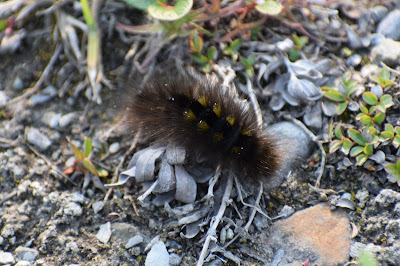
A Yukon arctic woolly bear in search of dinner. Syd Cannings photo.

Today, Isabel Barrio is a professor at the Agricultural University of Iceland, but in 2010 she was working on her doctorate under the direction Hik, a specialist in the alpine ecosystems of the southwestern Yukon. And she had a sharp eye for caterpillars.

Hik explained that there are two arctic species of woolly bear caterpillar -- Gynaephora groenlandica and Gynaephora rossii (the larval form of Ross' tussock moth) -- and they are easy to confuse. G. rossii, however, has a wide range all around the Arctic and in the high mountains farther south, so it was logical to assume the Kluane Range caterpillars were G. rossii.

When Barrio looked closely at the older caterpillars, however, she realized they weren't G. rossii. As improbable as it seemed, they appeared to be arctic woolly bears. The research group collected 30 caterpillars that summer to confirm the identification and to learn more about them.

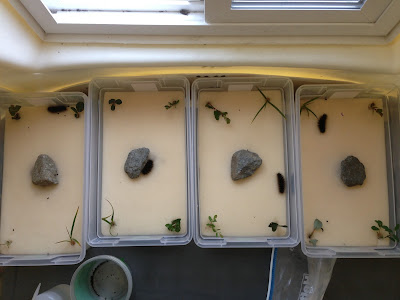
What's your favourite? An experiment to see what the Yukon caterpillars like to eat. D. Hik photo.

That led to another surprise. Analysis of the caterpillars' genetic code showed that the Yukon woolly bears were slightly different from other arctic woolly bears. They were, in fact, a newly discovered subspecies: Gynaephora groenlandica beringiana.

That last word is important. It refers to the fact that they were found in Beringia, the area of northwestern North America that remained ice-free during the last major glaciation. That probably explains their presence in the alpine valley. These fuzzy little beasts were likely crawling over the tough tundra vegetation of Beringia when most of Canada was buried under kilometres of ice -- and they're still there.

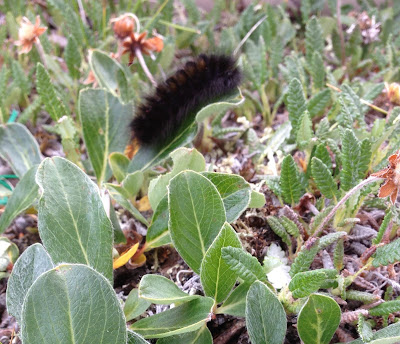
G. groenlandica beringiana perched on top of its supper. D. Hik photo.

Since Barrio's first identification of them, the caterpillars have been found in a few other locations in the Yukon. David Hik suspects they are widespread throughout the alpine areas of Beringia. He hopes that new research projects in the region will turn up more confirmed identifications -- and more information.

"They are very cool, and there is so much more to learn about them," he wrote.

16 Jan 2020

The Bug Girl is now an author!

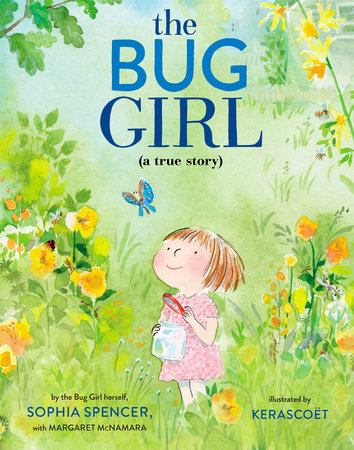
The Bug Girl by Sophia Spencer and Margaret McNamara


Did you hear the story of seven-year-old Sophia Spencer? Since she was a toddler, Sophia has loved bugs and learned about them. Her mother put out the call for... well, that would be telling.

Don't expect me to tell more about the Bug Girl. Click on this link to find out about her BRAND NEW BOOK now available from Random House.


(Kids these days! She's still in grade school but she's already friends with bug scientists and she's the author of a book from Random House. Oy!)