Showing posts with label adaptation. Show all posts

15 Jul 2022

Weird and Wonderful Animals

By Claire Eamer

I am fascinated by animals that surprise me, that make me rethink my assumptions about what is and isn't possible. Maybe they do something I'm sure they can't do. Or they find a completely unexpected way to survive in their bit of the world. Or they make me rethink how I survive in the world. 

Take, for example, the American dipper or water ouzel, scientific name Cinclus mexicanus.

American dipper. Photo by Ron Knight.
I used to live in Whitehorse, on the banks of the Yukon River in northern Canada. The river is huge and fast-flowing. And it's cold. In winter, it's mostly covered in ice with only a few patches of open water kept clear by the current.

Walking along a river trail one winter day, I saw a small black bird standing on the ice at the edge of the open water. As I watched, it dove straight into the (literally) icy water and disappeared. Just when I began to think it was drowned and frozen, it popped back out of the water and hopped onto the ice, looking none the worse for what should have been a near-death experience.

It was an American dipper, a species that pushes the boundaries of bird life. Dippers can stick their heads under water to search for food and swim underwater by using a flying movement with their short, strong wings. They can even walk along the bottom of a fast-moving stream, holding on with their extra-long toes and claws. 

An American dipper searches for food. Photo by David A Mitchell.

Watching that bird in Whitehorse led me to think about other animals that push boundaries, and that led to my book Lizards in the Sky: Animals Where You Least Expect Them (Annick Press). Snakes that glide from tree to tree, tiny worms that survive on glaciers, salamanders that live in the complete darkness of deep caves: they're all there.

My most recent animal book came from another kind of rethinking -- about why we find some animals or their habits disgusting and what they are really like if you don't just say, "Gross!" and turn away.


The result of my fascination with everything disgusting in the animal world was Extremely Gross Animals: Stinky, Slimy and Strange Animal Adaptations (Kids Can Press). It's full of animals that use puke and poop and spit and other gross stuff to survive. And if you look closely and ask questions, you'll find that they use it very well indeed.

I started by researching all things slimy and smelly (and found some great information), but I think my favourite beastie in the book is now the humble dung beetle. That might be because I found some in my own back yard.

It truth, dung beetles aren't all particularly humble. There are thousands of species of beetle that use dung as food or home or nest or all these. Some, like the elephant dung beetle, are big and showy. Elephant dung beetles actually eat elephant dung (thought it was just a name, didn't you?). Actually, they form it into a ball, roll it away, and bury it to make both a nest and food source for their young. 

[Take a look at Sci/Why contributor Margriet Ruurs's column about a trip to Africa, where she saw elephant dung balls -- and a lot more!] 

The dung beetles in my back yard aren't nearly as big or as showy. They don't roll the dung into balls. Instead, they dig little dens under it and use it as both protection and a food source for themselves and their young.

Two tiny dung beetles scurry away from the author.
I should explain that my back yard includes a couple of acres of forest on one of British Columbia's Gulf Islands -- and a lot of passing deer. I was curious about whether anything dung-beetle-like was using the deer droppings, so I went in search. 

I found a small pile of deer poop, about the size of a pocket wallet. It was dry on top and probably a few days old. I turned it over (using a stick, not my hand -- Come on! Some things really are a bit gross!). 

And there they were! Dung beetles -- two of them, peeking out of two little holes in the ground, the tunnels they had dug under the dung. Before I could tell them how pleased I was to discover them, they scooted away in search of another welcoming patch of deer droppings.

But I was pleased. It was a delight to meet some of the stars of my book face to face.


NOTE: The photos by Ron Knight and David A. Mitchell are licensed for use under Creative Commons Attribution 2.0.

16 Jul 2021

The "Ew!" Factor

By Claire Eamer

I have a new book out -- and it's so disgusting that it once put my editor right off her dinner. I'm proud of that! (Sorry-not-sorry, Stacey.)

The book is called Extremely Gross Animals: Stinky, Slimy and Strange Animal Adaptations, and it's exactly what it claims to be -- a book about the animals that make you go "Ew!" 


The thing is, once you get past the "Ew!" moment, these animals are fascinating. And adaptation itself is fascinating. 

For example, when I think of mucus, I mostly think of snot and all the unpleasantness that goes with a bad cold or (currently) my over-reaction to pollen in the air. As I blow my nose for the tenth time in a morning, I am not feeling all that friendly about snot. 

But when I learned about some of nature's snot-monsters, I started to change my mind. I'll be honest, I am just as likely as anyone to have a brief "Ew!" moment, but then.... Did you know that snot can be a primo defence mechanism? Or that snot can make a nice, safe place to sleep? Or a vehicle for travelling the world? Honestly, how can that not be fascinating?

And it's all true. Consider the hagfish, a far-from-beautiful eel-like fish with a mouth out of nightmares.

Pacific hagfish poking out of a hole 150 metres below the ocean surface. Credit: NOAA/CBNMS

Then think about picking up a hagfish, or sharing a tank with it as this fellow does. When a hagfish is attacked by a predator -- or even by a television commentator having an "Ew!" moment -- it can produce enough slime (mucus, snot, whatever you fancy) by the bucketful, enough to clog the gills of any fish that fancies it for dinner. Watch here to see some high school students have their own "Ew!" moment at a hagfish research lab at the University of Guelph.

But what about that snotty but safe place to sleep? That's not hagfish, that's the parrotfish, a much prettier denizen of the world's oceans. 

A rainbow parrotfish. Photo credit: Paul Asman and Jill Lenoble

A parrotfish spends its days pottering around coral reefs, eating algae that it has scraped off the coral with its bill-like mouth parts. At night, it sleeps safe and cozy in a cocoon of mucus freshly expelled from glands near its gills. Scientists aren't sure why. After all, you can't interview a parrotfish. However, the cocoon certainly keeps it safe from sharp encounters with coral, may protect it from parasites, and also would give it advance warning of any predator considering a midnight snack of parrotfish.

And the world traveller? Meet the violet sea snail, also called the purple bubble raft snail. 

This violet sea snail washed ashore in Maui with its bubble raft intact. Public domain photo.


As soon as it's born, the snail creates a raft of air bubbles enclosed in mucus to which its single foot is firmly stuck. The snail spends its life floating around the world's oceans upside-down, its foot attached to this mucus-and-bubble raft which keeps it safely at the water's surface. Both "Ew!" and "Awesome!"

And I haven't even begun to tell you what some animals can do with poop. Or puke. Or...well, you'll have to get the book for the rest of the grossness.

Enjoy!


23 Apr 2021

I have a new book!

By Claire Eamer

I HAVE A NEW BOOK COMING OUT JUNE 1!!!

(Oops. Did I shout? Sorry. It’s just that the birth of a new book is really quite exciting.)

Actually, let me tell you a bit about the book – and then I’ll move on to the “exciting.”

It’s called Extremely Gross Animals: Stinky, Slimy and Strange Animal Adaptations, published by my good friends at Kids Can Press. And it’s disgusting, in the best of all possible ways!

Note the tasteful use of both snot-green and puke-green on the book cover.

For example, did you know that baby elephants eat their mothers’ poop? And it’s good for them. Or that horned lizards shoot blood out of their eyes? (Okay, it’s from glands right near their eyes, but the effect is pretty much the same.) Or that giraffes can stick their tongues up their noses? And do!

The book has that and more – and I find it all fascinating. In fact, behaviour that looks icky at first glance usually turns out to be an unexpected but extremely useful way for an animal to survive and prosper. You can read all about it in my new book (did I mention that it’s called Extremely Gross Animals?) on June 1.

But back to the “exciting” bit….

A book isn't born either painlessly or quickly. It has a long, long gestation period. An elephant goes from fertilized egg to newborn baby in about 645 days, or about 21.5 months. Compared to a book, that’s downright speedy.

I checked back through my emails and found that I first mentioned the idea of Extremely Gross Animals to my editor at the end of August 2017. That means it will have had a gestion period of 44 months by the time it’s released to the world – more than twice the time it takes to produce an elephant. And all that for a book that’s just 40 pages long.

So what takes so long? Here’s a summary, based on my overflowing email archive (which I really should prune):

August 31, 2017: I mention in an email “…an old book idea I tinkered with a bit – gross and disgusting animals. I’m sure the world’s 8 to 12 year olds need this book!” My editor agreed, so we both started looking through lists of existing books to see if anyone had already written this book.

September 17, 2017: I submit a preliminary proposal for the book, designed not to duplicate any of the books we found in our search. The proposal bounces back and forth between me and the editor for a few months as we refine it.

January 9, 2018: I submit a full proposal to Kids Can Press (KCP): a detailed outline of the book, an explanation of the rationale behind it, a review of similar or competing titles, and suggestions about how it fits into the curriculum of several different school systems.

March 8, 2018: The KCP editorial board approves going ahead with the proposal, as long as there are enough good, kid-friendly photos of the animals. (There are.)

Long pause filled with personnel changes at KCP, publication schedule planning, and other mysterious goings-on. In other words, my proposal seems to have disappeared into a black hole.

November 8, 2018: After another editorial board meeting, input from the sales department, and more mysterious publisher activity, I’m told the book is a go. Yay!?! But that doesn’t mean the book is underway yet. I still don’t have a contract.

January 17, 2019: I receive a contract proposal from KCP. Then we (KCP, my literary consultant, and I) negotiate.

February 15, 2019: I have a contract with deadlines, royalty rates, lots and lots of fine print – and the book is officially underway! (At this point, of course, I have been researching my chosen animals for some time. But nothing’s official until it’s signed-official.)

…writing…researching…reorganizing…writing…more researching...more writing....

May 6, 2019: I submit the first draft of Extremely Gross Animals (although it doesn’t have that title yet).

May 28, 2019: Draft manuscript returned with editor’s comments.

June 6, 2019: I submit the second draft, along with a draft glossary and list of scientific names for some animals. A few days later, it starts circulating around the editorial department at KCP.

July 14, 2019: I receive editor’s comments on the second draft of the manuscript. I return the manuscript with a few changes a couple of days later, and then go on to work on the back matter, including the index word list, glossary, etc.

August 25, 2019: I receive a revised publication schedule from the publisher. The book has been moved forward to Spring 2021 publication instead of Fall 2021 (which still seems like a long way off). At this point, the designer, photo researcher, and printers get involved, with each stage checked by multiple people.

September 19, 2019: I receive the final edited version of the manuscript, along with the edited version of the end matter we’ve all been working on. Now we make decisions, such as figuring out which animals need to be identified by scientific name and how we do that without confusing the reader.

November 29, 2019: I receive the manuscript with the copy editor’s comments. These are usually the nitpicky bits related to the publisher’s house style, but it's also a chance for a fresh set of eyes to spot where something isn’t as clear as it should be. By this time, both the editor and I have read the manuscript so many times that we can’t reliably pick those moments out. So – yet a few more changes. At this point, I’m well over two years into this book.

April 29, 2020: The photo research is almost complete. The editor checks with me about a few of the photos – mainly whether they match the scientific information in the book.

May 7, 2020: I receive the first set pages (illustrated and laid out as they’ll appear in the book). My job is to check the text one more time, check all the photos to make sure they are scientifically accurate, and add any little touches that might seem necessary (for example, size references where it’s not clear how big or small the animal is). Comment from the editor: “And my advice is to do your review well before or well after eating -- after seeing the photos of the horsehair worms, I won't be eating spaghettini for quite a while.”

August 27, 2020: I receive a PDF file of the first complete colour version of the interior pages of the book. So pretty! And one more chance to catch problems. There aren’t many, but I send back my list of tweaks the next day.

September 9, 2020: I receive a draft of the cover copy (the text on the book’s back cover) for review.

September 22, 2020: I get my first look at the cover. Wow!

November 2, 2020: The final title is confirmed –

Author's delight -- a boxful of beautiful books!
Extremely Gross Animals: Stinky, Slimy and Strange Animal Adaptations – and I have official permission to start talking about the book.

And the rest is a matter of waiting to meet my book in person, face to …er…cover. That happened April 13 (less than four years after I started thinking about it), when my box of author's copies arrived. The rest of you will have to wait a few more weeks.

But you can pre-order the book at your local bookstore or online. It's called Extremely Gross Animals: Stinky, Slimy and Strange Animal Adaptations. Or did I already mention that?


25 Oct 2017

Galapagos – From Blue-footed Boobies to Swimming with Sharks (Part 1)

By Margriet Ruurs

Margriet and Kees Ruurs start their Galapagos adventure.
Galapagos Islands: the very name conjures up images of a mysterious paradise, of unique species of animals that have adapted to their environment in special ways.

I am so glad and grateful that I had a chance to visit these faraway islands, even thought they have now lost some of their magic for me. But the intrigue has been replaced by memories of walking among iguanas and swimming with sharks and sea lions.

When we made the decision to travel to South America, there were two things high on our wish list: Easter Island and the Galapagos. I had read a wonderful, insightful book called Charles and Emma by Deborah Heiligman. This book heightened my wish to see these islands for myself.

We flew from Guayaquil, Ecuador, west across the Pacific and landed on one of the circa 40 Galapagos Islands (did you know there are so many islands here?!): Baltra. The humid heat hit us like a wall.

Tourists can travel to the Galapagos on their own or via a planned trip. But even if you go on your own, you cannot visit the National Park areas without a guide or small tour group. The Galapagos Islands are not only expensive to reach; they are expensive in every way, since all food and drink needs to come from far away.

A guide met us at the airport, expertly whisked our luggage away, and loaded us and about 18 others onto a bus. It was only a 10-minute drive to the boat launch where we climbed aboard a bobbing dinghy. We would repeat this exercise in agility many times in the coming days.

The dinghy brought us to a medium-sized yacht. The MV Coral I had about 14 cabins and a total of 20 guests on board plus a crew of 15, including two naturalists.


That first day we visited the Charles Darwin Station on Santa C,ruz Island. This is where the breeding program for the Galapagos Giant Tortoises takes place. Eggs from all over the islands are hatched here and the little Giant Tortoises (what do you call a little giant tortoise?) are raised until the age of five, when they are released in hopes that they will survive on their own.

We saw several huge, ancient tortoises as well as amazing prickly pear cactus trees that grow into huge trees over 400 years old. Unfortunately, the buildings were not open to the public and we did not see eggs or baby tortoises.

We walked through town and discovered that, like Easter Island, the Galapagos we had imagined was very different from reality. For instance, did you realize that the archipelago consists of nearly 40 islands, four of which are permanently inhabited?

And did you know that over 30,000 people live in Galapagos? I had no idea. The cities of Santa Cruz and San Cristobal have schools, stores, government buildings, and much more. Two airports serve the islands. Since Galapagos was used as a penal colony by Ecuador, most houses had bars and gates as opposed by the much more friendly atmosphere on Easter Island. The heat was incredible.

There is almost no rain on these lava islands. Some are lush and green, but others are a volcanic wasteland. In fact, one early explorer wrote home to describe that he had arrived in what he truly thought was hell!


That first night we slept well in our slightly rocking bunks. However, the next two nights were rough as we crossed open ocean and coped with high swells that rocked the small boat left to right and front to back. Things flew through the cabin, and we ended up sleeping on the outside deck. Most of us didn’t get sea sick, but we rocked for three days afterwards.

(To be continued....)

All photos are Copyright ©Margriet Ruurs

For Margriet's previous blog posts about her visit to Rapa Nui, also known as Easter Island, click here and here.

17 Mar 2017

In Honour of Saint Patrick's Day - SNAKES!

By Claire Eamer

This day, March 17, is St. Patrick's Day, celebrated around the world by the Irish, the formerly Irish, the wannabe-Irish, and beer drinkers of all persuasions. It's generally marked by a lot of green - green clothing, green-dyed flowers, green-dominated parades, and that abomination - green beer.

But no snakes. Snakes almost certainly don't celebrate St. Patrick's Day (even though many of them are noticeably and naturally green). After all, St. Patrick is famous for driving the snakes out of Ireland. But did he?

A green tree python relaxes in comfort, using its own
body as furniture.
Sadly for legend, Ireland was snake-deprived long before St. Patrick arrived more than 1500 years ago. The cold temperatures and ice sheets of the last major glaciation drove snakes and other reptiles south. When the world warmed up about 10,000 years ago and the snakes moved back north, they were blocked by the cold waters of the Irish Sea. The few snakes that made it that far north simply settled down among the forests and hills of Britain and left the island of Ireland alone.

The Irish probably don't regret the lack of snakes, but they might be missing something. Snakes are amazing and quite beautiful. A few years ago, I wrote a book about animals adapting to extreme habitats (Lizards in the Sky: Animals Where You Least Expect Them) - and one of my favourite examples was the flying snakes of Southeast Asia.

The elegant rainbow boa is popular among collectors.
"Flying snakes?!?" you ask. (Well, most people ask that.) Really and truly! A small group of snakes in the jungles of Malaysia and Borneo has developed the ability to glide through the air. They fling themselves from a high branch, flatten out their bodies, and swim through the air in a wriggly glide. The most accomplished species, the paradise tree snake, has been seen to glide more than 20 metres - far enough to take it safely over a five-lane highway with room to spare.

And then there are the swimming snakes. "No, no... not swimming snakes too!" you cry. (I'm sure I heard you cry that.) Yup. Sea snakes, in fact.

Snakes taste tiny bits of scent in the air with their
tongues. The two forks of the tongue give the snake
a sort of stereo smelling capacity so it can tell
which direction the smell comes from.
Actually, sea snakes are quite common in the warm waters of the Indian and Pacific oceans, but most of them stay in the shallows close to shore.

The exception is the yellow-bellied sea snake, which is born at sea and lives there its entire life. Coolest fact? The yellow-bellied sea snake can tie itself in a knot. It loops around itself into a simple knot and runs the loop from one end of its body to the other to scrape off parasites and dead scales.

See what you're missing, Ireland?

Claire Eamer likes strange animals and weird facts and science of almost any kind. Her latest book is What a Waste! Where Does Garbage Go? (Annick Press, 2017).

5 Aug 2016

Who Knew What Grew on Poo?


pilobolus lentiger growing on dung
A large colony of Pilobolus, also called the
Hat Thrower or Dung Cannon 

I don’t want to offend anyone’s delicate sensibilities (or maybe I do!), but this post is about poo. More specifically, it’s about a secret world that grows on poo, a secret world than can be fascinating and sometimes—of all things!—strikingly beautiful.
cheilymenia stercorea growing on deer dung
This Eyelash Cup (Cheilymenia stercorea) grew on deer droppings.

I'm talking about coprophilous, or dung-loving, fungi. These fungi are our friends, as are all decomposers. They help dispose of what we don't want to see, breaking it down until it's nutritious compost—for the forest floor, the field, the garden. 

Some coprophiles are big. A few, like portobello and button mushrooms are good edibles (you did know that they're grown on a pasteurized substrate that contains manure, didn't you?). But most are so tiny you need a magnifying glass to see them. These are the guys I'm interested in.


ascomycetes growing on deer pellets
This deer pellet has three species growing on it. The tiny white
ones  grew into the smallest gilled mushrooms I've ever seen.

Right now, in fact, I'm trying to grow some of these mini characters on what used to be our dining-room table. 

About a week ago I was given a few samples of dried animal dung that are older than I am. At one time, these bits of dung had been studied, and then dried and stored, because interesting little fungi had been growing on them. The question is, are the spores that this dung holds still viable? Will fresh fungi appear? I have a bit of cow, goat, deer and rabbit dung, each now rehydrated and sitting in a moist chamber. Not much is happening yet, but I have high hopes.
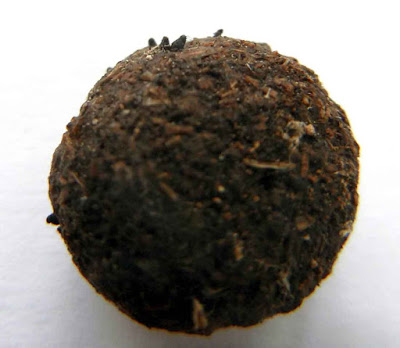
Podospora fungus growing on rabbit pellet
The wee black cones at the top of this rabbit pellet are a kind of Podospora.

These samples I'm nursing originally grew either nondescript lumps called Sporormiella (a Latin genus that when spoken aloud makes you sound drunk) or cuter ones from the genus Podostroma. I found some Podostroma a couple of years ago on a rabbit pellet. Though it's not the prettiest fungus, it has very nifty black spores that sport see-through tails.


podospora spore
Podospora spore—with see-through tails at both ends!

The Royal Ontario Museum's fungarium has an immense collection of fungi, over half a million, a large proportion of which are dung-lovers, because one of the early directors of the collection, Roy F. Cain, was a world-renowned dung-loving fungi lover. But what's to love about about these lowly characters? 


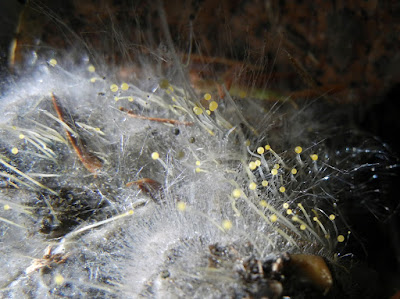
Phycomyces hairy fungus growing on raccoon dropping
I found this amazing furry Phycomyces fungus on raccoon scat.
Well, besides some being pretty, many have adapted to their chosen dung homes in downright astonishing ways.

My favourite is Pilobolus, also known as the hat-thrower or cannon fungus. These sparkling jewels don't look very fungal. Each has a skinny stem that rises only a few millimetres above the cow patty or horse puck it grows on. At the top of the stem there's a bulbous, transparent, fluid-filled "head," a head that wears a black "hat." Clustered beneath the hat are its spores.


Pilobolus lentiger hat thrower fungus dung cannon
Close up of the Hat Thrower or Dung Cannon
So how do the spores of these fungi get into the dung in the first place? They're ingested by the animal. And no, horses and cows don't eat poo. In fact, they shun it just like you do. Pilobolus's brilliant solution to this problem is to blast their spores away from the poo they grow on—up to two metres away. Recent research has determined that their spore-carrying "hats" can reach a speed of 25 metres a second. But the most amazing part is the acceleration, which is the greatest of any living thing! Pretty impressive for something that's less than a millimetre in diameter.


Pilobolus spore capsule
Pilobolus head & spore capsule "hat" under the microscope
Pilobolus lentiger spores
When I squashed it under a slide cover, the spores were released.
Not only do these little guys shoot their spore capsules a distance away, they're capable of aiming with the help of a light sensor inside their stems. On top of that, they also have a sticky coating on the exterior of their black "hats" that makes them stick to nearby plants, where they cling at the perfect height to be eaten by a passing quarter horse or Holstein. 


Pilobolus lentiger on manure
The black dots are Pilobolus spore capsules or "hats" that stuck to
the wall of the plastic container I put the horse dung in. 

How can you not love dung-loving fungi when there are characters like this around?

If you'd like to read more about Pilobolus and other fascinating fungi, (including a couple of other dung-lovers—Eyelash Cups on Moose and Deer Droppings and A Poop and Scoop Cup Fungus), check out my fungi blog, Weird & Wonderful Wild Mushrooms.


2 Jan 2016

Get Inspired for 2016!

Post by Helaine Becker

What better way to start the New Year off here at Sci-Why than with some inspiration?

I recently had the happy occasion to meet Filipe Deandrade, a nature filmmaker, while he was gathering footage for a new project with National Geographic. DeAndrade had won the 2015 Wild to Inspire film award, sponsored by the American Wildlife FoundationNational Geographic and the Sun Valley Film Festival for his short film, "Adapt." I think you'll like it, and hope we all find as much inspiration in our own work/lives in 2016!


 Happy New Year, everybody!


25 Jan 2013

Spider Art and Bioluminescent “Bombs”: Extreme Animal Mimicry


Exciting news for the world’s arachnophiles (spider lovers) broke late last year – a spider was discovered in the Peruvian Amazon that constructs a much larger fake spider in the center of its web. The as-yet-unnamed arachnid, likely belonging to the genus Cyclosa, creates its faux-spider masterpieces (some of which have eight legs!) out of leafy debris and dead insect parts. To further enhance the big-spider illusion, the real spider hides at the head of its creation and plucks strands of the web to make it vibrate.
The decoy spider's elaborate fake spider (Phil Torres)
So, does this spider make art? Nope, sorry – it’s not art. Creating a larger decoy of itself to frighten off potential predators is a form of self-protective mimicry that’s hardwired into the spider’s genes.
The most common form of mimicry is camouflage. Such visual mimicry can be as basic as a lion’s tawny coat blending in with the African savannah, or a gray-patterned moth disappearing when it lands on a similarly colored tree. More complex examples include caterpillars that pose as twigs, or leafy seadragons that are almost indistinguishable from seaweed, or spiders that, along with their webs, can be mistaken for bird droppings in both color and shape.
In Batesian mimicry, harmless species evolve to visually impersonate poisonous or distasteful species, which makes it much less likely that they, themselves, will be eaten. A master of this particular adaptation is the Indonesian mimic octopus.
The mimic octopus impersonates a flatfish, a scorpionfish, and a sea snake.
Octopuses are masters of disguise and can change color and pattern, and even texture, to match their surroundings. The mimic octopus’s self-defense strategy goes one step further – it’s a shape-shifter. This diminutive cephalopod has evolved an elaborate collection of behaviors that allow it to ape other marine animals. It stretches out its arms to imitate a scorpionfish flaring its poisonous spines, or hunkers down with only two legs extended in either direction to impersonate a venomous sea snake, or swims flattened out to mimic the shape of a flatfish. To date, this little octopus has been observed posing as fifteen other marine creatures! A fun twist to this amazing story is that scientists have recently witnessed a timid little black-marble jawfish, whose markings are strikingly similar to those of the mimic octopus, swimming perfectly disguised among the arms of one of these octopuses. A mimic mimics a mimic!
Australian chameleon gecko (Stewart MacDonald)
Decoy mimicry is yet another variation, in which animals have developed a means to either divert the attention of a predator or, conversely, to attract the attention of a potential meal.
One of the most radical practitioners of decoy mimicry is the gecko who, when threatened, is capable of discarding its own tail. The cast-off tails of some geckos flop around and writhe, offering a tantalizing alternative meal to predators while the geckos themselves escape. In Australia, the writhing, discarded tail of the chameleon gecko is made even more irresistible – it actually squeaks! Though self-amputation may sound like an extreme adaptation for survival, geckos are capable of growing replacement tails within a few months.

The adaptation of decoy mimicry isn’t confined to land animals. While studying life in the ocean’s depths aided by remote-controlled submarines, a group of scientists led by research zoologist Karen Osborn discovered seven new marine worms (annelids), some of which have developed a novel form of decoy mimicry – we just don’t know exactly what they’re mimicking.
Deep-sea marine worms release bioluminescent "bombs" (Karen Osborn)
These small bristly worms, the biggest no longer than a finger, come equipped with tiny balloons attached to their bodies near their heads. When one of these worms, which have been dubbed “green bombers,” is touched, it releases one or more of these bioluminescent “bombs” that give off intense green light for several seconds. It’s likely that a would-be predator, searching for a tasty morsel in the darkness, would be distracted by these mini floating lights while the worm is able to avoid being eaten by quickly swimming backwards out of harm’s way.


Update

August 21, 2018

I have to add this guy I came across in Chile. It's a fabulous example of automimicry – the kind where part of an animal's body looks like a more vulnerable part. 

Here's the first view I had of this insect:


"What a character!" I thought.  Kinda cute, and kinda homely at the same time, like an old shoe. 


Then I changed my camera angle... 


...and saw that what I'd thought was a face was actually the insect's rear end. 

How fabulous – it's abdomen was pretty much a replica of its head, complete with bulging red eyeballs! (If anyone knows anything about this beetle(?), I'd love to hear from you!!)


Here’s a link that has a video showing forward and backward movement of one of the newly discovered marine worms (genus Swima): http://news.sciencemag.org/sciencenow/2009/08/20-02.html
Here’s another that shows the mimic octopus in action: http://www.youtube.com/watch?v=H8oQBYw6xxc
And a delightful recording of the moment the decoy spider was discovered!: http://www.youtube.com/watch?v=RrWnZ7VySac