Showing posts with label fossils. Show all posts

25 Jun 2023

Dinosaur skin

Did you think that fossils were all bones and nothing more? Nope! Some fossils are impressions left of footprints or tracks. Other fossils are impressions left by skin textures. Sometimes even the tissues of an animal can be preserved, or visible in the fossil. It can be hard to figure out what we're looking at in a fossil of a soft-bodied invertebrate from long ago, but dinosaur fossils are usually easier to recognise. Some later dinosaurs may have had skin rather like an elephant, while others had skin and feathers like modern birds. There are many fossils with skin impressions showing scales much like a modern iguana or alligator!

Here are some articles about a dinosaur fossil, a nodosaur, that was preserved with skin or skin impressions and some of its innards: 

Check out this link at https://earthlymission.com/dinosaur-mummy-science-discovery-nodosaur-intact-canada/ - for fascinating photos of a nodosaur fossil found in Canada!

If you like to imagine what it's like to work in the field gathering fossils, try this link  https://www.huffpost.com/entry/dinosaur-mummy-unveiled_n_59187ca4e4b0fe039b35436f - for a video of the attempt to lift the wrapped fossil onto a truck.

For more than this brief note, look to this link for better explanations. https://earthlymission.com/perfectly-preserved-dinosaur-mummy-last-meal-science-study-nodosaur/ - for a discussion of this nodosaur's last meal, and wonderful drawings of the dinosaur as it would have looked alive.

2 Dec 2022

Velvet Worms

by Kim Woolcock


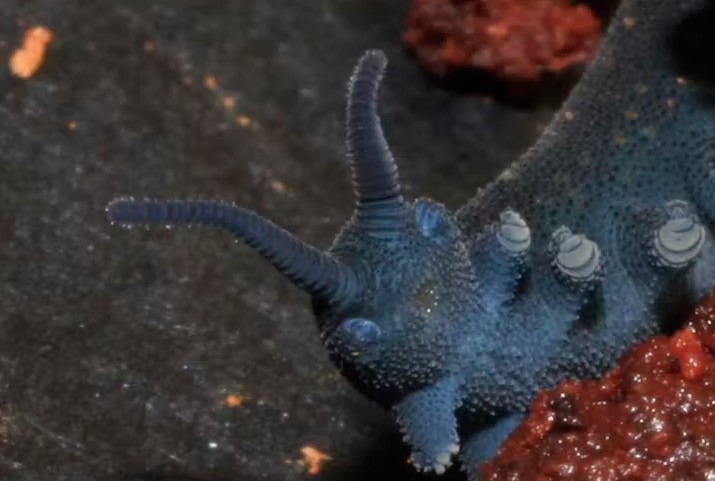
When I started writing It’s Tough to be Tiny, I didn’t know what a velvet worm was. I stumbled across a reference to them while researching small creatures with superpowers, and the name immediately hooked me. Velvet worms?? Would they be fuzzy and cute? And why had I never heard of them?
It turns out they are not fuzzy but they are very cute. And they are deadly hunters. I am a sucker for creatures that are cute but deadly, and as soon as I started reading about them, I knew velvet worms needed a place in the book.
 

The velvet worm Euperipatoides flexes its slime glands.
Image by: Andras Kezzei/Flikr
Velvet worms have soft, squishy bodies, and a kind of nubbly appearance (the nubbins are tiny whiskers that help them feel their way through tight spaces). To me, they look like living sock puppets. Their unique way of hunting is what makes them famous, though. They shoot their prey with sticky goo that comes out of two nozzles (slime papillae) on their face. The goo nozzles wiggle back and forth, like a garden hose that no one’s holding onto. The prey gets covered in a layer of sticky goo that rapidly hardens into a stiff cage of glassy threads. The velvet worm can then bite the prey to inject innard-melting enzymes, and drink the prey milkshake at its leisure.
A velvet worm attacking its prey
By: Stacey Thomas

Scientists have been fascinated for almost a hundred years by how the slime transforms from a sprayable goo to a glassy thread (the process is reversible, too—the dried slime melts in water, and can re-harden!). Even cooler, the prey actually helps in its own capture. Its struggles help to dry out and stiffen the threads, similar to how kneading transforms bread from a sticky lump into a stretchy dough.

A velvet worm devouring its prey
By: Stacey Thomas

So how had I never heard of them? They are not exactly the most cosmopolitan creatures. There are only about 200 known species of velvet worms (phylum Onychophora), mostly in the litter layer in tropical and southern hemisphere forests. They hunt at night, and even the scientists who study them say they are kind of hard to find.
Adding to their mystery, velvet worms have recently been found to be related to Hallucigenia sparsa, a puzzling fossil from the Cambrian explosion about 500 million years ago. A tubelike creature with spines on one side and tentacles on the other, it was called Hallucigenia because it was so bizarre looking that scientists couldn’t tell which way was up or which end was its head, never mind what other animals it might be related to.
 

Hallucigenia sparsa fossil
Taken by: Michael Brett-Surman

A recent study used state-of-the-art electron microscopes to examine the claws of Hallucigenia and modern velvet worms, and found that they both have claws with layers like an onion, indicating they are related. I love knowing that Hallucigenia, once so bizarre no one had ANY idea what it was related to, has such adorable descendants.
If you’d like to learn more about the amazing world of minibeasts, check out my book It’s Tough to be Tiny: The Secret Life of Small Creatures, illustrated by Stacey Thomas (Flying Eye Books, 2022). It’s all about the superpowers of small creatures, from springtails to cone snails, and how they stay safe, hunt for their lunch, or buddy up with bigger creatures for the benefit of both. It’s full of glitter and gross, because nature is both.
 

Resources:

A Baer, S Schmidt, G Mayer, and MJ Harrington. (2019) Fibers on the fly: Multiscale mechanisms of fiber formation in the capture slime of velvet worms. Integrative and Comparative Biology 59(6): 1–10. https://doi.org/10.1093/icb/icz048

Baker CM, Buckman-Young RS, Costa CS, and Giribet G. (2021) Phylogenomic analysis of velvet worms (Onychophora) uncovers an evolutionary radiation in the neotropics. Molecular Biology and Evolution 38(12): 5391–5404. https://doi.org/10.1093/molbev/msab251

Garwood RJ, Edgecombe GD, Charbonnier S, Chabard D, Sotty D, and Giribet G. (2016) Carboniferous Onychophora from Montceau-les-Mines, France, and onychophoran terrestrialization. Invertebrate Biology 135(3):179–190. doi: 10.1111/ivb.12130.

Smith, M, Ortega-Hernández, J. (2014) Hallucigenia’s onychophoran-like claws and the case for Tactopoda. Nature 514, 363–366. https://doi.org/10.1038/nature13576

https://theconversation.com/the-worlds-weirdest-creature-finds-descendants-in-cuddly-velvet-worms-30438

https://www.nytimes.com/2015/07/07/science/hallucigenia-cambrian-explosions-strange-looking-poster-child.html

https://www.wired.com/2014/03/the-creature-feature-10-fun-facts-about-velvet-worms/

7 Feb 2022

Fossil Microbes

Paleontologist Andrew Knoll has just been awarded the Crafoord Prize for Geosciences, a prestigious international award from the Royal Swedish Academy of Sciences. The academy chose Knoll to honour his work on understanding the first 3 billion years of Earth's history. 

By examining layers of bedrock, Knoll can learn not only whether it is volcanic or sedimentary but also the age of the rock. He is one of many scientists discovering tiny living things that became fossils in the rock long ago, and he's one of the best in the world. These fossils are the tiny ancestors of every living thing on Earth. Learning about them is key to understanding the world's worst mass extinction.

Knoll has travelled the world, studying rocks in Newfoundland and Norway, China and Siberia. He's found tiny fossils from microbes that lived three billion years ago, a time when scientists used to believe there was no life yet on Earth. When the Mars probe Opportunity was sending back images from 2003 to 2018, Knoll was interpreting the data. He has kept his sense of wonder since he was a child finding fossils in the Appalachian foothills. And it was while caring for his own child, awake one night, that Knoll considered an idea that might explain the Permian extinction.

During the Permian extinction, 90% of species in the ocean and 70% of land animals died. Knoll wondered if that mass extinction might have been due to a rapid rise in CO2. He and his colleagues discovered the source of that CO2, a massive area of volcanic activity now called the Siberian Traps. 

You can read more about Dr Andrew Knoll, his research, and his award at this link.

26 May 2017

Three Men in a Canoe – A Fossil Legacy

By Larry Verstraete

Over the phone, Don Bell is matter-of-fact and modest, as if just about anyone could have accomplished what he, Henry Isaak, and David Lumgair did. But others didn't - at least not initially, nor to the same degree - and you don't have to look far to find proof of their legacy. It's a floor below the indoor hockey rink in Morden, Manitoba, in a sprawling space called the Canadian Fossil Discovery Centre (CFDC).

During my research for ‘Dinosaurs’ of the Deep: Discover Prehistoric Marine Life (Turnstone Press), Don Bell's name came up often. "He knows more than almost anyone," someone at CFDC told me. "You should call him."

So I did. "Can you tell me how this all started?" I asked.

"We were on a canoe trip," Don said.
(L to R) David Lumgair, Henry Isaak, Don Bell taken on the day they heard about the fossil find
(Photo courtesy of Don Bell)
In quick steps, Don covered the story of a 1972 canoe trip involving a group of paddlers. Don, Henry and Dave were in one canoe, keeping leisurely pace with the others. At a stop for lunch, discussion ensued about a recent discovery of dinosaur bones in the Morden area.

"Hank and I were interested," Don said.

Bitten by curiosity, Don and Henry, both teachers, struck out at 6 a.m. on a later weekend to search for the fossil. A mile west of Morden's Stanley Park, they turned south and drove another 300 metres. Lying exposed in a field, they discovered a large fossil skull. Immediately, they realized that it was not a dinosaur, but a long-extinct – and very large – marine reptile.

"We knew it was important," Don added.

Ill-equipped to bring the skull home, Don and Henry drove back to town to regroup. By the time they returned, two young fellows were there, hammering the fossil to pieces.
The Manitoba Escarpment near Morden, Manitoba.

The Morden region lies at the edge of the Manitoba Escarpment. Eighty million years ago, at the time of the dinosaurs, the Western Interior Seaway sliced across North American dividing it in half. The escarpment is a by-product of Manitoba’s watery past and a rich source of marine fossils from that period.

At the time, the Pembina Mountain Clays Company had been mining the area for bentonite, a type of volcanic clay used in detergents and other products. Fossils turned up frequently, often crunched to bits by heavy equipment.

Realizing the scale of destruction, Don and Henry embarked on a mission to save as many as possible. The two got to know the miners and struck up a deal. When fossils surfaced, miners placed a call to the pair. In the evening, after the miners shut down for the day, Don and Henry salvaged what they could before operations resumed in the morning. Sometimes they worked through the night, excavating and jacketing fossils by the glow of headlights. They carted their prizes home and stored them in Henry's garage and Don's basement.

Knowing the demands of teaching, I couldn't imagine a life of all-nighters. "What kept you going?" I asked Don.

"To me it was exciting, discovering something that hadn't been discovered before," he said.
A plesiosaur on display,
one of many collected  by Don and Henry.
What started as a small-scale operation mushroomed. Interest spread. Volunteers joined the effort. Henry tapped into government grants and hired university students to help. The pair consulted paleontologists and made weekend field trips to Kansas City, Drumheller, and the University of Calgary, places with Late Cretaceous fossils and people with the necessary know-how.

Early on, David Lumgair – the third man in the canoe – got involved, too. He lived on a farm near Thornhill, a few kilometres from Morden. Fossils often surfaced on his land, and Dave had an open-door policy when it came to the growing brood of fossil hunters. He welcomed them and let them set up shop on his property.

In just two years, the ambitious team unearthed 30 mosasaurs, 20 plesiosaurs, and hundreds of other fossils from the region around Morden. In 1974, David’s farm yielded a spectacular prize – an immense mosasaur. Nicknamed Bruce, it took several seasons to unearth and jacket the entire creature.
Bruce, the world's largest mosasaur, on exhibit at the Canadian Fossil Discovery Centre.

Eventually, the collection of fossils outgrew Don’s basement and Henry’s garage. It was moved to the Morden and District Museum, and then in 1976 to its present quarters in the lower level of Morden's Community Centre.

Today, the Canadian Fossil Discovery Centre is a world-class institution. It houses Canada's largest collection of Late Cretaceous marine vertebrate fossils. The undisputed star of the Centre is Bruce. The sprawling 13-metre-long mosasaur is the world’s largest exhibited mosasaur and a Guinness record-holder.
Two university students with Victoria Markstrom (R), Field Collection Manager
for the Canadian Fossil Discovery Centre at a dig site along the escarpment.
The Morden area continues to yield fossil treasures, and new finds are constantly being added to CFDC’s holdings. The place is a buzzing hive of research and educational programs, and a fitting reminder of what three people hooked by passion and persistence can achieve.

Links:
Canadian Fossil Discovery Centre   http://discoverfossils.com/
Turnstone Press  http://turnstonepress.com/
Larry Verstraete  https://www.larryverstraete.com/

Unless otherwise noted, all photos by Larry Verstraete.

2 Oct 2015

Visiting Hoodoos and Royal Tyrrell Museum


Say hello to my little friend! This is Morgan and her auntie, among the hoodoos near Drumheller where she was having fun with science. Seventy million years ago, this area was a shoreline plain and shallow sea where lots of plants and animals lived. Now it's dry and not much grows except scrubby grass and bushes near the streams.


It's al lot easier to learn about geology and paleontology when you run around the hoodoos like Morgan has done, and you're able to see all the layers in the ground that have built up day by day over millions of years. In the Alberta Badlands, there are plenty of places where there's no recent accumulation of soil and plants to hide the layers in the ground. A hoodoo forms when there's a tougher layer that resists eroding. The tough layer makes a cap, and as the softer layers wear away on the sides a pillar can get quite high. Some of the hoodoos are interestingly shaped!


You can see the clay and bits of stone all around Morgan. As the ground is weathering away here, new bits of stone start to show from where they have been buried for millions of years in the layers of sediments. Some of these bits of stone are the bones of dinosaurs and other long-ago animals that have been in the ground so long, they have turned to stone. I've always liked that these bones are called fossils, from an old word for something dug out of the ground. It isn't an everyday thing to find fossils (unless you live near Drumheller!) so it's nice to have a non-ordinary word to name them.


At the Royal Tyrrell Museum in Drumheller, many of these fossil bones have been prepared for display. Some of the displays use carefully-made replicas of the bones, which are lighter and easier to arrange in the shape of the animal when it was alive. There's an active website for this museum which is as fun to explore as the building. The museum even hosts short courses for distance learning, and it hosts a course for homeschools on paleontology! It's one of my favourite museums.


While some fossil bones are from small animals, people are particularly interested in the animals larger than ourselves. I like to look at this picture, and see how Morgan's little hands and feet have bones like the ones in this dinosaur's foot!


It's easy to tell that Morgan enjoyed her day at the museum, learning about science and the animals of the past! I'll have to find her some books now she's growing old enough to read them and ask questions.

30 Jan 2015

Old Fossils, New Knowledge – and the Case of the Misplaced Mastodons

By Claire Eamer

About 18,000 years ago, during the last ice age, the Yukon was a menagerie of exotic animals – scimitar cats, giant short-faced bears, and huge, lumbering woolly mammoths, among many others. Until recently, scientists thought those “others” included the mammoth’s distant cousins, mastodons.
Mastodon, by George Teichmann. Courtesy of Yukon Palaeontology Program.

And they had the radiocarbon dates to prove it. Two mastodon teeth from the Yukon had been reported in the scientific literature as dating from 18,000 years ago and 24,000 years ago, respectively.

But, increasingly, the dates didn’t sit right with Yukon government palaeontologist Grant Zazula. The more scientists learned about the ecology of the Yukon 18,000 years ago, the more puzzling the presence of mastodons became.

You see, mastodons were common in the mid-latitudes of North America, where they roamed the conifer forests, grazing on forest plants and browsing the twigs and needles of the trees. But both reported dates put mastodons in the Yukon at the height of the last glaciation. And there were no trees.

At that time, when most of Canada was buried in ice, the Yukon lay along the eastern edge of a vast, cold, dry, grassy plain that reached all the way to Siberia. It was perfect for grass-eaters, such as the woolly mammoth, but the cold and the lack of trees wouldn’t have suited mastodons.

What were tree-chomping cousins of elephants doing in a landscape virtually without trees? Actually, Zazula wondered, were they there at all? The teeth were the real deal, but what about the dates?

In the years since the teeth were dated, scientists have improved dating technology and learned a lot about the materials they’re working with.

And more mastodon fossils have turned up. A truckload of them, in fact – courtesy of Yukon gold miner Earl Bennett. Zazula met Bennett a few years ago, not long after he started his job as Yukon palaeontologist. Bennett told him he’d found a partial mastodon skeleton in the Klondike goldfields, where so many Yukon fossils have been discovered. The next day, he showed up at the palaeontology lab with a pickup truck full of giant bones.
Mastodon tooth. Courtesy of Yukon Palaeontology Program

So – with more bones and with new approaches to dating them, Zazula set out to see if mastodons really had adapted to life on a dry plain.

First, the original teeth were re-dated, using new techniques. This time, both showed as more than 50,000 years old. Radiocarbon dating only goes back reliably to about 50,000 years, so they could well be older.

To check the new dates, Zazula decided to date as many mastodon fossils as he could find. Altogether, he and his team (there are 15 named authors on the paper reporting the findings) managed to get 53 new dates on 36 fossils. The dates consistently came back near the 50,000-year limit of radiocarbon dating.

Ultimately, the scientists concluded that mastodons last lived in the Yukon about 75,000 years ago, when a warm period between glaciations (called an interglacial) lasted long enough for forests to grow and forest creatures, such as the mastodon, to move into them. Then the ice came back and the forests died – and so did the mastodons.

But how could those first reported dates be so wrong?

It’s easy. The samples were contaminated by carbon from much younger sources – humic (organic) acids in the soil and even the materials museums put on fossils to preserve them, Zazula said in an email interview..

The error wasn’t due to carelessness on the part of the first dating labs. Only recently have scientists developed ways to separate old carbon from new. Zazula’s tests were done with a technique that isolates a single amino acid, hydroxyproline, that occurs in collagen – a protein in bones and teeth.

“Probably 99.9% of the hydroxyproline in the natural world only occurs in collagen,” Zazula said. “So, by isolating this single amino acid, we can be confident that the carbon that is radiocarbon dated, only comes from the fossil itself, not from these darn humic acids from soils which can bind themselves to bone collagen.”
Grant Zazula takes a sample of mastodon bone for dating.

Museum specimens can be contaminated too, he said.

“The problem is that museums have been putting 'stuff' on fossils for centuries to preserve their collections. In most cases, records were not kept in regards to what they actually put on the fossils. So, who knows what is on these bones sometimes?”

With younger specimens, around 10,000 years, it’s not such a problem, because they still contain plenty of radioactive carbon, Zazula said. But by the time a fossil is 50,000 years old or more, there’s almost nothing left to sample.

“Introducing even the smallest molecule containing 'young' carbon-14 into the sample can completely change the radiocarbon date because you are essentially only measuring the contaminant then.”

Separating a few molecules of old carbon from the mass of newer material sounds – and is – technically difficult and frustratingly fiddly. But the resulting information has rewritten thousands of years of history and solved the lingering mystery of the misplaced mastodons.


Here are a couple of news stories on the mastodon research: at CBC and in the Globe and Mail.

You can listen to Grant Zazula talk about mastodons on the Dec. 6, 2014 episode of the CBC radio program, Quirks & Quarks.

Here’s a lengthy and well-illustrated set of posts about Yukon palaeontology and mastodons on the Mostly Mammoths, Mummies and Museums blog: Part 1 and Part 2. Part 3 is still to come, so keep your eyes open!

The article setting out the results of the project was “American mastodon extirpation in the Arctic and Subarctic predates human colonization and terminal Pleistocene climate change” in Proceedings of the National Academy of Sciences, Vol. 111 No. 52, which was published online (but behind a pay wall) on Dec. 1, 2014. The full list of authors is Grant D. Zazula, Ross D. E. MacPhee, Jessica Z. Metcalfe, Alberto V. Reyes, Fiona Brocke, Patrick S. Druckenmiller, Pamela Groves, C. Richard Harington, Gregory W. L. Hodgins, Michael L. Kunz, Fred J. Longstaffe, Daniel H. Mann, H. Gregory McDonald, Shweta Nalawade-Chavan, and John R. Southon.