Showing posts with label extinction. Show all posts

7 Oct 2022

Museum in the Classroom: The Pleistocene Extinction Teaching Kits


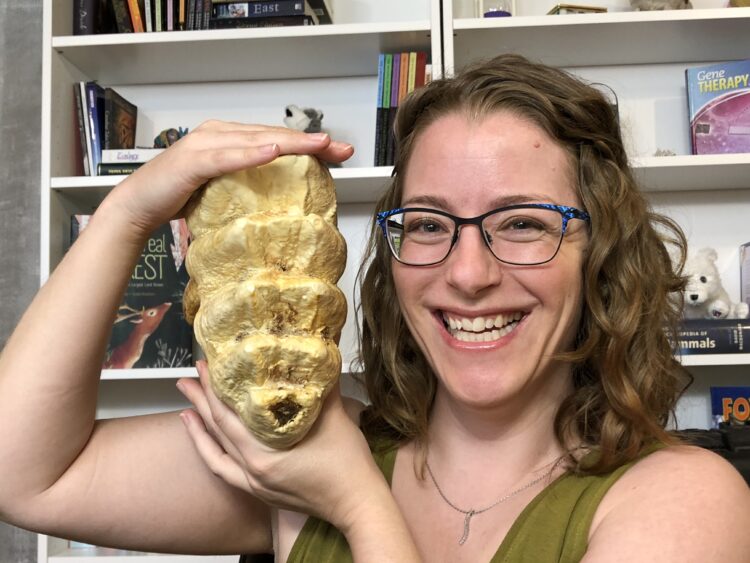
A mastodon molar is AS BIG AS MY HEAD, y'all.


by L. E. Carmichael

Did you have a dinosaur phase when you were a kid? I did. I was in the second grade, and I was obsessed. I pored over library books, memorizing five-syllable names and amazing the adults with my stockpile of bizarre dino facts (I still do that). I liked the armoured species best, because they were just so weird.

And then my parents took me to the Royal Tyrrell Museum to see real fossils. 

Mind. Blown.

Looking back, I can see how these early experiences helped spark my life-long obsession, not just with dinosaurs, but with all life on Earth. But not every child has opportunities to visit natural history museums, either with their families or on school field trips. That's why, when Dr. Lynda Colgan asked me to write the teacher's guides for her Learning with Palaeontology project, I jumped at the chance.

(Also, I'm pretty sure that all children's science writers are legally-obligated to write about dinosaurs at least once in their careers, so box checked!)

As with most of Lynda's ideas, this one was both simple and profound. First, we'd get some great big boxes. Next, we'd fill them with museum quality casts of real fossils, providing teacher's guides that provided the latest scientific knowledge about the species, while focusing on inquiry and hands-on learning. And then, we'd make the kits available to teachers for free.

And giant beavers? They were as big as black bears.
I mean, how cool is THAT?

The first two Kits, on the Pleistocene Extinction, are now available to borrow. Teacher-friends, here's what you need to know:

Features of the Kits

  • Fossil casts of mammals that lived in Canada during the Pleistocene
  • Supporting materials such as magnifying glasses, graphs, and charts
  • Teacher’s Guide containing
    • ALL the information needed to teach core concepts
    • Suggestions for hands-on learning and independent inquiry
    • Glossary, further reading lists, and bibliography of sources
  • Content vetted by experts in palaeontology, education, science communication, and Indigenous issues

Core Concepts and Skills

Junior Edition - Best for Grades 4-7

  • Habitat
  • Evolution and adaptations
  • Biodiversity and classification systems
  • Food chains and energy pyramids
  • Competition and predator/prey interactions
  • Climate change
  • Extinction

Senior Edition - Best for Grades 8-12

  • Habitat and geographic range
  • Evolution and adaptations
  • Competition and predator/prey interactions
  • Trophic cascades
  • Heredity and ancient DNA
  • Climate change
  • Extinction
  • De-extinction: biotechnology and bioethics
  • Correlation vs. causation

At both levels, students will:

  • Evaluate sources of information and assess their strengths and weaknesses
  • Draw conclusions using multiple lines of evidence
  • Understand the relevance of palaeontology to urgent contemporary issues

Junior/Elementary Kit

Borrowing Instructions:

Are you in Ontario? You're in luck! Head on over to the Queen's University Education Library catalogue and place a hold on a physical kit. The cases are on wheels, but they weigh about 40 pounds, so I recommend bringing a friend and a vehicle with a big trunk.

Not in Ontario? Don't worry, we have got you covered. Each Kit is also available in a digital edition, complete with 3D scans of the fossils that you can manipulate from your web browser. Direct links are here:

Junior/Elementary Level

The Pleistocene: Using Ice Age Mammals to Explore Climate, Habitat, and Extinction

Senior/High School Level

Conservation Palaeontology: Using Ice Age Mammals to Explore Climate Change and Extinction

Again, these resources are available to Canadian teachers absolutely free. I field tested them at some student workshops during Science Rendezvous in May, and I can guarantee your kids will be spellbound. I was beyond delighted at the level of critical thinking and curiosity my groups displayed while interacting with the fossils, and I can't wait to hear similar stories from classrooms across the country.

I also cannot wait to launch the new Kits we've been developing this year. Stay tuned, and keep exploring!


The Learning With Palaeontology Project is supported by:



with graphic design by:



7 Feb 2022

Fossil Microbes

Paleontologist Andrew Knoll has just been awarded the Crafoord Prize for Geosciences, a prestigious international award from the Royal Swedish Academy of Sciences. The academy chose Knoll to honour his work on understanding the first 3 billion years of Earth's history. 

By examining layers of bedrock, Knoll can learn not only whether it is volcanic or sedimentary but also the age of the rock. He is one of many scientists discovering tiny living things that became fossils in the rock long ago, and he's one of the best in the world. These fossils are the tiny ancestors of every living thing on Earth. Learning about them is key to understanding the world's worst mass extinction.

Knoll has travelled the world, studying rocks in Newfoundland and Norway, China and Siberia. He's found tiny fossils from microbes that lived three billion years ago, a time when scientists used to believe there was no life yet on Earth. When the Mars probe Opportunity was sending back images from 2003 to 2018, Knoll was interpreting the data. He has kept his sense of wonder since he was a child finding fossils in the Appalachian foothills. And it was while caring for his own child, awake one night, that Knoll considered an idea that might explain the Permian extinction.

During the Permian extinction, 90% of species in the ocean and 70% of land animals died. Knoll wondered if that mass extinction might have been due to a rapid rise in CO2. He and his colleagues discovered the source of that CO2, a massive area of volcanic activity now called the Siberian Traps. 

You can read more about Dr Andrew Knoll, his research, and his award at this link.

6 Apr 2018

Moby, we hardly knew ya!

By Claire Eamer

I recently wrote an article for Hakai Magazine, an online magazine about coastal life and science, on the accuracy (or lack of it) in the way whales are portrayed in children's books. Researching that article led me to a great irony: whole species and populations of cetaceans -- both whales and dolphins -- are at risk of extinction because of humans, while, at the same time, we humans are just realizing how amazing and possibly how like us cetaceans are. We could lose whales -- or, at least, a great many of them -- before we really get to know them.

A blue whale surfaces in the open ocean. Pixabay photo

The Bad News First

 Instead of teeth, blue whales and
right whales have baleen, plates
made of keratin, 
that sieve food
out of the water.
Claire Eamer photo
The bad-news side of that equation is how much damage we have already done to the world's whales. Take, for example, the blue whale, the largest animal that ever lived on Earth. Before the days of commercial whaling, the world population was probably about 250,000. Today, 50 years after an international ban on hunting blue whales went into effect, the world population has recovered to somewhere between 10,000 and 25,000 individuals, scattered across all the world's oceans except the Arctic Ocean. That's a tenth or less of what the world once supported.

Other whale species are further from recovery -- some maybe too far. North Atlantic right whales had a terrible year in 2017. At least 17 died in the waters off Atlantic Canada and the Atlantic coast of the United States, most as a result of ship strikes or entanglement in fishing gear. The most recent estimates put the population of North Atlantic right whales at about 430. About 100 are reproductive females, but after the most recent breeding season no new calves have been spotted. Some scientists have warned that the whales are just a couple of decades from extinction if nothing changes.

The waters around southern Vancouver Island, where I live, are home to a population of killer whales that is in just as much trouble as the North Atlantic right whales. Maybe even more trouble. The southern resident killer whales are fish-eaters -- and a whale can eat a lot of fish. They rely heavily on chinook salmon, which used to return to their spawning grounds along the coast of the Pacific Northwest in huge numbers. But commercial fishing, habitat destruction, and contaminants have reduced the numbers of chinook and, along with them, the numbers of fish-eating killer whales. The southern resident killer whale population is down to just 76 individuals at last count, and even those few have having trouble finding enough salmon to stay alive and healthy.

Killer whales, whether they eat fish or mammals, have impressive sets
of sharp teeth to catch and hold their prey. Claire Eamer photo

And Now the Good News

The good news is that we're learning a lot about whales, both through science and through a growing recognition of the traditional knowledge of whale-hunting cultures, such as the Inuit and other peoples of the Arctic. Perhaps if we know enough about them, we will care enough to save and protect them. As a start, here are some cool facts about whales.

Whales have cultures. They pass knowledge and forms of communication down from generation to generation. The southern resident killer whales know how and where to hunt for salmon, and they pass that information on to their calves. The Bigg's killer whales (also known as transients) know how to hunt sea mammals, such as seals and sea lions, and they pass that information along, generation after generation, possibly for millennia. A 2010 genetic study showed that Bigg's killer whales, which often hunt in the same waters as the southern resident killer whales, have been separate from other killer whale populations for 700,000 years.

Whales have language. And they sing songs. The long and complex songs of humpback whales have fascinated scientists and non-scientists alike for decades, but they're not the only singing whales. Most recently, scientists working near Svalbard in the Arctic catalogued 184 different song types sung by bowhead whales in the icy dark of an arctic winter.

Whales are like us in another important way -- they're mammals and they breathe air. However, over millions of years, their bodies have adapted to life in the water. Their nostrils moved to the tops of their heads and became blowholes that can suck in a lungful of air at the water's surface. The passage leading from their mouths to their lungs -- that's what lets us breathe through our mouths -- closed off so that they could gulp up food under water without drowning.

A Bigg's killer whale, its blowhole clearly visible, swims past
 the shore of Vancouver Island. Alan Daley photo
And they learned to sleep without breathing in water instead of air. A whale or dolphin rests only half its brain at a time. The other half stays slightly awake in order to make sure the animal opens its blowhole to take a breath of air and closes it to keep out water. After the sleeping half of the brain has had a thorough rest, it takes over breathing and swimming duties while the other half sleeps. Scientists call this method cat-napping but whale-napping seems a much better name!

That's just a taste of the amazing things we've learned about whales. If we can avoid harming them further with noise, pollution, fishing gear entanglement, ship strikes, habitat destruction, and all the other dangers we have created for them, we could learn so much more.

25 Nov 2016

Canada's Only Great Auk

by Jan Thornhill
museum illustration Jan Thornhill Tragic Tale of Great Auk
"Museum" page from The Tragic Tale of the Great Auk (Jan Thornhill)

While working on my new book about the extinction of the "northern penguin," The Tragic Tale of the Great Auk, I became aware that the Royal Ontario Museum (ROM) in Toronto was in possession of Canada's only stuffed one. Hoping to see it, I visited the ROM's brilliant Schad Gallery of Biodiversity, but was disappointed to find no Great Auk, though there was an equally extinct Labrador Duck on display. How sad, I thought, that the regal bird I sought was not on view, was instead tucked away in some dark cupboard, sealed, perhaps, inside a titanium box, safe, but invisible.


John James Audubon illustration Labrador Duck
The extinct Labrador Duck (John James Audubon)
But a couple of months later, when I arrived at the ROM to talk auks with Oliver Haddrath, the ornithology reasearch technician whose specialty is extinct flightless birds (like the poor Great Auk), I was thrilled to be led out into the same animal diversity gallery where this time—ta da!—behind two layers of glass, there it was, one of the last of the millions of Great Auks that once thrived in the North Atlantic. 


Jan Thornhill with stuffed Great Auk ROM
Me and Canada's only Great Auk (Frankie Thornhill)
There are only 78 stuffed Great Auks in the world, almost all held by museums. American museums own a decent chunk of them—eleven—though that number used to be twelve. The twelfth one was once owned by John James Audubon, the American bird painter famous for his Birds of North America book published as a double-elephant portfolio, "elephant" because it had to be big: Audubon presented all of his subjects life size. Though each page is a huge 39.5 inches tall and 28.5 inches wide, the largest birds—cranes, herons, flamingos—had to be doubled over in his compositions to fit. 


John James Audubon flamingo
Because Audubon painted birds life-size, he had to double
over the biggest ones to make them fit on the pages. 

Audubon included the Great Auk in the book, but he never saw one alive. He had to base his painting on a taxidermy model, a specimen killed in Iceland in 1830 that he bought in London in 1836. 


Great Auk John James Audubon
Audubon's Great Auks

Eventually, Audubon gave has stuffed auk to a birder friend, Jacob Post Giraud Jr., who, in turn, gifted it (along with the rest of his large collection of stuffed birds) to Vassar College in 1867. There, "Audubon's Auk" gathered dust—quite literally—for more than 50 years, until it was found under a lab sink by Dr. L.C. Sanford who had connections to the American Museum of Natural History. Though the college continued to own the bird, Sanford convinced them in 1921 to allow him to send the auk off for renovation and remounting. When it was all spiffy again, it wasn't sent back to Vassar, but was housed instead at the Museum of Natural History in New York, hidden away in a double crate for the next 43 years. 


great auk profile ROM
The friendly face of the Royal Ontario Museum's Great Auk
Though Canada had once been home to the largest Great Auk colony in the world—on Funk Island off the northeast coast of Newfoundland, (there had been no colonies on American soil at all)—by the early Sixties we still had no stuffed Great Auk of our own. The ROM was desperate to find one. Finally, they convinced Vassar to sell them Audubon's auk. In 1965 they paid $12,500 for it (the equivalent of about $100,000 today), and got a stuffed Labrador Duck thrown in for good measure—the same Labrador Duck I had seen on my earlier visit to the museum.


signs royal ontario museum ornithology
Signs on a door in the ROM's ornithology department (Frankie Thornhill)
Oliver explained that, because bird feathers deteriorate more quickly when subjected to light, the museum only shows off its Great Auk for six months of the year. For the other six months, the Labrador Duck is the star. 


illustration Geirguglasker tragic tale great auk jan thornhill
The ROM's Great Auk came from Eldey Island in Iceland,
 the last place these birds nested after 
a volcanic eruption caused safer Geirfuglasker to sink beneath the waves. (Jan Thornhill)
As thrilling as it was to finally see an actual Great Auk, I couldn't exactly get close to it, displayed, as it was, at a height and behind double panes of glass. But then Oliver led me and my sister, (who had the camera—yay!), into the secret storerooms of the bird department. First he showed us the egg room. The ROM has a lot of bird eggs. In fact, it has roughly 12,000 sets, a "set" being the number of eggs normally laid in a nest. There is a bird skin room, too, where thousands of boneless birds from around the world are laid out in drawers. 


egg collection royal ontario museum
A tiny sample of the ROM's 11,715 bird egg collection (Frankie Thornhill)
These collections are kind of shocking to see, since each skin and each egg represents a life cut short, but almost all were collected long before any of us was born, in an era when there were a) way more birds of all kinds, and b) different attitudes towards killing wildlife. 

For a while there was a question about whether or not museums should waste precious space storing so many skins and eggs, especially when some species are represented by multiple specimens. The ROM's collection wasn't culled, which is fortunate because it has become clear that these lovingly stored remains hold a treasure trove of information that no one a hundred years ago could have imagined: DNA. When the DNA from skins of birds of the same species that were collected in different places, or ones collected from similar locations but years apart, is compared, we can learn a lot about how our world has changed, and how it continues to change. 


bird study skins royal ontario museum
Nine of the ROM's 136,350 study skins (Frankie Thornhill)
Similarly, each egg in the collection has documentation of exactly when and where it was collected. These dates, sometimes from more than a hundred years ago, can be compared to the nesting dates of contemporary birds to help us learn how various species are adapting—or not adapting—to climate change. 


extinct bird great auk bones
Great Auk bones collected on Funk Island (Frankie Thornhill)
Though the eggs and study skins were fascinating and often gorgeous, the pièce de résistance of the tour was yet to come. Without saying anything, Oliver opened a drawer and pulled out a small, nondescript cardboard box. He opened it. It was filled with bones. Great Auk bones. Auk bones that included a skull and upper beak. Which Oliver handed to me. 


jan thornhill holding great auk skull and beak
Me giddily holding an extinct Great Auk's skull and beak (Frankie Thornhill)
Maybe that doesn't sound like a big deal. But it was. I'd just spent the better part of a year living with the Great Auk, reading about its amazing and tragic history, its connections to prehistoric and First Nations peoples on both sides of the Atlantic, learning about its anatomy, writing about it, drawing it, painting it, dreaming it. I was so familiar with it it had become my totem animal. And I was holding in my hands the head of one that more than two hundred years ago had swum the North Atlantic. Though you can't tell from the photograph, I was so excited my hands were shaking. 

There's only one thing that could have been better. To see an actual, living Great Auk. But, of course, that would be impossible, since the Great Auk has been extinct since 1844. But,wait! Maybe in the future it won't be impossible. Stay tuned for my next post about efforts to resurrect the Great Auk!


I made Great Auk cookies for my book launch!
great auk egg cookies
great auk cookies


Tragic Tale of Great Auk cover

published by Groundwood Books