Showing posts with label traditional knowledge. Show all posts

15 Oct 2021

The Wild Side of Everyday Food

 by Anne Munier

Thousands of years ago, in what is now Mexico, people chewed a wild grass called teosinte, enjoying the sweet juice from the stalks. The plant was short and bushy-looking, with lots of stems going every which way. People didn’t bother much with the seeds, because they were covered by a hard, protective case.

But every once in a while a mutation -- or unexpected slipup in the plant’s genetic structure -- came along, and suddenly some plants appeared without seed casings. This wasn’t great news for the plant -- animals could eat and digest these unprotected seeds, so the plant was less likely to reproduce. It was pretty good news for people though, who got to finally taste the seeds!

Teosinte seed head. Photo credit: Two Row Times

In truth, even the “naked seeds” weren’t anything to get too excited about -- there were only a few per seed head, which were dry and potatoey-tasting. But they were good enough for people to eat, and even to plant a few (perhaps inadvertently at first, when seeds accidentally fell into the soil near people’s home). 

Hard little teosinte seeds. Photo Credit: Two Row Times

These seeds produced more naked-seeded teosinte. Over time, people learned that when they planted the seeds from their favourite plants -- say those with the biggest, juiciest, or sweetest seeds; or those easiest to grind into flour; or those less vulnerable to pest attacks -- many of the next generation’s plants would have these same characteristics. 
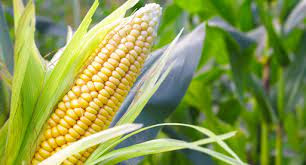
Over hundreds, perhaps thousands of years, farmers changed the plant from a bushy wild grass with lots of tiny seed heads, into a tall, straight plant with a few large cobs, each containing hundreds of big seeds. Not only did the plant provide more food, but it was easier to harvest, easier to eat, and, well, it just plain tasted better. In short, about 9000 years ago, these Mexican farmers turned the wild grass teosinte into maize (also called corn), now one of the most important food crops in the world! 

Lots of changes on the journey from teosinte to corn! Check out how large the cob is compared to a coin. Photo credit: Nicole Roger Fuller, National Science Foundation

The process of changing wild plants (and animals!) into domestic ones by choosing the favourite ones to reproduce is called selective breeding. It’s the basis of agriculture! While corn was being domesticated in Mexico, the same process was happening with wheat in the Middle East, bananas in New Guinea, rice in China, and millet in Africa (among so many others). 

Wild relatives of modern potatoes. Photo by L. Salazar

 
A commercially-sold banana beside a wild relative. Photo by A. D'Hont

Carrots still look much like wild carrots, though larger and juicy!

It’s Thanksgiving as I write this, one of many harvest festivals celebrated around the world. As we honour food, family and friends, I think of the special debt of gratitude we owe Indigenous People in all parts of the world who -- over millennia and still today -- learned and shared so much about the local environment, and how we can sustain communities with the gifts of nature.

(Traditional knowledge has many stories for the origin of corn/maize, taro, camas, and other important foods. Some of these stories are shared in books and online resources. Indigenous people keep this traditional knowledge as part of culture, history, and how the world is understood.)

22 Sept 2017

Moving Moai and the Birdman Battle

By Margriet Ruurs

Note: This is the second of two posts by Margriet about Rapa Nui. To see the first, go to https://sci-why.blogspot.ca/2017/09/exploring-world-through-travel-rapa.html

Walking along the steep cliffs of the southwest coast of Rapa Nui, or Easter Island, I gaze down on foaming white waves pounding the shore of a small island: Moto Nui. This is where history was made.

The view of Moto Nui from the cliffs of the larger island, Rapa Nui.
The first inhabitants likely arrived on Rapa Nui in wooden canoes from far-away Tahiti. From these first few grew a population of thousands. But European diseases and fighting reduced their numbers to a low of 110 at one point. After the era of the moai (stone figure) carving culture, competing tribes designed a non-violent way to establish order on Easter Island: the Birdman Cult. Chosen young men competed for the right to have their tribe rule for the next year, until the next competition was held.

Birdman figure
The competition was held near the most important site on the island, the Rano Kau volcano, and consisted of climbing down the steep rock face of Orongo to the wild ocean below, building rafts from reeds, using these as flotation devices and swimming the rough kilometre-wide passage of pounding ocean to Moto Nui island.

The young men had to bring back the first egg laid by birds returning in spring. They tucked this egg into a woven headband, swam the ocean and climbed the cliff to hand the egg, unbroken, to the chief.

I saw tiny rock houses at Orongo and scattered rocks carved with birdman and boat pictures. We climbed the sides of the ancient volcano to look inside the crater, filled with shallow lakes where drinking water was collected and reeds for the rafts were cut.

The best came last, when we visited the site famous from so many photos – the long row of moai standing shoulder to shoulder. This is iconic face of Easter Island.


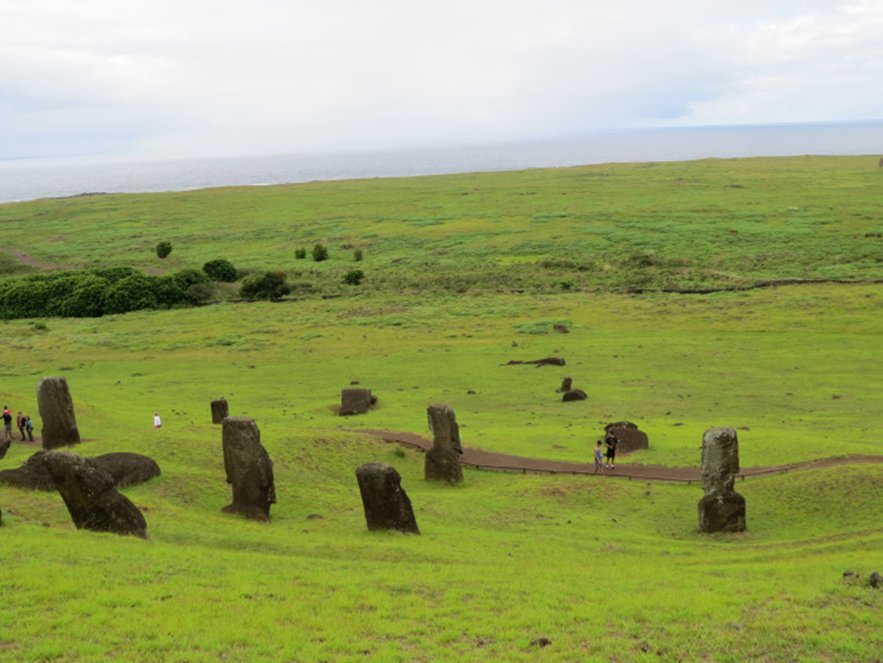
But my favourite site is the quarry. When I first heard the name, I pictured a rock excavation site where rocks were dug up. However, when you approach the quarry, it is as if the stone people have come to life and are walking out of the mountain from where they were born. A gently sloping green side of a volcano is scattered with upright figures. They seem to be walking down, stumbling and standing all over the slopes. The sight gave me goosebumps and a lump in my throat.

The moai were carved here from gigantic blocks of basalt and lava. Weighing many tons and measuring up to ten metres in height, their individual features were carved. I had heard that most figures only show the upper body while the lower half is still buried.

Before I saw them, I thought that this meant that the moai had been covered by drifting sand over the ages. But that is not true at all. There is no sand. Only lava and rocks. The artists did not have ladders, so they dug deep pits in which they lowered or raised the moai until they could reach their faces to carve them.

Once a figure was finished, it was erected and “walked” down the mountain to spots all over the island – a mind-boggling feat that National Geographic has tried to recreate.

Why did people stop carving and moving the figures? It seems like they were in the middle of ongoing projects when work came to a halt. No one knows why.

Why did the Rapa Nui create these statues in the first place? Scientists believe that well-to-do families ordered a moai in memory of an important member of the community. When this person died, male or female, a moai was constructed in his or her image and erected over their bones.

Once the grey basalt figure, with or without red lava topknot, had been given white coral eyes with a black obsidian center, it was believed that the deceased person’s spirit had entered the moai and would now protect Rapa Nui and its future generations.


For details on Easter Island and its history, click here: http://www.mysteriousplaces.com/easter_island/

See a reenactment of ‘walking’ the statues here: https://www.youtube.com/watch?v=yvvES47OdmY

All photos by Margriet and Kies Ruurs. For more of the Ruurs's travel adventures, visit their blog, Globetrotting Grandparents.

15 Sept 2017

Exploring the World Through Travel: Rapa Nui’s Moai

By Margriet Ruurs

I was lucky enough to take a trip to Easter Island, Chile, earlier this year. I had booked a flight from Santiago. Before getting there I imagined an old, small airplane. I don’t know why – but I had thought it would be a local airline with an old prop plane. The opposite turned out to be true: Latam is part of One World and operates a brand new Boeing 787 on the route to remote Easter Island across the south Pacific Ocean. Only during the long flight does it become clear how distant this place is. From mainland Chile you fly at a speed of 850 km an hour for about 5 hours! The island is almost halfway between mainland Chile and New Zealand.

Rapa Nui from the air.
We arrived in comfort. But now imagine that you are an early explorer, sailing the Pacific Ocean in search of new lands. After weeks of nothing but water, you spot land. A green island with round, cone-shaped hills and the odd ragged cliff dropping off into the roaring ocean. As this Dutch ship, under the command of Captain Roggeveen, cautiously approaches the island, furling the sails that billowed from its three tall masts, you spot people. Giants.

Huge, towering people standing shoulder to shoulder with their backs to the sea. These stone giants are most likely meant to honour chiefs and other important people. For more than a thousand years – no one knows their exact date – they have been standing here, silently. Only a few statues face out over the sea, looking in the direction of other Polynesian islands, possibly the Marquesa Islands from where the first inhabitants of Easter Island might have come by canoe.

Roggeveen did go on land and communicate with the native population. As it happened to be Easter for the European Christian sailors, they named the island Easter Island: Paas Eiland in Dutch, or Isla de Pascua in Spanish. Never mind that the island already had inhabitants and a name: Rapa Nui. Like other islands claimed by European nations, it has now gone back to using and being proud of its original name and so I shall refer to Easter Island as Rapa Nui here. Since 1965 the island has been under Chilean governance. It uses Chilean pesos but has its own Rapa Nui postage stamps.

The stone statues, for which the island is famous, are so shrouded in mystery that it is hard to realize that they stand on a normal island where regular people live in a regular town. I had only ever seen images of statues and green grass and found it slightly jarring to arrive in this mysterious place to see ordinary trucks, cola machines, dogs – just like in any other town. Where was the mystery?

We walked across the tarmac to the palm-frond-covered entrance of a tiny airport. Each and every new arrival is greeted with a lei of fresh flowers.  People here still speak Spanish but also Rapa Nui, which is very Polynesian and looks like Hawaiian to us.

Rapa Nui is roughly the same size as Canada’s Salt Spring Island with almost the same number of people, around 7000 – increasing with tourists. They also face similar problems, such as sustainability, water shortages and recycling. Of course this island is much further away from a mainland. Supplies used to come, and still may, once a year by ship. Everything else is flown in. So the cost of a soft drink or anything else is sky high. A small bottle of water, which was 1 dollar in Santiago, costs 3 dollars here. Everything needs to be recycled or re-used. A sign in our bathroom asked us not to "throw paper at the toilet" – which we took to mean no flushing of paper.


Our very first moai, or stone statues, was a row of five that, unlike all other moai, face out over the ocean rather than inland with their backs to the sea. Why? We can only guess and only “the ancestors” know the real answer. They sit near two platforms on which the moai typically rest. These platforms are built of huge square basalt blocks with straight lines and rounded corners. It is impressive how precisely these were constructed so many hundreds of years ago, without the use of metal tools.

Once the guide pointed it out, we noticed moai that have fallen forward, on their faces, and cracked. Many were destroyed during a civil war between the Long Ears and the Short Ears tribes around 1680, as well as by missionaries, neglect and the passing of time.

Top Knot lava stone
The standing, reconstructed moai are about 5 metres tall. Each face is quite individual. A few wear "top knots" – these round blocks of red lava have a smaller red part on top and are said to resemble not hats but hair, worn traditionally in a long ponytail tied in a knot on top of the head, just like most men here still wear it.
Typical modern men's "top knot" hair style on Rapa Nui
All photos by Margriet Ruurs. You can find more of Margriet's travel stories at Globetrotting Grandparents.


28 Jul 2017

Arctic Publisher Shares Northern Voices, Traditional Knowledge

By Gillian O'Reilly

Looking for engaging, appealing and informative science-themed and technology-themed books that incorporate traditional knowledge? Look no further than Inhabit Media.

Inhabit Media, an Inuit-owned publishing house based in Iqaluit and Toronto, aims to “promote and preserve the stories, knowledge and talent of northern Canada.” The company publishes a wide range of books for adults and kids, plus two magazines: Kaakuluk: Nunavut’s Discovery Magazine for Kids and Pivut: The Magazine for Nunavut Youth.

With an author list that includes established and emerging Northern writers and elders, as well as knowledgeable Southerners, Inhabit offers readers a rich variety -- from board books on Inuit tools and clothes to informational picture books to YA novels, historical and contemporary. Publishing in English, French, Inuktitut and sometimes Inuinnaqtun, Inhabit works to ensure that its books are accessible to both Northern and Southern readers.

A recent success for the company has been the Animals Illustrated series for readers aged 4 to 6. Each book is a lively mix of animals facts and first-hand accounts from authors who live in the Arctic, accompanied by meticulous and appealing illustrations. There are now four books in the series, covering polar bears, narwhals, muskox and walruses. A fifth book, on bowhead whales, is coming this fall.

One of my personal favourites in Inhabit’s list is A Children’s Guide to Arctic Birds (2014), written by Mia Pelletier and illustrated by Danny Christopher (for ages 4 to 6). Informative, accurate and with gorgeous illustrations, the book looks at 12 birds that make the Arctic their permanent or seasonal home.

Another favourite is A Walk on the Tundra (2011) written by Anna Ziegler and Rebecca Hainnu and illustrated by Qin Leng (for ages 6 to 8). This is a picture book story that features a warm intergenerational relationship while incorporating a great deal of traditional knowledge.

Innuujaq reluctantly accompanies her grandmother on a walk to pick Arctic plants. Through it, she learns a few things about her grandmother and much about tasty, nourishing and medicinal plants. Included at the end are scientific descriptions of the plants, photographs and a glossary of Inuktitut words and phrases.

More recently, Ziegler, Hainnu and Leng collaborated on A Walk on the Shoreline (2015).

Discover your own favourites among Inhabit’s books at www.inhabitmedia.com!