Showing posts with label agriculture. Show all posts

15 Oct 2021

The Wild Side of Everyday Food

 by Anne Munier

Thousands of years ago, in what is now Mexico, people chewed a wild grass called teosinte, enjoying the sweet juice from the stalks. The plant was short and bushy-looking, with lots of stems going every which way. People didn’t bother much with the seeds, because they were covered by a hard, protective case.

But every once in a while a mutation -- or unexpected slipup in the plant’s genetic structure -- came along, and suddenly some plants appeared without seed casings. This wasn’t great news for the plant -- animals could eat and digest these unprotected seeds, so the plant was less likely to reproduce. It was pretty good news for people though, who got to finally taste the seeds!

Teosinte seed head. Photo credit: Two Row Times

In truth, even the “naked seeds” weren’t anything to get too excited about -- there were only a few per seed head, which were dry and potatoey-tasting. But they were good enough for people to eat, and even to plant a few (perhaps inadvertently at first, when seeds accidentally fell into the soil near people’s home). 

Hard little teosinte seeds. Photo Credit: Two Row Times

These seeds produced more naked-seeded teosinte. Over time, people learned that when they planted the seeds from their favourite plants -- say those with the biggest, juiciest, or sweetest seeds; or those easiest to grind into flour; or those less vulnerable to pest attacks -- many of the next generation’s plants would have these same characteristics. 
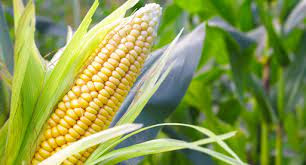
Over hundreds, perhaps thousands of years, farmers changed the plant from a bushy wild grass with lots of tiny seed heads, into a tall, straight plant with a few large cobs, each containing hundreds of big seeds. Not only did the plant provide more food, but it was easier to harvest, easier to eat, and, well, it just plain tasted better. In short, about 9000 years ago, these Mexican farmers turned the wild grass teosinte into maize (also called corn), now one of the most important food crops in the world! 

Lots of changes on the journey from teosinte to corn! Check out how large the cob is compared to a coin. Photo credit: Nicole Roger Fuller, National Science Foundation

The process of changing wild plants (and animals!) into domestic ones by choosing the favourite ones to reproduce is called selective breeding. It’s the basis of agriculture! While corn was being domesticated in Mexico, the same process was happening with wheat in the Middle East, bananas in New Guinea, rice in China, and millet in Africa (among so many others). 

Wild relatives of modern potatoes. Photo by L. Salazar

 
A commercially-sold banana beside a wild relative. Photo by A. D'Hont

Carrots still look much like wild carrots, though larger and juicy!

It’s Thanksgiving as I write this, one of many harvest festivals celebrated around the world. As we honour food, family and friends, I think of the special debt of gratitude we owe Indigenous People in all parts of the world who -- over millennia and still today -- learned and shared so much about the local environment, and how we can sustain communities with the gifts of nature.

(Traditional knowledge has many stories for the origin of corn/maize, taro, camas, and other important foods. Some of these stories are shared in books and online resources. Indigenous people keep this traditional knowledge as part of culture, history, and how the world is understood.)

14 Mar 2014

“Potbelly Hill” gives birth to new theories of civilization

By Judy Wearing

Tall, flat stones arranged in circles stand straight, their limestone edges sharply sculpted. Some are six metres in height, and decorated with a menagerie of carvings: lions, gazelles, foxes, donkeys, bulls, reptiles, insects, and birds. The pillars are enclosed inside circular walls. There are four such enclosures, back to back, each surrounding up to eight pillars each. Sixteen more enclosures remain out of sight, under the earth. These 'rooms,' with their rings of standing stones, were buried at Gobekli Tepe (potbelly hill), a man-made mound 15 metres high, located in Southern Turkey. These awesome monuments were made without metal. They were sculpted with stone tools, and transported hundreds of feet from a quarry without beasts of burden or wheels. At the time they were built, writing had not yet been invented. Neither had pottery. Their discovery has changed the way archaeologists think about human civilization.

Gobekli Tepe rivals Stonehenge in its complexity, but predates it by some six thousand years, hailing to 9600 - 8800 BC. It is older than the pyramids and the ancient cities of Ur and CatalhÓ§yuk. It is the oldest known building project on Earth. But it is not its age per se, its engineering, or even its artistry that make Gobekli Tepe so special. It is that the people who created and used it were nomadic hunter-gatherers living before the invention of agriculture. There is no local source of water, no traces of housing, cemeteries, domesticated animals or plants. The people who built this 'temple' did not live here, nor anywhere else permanently.


The existence of Gobekli Tepe turns the common understanding of the development of human civilization on its head. The old way of thinking has humans in Mesopotamia discovering that wild grains can be saved and planted, and wild animals captured and contained. This ‘Neolithic revolution’ encouraged people to settle in one place, growing and keeping food instead of hunting and gathering it. Then, as a consequence of the new stability, came increased food supply, growth of community, cooperation, division of labour, extra time to devote to art and architecture, religion, organized cemeteries, public buildings, etc. Gobekli Tepe, however, was built by a number of people over a significant amount of time, organized, cooperating, and practicing a common  religion -- all without the existence of stable, permanent settlements.

Besides demonstrating that long-held beliefs can be wrong, and that early human societies were more complex than previously thought, Gobekli Tepe is a spectacular site in its own right. What people were doing here is still a mystery, and the lack of writing means there is no voice from the past to tell us what these structures meant to their culture. There are some intriguing clues, however. For one, some of the T-shaped stones have belts and arms carved on them, suggesting they are stylized representations of people. For another, what look like benches are built into the walls – for visitors to rest awhile, dead or alive, in the company of the stone statues.

Some believe that Gobekli Tepe’s stone circles were sanctuaries to link the world of the living with the world of the dead. Today, they still function as a link to the world of the dead, the only connection we have to the culture that lived and died in that part of Turkey more than 11,000 years ago. The stones still tell stories of their builders, whispering secrets of our distant relatives.

29 Nov 2011

Ten Random (But Fascinating) Facts I Learned While Researching A Magazine Article

By L E Carmichael

1. Dogs were the first domestic animal species.  Unambiguous archaeological evidence for dogs is about 12,000 years old, but domestication may have started 20,000 years or more before that.

2. Ancient Egyptians had at least three dog breeds: a greyhound type, a mastiff type, and a small Spitz type.

Shetland sheepdogs - note the floppy ears!
3. The modern concept of breeds, and of deliberately breeding animals for specific traits, developed in Victorian England.  Which means that most of the 400-ish dog breeds recognized today are less than 200 years old.

4. Scientists aren't entirely sure whether house cats are actually domesticated.  It's possible they're nothing but "delightful profiteers," to borrow a phrase from Stephen O'Brien, well-known expert on the evolution of the cat family.

5. Dingos are a breed of domestic dog.  People took dingos with them to Australia several thousand years ago.

6. Floppy ears are found in almost every domestic species.  The only wild species with floppy ears is the elephant.

7. Chimpanzees are humans' closest relatives.  Dogs are better at interpreting human gestures, such as pointing.

8. Crop species are considered domesticates of wild plants.

9. Domestication is a type of evolution.  Natural, artificial, unconscious, and conscious forms of selection are all involved.

10. A group of Russian scientists once attempted to domesticate otters.  It did not go well.  Neither did attempts to domesticate zebras, despite their close relationship to horses.

And this is how one article pitch becomes two, and two become a book proposal...

20 Jun 2011

Unlocking the Science Writer Within...

If I am to tell the truth, I would report that never in my wildest imagination did I dream I would become a science writer.

When I was in elementary school, science was my most dreaded subject. It was tedious and achingly boring. In my memory, our lessons were mainly composed of flipping through worn textbooks full of line drawings showing how the earth revolved around the sun, and how the moon revolved around the earth. (Or were they rotating?) I never could quite figure out how night and day and the four seasons resulted from all this spinning. Nor could I figure out how any of this related to me.

I’m glad to say that I eventually sorted it all out and have now developed a lasting appreciation for science, both in books and in my everyday life.

Where did my appreciation come from? I owe it all to the kids.

Here’s what happened. One day, long before I knew I’d be a writer, I became a teacher and spent more than a decade in a primary classroom. There’s no better place to get a firsthand view of the delight children experience from nature and the living world.

Kids know there’s nothing more wonderful than peering into the tall grass to see a tiny ant scurry by, or watch busy squirrels chase each other along the branches of a tree. They love to tell you which wild animal is the biggest, the strongest, the fastest or the most fierce. Kids see the magic in the garden as they plant a seed and watch it grow. They find joy in every detail of a changing season.

When I moved from teaching to writing, I never forgot my students. I made it my goal to write books that they would enjoy — books on nature, wild animals, gardens and growing — all for the youngest readers.

I didn’t really think of these as science books, nor did I think of myself as a science writer. I only knew that I was trying create books that reflected the world the way a young child sees it — books that captured an appreciation of the wonders of nature, and answered some of the questions that kids have about the earth and its living creatures.

These books weren’t much like the serious science books of my school years — so I wasn’t sure I qualified as a science writer.

But, as I look around in schools and bookstores today, I understand that I need to expand my idea of what science writing is. Gone are the stiff and formal books of yesteryear. Replacing them is an explosion of bright, colourful books, full of engaging information for modern kids. What an amazing transformation!

I’ve had to shift my thinking to entertain the possibility that what I write may indeed fall under the banner of science writing.

Me, a science writer. Who knew?

I’m thrilled to be included!

Deborah Hodge

Deborah Hodge is the author of Up We Grow! A Year in the Life of a Small Local Farm and 25 other books for children.

www.deborahhodge.com