Showing posts with label winter. Show all posts

9 Apr 2022

When Ice Plays the Frazil Jam

 by Nina Munteanu

I’m a limnologist (someone who studies water and water systems); I’m also a Canadian, living in the north. That means that the water and waterways I study are often covered in ice and snow.

Since moving to Peterborough a few years ago, I’ve been walking daily along the shores of the Otonabee River, through riparian forest and marsh and small tributaries. The Otonabee River is a regulated river, with several dams and locks, forming part of the Trent-Severn Waterway in the Great Lakes Basin. The Otonabee River, which provides Peterborough its drinking water, receives water from Katchewanooka Lake in Lakefield and flows south through Peterborough into Rice Lake and from there water flows via the Trent River into Lake Ontario.

The Otonabee is regulated through a series of locks and dams with generating stations for electricity. I’ve been enjoying the seasonal changes of the river, along with the ostensible water level changes imposed throughout the seasons by the various dams and diversions. This has been particularly interesting for me during the onset and duration of winter, when ice and snow play a role in the river’s character. When it’s cold enough (at zero degrees Celsius or 32 degrees Fahrenheit), ice forms. It can form as a solid sheet on lakes and rivers and on land (as a glacier). Ice can also occur as frost, snow, sleet and hail. 


Limnologists talk about the ice-up of lakes and rivers, often making it sound like a singular phenomenon. But it isn’t. The characteristic ice sheet of a fully frozen lake or river goes through several stages and will vary from year to year. The cyclic nature of ice-up determines the quality and nature of the ice that forms and the under-ice environment. In a regulated river it gets even more complicated.

But it all starts with young ice crystals, frazil ice, that grow and evolve into something bigger. 


When Water Freezes & Ice Grows

Two things determine how ice forms: temperature and turbulence. The Otonabee experiences below freezing air temperatures for close to five months of the year and is both turbulent and calm in various places and times based on its level changes. This makes for some varied and interesting ice phenomena.


As early as November, when it’s freezing cold and water supercools, sharp pointed discs of ice crystals (frazil ice) form and mix into the waterbody’s upper layer. The ice molecules expand into an organized latticework that is less dense and lighter than liquid water, allowing it to float. Frazil ice often develops into slushy clumps of white ice a few centimeters across (grease ice or slushy, spongy grease ice called shuga). Frazil and grease ice may also create nilas ice, an up to 10 cm thick elastic ice crust with a mat surface.

On a quiet surface with little wind, such as a protected bay or pond, clear ice forms under very cold weather. Transparent ice may resemble Goethe glass and reflect light like clear wate or it can be slightly cloudy, reflecting a deep or aqua-turquoise blue, depending on the materials the crystals nucleate on. When the ice cover expands from the shore to the entire river or lake, it’s called fast ice because it’s held fast by the shore.


In rougher moving water, ice forms in a less orderly and transparent way, first forming frazil.

In more calm waters of shorelines and inlets, frazil ice may form skim ice that may look like a film of grease. Ice rind, a brittle shiny crust up to about 5 cm thick may form along protected shores around marsh reeds or on exposed rocks. 


Ice crystals need a nucleating agent to form in supercooled surface water. Examples include snow and ice fog, or already existing ice (e.g. frazil). Sediment and bacteria in lake and river water can also act as nucleating agents. In moderately cold and calm water with no falling snow, large crystals form unseeded ice; the nucleation sites are most likely particulates in the water. When snow falls, tiny ice crystals form on the water surface (seeded ice).


On a minus twenty C° January day, I followed the frazil or floating slush as it drifted downstream below a dam until the frazil ran into an ice jam that was piling up behind the next dam. Much of the frazil had organized into hundreds of small circular 4-cm diameter wide ice pancakes in the turbulent flow. The tiny pancakes collided into one another and jammed up against the established frazil ice sheet, creating a frazil floc and eventually cementing into the larger ice jam. The small ice pancakes foamed up with a milky froth, sliding on top or below each other and crowding into the ice jam. They made a distinct fizzing high pitched ‘shhh’-sound, just like soda pop when it’s first opened. They were frazilling. Frozen waves of ice fraziling formed and thin shards of broken ice rind had rafted over each other to form rows of hummocks as the ice jam grew upstream from the dam. 


Pancake Ice

Pancake Ice is ice that spins around in waves and thickens into free-floating ice disks. It forms particularly where the turbulence of rough water and rapids affect slush or ice rind, such as just downstream of a dam. This is exactly where I’ve seen pancake ice of varying sizes on the Otonabee River (pancakes from as small as 4-centimetres to as large as 3-metres wide and up to 10 cm thick). 


Pancake ice forms in two ways: 1) on water covered by slush, shuga or grease ice that, when it becomes sufficiently dense, congeals to form a pancake, or 2) from breaking ice rind, nilas or even gray ice in agitated conditions. When the floating ice rinds of grease ice break up, pancake ice forms from the pieces. I’ve seen pancakes raft over each other, creating an uneven top and bottom surface on an ice jam. I saw good examples of pancake-frazil formation below one dam and these formed an ice jam behind a downstream dam.

The rims of pancake ice are often turned up; when the pancakes collide into each other like bumper cars, frazil ice or slush piles onto their edges.  


Glossary of Ice Terms (Environment Canada):

ADVECTION FROST: A collection of small ice crystals in the shape of spikes that form when a cold wind blows over branches of trees, poles, and other surfaces.

BRASH ICE: Accumulations of floating ice made up of fragments not more than 2m across; wreckage of other forms of ice.

FAST ICE: Ice that forms and remains fast along the shore, where it is attached to the shore, an ice wall, or ice front.

FRACTURING: Pressure process whereby ice is permanently deformed, and rupture occurs.

FRAZIL ICE: Fine spicules or plates of ice (ice crystals), suspended in water.

GRAY ICE: Young ice 10-15 cm thick, less elastic than nilas and breaks on swell. Usually rafts under pressure.

GRAUPEL: Heavily rimed snow particles or pellets, typically white, soft and crumbly.

GREASE ICE: A later stage of freezing than frazil ice. It occurs when the crystals have coagulated to form a soup layer on the water surface. Grease ice reflects little light, giving the water a mat appearance. Forms shuga.

HUMMOCKED ICE: ice piled haphazardly one piece over another to form an uneven surface. When weathered, it has the appearance of smooth hillocks.

ICE BRECCIA: Ice of different stages of development frozen together.

ICE JAM: An accumulation of broken river ice caught in a narrow channel.

ICE RIND: A brittle shiny crust of ice formed on a quiet surface by direct freezing or from grease ice. Thickness to about 5 cm. Easily broken by wind or swell, commonly breaking in rectangular pieces.

NILAS: A thin elastic crust of ice, bending easily on waves and swell. Up to 10 cm thick with a mat surface. Under pressure it thrusts into a pattern of interlocking fingers.

PANCAKE ICE: Mostly circular pieces of ice from 30 cm to 3 m in diameter and up to 10 cm thick, with raised rims due to the pieces striking against one another. May form on a slight swell from grease ice, shuga, or slush, or from the breaking of ice rind, nilas or gray ice.

POLYNYA: Any nonlinear-shaped opening in the water but enclosed by ice. Some polynya recur annually in the same position.

RAFTED ICE: Type of deformed ice formed by one piece of ice overriding another.

RAFTING: Pressure processes whereby one piece of ice overrides another. Most common in new and young ice. 

SHUGA: An accumulation of spongy white ice lumps, several centimeters across; formed from grease ice or slush and sometimes from ice rising to the surface.


References:

Armstrong, T., and B. Roberts. 1956. Illustrated ice glossary. Polar Record 8:4-32.

Ashton, G., editor. 2010. River Lake Ice Engineering. Water Resources Publications LLC, Highlands Ranch, Colorado, USA.

Bengtsson, L. 1986. Spatial Variability of Lake Ice Covers. Geografiska Annaler: Series A, Physical Geography 68:113-121.

Brown, L. C., and C. R. Duguay. 2011. A comparison of simulated and measured lake ice thickness using a Shallow Water Ice Profiler. Hydrological Processes 25:2932-2941.

Burn, C. R. 1990. Frost heave in lake-bottom sediments, Mackenzie Delta, Northwest Territories. Nordicana 54:103-109.

Cherepanov, N. 1974. Classification of ice of natural water bodies. Pages 97-101 in Ocean '74 : IEEE International Conference on Engineering in the Ocean Environment Institute of Electrical and Electronic Engineers, New York, NY, USA.

Downing, John A. 2021. “Ice Formation is Not a Singular Phenomenon.” University of Minnesota Sea Grant. February 25, 2021.

Eisen, O., J. Freitag, C. Haas, W. Rack, G. Rotschky, and J. Schmitt. 2003. Bowling mermaids; or, how do beach ice balls form? Journal of Glaciology 49:605-606.

Fahnestock, R. K., D. J. Crowley, M. Wilson, and H. Schneider. 1973.Ice& volcanoes of the Lake Erie shore near Dunkirk, New York, USA. Journal of Glaciology 12:93-99.

Kavanaugh, J., R. Schultz, L. D. Andriashek, M. v. d. Baan, H. Ghofrani, G. Atkinson, and D. J. Utting. 2019. A New Year’s Day icebreaker: icequakes on lakes in Alberta, Canada. Canadian Journal of Earth Sciences 56:183-200.

Kempema, E. W., E. Reimnitz, and P. W. Barnes. 2001. Anchor-Ice Formation and Ice Rafting in Southwestern Lake Michigan, U.S.A. Journal of Sedimentary Research 71:346-354.

Knight, C. A. 1962. Studies of Arctic Lake Ice. Journal of Glaciology 4:319-335.

Michel, B. 1971. Winter regime of rivers and lakes. US Army Corps of Engineers, Cold Regions Research and Engineering Laboratory, Hanover, New Hampshire USA.

Michel, B., and R. O. Ramseier. 1971. Classification of river and lake ice. Canadian Geotechnical Journal 8:36-45.

Muguruma, J., and K. Kikuchi. 1963. Lake Ice Investigation at Peters Lake, Alaska. Journal of Glaciology 4:689-708.

Pounder, E. 1965. Physics of ice. Pergammon Press, Oxford, UK.


23 Feb 2019

Muskrat Encounter

by Joan Marie Galat

I often think how time spent in nature is interesting and different, not only from season to season, but also in different types of weather. Varying conditions bring new, and sometimes surprising, outdoor experiences. One mild winter day, I spotted this muskrat (Ondatra zibethicus) crossing an Alberta country road between two swampy areas. I pulled over to have a look. To my surprise, the animal turned, walked over to my vehicle, and took a good long look at me through the open window.

It was fascinating to see his long toes up close. So that's how they dig into mud banks and build underwater tunnels! They also build houses, called push-ups, out of mud and cattails, bullrushes, and other aquatic vegetation. I could see why his rubbery-looking tale makes such a great rudder when navigating through water. Muskrats can stay underwater for up to 20 minutes. Their lips close behind the incisors, allowing them to chew underwater. Like beavers, muskrats may slap the water with their tails to warn of danger.

Muskrat: Ondatra zibethicus

This muskrat did not seem too concerned about possible danger. In fact, he walked beneath my vehicle during our encounter. (The last photo shows how my photography was impacted when I realized he was under the car.) As I turned off the engine and unbuckled to look out the opposite window, he finished inspecting the vehicle's undercarriage. Popping out, the muskrat resumed his waddling walk towards the frozen water.

Experiencing nature in winter may lead you to surprising encounters. Even if you don't spot animals, you might see signs of their presence. Look for tracks, paths, and depressions in the snow, where animals may have bedded.

If the weather is going to keep you indoors, check out Dot to Dot in the Sky, Stories in the CloudsWhile waiting for your ideal day, you can discover the science of how different types of weather occur. You'll also find tales and folklore from around the world that reveal how ancient cultures first explained rain, thunder, wind, frost, and snow. You might even find a few tips for predicting the weather, so you can plan your next nature visit!


Dot to Dot in the Sky, Stories in the Clouds
Book Trailer (1 minute, 48 seconds.)  

16 Jan 2015

Winter Whites: How Snowshoe Hares and Ptarmigan Are Influenced by Climate Change & Evolution


By Jan Thornhill

Josée Bisaillon illustration snowshoe hare
Josée Bisaillon's illustration of Lily wearing her 
"winter whites" in Winter's Coming.
My most recent book, Winter’s Coming: A Story of Seasonal Change, follows Lily, a young snowshoe hare, as she learns about the ways in which other animals prepare for winter’s arrival. While the forest's leaves turn from green to yellow to brown and eventually fall to the ground, Lily is unaware that she, herself, is gradually changing colour from brown to white.

baby snowshoe hare
A young snowshoe hare has no idea that it will turn
completely white in the fall. 
(NPS/Tim Rains)

Snowshoe Hares

Snowshoe hares are one of seventeen northern animals that have adapted to their environments by undergoing a colour change twice a year. In the autumn these mammals and birds grow white fur or feathers so they’ll be hidden against the snow, and in the spring they trade their glorious whites for a variety of muted browns that provide summer camouflage.


white camouflage snowshoe hare
Snowshoe hares turn white for the winter (NPS/Jacob W. Frank)

Right now it’s January and winter’s well under way in the northern hemisphere, which means that throughout their range snowshoe hares are safely camouflaged in their “winter whites.” Unfortunately there’s a new glitch in this fabulous winter adaptation: climate change is causing snow cover to arrive later and disappear earlier than usual in many of the areas where snowshoe hares live. 

Snowshoe hare researchers have been keeping track of this shortening of winter for a few years now and, not surprisingly, it’s not a great situation for the hares: for each extra day their coats are mismatched with their surroundings, there is an increase in mortality from predation.


snowshoe hare transition colors
A snowshoe hare in transition. (D. Sikes/Wikipedia)

Unlike people, snowshoe hares can’t just slip on appropriate clothing at will. Their colour changes are triggered by something neither they nor we can control: the changing length of daylight hours. Because of this, as warming trends continue, the snowshoe hare population is going to take a hard hit. The species, however, will likely bounce back as they gradually adapt to climate change. It’s all about evolution: any hares that turn white later than the majority in the fall or that moult earlier than others into their summer browns will have a greater chance of surviving long enough to breed and pass on this advantageous trait to their offspring.

This might be the only chance the species has since, like my character Lily in Winter’s Coming, snowshoe hares don’t have a clue that they spend half the year white and the other half brown. Researchers have found that in the spring, pure white hares do not seek out and crouch in areas where snow remains, but instead choose open areas where they are easily seen. 


Ptarmigan


 illustration ptarmigan and wilson's warbler soyeon kim
Soyeon Kim's illustration of a moulting ptarmigan from Is This Panama?

Ptarmigans are another species that turn white in the winter to match their snowy northern surroundings. Although, like the snowshoe hare, the change in a ptarmigan's plumage is linked to changes in daylight hours, researchers have shown that these birds, unlike snowshoe hares, appear to have an awareness of their colour.  


snow ptarmigan camouflage
Ptarmigans are camouflaged by white plumage in the winter, and will
also burrow into snow for warmth.
 (Xander/Wikipedia)
While both male and female Ptarmigans turn almost pure white in the winter, the females' springtime return to cryptic, camouflaging browns happens considerably earlier than the males'. So, while a female in her mottled summer colours is almost impossible to see once the snow melts, the white feathers the male still sports glow like beacons against the greens and browns of their habitat. Which makes them a target for predators such as gyrfalcons. But, apparently, standing out is the whole point: their flashy whites impress the girls, and impressing the girls is more important than hiding from predators. The really interesting thing, though, is that once the females begin egg-laying and are no longer receptive to the males' attentions, the males go out of their way to muddy their white feathers, masking the glaring white with smears of brown dirt for a couple of weeks until their spring moult is complete.


camouflaged female ptarmigan
A female willow ptarmigan is well camouflaged in the spring after
she grows her cryptic breeding plumage. 
(Jan Thornhill)

male willow ptarmigan spring white
Male ptarmigans keep their conspicuous white feathers longer than
the females in the spring to attract the girls. 
(Jan Thornhill)

To prove that this feather-soiling activity wasn't just a coincidence, during a 17-year study, Bob Montgomerie of Queen's University and his team purposely dirtied the white feathers of males early in the mating season with markers when the females were still receptive. This sullying of the birds showy "winter whites" so disturbed the amorous males, that they went to work, primping and preening, making their handsome white feathers once again immaculate within 48 hours.  


illustration Soyeon Kim Is This Pananma?
Soyeon Kim's illustration of a moulting ptarmigan from Is This Panama?

References:


Zimova M, LS Mills, PM Lukacs and MS Mitchell (2014). Snowshoe hares display limited phenotypic plasticity to mismatch in seasonal camouflageProceedings of the Royal Society B: 281(1782).
Mills LS, et al. (2013) Camouflage mismatch in seasonal coat color due to decreased snow duration Proceedings of the National Academy of Sciences of the United States of America 110(18):7360-7365.
Dirty ptarmigan: Behavioral modification of conspicuous male plumageBehavioral Ecology 12(4): 429-438


Kids' Resources:

Shameless plug for my two most recent books, Winter's Coming: A Story of Seasonal Change (illustrated by Soyeon Kim), and Is This Panama? A Migration Story (illustrated by Josée Bisaillon)
Winter Is Coming Jan Thornhill coverIs this panama? cover Jan Thornhill

20 Sept 2013

First Frost... and a Book Giveaway!

By Guest Blogger Carolyn Fisher


Hi. I'm artist and author Carolyn Fisher. I write and illustrate picture books. Today I'm pinch-hitting on Sci/Why for Joan Marie Galat, who is gallivanting around Australia to look at stars in the southern hemisphere.

In my picture book The Snow Show, I wrote and illustrated a story about how snow is made.


When you're making a book, you do oodles of research. You brainstorm, you write, and then - if you're an illustrator like me - you draw zillions of sketches to plan out the pages. But because my editor gave me a 48-page limit on The Snow Show, there were lots of things that I left out.

Like how frost is made, for example. So today, in honour of September's dropping temperatures, I wanted to write about frost.

First, we have to talk about how snow grows. Here are some drawings that got rejected from The Snow Show:


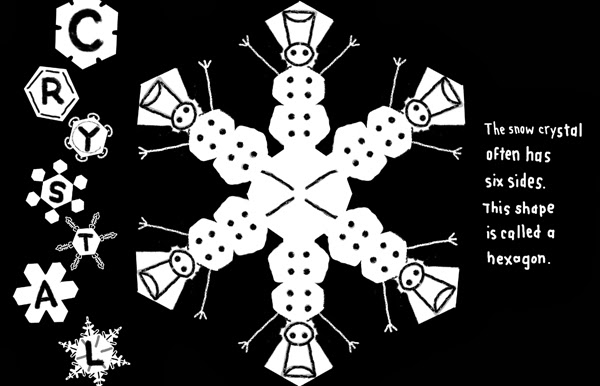
Did you catch that? If the air temperature is below zero degrees Celsius (32 degrees Fahrenheit), water vapour molecules can change to ice without turning to liquid first. That’s called DEPOSITION. Snow crystals form when floating water vapour molecules change by deposition directly into ice crystals.

There, I just summarized The Snow Show in three sentences. Can you believe it took me 48 pages to say that?

Frost crystals grow the same way: water vapour molecules in the air freeze by deposition onto plants, glass, or snow surfaces. (Sometimes frost forms beneath snow surfaces: that’s called depth hoar and it can cause avalanches if conditions are right. But that’s a whole other blog post!)

BOOK GIVEAWAY: Is it frosty where you are? What’s the average first fall frost date where you live? Post your answer in the comments by 12 noon on September 30th and I’ll draw a name for a free signed copy of The Snow Show.

For more about snow and making picture books, check out my website: www.carolynfisher.com
For a snow study guide, download my free snow activity kit pdf: http://www.carolynfisher.com/study-guides/

And if you’re Joan Marie Galat? Don’t bother entering the first fall frost date in Australia. We all know that it’s spring down there!