Bloom’s Day by Raymond Nakamura
by Paula Johanson
The Covid-19 pandemic is still affecting everyone during the fall of 2021, even nature centres in outdoor parks. Many nature centres have been closed to the public for most of the past eighteen months. Some centres open or close according to provincial health guidelines. One of those nature centres is Narcisse Snake Dens in Manitoba near the town of Gimli.
This park showcases a fascinating phenomenon! Every autumn, thousands of garter snakes find their way to hide together in underground dens. There they hibernate together, sleeping during the long, cold winters in Manitoba. When spring comes, the snakes emerge and go their separate ways. Take a moment to click on this link, and follow a virtual tour around the trail that shows you several snake dens. Right now in the fall of 2021, garter snakes are gathering at their dens getting ready to hibernate.
Now, maybe snakes aren't your thing, or you're actually scared of snakes. It's okay to be cautious around rattlesnakes and other venomous snakes! But in Manitoba, snakes are not dangerous to humans. Most are garter snakes, and other types listed here at this link.
What can you do if you're afraid of snakes? It's a good idea to learn more about nature where you live, whether you're on the Prairies in Canada, or anywhere in the world. That will help you to know how much caution around snakes is smart for your area. All snakes have important roles in the natural world. Garter snakes in a Canadian garden or yard are a good sign that this place is healthy for nature.
You can read more about Narcisse Snake Dens and about nature in Manitoba at the online magazine Nature North when you click on this link. They have a lot of information about wild animals and cottage country, and a YouTube channel of videos as well. There's also a link to the Manitoba Herps Atlas of reptiles and amphibians in Manitoba, a terrific resource that maps where people have seen snakes, frogs and toads, salamanders, and turtles. (Herps is the nickname used for amphibians and reptiles, by scientists called herpetologists.)
by Anne Munier
The scoop on poop
We all do it, most of us don’t like to talk about it, but perhaps we should get over that, because poop is not only fascinating, it’s also powerful stuff that may be a solution to at least a couple world problems! Let’s start with the basics:
What is it? Poop is waste from our bodies. We eat, our bodies take in nutrients, and then pass out what’s not needed. So poo is basically undigested food, along with bile (more on that in a moment), bacteria, parasites, and dead cells. Other names include stool, faeces, human waste, excreta, bowel movements, and a few more that are somewhat less polite.
Why the brown colour? Poo is usually brown because that’s the colour that bile- a substance our liver produces to help digest fats- becomes as it passes through the digestive system. Fun fact: bile starts out yellow-green. When we have diarrhea (which tends to come out extra quickly), the bile doesn’t have time to change colour as it passes through the intestines, hence diarrhea is often more of a yellow or green colour.
Why are we grossed out by poo? Evolution, of course! We’ve evolved to be disgusted by poo to reduce our chances touching the stuff. This reduces the chances of being infected by disease-causing microbes or parasites that it could be harbouring. The smell, which comes from the bacteria that break down food in our digestive system, probably helps as well.
![]() |
| A proud manure producer! Photo by Ian Barbour |
Is poo useful? Oh, my yes! Agricultural manure is basically livestock poop (often it’s been composted first), which helps crops grow by providing nutrients and bacteria, and by making the soil more rich and fertile. It also improves soil’s ability to hold onto moisture, and can reduce erosion. Yay manure!
Anything else? You bet, now we’re getting to the really exciting part. Let’s talk alternative energy.
But first, let’s recognize that every year we produce hundreds of billions of kg of poo worldwide (yeah, take a moment to think about that. Or…. don’t). Either way, that can be a heaping sanitation problem, particularly in areas that don’t have good quality infrastructure for dealing with human waste. When people are in close contact with poo, they can get sick from the germs and parasites, which can cause diseases like cholera, dysentery, or typhoid.
So- billions of people on Earth producing billions of kg of potentially harmful waste- that’s a problem. Meanwhile we’re looking for ways to make our energy system more ecologically friendly to reduce the impacts of climate change- another problem. A response to both problems: Biogas!
Biogas is produced when organic matter (like food waste, wood, agricultural waste, and yes, human and animal poo) is digested in a sealed container without any oxygen. The gas is then captured and used for energy, like cooking gas, fuel for cars and trucks, electricity, or heat. It doesn’t even smell bad!
The solids that are left behind are a great, high quality fertilizer that can be used in landscaping or farming. Another benefit!
Biogas
plan: Organic matter goes in, biogas bubbles out the top, and
"digestate" (i.e. fertilizer) is left over
It’s a simple concept, but please don’t try it at home; it’s not *that* simple.
Let’s check out some examples:

This Sumatran orangutan is contributing to clean energy!
The Toronto Zoo recently started putting the 2,000 tonnes of waste that their animals produce every year to good use. They combine it with thousands of tonnes of grocery store waste, and generate enough biogas to power 500 homes! In the process they’re reducing thousands of tonnes of greenhouse gas emissions, those heat-trapping gases that are causing climate change!
A primary school in Uganda is now able to cook student lunches thanks to human waste-derived biofuel.
Poop power will soon be heating about 600 homes in the Vancouver area!
England has “bio-buses” that run entirely on gas from human faeces and food.
And that’s just the start. The United Nations anticipates that human waste could power 138 million homes while improving human and environmental health. Companies investing in the technology to make it happen are popping up all over the world.
Suddenly, a waste problem becomes part of the solution to clean energy! And we certainly won’t be running out of the raw material (that is, human poop) anytime soon.
![]() |
| Photo: Pixabay |
In Southern Ontario, May 24th is the traditional day for planting annuals. That’s because the probability of frost after that date is negligible. Not this year. A few days after the 24th, Environment Canada warned us of the possibility of frost overnight, and they were correct. We had quite a lot of frost damage. The strange thing was that the overnight temperature was predicted to be above zero by a degree or two. I was puzzled because I thought you can only get frost at temperatures below freezing.
To understand frost, you have to understand dew. Air contains moisture. The warmer the air, the more moisture it can hold. If the temperature keeps dropping, it reaches the “Dew Point” where the air can no longer contain its moisture and water droplets (dew) form out of the air. The Dew Point is dependent on the humidity of the air. If there a lot of moisture in the air, the Dew point is only a little below the actual temperature. If the air is relatively dry, the Dew Point is well below the actual temperature. What if the Dew Point is below freezing? Then we rename the Dew Point and call it the “Frost Point”. When the temperature drops to the Frost Point — you guessed it — instead of water condensing out of the air, frost appears.
Back to the mystery of frost when the temperature doesn’t reach freezing. Overnight, as the temperature drops, the ground radiates heat more quickly than the air. So the ground is colder than the air, and the air closest to the ground is colder than air higher up. The fact that cold air is denser and therefore sinks also contributes to the temperature increasing with height. A difference of four degrees between the ground and a height of 1.5 metres would be typical if there is no wind to mix the layers of air.
![]() | |||
| Stevenson Box. Photo: Metfm, CC BY-SA 4.0, courtesy Wikimedia Commons |
And one learning from this is to remember that meteorology is not an exact science.
By Claire Eamer
I have a new book out -- and it's so disgusting that it once put my editor right off her dinner. I'm proud of that! (Sorry-not-sorry, Stacey.)
The book is called Extremely Gross Animals: Stinky, Slimy and Strange Animal Adaptations, and it's exactly what it claims to be -- a book about the animals that make you go "Ew!"
The thing is, once you get past the "Ew!" moment, these animals are fascinating. And adaptation itself is fascinating.
For example, when I think of mucus, I mostly think of snot and all the unpleasantness that goes with a bad cold or (currently) my over-reaction to pollen in the air. As I blow my nose for the tenth time in a morning, I am not feeling all that friendly about snot.
But when I learned about some of nature's snot-monsters, I started to change my mind. I'll be honest, I am just as likely as anyone to have a brief "Ew!" moment, but then.... Did you know that snot can be a primo defence mechanism? Or that snot can make a nice, safe place to sleep? Or a vehicle for travelling the world? Honestly, how can that not be fascinating?
And it's all true. Consider the hagfish, a far-from-beautiful eel-like fish with a mouth out of nightmares.
![]() |
| Pacific hagfish poking out of a hole 150 metres below the ocean surface. Credit: NOAA/CBNMS |
Then think about picking up a hagfish, or sharing a tank with it as this fellow does. When a hagfish is attacked by a predator -- or even by a television commentator having an "Ew!" moment -- it can produce enough slime (mucus, snot, whatever you fancy) by the bucketful, enough to clog the gills of any fish that fancies it for dinner. Watch here to see some high school students have their own "Ew!" moment at a hagfish research lab at the University of Guelph.
But what about that snotty but safe place to sleep? That's not hagfish, that's the parrotfish, a much prettier denizen of the world's oceans.
![]() |
| A rainbow parrotfish. Photo credit: Paul Asman and Jill Lenoble |
A parrotfish spends its days pottering around coral reefs, eating algae that it has scraped off the coral with its bill-like mouth parts. At night, it sleeps safe and cozy in a cocoon of mucus freshly expelled from glands near its gills. Scientists aren't sure why. After all, you can't interview a parrotfish. However, the cocoon certainly keeps it safe from sharp encounters with coral, may protect it from parasites, and also would give it advance warning of any predator considering a midnight snack of parrotfish.
And the world traveller? Meet the violet sea snail, also called the purple bubble raft snail.
![]() | |
| This violet sea snail washed ashore in Maui with its bubble raft intact. Public domain photo. |
And I haven't even begun to tell you what some animals can do with poop. Or puke. Or...well, you'll have to get the book for the rest of the grossness.
Enjoy!
This Red Cedar Book Awards have just announced their nominees for the 2020/2021 season. And on this list there are books by two people among the Sci/Why writers!

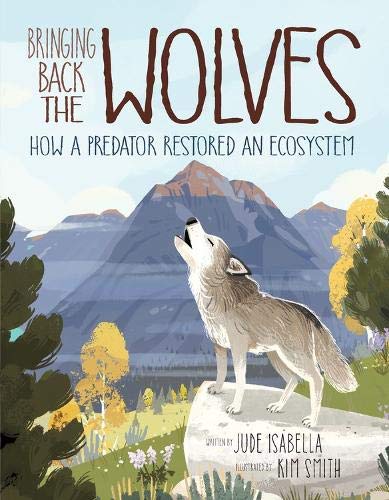
Boreal Forest by L.E. Carmichael is one of the nominees, and another nominee is Jude Isabella's book Bringing Back the Wolves: How a Predator Restored an Ecosystem. Both books are from Kids Can Press.

Red Cedar Book Awards are British Columbia's Young Readers' Choice Book Awards. Click on this link to see the entire list of nonfiction nominees. It's worth saying that ANY of these nonfiction books will make good reading, and most of them are very scientific indeed. You can also see the list of fiction nominees here at this link.
by Paula Johanson
The news in Canada this summer is troubling, with stories of unmarked graves on the sites of former Indian Residential Schools. Searches are being done on other former school sites, and in the United States as well. The little that was ever taught in public schools about the Residential School system is not enough, and people are looking to learn more.
Forensics is the science of examining physical evidence. There can be a forensic audit of paperwork and records, but forensic science is commonly used to study physical evidence of a crime.
Here are some books on forensic science which you can request at your public library, or order online. If you take this list to a library or bookstore, they will help you get a copy. There are other books as well available on this topic, and referenced in the back of these books.
Forensic Science: In Pursuit of Justice written by Sci/Why's own member L.E. Carmichael
ISBN: 978-1624035616 Essential Library Publishing
https://www.amazon.ca/Forensic-Science-Pursuit-L-Carmichael/dp/1624035612/
This title presents the history of forensics. Vivid text details how early studies of toxic chemicals and firearm analysis led to modern scientific crime solving techniques. It also puts a spotlight on the brilliant scientists who made these advances possible. Useful sidebars, rich images, and a glossary help readers understand the science and its importance. Maps and diagrams provide context for critical discoveries in the field. Aligned to Common Core Standards and correlated to state standards. Essential Library is an imprint of Abdo Publishing.
Look on the author L.E. Carmichael's website at https://www.lecarmichael.ca/books/ and scroll down to find among covers for her many books, the covers for these books on forensics.
Forensics in the Real World by L.E. Carmichael
ISBN: 9781680784794
https://abdobooks.com/shop/show/9632
Fuzzy Forensics: DNA Fingerprinting Gets Wild by L.E. Carmichael
ISBN:9780994817716
Focusing on forensic science to protect endangered animals, this book is winner of the 2014 Lane Anderson Award for exceptional children''s science writing.
Discover Forensic Science by L.E. Carmichael
https://lernerbooks.com/shop/show/14712
Bones Never Lie: How Forensics Help Solve History's Mysteries by Elizabeth MacLeod
ISBN: 978-1554514823 Annick Press
https://www.amazon.ca/Bones-Never-Lie-Forensics-Mysteries/dp/1554514827
This book collects seven mysteries about historic royal figures whose deaths were under suspicious circumstances. Hard scientific facts about crime-solving techniques make this book highly recommended by Sci/Why author L.E. Carmichael.