Showing posts with label Katherine G. Johnson. Show all posts

10 Aug 2018

The Art of Presenting Science = Literally!

Post by Helaine Becker

I had the great pleasure of working with illustrator Dow Phumiruk on Counting on Katherine: How Katherine Johnson Saved Apollo 13, which "launched" earlier this summer.


Dow's artwork, in my opinion, is stunning, and really brought the book to the next level. I was curious as to how she blended her knowledge of math and science with her artwork to create such effective illustrations. So I asked her.

Here is the result of that interview:

H: Your artwork in Counting on Katherine is so beautiful. But it's more than that - I can tell that it's historically accurate too. Can you describe your process - how did you research the illustrations in Counting on Katherine?

D: So much research!!

I started with online sources from NASA. I also watched online interviews with Katherine Johnson herself, which I found to be the most helpful to learn about her personality. I read about the start of NASA, about the solar system. I filled a folder on my computer with screenshots of images I thought might be useful for reference. I read the Hidden Figures narrative nonfiction book by Margot Shetterly (the movie did not come out until after my final art was turned in). I made trips to the library to look through books about space. I also looked at maps and images of what West Virginia looked like in the 1930s, including the Greenbrier Inn in her hometown, and what her classrooms might have looked like back then. I looked at online clothing ads and patterns as well as old photographs to see what styles of clothing best represented the fashion of each phase of her life. And of course, I found as many photographs of Katherine herself at different ages.


H: What were the biggest challenges? Biggest surprises?

D: The biggest challenge was the above-described quest for accuracy, from the math to the scenery from her childhood. It was really difficult to find enough photo reference from that long ago. Little details were hard to discern, like if her family might have owned a car upon moving to Institute, West Virginia. In addition, her achievements spanned decades, and this meant learning as much as I could about the evolution of our space program over this long period of time.

I was surprised about Katherine in general. I didn't know who she was upon receiving the pitch for this project. I couldn't believe I had not heard of her before. The more I learned about her life, the more I grew inspired!


H: The endpapers are stunning. They show a blackboard covered with mathematical equations and math problems. How did you, a)think to do this for the book, and b) come up with the material to put on the board?  

D:  I wanted to represent Katherine's genius with math-filled chalkboards. Picturing her as a young girl in front of these chalkboards made sense to emphasize the extent of her abilities since early childhood.

Coming up with the information to fill the chalkboards was not easy! I may have been proficient at math in my youth, but now advanced math is a challenge. Basic algebra and word problems, like the picnic pies and the rocket ship questions, are not a problem for me to make up. I was able to easily google search equations for circumference, radius, volumes of different shapes for example, to make up the ice cream cone question (in which I do not clarify is the volume of the parts of a one scoop cone, by the way!). Sometimes, as for the rocket ship trajectory question, I’d leave off needed information to answer the question (so that I wouldn't need to have an answer!).
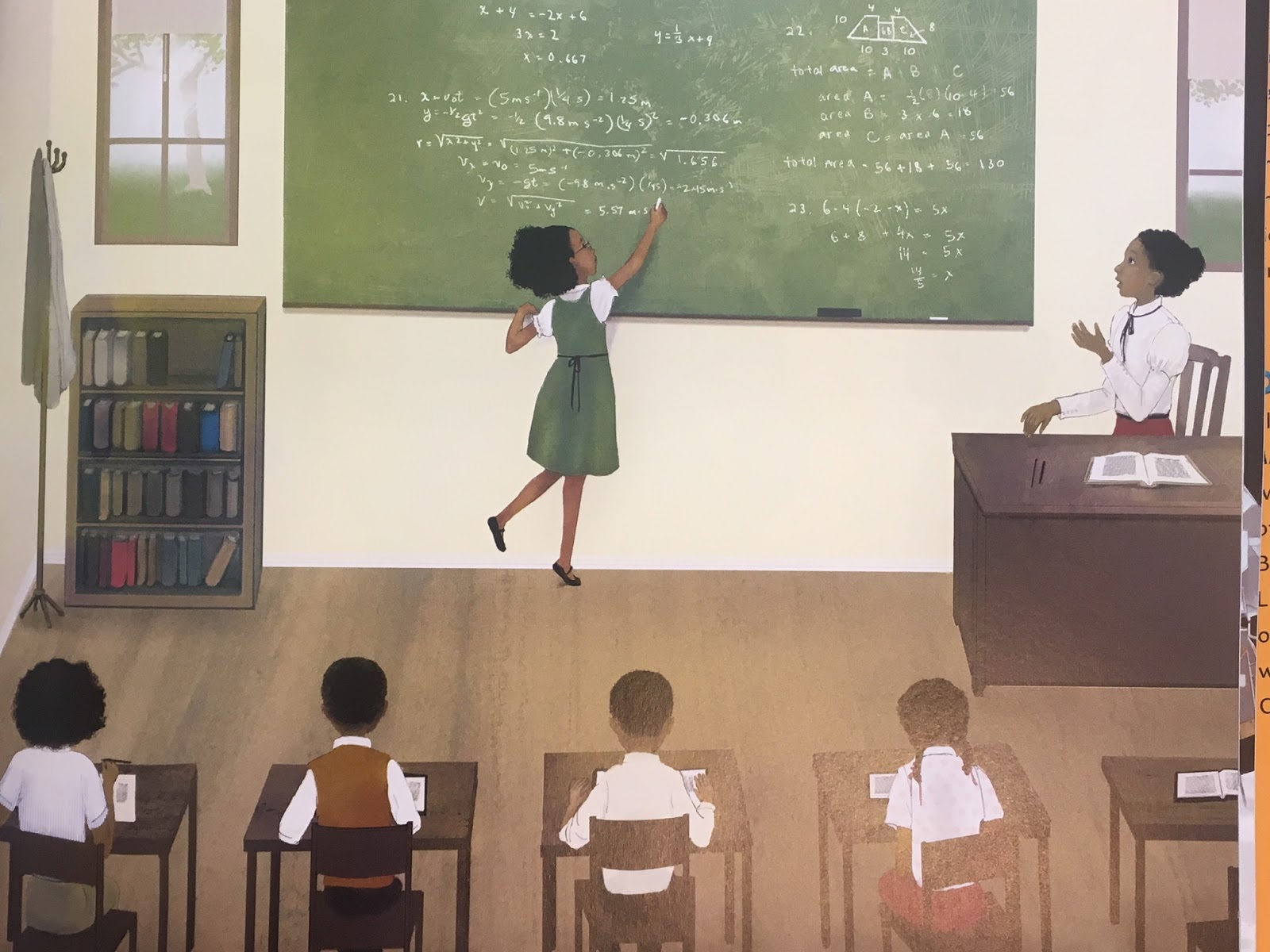
  
I used multiple sources for the rest and especially for the higher level math and physics seen in the book. I got lots of help from my family, sampling bits from my girls' homework (their work spanned algebra to calculus) and basic physics equations from my husband’s old physics book (he is a former engineer). I also found some information online, altering the source by replacing letters and figures so it would not be just copied. In compiling this together to fill the board, I would sometimes intentionally obscure parts.

In the end, I would remind myself that this is a book about a mathematician and her brilliance and not a math textbook to keep myself from hyperventilating.


What projects are you working on now???

I have a couple books in the works, but they have not been announced yet. I will say that I am very excited to be both author and illustrator for these upcoming projects!


3 Feb 2017

A Wonderful Announcement!

Post by Helaine Becker

So I can FINALLY share some wonderful news. After 3 years in progress, and interminable months of the contract process, I can finally announce my upcoming picture book, Counting on Katherine, the story of Katherine Johnson (of the Hidden Figures movie). 
Christy Ottaviano at Henry Holt and Co. will be publishing it next winter, and it will be illustrated by Dow Phumiruk.  

I am thrilled beyond words that this project is actually happening; it has been a long and winding road to make it happen to be sure.
Katherine Johnson's daughters, Kathy and Joylette,
 accept the award on Katherine's behalf. 
I had the honor of meeting the Johnson family when Katherine was awarded a De Pizan Living Legacy award from the National Women's History Museum two years ago, and interviewing Katherine for the book. They are terrific folks. 
Katherine was a teacher, and she told me she is so excited to have a book for children about her (this was well before we knew anything about the movie). I am looking forward to going to Virginia with the book in my hands to give to her - she is 98 now so she better hang tough!!!!
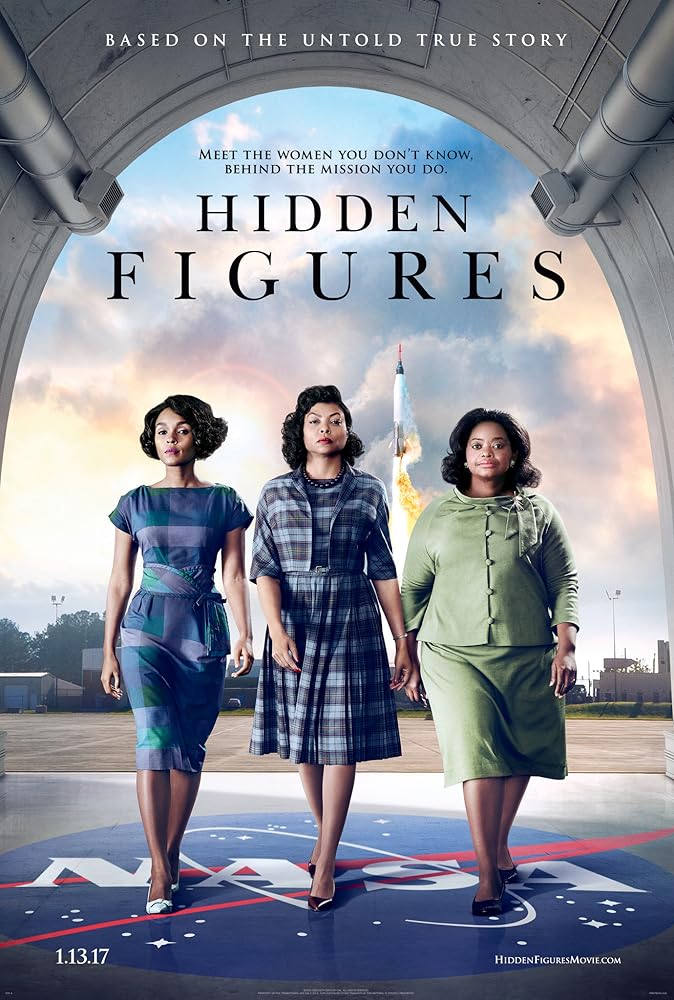
So everyone go see the movie! And BTW my book focuses on the part of her story Hidden Figures doesn't cover - how she saved Apollo 13.

28 Nov 2014

DePizan Awards go to Three Amazing Scientists! Who Ahem Happen to be Women...


Posted by Helaine Becker

Earlier this month I had the privilege of attending the award ceremony for the De Pizan Awards, given by the National Women's History Museum in Washington, DC. The awards are named for Christine de Pizan, the first woman in the West to write about women's history (that was in the 14th century!).

This year, the awards went to three incredible women, all of whom worked in STEM fields, and all of whom work to make the world a better place.

The first was Sally Jewell, Secretary of the Interior. Trained as an engineer, Jewell has worked tirelessly for environmental issues. The award she received is named for Rachel Carson, scientist and the author of Silent Spring, the book that 'kickstarted' the environmental movement.

Sally Jewell accepting her award, chokes up as she thanks her 'brave' grade 4 teacher!
Jewell gave a moving speech in which she thanked yet another woman for inspiring her love of science - her 4th grade teacher. She said how this 'brave woman' took an entire class of 9-year-olds out into the woods for two weeks to give them a chance to explore, and to do science investigation in the field. She owes her career, she said, to this one great lady.


The second winner was Katherine G. Johnson, a pioneering mathematician who calculated the trajectories to the moon for the Apollo space program. She received the Maria Mitchell Award, named for an influential American astronomer and educator (more about Katherine below!)

Katherine Johnson sent a video acceptance for her award.

Johnson's daughters, Kathy and Joylette, shown here with NWHM's President,
 Joan Wages, accepting the award on Johnson's behalf.

The third award went to  Debbie Sterling, the inventor of Goldieblox. Sterling earned a degree as a Mechanical Engineer. She tells how she had a revelation when visiting a toy store, and being shocked and disgusted by the 'pinkified' toy aisles featuring toys ' for girls' - toys that included ironing boards and dress up princess outfits. She decided she'd use her training as an engineer to create construction toys that would defy stereotype and convention. Check out this PSA which Sterling spearheaded: "This is Your Brain on Princess."

Debbie Sterling, accepting her award, speaks out against sexism and 'pinkification.'
I had attended the event because I intend to write a biography about Katherine Johnson. I learned about her inspiring career this past summer, when working on a book about space for National Geographic Kids. I was shocked - and disgusted - that there isn't a single book about Katherine Johnson out there.

Why is this? It's not bad enough that girls and women have been denied opportunities in the STEM fields.

Or that girls and women are told, explicitly and implicitly, that science careers are not for women (witness the pinkified toy aisles, or the teacher who holds up one of my science-related books in front of a class and says, 'You boys will like this one!').

But even when women DO make careers in science, and contribute hugely, like Katherine Johnson, their accomplishments are ignored, swept under the carpet, neglected. Their stories are lost to history, confirming what is patently false: that women don't do science.

Here is the truth:

Women do science. They excel at science. They make great discoveries and advance the knowledge of the human race, just as capably as men.

So I have decided to correct the injustice, in my own small way, by making it my 'mission' to tell stories like Johnson's. I'm a writer, and a science writer. I can do this!

But where to start?

In August, I contacted the Johnson family and told them what I wanted to do. I asked for Johnson's blessing, and permission to interview her and her family about her extraordinary life.

Johnson was delighted - no one had ever asked her if they could write a children's book about her! It turns out she'd volunteered as a literacy tutor for much of her adult life, so the idea of having children be able to read about her...well, let's just say it made her happy to imagine kids being inspired by her story.

That initial conversation brought me to D.C. for the De Pizan awards, where I was able to meet Johnson's family in person for the first time.  They have so, so graciously invited me into their lives, and are giving me the opportunity to conduct interviews with them all! I am looking forward both to getting to know this wonderful family better, and to hearing what I am sure are going to be some incredible stories.

I know I'm not alone in wanting to tell stories like Johnson's. The We Need Diverse Books campaign evolved out of frustration at the glacial pace of change in the children's book industry. The campaign seeks to correct the imbalance that exists in children's books, which still predominantly feature subjects and authors that are primarily white and primarily male.  (For more info, see  stats here.)

So let's get cracking! Please support the We Need Diverse Books Campaign, and the National Women's History Museum!