Showing posts with label math. Show all posts

15 Jan 2021

STEAM Benefits of Stop Motion Animation

by Joan Marie Galat  

I wasn’t looking for a new hobby when I discovered how fun it is to play with stop motion animation. Inspired by a friend’s video of a jigsaw puzzle completing itself, I decided to learn more about the technique of moving static objects in small increments and photographing each change. Playing back a series of frames makes objects appear to move, and you have animation.

Stop motion is a useful STEAM (science, technology, engineering, arts, and math) building activity for the learners in your life, and intriguing because you can make anything appear to move! It’s easy to get started using free phone apps, such as iMotion. Common props include clay figures, Lego, and paper cut-outs. You can also alter images in increments on a whiteboard and photograph each change through the app. I like the challenge of using household objects. This no-shopping route is pandemic-friendly. You can take part without leaving home and spend as much time as like honing your skills. One of my first attempts was to make one of my books climb a flight of stairs.
    
 Next, I used letter tiles to announce a new book.

 
Then I tried to get fancy.
   
As well as encouraging creative expression, stop motion is an effective tool for illustrating science, as it requires breaking concepts into parts. Suppose you decide to demonstrate planet movement in our solar system. Your process would include arranging the planets in order, setting scaled distances to the Sun, and demonstrating speed of movement.

As you experiment, practical math themes arise. How can you best sequence images to tell a story? What happens if you move an object in smaller or larger increments? How do images present if you speed or slow your number of frames per second?

Engineering comes into play as creators brainstorm approaches and solutions. Like engineers, animators must revise and try again before sharing results. Animating science and engineering concepts puts art into learning, keeping students interested. It’s easy to work literacy skills in too, as you storyboard your ideas. Stop motion endeavors build technological expertise, encouraging students to experience media from a creator’s perspective. This encourages critical thinking, when consuming media. How did they do that? How can I find out? 

Stop motion was used to make Isle of Dogs, Chicken Run, Wallace and Gromit: The Curse of the Were-Rabbit, The Lego Movie, Shaun the Sheep, and many other films. You can find plenty of examples on YouTube including a few on my channel, such as Alien Telescope Invasion.
   
For more ideas on how to get creative using engineering, check out Solve This! Wild and Wacky Challenges for the Genius Engineer in You (National Geographic Kids).

10 Aug 2018

The Art of Presenting Science = Literally!

Post by Helaine Becker

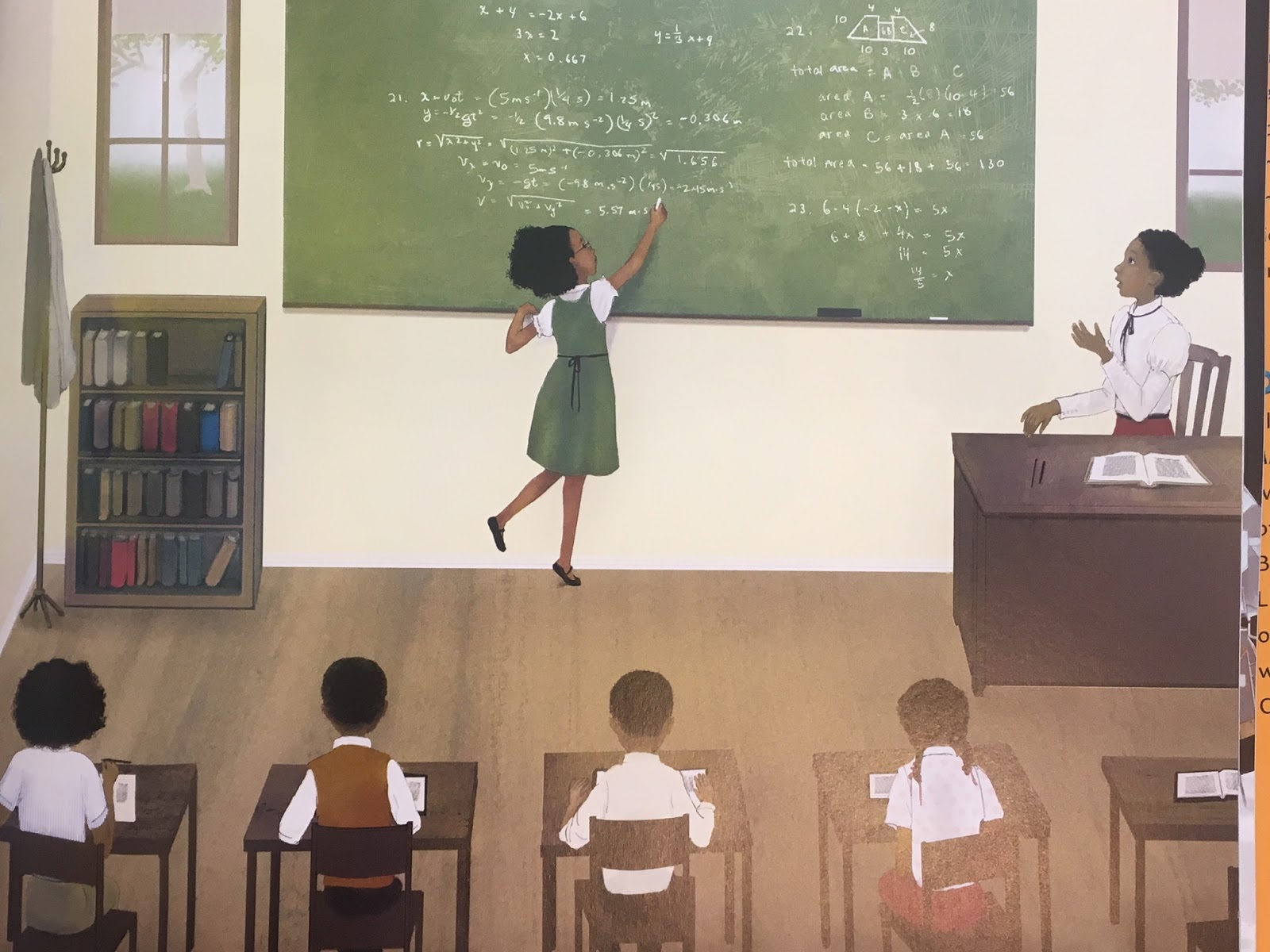
I had the great pleasure of working with illustrator Dow Phumiruk on Counting on Katherine: How Katherine Johnson Saved Apollo 13, which "launched" earlier this summer.


Dow's artwork, in my opinion, is stunning, and really brought the book to the next level. I was curious as to how she blended her knowledge of math and science with her artwork to create such effective illustrations. So I asked her.

Here is the result of that interview:

H: Your artwork in Counting on Katherine is so beautiful. But it's more than that - I can tell that it's historically accurate too. Can you describe your process - how did you research the illustrations in Counting on Katherine?

D: So much research!!

I started with online sources from NASA. I also watched online interviews with Katherine Johnson herself, which I found to be the most helpful to learn about her personality. I read about the start of NASA, about the solar system. I filled a folder on my computer with screenshots of images I thought might be useful for reference. I read the Hidden Figures narrative nonfiction book by Margot Shetterly (the movie did not come out until after my final art was turned in). I made trips to the library to look through books about space. I also looked at maps and images of what West Virginia looked like in the 1930s, including the Greenbrier Inn in her hometown, and what her classrooms might have looked like back then. I looked at online clothing ads and patterns as well as old photographs to see what styles of clothing best represented the fashion of each phase of her life. And of course, I found as many photographs of Katherine herself at different ages.


H: What were the biggest challenges? Biggest surprises?

D: The biggest challenge was the above-described quest for accuracy, from the math to the scenery from her childhood. It was really difficult to find enough photo reference from that long ago. Little details were hard to discern, like if her family might have owned a car upon moving to Institute, West Virginia. In addition, her achievements spanned decades, and this meant learning as much as I could about the evolution of our space program over this long period of time.

I was surprised about Katherine in general. I didn't know who she was upon receiving the pitch for this project. I couldn't believe I had not heard of her before. The more I learned about her life, the more I grew inspired!


H: The endpapers are stunning. They show a blackboard covered with mathematical equations and math problems. How did you, a)think to do this for the book, and b) come up with the material to put on the board?  

D:  I wanted to represent Katherine's genius with math-filled chalkboards. Picturing her as a young girl in front of these chalkboards made sense to emphasize the extent of her abilities since early childhood.

Coming up with the information to fill the chalkboards was not easy! I may have been proficient at math in my youth, but now advanced math is a challenge. Basic algebra and word problems, like the picnic pies and the rocket ship questions, are not a problem for me to make up. I was able to easily google search equations for circumference, radius, volumes of different shapes for example, to make up the ice cream cone question (in which I do not clarify is the volume of the parts of a one scoop cone, by the way!). Sometimes, as for the rocket ship trajectory question, I’d leave off needed information to answer the question (so that I wouldn't need to have an answer!).
  
I used multiple sources for the rest and especially for the higher level math and physics seen in the book. I got lots of help from my family, sampling bits from my girls' homework (their work spanned algebra to calculus) and basic physics equations from my husband’s old physics book (he is a former engineer). I also found some information online, altering the source by replacing letters and figures so it would not be just copied. In compiling this together to fill the board, I would sometimes intentionally obscure parts.

In the end, I would remind myself that this is a book about a mathematician and her brilliance and not a math textbook to keep myself from hyperventilating.


What projects are you working on now???

I have a couple books in the works, but they have not been announced yet. I will say that I am very excited to be both author and illustrator for these upcoming projects!


20 Apr 2018

A Mathematician Barbie???? Who'da Thunk It?

Post by Helaine Becker

When I was growing up, Barbie was the ultimate aspirational toy. She had a fantastic slinky black dress. An over the top wedding dress. And clothes for being a stewardess, a picnicker, and attending a sock hop.

But there was no Barbie mathematician attire. Are you kidding? This was the era of "men don't make passes at girls who where glasses." And "men don't like women who are smarter than they are. So play dumb!"

Image for BRB INSPR WMN DL 3 from Mattel


Times have moved on. Not enough, of course, but some.

And this is where I get to tell you about the newest dolls in Barbie's inspiring women collection, being released next month. One of them is Katherine Johnson, the subject of my upcoming picture book, Counting on Katherine. 

I only wish this doll had been available when I was growing up. I might not have skipped out on grade 12 calculus.

9 Jun 2017

Superfun STEM trailer!

Post by Helaine Becker


Kids Can Press has  released the trailer for my new picture book biography about William Playfair, the Victorian-era rogue who single-handedly invented the field of infographics. Check it out!

13 Jan 2017

Crochet Your Own Coral Reef - and Help Save the Planet

Post by Helaine Becker


All images courtesy Institute of Figuring

The coral reefs of our planet are in danger. That's one reason a group of crafters are getting together to create artificial reefs - out of wool! Not only are they making something of extreme beauty, but their creation is bringing awareness of the reef's troubles to museum visitors. It's also helping to teach people about topology - the science of shape.
Image courtesy Institute of Figuring

The Crochet the Reef project is a brainchild of two sisters,  Margaret and Christine Wertheim, of the Institute For Figuring.

They began the project in 2005 in their Los Angeles living room but gradually the project - and their gorgous woolly reef -  began to expand into other cities and countries. It  has now become a worldwide movement that engages communities across the globe from Chicago, New York and London, to Melbourne, Dublin and Capetown. The Crochet Reef is a unique fusion of art, science, mathematics, handicraft and community practice that may well be the largest community art project in the world. Eager crafters can create their own sub reefs! ( For information, on how, click here.  )

Image courtesy Institute of Figuring

The inspiration for making crochet reef forms begins with the technique of "hyperbolic crochet" discovered in 1997 by Cornell University mathematician Dr. Daina Taimina. The Wertheim sisters  elaborated upon it to develop a whole taxonomy of reef-life forms. 

The method for making these forms is a simple pattern or algorithm. On its own it it produces a mathematically pure shape. By varying this algorithm, however, the sisters discovered they could create endless variations and permutations of shape and form.

One fascinating aspect of this project is how it addresses the dangers of a disappearing habitat with that of a disappearing craft. Traditionally, crocheting has been a feminine pastime and one sniffed at by men as being a less important technology than, say, IT. However, crocheting can not only produce many useful and beautiful materials, it can also be an excellent tool for exploring mathematical problems. 

To see the crochet reef in person, you can visit the Museum of Art and Design in New York until January 22, 2017. Or check the Institute for Figuring website for other exhibit locations near you. 
Image courtesy Institute of Figuring

5 Jul 2012

Paddling the Ice Kap

No, I didn't get up North or to Antarctica, to paddle my kayak at either of the actual ice caps. Instead I got to try out a kayak model called the Ice Kap, from Sterling Kayaks. It was a great day to learn more about kayaking science. Yes, there's science in kayaking! There are all the measurements, when designing and constructing boats. There's also research. Which boat shape is good for racing, or for surfing in waves? And then there are the experiments. No lab coats and clipboards for me -- I just try the different boats and have fun, while my friends Louise and John keep a notebook of their own experiments with kayaks.

At the MEC Paddlefest on Willows Beach, we found an assortment of several models from Sterling Kayaks. Each is a custom job, with the foot pedals set to accommodate the paddler's own leg length, for example. I got to sit in an Illusion, but even with the footpedals adjusted as far as possible, my feet still couldn't reach. That would be no problem if I owned one of their kayaks, explained the designer, Sterling Donaldson. He would put the footpedals closer to the seat for someone as short as me. He's calculated the centre of gravity and balance points for all his kayak designs.

Donaldson gets fibreglass under his fingernails and epoxy all over his hands, he complained at one point. But there's no substitute for the hands-on approach when customizing a kayak for someone with special needs.

The foam seats are a terrific support... lifting the knees a little and fitting around the butt. I'm guessing that my partner Bernie would find THIS seat doesn't hurt his back. The seat back is good support, but low so that a paddler can lean back when rolling the kayak. On each side of the seat is a support for foam padding, to customize the fit to the paddler's thighs.

I got into the Ice Kap which is designed for small people. The coaming, the edge around the cockpit opening, is low. As in half-way up my thighs when I'm seated in the kayak. No more rubbing my elbows on the coaming with each stroke! That happens in most kayaks for me. The designer Donaldson pointed out, most shorter people are not only short in the leg, but have short backs as well. It's hard to roll a kayak that is too big.


My friend John Herbert  took a photo of me on the water in the Ice Kap. It's pretty clear in the photo that this boat has a lot of rocker, a curve which brings the keel up in the bow and stern. That makes for a lot of fun riding waves. I expressed some concern about the front deck being so high out of the water, and the stern so high. Wouldn't they catch wind and turn like a weather vane? "None of our boats weathercocks," Donaldson insisted.
The Illusion has a similar hull to the Ice Kap, but the coaming rises a little higher at the paddler's thighs and sides. John could tell that he wouldn't fit either model. At 6'4", he went for their Grand Illusion that fits the 6'3" designer. But the model on the beach had been padded to fit a thinner paddler. Not for John today!
Louise tried the Ice Kap as well, just to add another model to her research for which style of boat she would buy this summer. We compared notes. Afterwards, John and Louise changed out of their paddling clothes while I just wandered around evaporating. One of the most important things I learned about kayaking science is to wear clothes that evaporate dry quickly.
Our verdict: if you're a thin, short man or woman who is wanting an exciting kayak, try the Ice Kap for an experiment of your own. If you're not thin, try the Illusion as the coaming is just a little higher instead of pressing on the sides of your thighs.
And if you're a differently-able paddler (like every member of our paddling group, and plenty members of SISKA and VCKC and the entire crew of the Breaststokers Dragon Boat team), talk to a kayak designer about kayak science. How can a kayak meet your needs?
This particular designer understands. Sterling Donaldson not only talks the talk, he walks the walk with one leg and crutches on the beach among his kayaks. He grew up designing experimental aircraft with his father, and now he applies the scientific methods he learned to building kayaks.

6 May 2012

Hockey Science


Today's post is just for kids.
It's the playoffs for Lord Stanley's cup and even though my hockey team was knocked out in the first round, it doesn't mean I've given up on the game.

My writing partner, Leslie Johnstone and I have a new book on Hockey Science, soon to be published by Scholastic Canada.  The book has 25 really cool experiments but some activities which we thought we terrific were cut by the editor.  We aren't complaining, but this was one activity which we really liked. So- rather than lose an experiment, we thought we would share it with you. 

The image above is the cover for the book. Great job by a fabulous illustrator.


Tasty Ratios
You may not have thought about this, but hockey involves a great deal of math. Anytime you quote a player’s statistics or recite win/loss percentages you are using math. Here’s a tasty way to think about advantages when a team is short a player.


NOTE: If you have a food allergy check with a parent before using any of the ingredients

You Will Need

4 pieces of round pita bread or small round tortillas
Peanut butter or almond butter (do not use if you have nut allergies)
Honey
Butter knife

What To Do

1 Spread peanut butter or almond butter over the pita or tortilla and drizzle a bit of honey over it.
2.  Use a knife to divide two of the pitas into 3 equal sections. Cut the pita and set aside 4 of the 6 sections.
3.  Use a knife to divide the other two pitas into 4 equal sections. Cut the pita and set aside 5  of the 8 sections. Which gave you the greatest servings of pita- the one cut into thirds or the one cut into fourths?
4.  Eat the pita hockey snacks.

What Happened?

You have two pies. Someone offers you 4/3 of the pies or 5/4 of the pies. Which offer would you choose to receive the greatest serving of the pies? You discovered that 4/3 is greater than 5/4. But what does that mean for hockey? Consider power plays: If a team is playing 4 against 3, it means they have a greater advantage than if they were playing 5 against 4.

Did You Know?

You also created a great science snack. The pita provided a carbohydrate and the peanut butter gave you a protein. 

 Your body needs carbohydrates and proteins after a strenuous workout. In fact, nutritionists recommend that you have some kind of carbohydrate such as fruit, or juice shortly after exercising. This gives you more energy and helps to restore your levels of glycogen, the chemical your body makes to store carbohydrates for later use. Proteins from foods such as nuts, meat or milk give your muscles the amino acids they need to not only recover from the workout but also to rebuild.  It is recommended that you consume both carbohydrates and protein within 30 minutes of a strenuous workout. If you wait longer than that period of time your body will take in or absorb less glycogen.