Showing posts with label human biology. Show all posts

18 Jan 2019

Death by Oxygen

by Adrienne Montgomerie
Flying high in the sky where the air is thin, fighter pilots wear oxygen masks to make sure they can breathe. But oxygen can be deadly. It's a tight balance.

Oxygen to Live

The air we breathe is actually mostly nitrogen (close to 4/5 of it). Only about 1/5 of the air outside is oxygen.* And what we breathe out still has quite a lot of oxygen in it. Our bodies only use about 1/4 of it.
We breathe O2: it has two atoms of oxygen in every molecule. Add an oxygen atom, and we get O3: ozone. High up in Earth's atmosphere, a thin layer of ozone protects us from too much harmful solar radiation (the UV in sunshine).

Oxygen to Kill

Oxygen is also used to clean water. The O3 of ozone quickly breaks down into O2. The free oxygen atom oxidizes cells and other pollutants in the water.
Oxidation happens when a substance joins with oxygen and turns into another substance. Rust is oxidation, so is an avocado turning brown. In cells, oxidation happens when oxygen burns through membranes and joins with the DNA inside.
Antioxidants prevent oxidation in cells, or at least slow it down. Vitamins C and E and others do this work, but with questionable results.

Can’t Live With It, Can’t Live Without It

When the air has less than 6% oxygen, humans can't get enough to live. But getting too much oxygen can be deadly too. When there's much more that 21% oxygen in the air, some of that oxygen binds to proteins in the lungs, interferes with the central nervous system, and messes with the eyes. It can lead to death. So doctors and nurses are very careful to not give patients too much.
Breathing is necessary, and oxidation is a natural process linked to aging. So, in some sense, oxygen will be the death of you.


*There's another 1% or so of outside air that is made up of carbon dioxide and argon (mostly), plus some other gases.

Photo courtesy of Defence Imagery, CC0 Pixabay.

22 Oct 2016

Iceman CSI: Tales from a 5300-year-old man

Forensic reconstruction imagines this is
what the 5300-year-old Ötzi looked like.
(Thilo Parg, CC BY-SA 3.0)
by Adrienne Montgomerie

An arrow sang through the air and plunged deep into a man’s shoulder 5300 years ago in Italy. That man fell as he gasped his last breath, his left arm flung awkwardly across his chest, pinned beneath him.

A mummy is not what you expect to find when you’re strolling through the Alp mountains with your husband. But that’s what happened to the group of mountaineers who found this mummified man in 1991.

What happened to this man? Why did he lay there, undiscovered, for so long? What can his body tell us about humans and life so long ago?

Because he died in a place that is always cold, his body did not disappear into the earth or get eaten by animals. All his parts are there, exactly where they were. He is not covered in rags like a mummy in a movie, but we say his body was mummified because it did not rot. This ancient man they named Ötzi, contains a lot of clues.
.

Learning without destroying

Early scientists would cut apart specimens to learn about them, but that destroyed the body. Today, scientists know that the more they can preserve, the more will be available for other scientists to learn from, and for new technologies that get developed in the future.

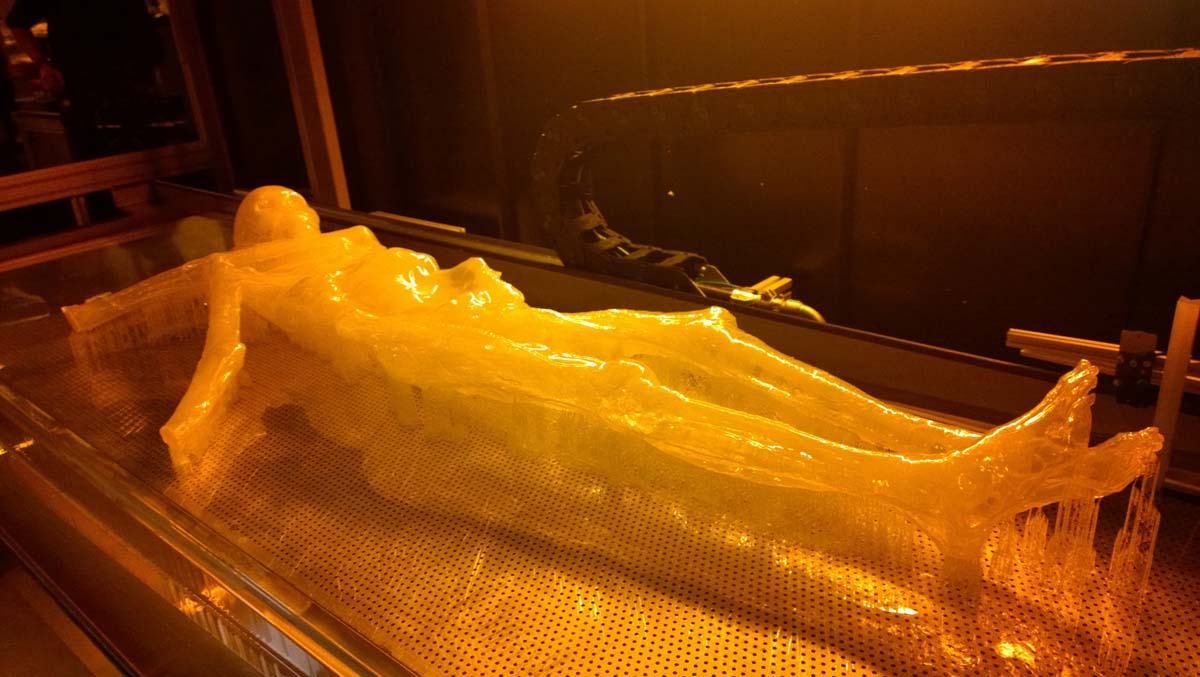
The body is too fragile let everyone examine it closely, so 3D printing was used to create a copy so people can get a closer look at him.
The 3D print formed the base that the sculpture is made from. (Materialise)
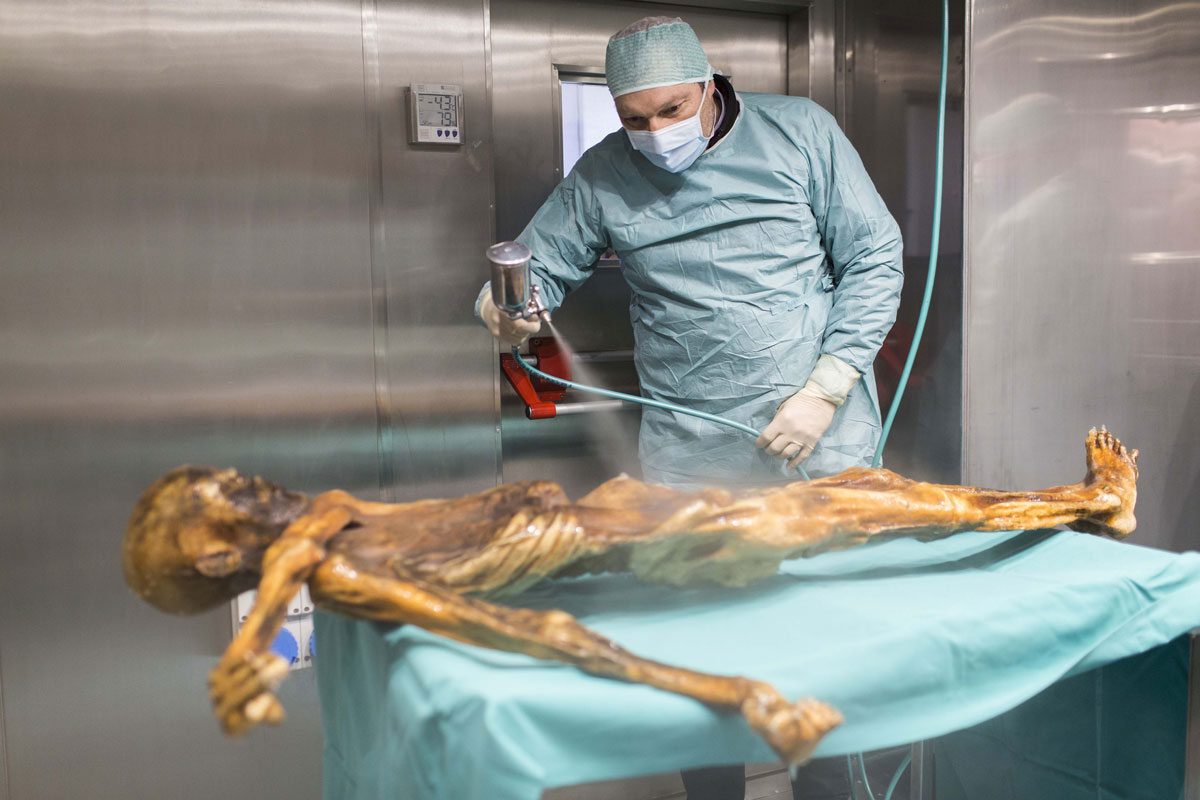
Preserving the iceman Ötzi, so that others can study him, means keeping his body in a room that is –6 °C and nearly 100% humidity — just like on a glacier. The room is dim too, to protect the artifacts from damaging light. An alarm goes off it the room changes.
Ötzi is kept at –6 °C and nearly 100% humidity. (South Tyrol Museum of Archaeology)
Dinosaur bones are replicated for display, too. That’s right, the bones you see in the museum are not the actual bones that were dug up. The originals are stored in conditions that keep them from falling apart, so that scientists (like archeologists) can study them.
.

What can scientists find out from the iceman?

Well, first, they can find out how long humans might have lived, so long ago. Because we have a lot of data about how bones age, scientists can estimate that Ötzi was 45 years old when he was killed.
Because of what we know about how vocal chords work, scientists can guess what Ötzi’s voice sounded like.

Because of the contents of his stomach, they can find out what kind of diet people had that long ago. His last meal was ibex, deer, and grain. His stomach also gives clues about where he travelled, because of the h. pylori bacteria they found in his gut came from Asia, very far away from Italy.

By analysing his DNA, they can find out that he was lactose intolerant, was likely to get heart disease, and had Lyme disease.
His shoes look a bit like Uggs.
(Wolfgang Sauber, CC BY-SA 3.0)

Because of the bits of clothes that were still on him, researchers can make guesses about the style of clothes he wore and the animals that they were able to kill (to use to make clothes).

Because of X-ray and CAT scans, we know there is an arrow-head lodged in his shoulder. But forensics showed he had many more injuries — the kinds that people get from a fight — and blood from four other people on his clothes and tools. Now experts think he actually died from a hit to his head.
.

Mysteries still

There’s still a lot you can’t know by examining a body. Wouldn’t you like to know where Ötzi lived and why he was in the mountains? Who he was fighting and why? How big was his family, and did his brothers and sisters play pranks on each other?
.

Learn more

There are a couple documentaries about Ötzi (Iceman Reborn, and others by NOVA), and several websites explaining different aspects scientists have discovered about him (follow the links in this article). You can even find out how a body becomes a mummy naturally

You can see the Ötzi copies in person at the DNA Learning Centres in New York city and Cold Spring Harbor, USA. To see him in person, you have to look through a small window into a climate-controlled room at the South Tyrol Museum of Archaeology in Bolzano, Italy.

9 Mar 2012

Learning more about the brain

By Marie Powell

Learning about the brain might seem like something that's only interesting for neuro-scientists (photo by Dendroica cerulea via Flickr Creative Commons).

But the more we find out about the brain, the better off we are - or that's what Dr. Bruce Perry seems to say. I was lucky enough to attend one of his workshops recently, and he made it easy to understand how the brain works, and how we learn.

The workshop was geared to child trauma, but I think some understanding of the way the brain works can help in many other contexts. Perry's diagram of an inverted triangle divided into four parts is easy to understand: the bottom of the cone is the brainstem, and the top is the neocortex.

I'm simplifying it of course, but essentially, Perry reminded us that it's important not to ignore the lower areas of the brain (brainstem, diencephalon, and limbic), while we try to communicate through the higher levels (neocortex). For example, any time we learn something new, we go through stress, he says. Our ability to self-regulate, or pay attention, is affected by the lower areas of the brain. Demanding attention - through the neocortex - won't be as effective as planning to engage it from the bottom up.

Planning regulatory breaks in the day, for instance, will help us to pay attention more effectively all day long. Perry suggests rhythmic activities like dancing or music-and-movement. These activities work on the lower brain to help relieve feelings of stress. (I found a good example in getting up to walk to my car to plug the parking meter, and those "regulatory breaks" may explain why I got so much out of this workshop!)

Perry's theories make sense. We expect young children to move from one activity to another within any given hour. We build rhymes and rhythm and movement into great preschool programming like Mainly Mother Goose and Toddler Time to help them learn. Why do we forget the importance of these regulatory breaks as children grow older? Or even as we grow older?

There was a lot more to this workshop, of course. Some of this material can be found on the Child Trauma website Perry founded, at www.ChildTrauma.org. Scholastic also provides a section about him that will prove useful to teachers: http://teacher.scholastic.com/professional/bruceperry/.

Learning more about the brain can help us understand how best to approach and positively influence others, and I believe it's especially important for those of us who work with and write for children.

It's useful to think about how we learn, and visual images like the ones Perry uses can help make it easier to understand. Here's another image of brain mapping called "Knowledge Management," provided courtesy of Harold Jarche.


Marie Powell is the author of Dragonflies are Amazing! (Scholastic Canada, Grade Two Guided Reading, 2007).

30 Dec 2011

Santa’s White Hair

Santa's hair and long beard are white as snow. But as a boy, his hair was probably a different color. Just like boys the world over, his head would have been topped with shades of brown, red, or yellow.


Hair color originates inside the skin on the head, where hairs are attached. Pull on a hair firmly and slowly until it comes out, and you'll notice a small white tube clinging to the end of it. This tube is a clump of cells that fit inside a narrow hole in your scalp, a hair follicle. Hair grows in hair follicles, and the cells that line hair follicles supply the growing hair with color.


A hair grows as cells are added to its bottom. These cells contain a strong protein called keratin, which gives hair its structure. Fingernails are made of keratin too. As more and more cells rich in keratin are added to the bottom of the hair, the older cells are pushed higher in the follicle tube, towards the surface of the scalp. By the time a hair cell has been pushed through the entire follicle tube to the surface of the head, it is dead. Hair is not alive, which is why it does not hurt to cut it! The more cells that are added, the longer the hair grows.


In case you are wondering…Hair grows about 1 cm every month.


Hair does not keep growing and growing forever. Every two to seven years the follicle stops adding keratin cells. The hair stays attached for a few months and then it falls out. Every day,

50 to 100 hairs fall out of a person’s head. New ones start to grow in their place.

Hair color of all shades are the result of the presence of one chemical, melanin, which is transferred to hair cells inside the follicle. Melanin is also found in skin. Dark skin has more melanin than pale skin. When people get a tan, their skin cells are producing extra melanin. Similarly, the darker the hair, the more melanin its cells contain. Black hair has the most melanin, red hair has less melanin, and blond hair has less still. Gray hair has even less melanin, and pure white hair, like Santa’s, has none.

As people get older, especially when they have lived for fifty years or more, the color cells start to disappear, and there is less melanin to transfer to the growing hairs. We are not sure why these cells disappear. For some people it happens slowly over many years. For other people it happens quickly. Hairs still keep growing, they just don’t have much color in them any more.


Santa's white hair tells us a lot about him. It is a sure sign that Santa is probably well over 50. (It is unusual, but occasionally a young person has no melanin in their hair.) As well as being white, Santa’s hair is thick and shiny. This tells us that Santa is healthy and eats plenty of good food. Also, when a person goes out in the sun a lot, their white hair gets stained yellow. Santa’s bright white hair tells us that he does not spend a lot of time on the beach. Christmas keeps him much too busy for that!

14 Oct 2011

This Hour Takes 22 Minutes. Off Your Life.

By L E Carmichael

News.  Sit-Coms.  The Discovery Channel.  The latest "reality" drama.   No matter what you're tuning in to, you might want to turn it off.  According to a new study, television does more than rot your brain: it shortens your life.

A group of Australian scientists collected data from more than 11,000 people over the age of 25.  They compared the number of hours people spent watching TV every day to the number of years people lived.  The results were shocking.

A person who watches 6 hours of TV per day lives, on average, 4.8 years less than a person who watches no TV at all.  Every hour of TV watched after age 25 is associated with a decline in life expectancy of 22 minutes. 

The researchers compared TV viewing time with other risk factors for reduced lifespan.  This is a chart I made, based on data mentioned in the study:


That's right - watching 6 hours of TV per day appears to be as dangerous as lifelong smoking.  And if you're thinking that no one watches 6 hours of TV per day, you're wrong - the average adult in the USA watches about 5 hours a day.  That's 35.5 hours per week spent watching TV.  Or put another way, almost as many hours as a full-time job.

It might be a little soon to go throwing away your remote control.  This study demonstrates a negative correlation - in science-speak, interdependence between two variables.  In other words, as TV-viewing time increases, lifespan decreases.  That doesn't mean that television, in and of itself, is directly responsible for early death.  Correlations are not the same as causes.  Indeed, two correlated variables may in fact be responding to the same underlying-and-as-yet-unidentified cause.

In the case of this study, that cause is most likely sedentary behaviour, also known as too darn much sitting around.  And that sitting isn't just done in front of the tube.  It's at work, in the car, eating at restaurants and typing out emails.

Excuse me.  I have to put my laptop down now, go out, and take a walk.

4 Oct 2011

Eyebrows: An example of how little we know about ourselves


I’ve been reading and writing about eyebrows this week. I’m learning a lot. It has made me think, with amazement, how human beings (like me) are so oblivious to our own biology in so many ways. I mean, eyebrows are just two strips of hair; they’re kind of boring, perhaps even a little gross. Even though I look at eyebrows dozens or even hundreds of times a day, I’ve never paid them much attention before. All this time, I had no idea how important they are to everyday life.

For one, they are crucial for communicating emotion– more so than words. Our eyebrows tell others when we are angry, sad, afraid and happy. We also use them in conversation, like visual punctuation, as well as to convey empathy. And we send specific messages with them; raising our eyebrows quickly, known as the eyebrow flash,is something that cultures around the world do automatically to send signals. The message can be “hello,” or “yes,” or “I’m flirting with you.”

Detail, portrait of a man with raised eyebrows, Giovanni Battista Moroni

Eyebrows talk, and we are very good at understanding what they are saying, without thinking. But there is more. Eyebrows are crucial for us to recognize faces and determine the identity of its owner. That is one reason why we first look at the eyebrows and eyes when we see a face. People’s eyebrows give us even more information – whether they are male or female, and to some extent how old they are.

THICK EYEBROWS ON A YOUNg male

We also seem to read information from eyebrows about people’s personalities, though there is no evidence (and it is unlikely) that eyebrow shape and personality are actually related. We judge a face with thin eyebrows to be happier, weaker, and more intelligent. Thick eyebrows are judged as stubborn, strong, even mean. This makes me wonder if there is a biological reason for people in so many cultures, especially women, altering their brows to make them thinner. Could it be that we are unconsciously changing what our faces communicate to the world?

Female eyebrow, thinned and tattooed

So here I am, looking at my own eyebrows in the mirror several times a day, using them to detect the emotions and identity of the faces of everyone I meet, and moving them up and down and in and out to send signals to people without being aware of it. My mind pays attention to eyebrows when I’m speaking to people and when I’m watching actors on a screen, and registers and understands the signals they convey without my knowledge.

My conscious mind can try to fake emotions using my eyebrows, but this uses a different part of my brain, and like most of us I am not very good at faking it. The movements we make when deliberately “making a face” are faster, bigger, and last longer. Most people have little difficulty telling the difference between when we are faking a frown and when we really mean it.

Studying the science of eyebrows has made it very clear that my brain is causing me to behave in ways that I do not know about. This makes me wonder what else I’m doing that I have no control over. It makes me uncomfortable to think that I’m an animal, a product of evolution, and that I respond to my environment – including other people – in such complex ways without my knowledge.

It is also marvellous to realize how little we understand about our own biology. Eyebrows are right under our noses (well, actually above our noses), are utterly unique to our species, and yet are not fully understood. From a purely selfish perspective, this means there is plenty of intrigue and mystery left to explore, and plenty still to write about.