7 Mar 2014

Tales in time: Criccieth Castle

By Marie Powell (Photos by L. L. Melton)

I love castle hopping, and Wales is one of the best places to explore ruins from bygone days. With some 400 castles in about 20,000 square kilometres (8,000 square miles), there's a lot to explore.

Last year I had the chance to see Criccieth Castle, located at the top of a rocky hill overlooking Cardigan Bay, North Wales. According to the Cadw's Criccieth Castle guidebook, the earliest records of the castle date from the 1230s, when Llywelyn ab Iorwerth (Llywelyn the Great) made it a main seat of power in North Wales.

He built the inner ward of the castle, including the twin towers, using a mix of angular stones from the rock around the castle, glacial boulders, with grey mortar made from beach gravel. The D-shaped towers are typical of Welsh native castles, but these twin gatehouses may have also been influenced by castles of the Marcher lords at Cheshire and Montgomery.

The various princes and kings who owned and controlled Criccieth had a hand in adding to its architecture. Although determining the date of a castle ruin might seem straightforward, there is a controversy over who built what part of Criccieth. Experts turn to structural evidence in the ruins to develop their theories and time estimates.

For example, Llywelyn ap Gruffudd (Llywelyn the Last) added an outer ward to the castle. The mortar used in his time is more gravelly, with stones and boulders brought to the site (rather than quarried from the castle rock) along with blue-grey slate. Experts believe the square holes about eight feet from the top mark the height of the towers during the time of the Welsh princes.

Arrow slits that can be seen at the ground level of the towers, as well as at strategic positions throughout the castle, offered a protected spot for archers guarding the castle from attack. Criccieth had several other buildings and towers as well, including one thought to have housed a trebuchet (a machine to throw stones) or a catapult for warding off enemy attacks.

Criccieth fell to Kind Edward I of England in March 1283, and was later held by Edward II (1307-1327) as well. They built up the top of the towers to the height we see today. The square holes held horizontal beams for a fighting platform (or "hourd") projecting from the wall. The English also used castle rock again, but the mortar from this period contains more shells.

Edward II spent over £250 on repairs and refurbishing, according to the guidebook. The castle was finally destroyed in about 1404, during the time of Owain Glyndwr, and was never rebuilt.

A small museum and gift shop at Criccieth tells more of the history and architecture of the castle, with colourful floor plans such as this one.

Another useful resource is the Castles of Wales website, which includes a discussion of the history, geography, architecture, and archaeology of this and other Welsh castles. As well as the guidebook, Welsh Castles by Adrian Pettifer also offers discussion of Criccieth and other castles by area.

Marie Powell is the author of seven books for children, including Dragonflies are Amazing (Scholastic Canada) and a six-book Word Families series (Amicus Publishing). Her second six-book series is expected this fall.


28 Feb 2014

Book Review: It's About Time, by Pascale Estellon

Title: It's About Time: Untangling Everything You Need to Know About Time
Author: Pascale Estellon
Publisher: Owl Kids
ISBN: 9781771470063

Book Source: review copy from publisher

I've published 10 science books for kids since 2012. Nine were "fact" books, dealing with straightforward, concrete information. The tenth is on the scientific method - a way of thinking - and my experience on that project showed me how much harder it is to write effectively about something so insubstantial and abstract.

Is there anything more abstract than time, the subject of Pascale Estellon's latest book?

Starting with one second and working up to one century, Estellon's done a marvellous job of taking the insubstantial and making it concrete. She relates each measure of time to a specific activity young children have already experienced, giving them a solid frame of reference. One second, for example, is the amount of time it takes to turn the page of the book; one hour is how long it takes to mix and bake a pound cake. The recipe for the cake is included, encouraging kids to tackle time in an interactive, hands-on way.

The book also includes questions, activities, and a clock kids can make and use while learning how to tell time. The design is extremely visual - Estellon's illustrations don't just add colour and life to the page, they are used to explain and help kids picture difficult concepts.

The only concept in the book I felt wasn't clearly explained is the Monday's Child rhyme included in the days of the week section - the heading asks kids "What day of the week are you?" without explaining that the rhyme relates to birth day. Unless kids are reading with an adult who's familiar with this rhyme and can explain, they may find this a bit confusing.

Altogether, however, It's About Time is cheerful, appealing, and very effective, and I heartily recommend it.

---

Review by L. E. Carmichael


14 Feb 2014

Penguin Enthusiasm

No, I'm not a penguin scientist -- though I am applying to join an Antarctic expedition as a writer-in-residence. But I did enjoy finding this pair of photos of a penguin who appears to be trying to join an expedition of his own:

What's the Name of That Bird?: A Sampling of Identification Guides (Part II)


by Jan Thornhill 
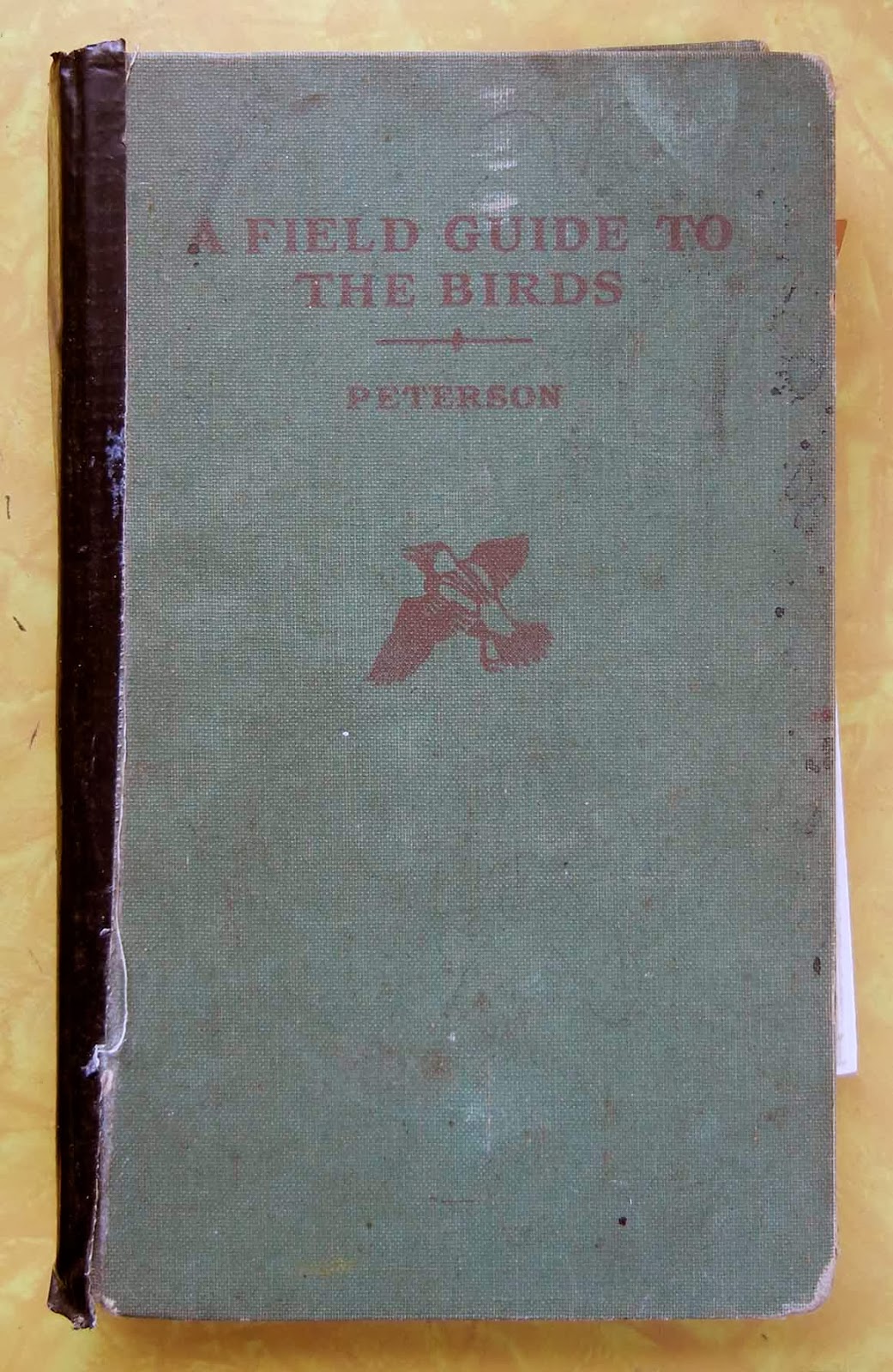
My 1965 Peterson's Field Guide to Birds

I blame my dad for nurturing my natural propensity to put names to things. He was a walking encyclopedia and knew the names of all kinds of things—of rocks and minerals, of trees and plants, of clouds and bugs—and could easily explain the differences between, say, the flat needles of a hemlock tree and those of a balsam fir (hemlock shorter; fir with two light stripes on the underside). He fell short, though, on the names of birds, and couldn’t differentiate between a Downy Woodpecker and a Hairy one. Understanding that this was a flaw, he bought the family a copy of Peterson’s A Field Guide to the Birds when I was ten.

It was spring thaw when he took me to the Humber River to try it out. We shared the binoculars, but I was given the honour of being Keeper of the Book. Breakup had just happened and the river was swollen and roiling, carrying fast-moving ice floes towards Lake Ontario.


We Were on the River’s Edge When the Awful Thing Happened


A Yellow-rumped, or Myrtle Warbler almost caused
my dad's demise in 1965. (Dan Pancamo)
While trying to find a picture to match the tiny yellow-rumped bird I’d just seen, I did the unimaginable. I dropped the precious book. To my horror, it tumbled down the bank, straight into the freezing Humber. The river was moving fast. And so was the ice. And now, so was the book.

In a family like mine, it was clear to me at a very young age that books were important. I just didn’t know how important until that day.

My dad was no athlete. We didn’t play catch, and I never did see him run. But when that book hit the water and started to float away, he leapt into action. He skidded down the bank, and then—just like a super hero—he pounced onto the nearest ice floe. It tilted precariously, but he maintained his balance. Following the bobbing book, he leapt to the next floe. Then the next. He kept going until the prize was within reach. Somehow he scooped it sopping from the water without falling in himself, then inelegantly danced from one floe to another until he’d made it back to shore.

My dad had just risked his life for a book. A book! Powerful moment. 

The book, of course, was ruined. But no matter. He bought another. Which I still have.

Sibley Guide to Birds


This updated and improved Second Edition
 of the pocket version is due out next month.

Remarkably, that Peterson guide held its position as my birding bible for more than thirty years, and might have remained there if ornithologist David Allen Sibley hadn’t decided to spend ten years hunkered down with watercolours and brushes to paint the 6,600 images of 810 species found in the Sibley Guide to Birds, first published by Knopf in 2000. With multiple depictions showing alternate and juvenile plumages, flight patterns, and comparative perching views, it’s a monumental and irreplaceable work. Though the original edition is too cumbersome to be used comfortably in the field, pocket editions have been available for several years. 


The Warbler Guide


One of the things the Sibley guide has been lauded for is its treatment of the more than fifty species of wood-warbler that nest in North America. These tiny jewels can be challenging to identify, partly because so many of them prefer to spend the bulk of their time flitting amongst the highest leaves of forest trees (hence a birder malady known as “Warbler Neck”), and partly because, by autumn, they’ve traded their fancy, and often brightly coloured breeding plumage for much drabber winter outfits. Making this latter, seasonal task of identification even more difficult is the addition of immature warblers wearing their own muted versions of adult markings. Peterson referred to these duller versions as, appropriately, “Confusing Fall Warblers.”


So what’s a warbler hunter to do? Well, Sibley’s is good, but a new book, The Warbler Guide (Princeton University Press, 2013), completely blows it out of the water. In this unbelievably comprehensive book, Tom Stephenson and photographer Scott Whittle tease warblers apart with a fine tooth comb—not literally, of course, but with more than 1,000 photographs. 
Each species, (presented alphabetically by common name—yes!), is extensively explored with multiple views, close-ups of distinctive characteristics, photographs of comparison species, visual tips on aging and sexing, detailed range maps, and numerous captions that cover behavioural traits. Each species is also given several pages of sonograms to help with identification by song or call. “Quick Finder” spreads show these little beauties from a variety of angles, fantastic resources that are downloadable for free from Princeton University Press.

The Underview Quick Finder from The Warbler Guide that
 will go a long way in reducing "Warbler Neck."


Bird Feathers: A Guide to North American Species


But what if you see a warbler and before you can identify it it flits out of sight, leaving only a falling feather in its wake? Another book comes to the rescue: S. David Scott and Casey McFarland’s Bird Feathers: A Guide to North American Species (Stackpole Books, 2010). The first part of the book has detailed information about avian physiology, conservation, feather morphology, bird flight, tips on flight feather identification, and an explanation of feather colour and iridescence. 
Red-tailed hawk feathers
The bulk of the book, however, shows examples of each species’ right wing feathers, all clearly photographed on neutral backgrounds, along with measurements and range maps. 

Whether you find a stray feather lying at the side of the road, or the fluffy, strewn remains of a predator's kill, this book, like all the others in this post, is a wonderful resource.


  • Peterson Field Guide to Birds of North America, Roger Tory Peterson, Lee Allen Peterson, Houghton Mifflin Harcourt, 2008, 544 pages. ISBN: 0618966145
  • The Sibley Guide to Birds, Second Edition, David Allen Sibley, Knopf, 2014, 624 pages. ISBN: 030795790X
  • The Warbler Guide, Tom Stephenson, Scott Whittle, Princeton University Press, 2013, 560 pages. ISBN: 0691154821
  • Bird Feathers: A Guide to North American Species, S. David Scott, Casey McFarland, Stackpole Books, 2010, 400 pages. ISBN: 0811736180

Click here for Part I: "What's the Name of That Caterpillar?: A Sampling of Identification Guides 


7 Feb 2014

The 50 Greatest Inventions Since the Wheel? Maybe....

In the November 2013 issue of The Atlantic, the Editors present a list of their top 50 inventions since, well, the wheel.

A few years ago, I covered this same ground in my book What's the Big Idea? from Owlkids.


Needless to say, the choice presented in my book were not exactly the same as the ones the Atlantic came up with (and there are more of them). That's partly because I selected inventions based on what's most important to kids.

For example, there's the all-important needle.


The needle you say? Why would kids care about a needle?

Simple. The needle is what allowed our ancestors to survive the brutal cold of the Ice Age in Northern Europe etc. etc. They used it so they weren't totally reliant on furs for clothing. And think about it - if you drape furs around you, they can be a little drafty. You really need something to wear underneath them, something close to the skin that you can layer...

Underwear.

Without the needle, there'd be no underwear. And without underwear, we wouldn't have survived the freezy breezy.

So check out the Atlantic list of inventions for sure, but don't overlook, ahem, what's under-represented. Check out What's the Big Idea? for a real EYE-opener. (get it?)

PSST, while you're at it, you might what to check out my current book, Ode to Underwear! Yes, I have a "thing" for underthings!)


31 Jan 2014

What’s the Name of That Caterpillar?: A Sampling of Identification Guides (Part I)


by Jan Thornhill


It’s the middle of winter, not exactly a traditional season for mushrooming, but the big table in my dining room is nonetheless covered with fungal specimens—weird crusts, desiccated jellies, mini shriveled cups, spore-spewing remnants of slime moulds—all of which I’ve peeled off frozen logs and dead branches with my equally frozen fingers. Many of them I’ve never seen before. Many are minute. Many take hours to identify. But I don’t care how long it takes to find out what they are. I want to know their names. I need to know their names.
Yes, I'm even dragging chunks of firewood up to my table.
Am I weird to be so obsessed with the sorting and naming of my mycological discoveries? Hardly. It turns out I’m not weird at all. Sorting and naming living things is hardwired into all of us. We are intuitively ontological animals, and we start out this way in infancy. Human babies are adept from a very early age at distinguishing between what is alive and what is not, and show a clear preference, (judged by length of attention span), for depictions of animals—of pandas and frogs and chickens, as opposed to hats and hammers and rocks. This preference, along with an ability to easily distinguish between different genera, is even more apparent once we begin to talk.

In one analysis of the first 25 nouns spoken by babies, an average of more than ten of those words represented animals of some sort or form: dog, cat, bird, Daddy, baby, etc. And babies don't just name. They are amazingly adept at sorting, at practicing folk taxonomy. Toddlers, who have only just figured out what DOG is, have an almost mysterious ability to instantly place both a
Chihuahua and a Great Dane—despite the gross visual differences between those breeds—into that DOG category. 
(Image: Shutterstock)
This predisposition to sort and name living things is an adaptation that has stood our species well. For millennia it was crucial to our survival, in all stages of life, to be able to identify which living things were of benefit to us and which could cause us harm. Though most of us in the western world are now far removed from those original wild environments, we continue to exhibit an uncommon interest in other animal species, most strikingly when we’re young, evidenced by the collections of stuffed animals in many children's rooms, the preponderance of animal-themed picture books (some of which I'm responsible for), and, of course, by those dinosaur fanatics who, by the age of seven, can not only name an astonishing taxa of prehistoric creatures, but can also clearly articulate the differences between them. 

Though never a dinosaur fanatic myself, I have been a more than keen sorter and name-seeker since childhood. Birds, butterflies, fossils, leaves, beetles, skulls, animals tracks—I've spent time with them all. And I am not alone. It turns out that there are lots of people out there who are way, way more obsessed with this naming and sorting business than I have ever been. And some of these people write books to help those of us who are identification-obsessed, and some of these books are very specialized.

Jewel Beetles

Take jewel beetles, for instance. Never heard of them? Well, you've actually probably heard of one: the Emerald Ash Borer that has killed tens of millions of ash trees on this continent since its accidental introduction in the 1990s. The Emerald Ash Borer, along with the other 163 named jewel beetles found in northeastern North America, is featured in the new, and very specialized, Field Guide to Jewel Beetles (Coleoptera: Buprestidae) of Northeastern North America (Canadian Food Inspection Agency). Specialized, however, doesn't mean this book isn't a jewel itself—and it doesn't hurt that it's free (though they might have run out). 


Each species—many of which are gorgeously iridescent, hence their common name—is represented with at least four clear photographs, including dorsal views of male genitalia, which are apparently helpful for identification. The facing pages have range maps, detailed notes, and easy-to-grasp icons indicating size, habitat, and feeding habits. Sections at the front include the morphology of jewel beetles, tips on finding and preserving them, a glossary, a technical key, and, for those who are inspired to take the task of identification seriously, there is also an illustrated tutorial on how to dissect jewel beetle genitalia to help separate cryptic species! 


Caterpillars

Are jewel beetles too specific? How about the lowly caterpillar, then? Though many of us can recognize a monarch butterfly’s striking larva, most of us would be hard-pressed to identify many others. Yes, there are butterfly guides that include a few pictures of the most common Lepidoptera progeny, but the identity of most caterpillars has been out of reach for a lay person. Until now.
David Wagner, an entomologist at the University of Connecticut, has finally come to our rescue with Caterpillars of Eastern North America (Princeton University Press). Inside this beautifully produced guide are photographs of the caterpillars of nearly 700 species of butterflies and moths. The first thirty pages of the book contain masses of information covering caterpillar anatomy, life cycle, where to find them, how to rear and overwinter them, and more. In the guide portion of the book, each page includes at least one close-up of the star, plus another of an adult specimen, along with a clear description of the larva, its habitat and range, and its food plants. The best part, though, are the detailed Remarks that are so filled with bewitching ecological, historical, and behavioural details, it's difficult to put the book down. Where else would one not only learn that the Scarlet-winged Lichen Moth practices "fecal flicking" to avoid detection by parasitic and predatory moths, but exactly how this "flicking" mechanism works? 


Moths

The Scarlet-winged Lichen moth is also featured in the new Peterson Field Guide to Moths of Northeastern North America (Houghton Mifflin Harcourt), as are nearly 1,500 other species. For someone like me who has been known to spend hours on the porch with flashlight and magnifying glass glorying in the exquisite beauty of the "jewels of the night" that collect under the illumination of the porch light, this book is a godsend. 
Co-authors, David Beadle and Seabrooke Leckie (both Ontarians), present each species in natural resting position, instead of with wings spread the way they are when pinned, as they have been depicted in other guides. Range maps are included, as are colour bars that indicate when you are most likely to see each species. Beyond this book's near perfection as a field guide, there are comprehensive sections at the beginning that cover various aspects of "mothing" (new word!), such as "How to Find" and "How to Photograph." The names alone are so much fun—Pink-patched Looper, Music-loving Moth—that I can't wait till the weather warms enough to get out there under my porch light with magnifying glass. In the meantime, I could start up a heavy metal band and maybe call it Fragile Dagger. Or Impudent Hulda. Or Sordid Wainscot. The possibilities are endless.

Part II coming February 14!

  • Field Guide to Jewel Beetles (Coleoptera: Buprestidae) of Northeastern North America, S.M. Paiero, M. Jackson, A. Jewiss-Gaines , T. Kimoto, B.D. Gill, and S.A. Marshal, Canadian Food Inspection Agency, 2012. 411p. ISBN: 978-1-100-19794-4
  • Caterpillars of Eastern North America: A Guide to Identification and Natural History, David L. Wagner, Princeton University Press, 2005. 496p. ISBN: 0691121443
  • Peterson Field Guide to Moths of Northeastern North America, David Beadle, Seabrooke Leckie, Houghton Mifflin Harcourt, 2012. 624p. ISBN: 9780547238487


25 Jan 2014

My Stinky Sneakers

    Ewww...What is that smell? Were my socks washed in skunk juice? Did my feet turn into moldy cheese I don’t think so. It is my stinky sneakers.

I hold my nose when I take off my sneakers. My mom holds her nose too. My dog sniffs and quivers with delight. Why are my sneakers so smelly?


My stinky sneakers were not dropped in the garbage. They did not come from a manure factory. My sneakers stink because they have tiny creatures called bacteria (back-teer-ee-ah) living in them. It is not the sneakers that smell, it is the bacteria living in them. More precisely, it is not the bacteria in my sneakers that smell, it is their farts.

Your old shoes probably have smelly bacteria too.  But no matter how hard you or I look in our shoes, we will not see the bacteria. They are too small. We cannot see everything that is real.

Bacteria don’t just live in my sneakers… They live all over me, all over my body, inside and out. Bacteria live everywhere. On animals, on plants, in the air, in the soil, in the water. Bacteria live deep in the ground, on the ocean floor, on the top of Mount Everest, in the clouds, in the Antarctic ice.

The bacteria that live on my body are body bacteria. They like it warm, the temperature of me. Not all bacteria living on me are stinky. Some of them keep me healthy. I need them to help me make vitamins and keep my skin clean. But a few of the bacteria that live on my body can make me sick. Sometimes, my throat gets sore because too many bacteria are growing in my mouth.

Most bacteria just hang around, living on me like I live on the Earth. The stinky bacteria living in my sneakers are like that. There is more than one kind of bacteria living in my stinky sneakers. They have big names like Staphylococcus (Staff – ee – low –cock – us) and Propionibacteria (Pro – pee – on –ee – back – teer – ee – a). Stahylococcus are very small, and are shaped like a marble. Propionibacteria are shaped like jellybeans. These kinds of bacteria like to live where it is warm and dark. My sneakers are a perfect home.

My sneakers have something else that these bacteria love..lots of sweat to eat. Feet make a lot of sweat. Most people’s feet make more than a cup of sweat, every day. The sweat my feet makes soaks into my socks and into my sneakers. Sweat is mostly water, but there is also a little bit of salt and a little bit of sugar. Sneaker bacteria eat this salt and this sugar. It is their favorite food.

The more sweat in my sneakers, the more bacteria food. The bacteria grow and make even more bacteria. If there was a straight line of bacteria from my toe to my heel, there would be sixty thousand bacteria in a row. Lots of sweat makes crowds of bacteria. My sneakers are like a giant bacteria concert, like the Superbowl, or Times Square on New Year’s Eve.

My sweat does not smell. But when the bacteria in my stinky sneakers eat it, they sure leave behind smells when they finish dinner. In a way, it is like lots of minuscule bacteria farts. Phew!

Scientists are trying to grow a new kind of bacteria that eats sweat but does not make bad smells. This kind of bacteria would live in sneakers and clothes and eat up all the sweat and dirt. My sneakers would stay clean and never need to be washed. My mom says these scientists should hurry up.

Stinky sneakers mean that I have been playing and running. Stinky sneakers mean that I have been exercising and staying healthy. Stinky sneakers give my bacteria a place to live and food to eat.

When I get home, I take my stinky sneakers off. And I put my smelly socks in the laundry basket. And then I do the stink test.  I lift my leg in the air, point my toes at my sister and say, “smell my feet.” If she holds her nose or runs away, my feet are stinky too. And then I know…

...it is time to take a bath.