21 Oct 2022

Backyard Birds

I’ve had a birdfeeder in the back garden for years. I never paid a whole lot of attention to the little brown birds who were attracted to it. Occasional bright red cardinals were an exception, of course. But a silver lining to COVID was that I spent a lot of time in the garden in the last few years and became an avid bird watcher and photographer. I took all of the photographs in this post in my back yard.

I discovered that most of the birds were House Sparrows, the most successful bird species on the planet. I wrote a blog entry on the House Sparrow in May of last year.


Males are quite striking, females more restrained, but also pretty if you look up close.


A major problem when feeding birds is how NOT to feed squirrels instead. Squirrels eat a lot more than birds and can empty a bird feeder in minutes. They’re also incredibly smart and athletic, so they’re hard to outwit. For now this feeder is working for me.

The bar that the sparrows are perched on is spring-loaded. The weight of a squirrel drops the bar and a shield that blocks off the bird seed.

Undoubtedly this guy is trying to figure out how to outsmart me and get the birdseed.

 
I discovered that not all the sparrows were House Sparrows. We also had occasional Chipping Sparrows, with bright red caps and White-Throated Sparrows, with their yellow eyebrow patches. 
 
Chipping Sparrow

White-throated Sparrow

 
In addition to the Sparrows, I started noticing a lot of Nuthatches, mostly Red-breasted, but also the occasional White-breasted. 


Red-breasted Nuthatch

White-breasted Nuthatch


Black-capped chickadees are also frequent feeders.

 
On the more colourful side, I get lots of Cardinals. 
 

Spectacular male Cardinal. They particularly like showering when the sprinkler is on.


More restrained and very beautiful female Cardinal.

 
For a change, female Blue Jays are as brightly coloured as the males.


Blue Jays come for the peanuts in a special “wreath feeder”. The two baffles above the feeder have successfully defeated the squirrels ... for now.


Brown-Headed Cowbirds are interesting. Like Cuckoos, they lay their eggs in the nest of other species and outsource the raising of their chicks to the unsuspecting hosts.


Grackles have shown up occasionally. This female seems be yelling at her spouse for some unknown reason. Perhaps she didn’t like the lawn furniture, because they haven’t been back since.  


An American Goldfinch enjoyed feeding on the seeds of our dappled willow.

I bought a special feeder for tiny niger seed, which is supposed to attract goldfinches. It hasn’t done that, but Chickadees eat a little of the niger seed.


Perhaps the most exciting bird – and only once, so far – a Cooper’s Hawk showed up and posed for a few minutes. I expect he was not here for the food, but for those who were here for the food.

 
I used Photoshop to combine the front and back view of the same bird into one picture.

Winter was a surprise to me. I had believed the common myth that you should stop feeding birds in Fall, because the availability of food might persuade them not to migrate in time, and then they’ll get stuck in the cold and might die. In fact, that’s untrue. Birds are far smarter than that. They know when they need to migrate based on the shortening daylight hours. They’re not affected by an abundance of food. More than that, I discovered that many bird species don’t migrate. I used to think that call of Cardinals in Spring was evidence that they had returned from their winter homes. But  no, Cardinals are here for winter. 


Dark-eyed Juncos do presumably migrate, but only to “mild” Toronto. I never see them except in Winter.


Woodpeckers also stay over winter. I get Downy and Hairy Woodpeckers. They’re almost the same, except for the size. In both species, the male and female are almost identical, except that the male has a prominent red spot on its head.

Male Downy Woodpecker

Female Hairy Woodpecker

 
Robins are a welcome early spring arrival.


Adding a bird bath to the garden also attracted more birds. Juvenile robins were particularly interested in splashing around.


Capturing pictures of birds in flight has been a great motivator to explore some of the more complex functions of my camera. Shutter speeds of 1/2500 seconds, continuous shooting and focusing are really useful.


If you’re not already a bird-watcher, I hope this inspires you take an interest in the birds in your back yard.

Useful equipment:

  • A squirrel-proof bird feeder.
  • Binoculars. You don’t need (or want) high-powered one. Magnification of 7 or 8 is ideal (this is the first number in the specification of the binoculars. I’m using very small 8x25. Bigger 8x42 will give a brighter image. 
  • A bird recognition guide. This one works well for me
 
 
  • The smartphone app Merlin, from the Cornell University Lab, is brilliant. By giving just a few details about a bird you’ve seen – location, size and colours – the app will show you the most likely candidates. It has recently been enhanced to give you amazingly accurate real-time identification of bird calls. 

Happy birding. 

7 Oct 2022

Museum in the Classroom: The Pleistocene Extinction Teaching Kits


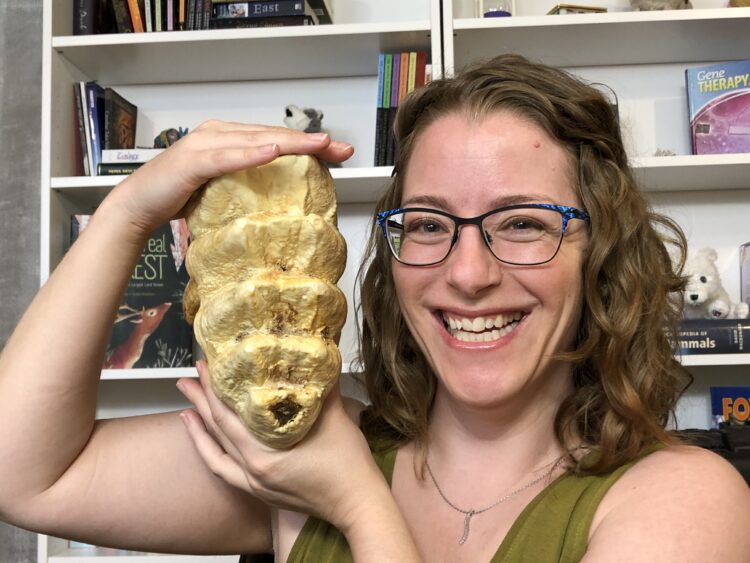
A mastodon molar is AS BIG AS MY HEAD, y'all.


by L. E. Carmichael

Did you have a dinosaur phase when you were a kid? I did. I was in the second grade, and I was obsessed. I pored over library books, memorizing five-syllable names and amazing the adults with my stockpile of bizarre dino facts (I still do that). I liked the armoured species best, because they were just so weird.

And then my parents took me to the Royal Tyrrell Museum to see real fossils. 

Mind. Blown.

Looking back, I can see how these early experiences helped spark my life-long obsession, not just with dinosaurs, but with all life on Earth. But not every child has opportunities to visit natural history museums, either with their families or on school field trips. That's why, when Dr. Lynda Colgan asked me to write the teacher's guides for her Learning with Palaeontology project, I jumped at the chance.

(Also, I'm pretty sure that all children's science writers are legally-obligated to write about dinosaurs at least once in their careers, so box checked!)

As with most of Lynda's ideas, this one was both simple and profound. First, we'd get some great big boxes. Next, we'd fill them with museum quality casts of real fossils, providing teacher's guides that provided the latest scientific knowledge about the species, while focusing on inquiry and hands-on learning. And then, we'd make the kits available to teachers for free.

And giant beavers? They were as big as black bears.
I mean, how cool is THAT?

The first two Kits, on the Pleistocene Extinction, are now available to borrow. Teacher-friends, here's what you need to know:

Features of the Kits

  • Fossil casts of mammals that lived in Canada during the Pleistocene
  • Supporting materials such as magnifying glasses, graphs, and charts
  • Teacher’s Guide containing
    • ALL the information needed to teach core concepts
    • Suggestions for hands-on learning and independent inquiry
    • Glossary, further reading lists, and bibliography of sources
  • Content vetted by experts in palaeontology, education, science communication, and Indigenous issues

Core Concepts and Skills

Junior Edition - Best for Grades 4-7

  • Habitat
  • Evolution and adaptations
  • Biodiversity and classification systems
  • Food chains and energy pyramids
  • Competition and predator/prey interactions
  • Climate change
  • Extinction

Senior Edition - Best for Grades 8-12

  • Habitat and geographic range
  • Evolution and adaptations
  • Competition and predator/prey interactions
  • Trophic cascades
  • Heredity and ancient DNA
  • Climate change
  • Extinction
  • De-extinction: biotechnology and bioethics
  • Correlation vs. causation

At both levels, students will:

  • Evaluate sources of information and assess their strengths and weaknesses
  • Draw conclusions using multiple lines of evidence
  • Understand the relevance of palaeontology to urgent contemporary issues

Junior/Elementary Kit

Borrowing Instructions:

Are you in Ontario? You're in luck! Head on over to the Queen's University Education Library catalogue and place a hold on a physical kit. The cases are on wheels, but they weigh about 40 pounds, so I recommend bringing a friend and a vehicle with a big trunk.

Not in Ontario? Don't worry, we have got you covered. Each Kit is also available in a digital edition, complete with 3D scans of the fossils that you can manipulate from your web browser. Direct links are here:

Junior/Elementary Level

The Pleistocene: Using Ice Age Mammals to Explore Climate, Habitat, and Extinction

Senior/High School Level

Conservation Palaeontology: Using Ice Age Mammals to Explore Climate Change and Extinction

Again, these resources are available to Canadian teachers absolutely free. I field tested them at some student workshops during Science Rendezvous in May, and I can guarantee your kids will be spellbound. I was beyond delighted at the level of critical thinking and curiosity my groups displayed while interacting with the fossils, and I can't wait to hear similar stories from classrooms across the country.

I also cannot wait to launch the new Kits we've been developing this year. Stay tuned, and keep exploring!


The Learning With Palaeontology Project is supported by:


with graphic design by:


29 Sept 2022

Living in Space

by Joan Marie Galat 

Photo credit: NASA
Astronauts have been living over our heads—in outer space—on a continuous basis since 2000. It takes three astronauts to run the International Space Station (ISS) but up to ten may be on board at one time. The entire structure is as big as a football field but the living area is only about the size of a five-bedroom house. Giant solar panels power the station. Some of the electricity is used to split water into gas to generate oxygen for the astronauts. The ISS orbits the Earth at a speed of 28,500 kilometres per hour. That’s eight kilometres a second—25 times faster than the speed of sound! 

I wanted to know what it’s like to live on the ISS, and made plans to write a book on the topic. As part of my research, I visited NASA facilities and watched a SpaceX Falcon heavy rocket launch. The result is the middle grade novel Mortimer: Rat Race to Space (DCB 2022). Written for ages 9-12, it tells the story of a journal-keeping lab rat who sets out to collect scientific evidence that will prove his species is the one that should colonize Mars. Mortimer records video for his future YouTube channel, but not everything goes as planned. He is forced to face new truths about dreams, friendships, and choosing the right thing to do. You can read an excerpt on Amazon.ca or Amazon.com. 


I collected much more information than I could use, including these facts: 

- Astronauts can’t be too tall or short. If you want to be an astronaut, try to grow taller than 62 inches but stay below 75 inches. 

- American astronauts must have 20/20 vision, even if that means wearing glasses, contacts, or undergoing eye surgery. 

- In the USA, jet pilots with at least 1000 hours of flying time, and teachers who have taught K-12, can apply to be astronauts. 

- Astronauts practice everything they’ll do in space on Earth. This includes how to fix malfunctioning equipment, use cameras, conduct experiments, make a meal, stow equipment, and even store trash. 

- Every astronaut has a university education and experience in engineering, biological science, physical science, or math. 

- Astronauts find out what it’s like to be weightless before they go into space. They practice floating inside a high flying plane known as the vomit comet. The plane flies to an altitude of 24,000 feet then climbs at a 45 degree angle to reach 34,000 feet. It then enters a controlled free fall which involves traveling to 24,000 feet in a gradual curve, following a 30-degree descent. This gives about 20 seconds of being weightless. The sensation of weightlessness makes a lot of people feel nauseous. Passengers in the vomit comet also feel 1.8 times heavier when the plane reaches its lowest point. 

- You can experience a few seconds of being weightless when you go down a sudden drop on a rollercoaster or other amusement park ride. 

If you’d like to see the International Space Station pass by at night, visit the Resources page of my website to access information on alerts for your area. If you’re an educator interested in a STEM or STEAM-themed presentation based on Mortimer: Rat Race to Space, contact me to ask about my virtual session—A Rat, A Rocket, and Science. As well as fun science, it includes literacy-building discussion on research, misinformation, and writing.


11 Sept 2022

When the Diatom Forest Turns into 'Cafe Crema'

[Ever wonder what makes foam on the surface of streams you know aren't polluted? You'll learn all about this natural foam, in today's post by Nina Munteanu]

On a late July morning, I was on my daily walk along the Otonabee River in the Kawarthas when I noticed a yellow-brown creamy film on the water lapping onshore. In some places it looked like left over dishwater, but in others, it resembled cream. The multi-hued film swirled like flowing paint in an Emma Lindstrom artwork. It was the “eddy shedding” patterns of Saturn’s north polar atmosphere or Jupiter’s Great Red Spot. 


Otherworldly. But it didn’t end there…

Later in the day, the froth turned into a mocha-coloured micro-foam that resembled the crema of a well-made espresso. Entrained by the wind that conspired with the river’s current, the film grew into caramel ropes that covered the rocks on shore in stripy shades of delicious earthy mocha cream—a synesthete’s dream. 


 At the mouth of one little tributary to the river, foam with hints of caramel rose in a cloud of froth where the runoff tumbled into the Otonabee River.


“Crema” Micro-foam on Water Surface

My first thought was crushed diatoms. Diatoms are often the main component of periphyton (attached algae) the dominant micro-community in a riverine ecosystem that provide an important food source and home to a diversity of other life. 


Diatom shapes diagram from AQUALITA public website


Diatoms are single-celled algae enclosed in shells made of nanopatterned silica and organic compounds called frustules. The glass frustules are hard but porous and etched in decorative markings or bands (rows of pores or alveoli to form striae and interstriae) that are used in identifying the more than 20,000 species. The silica shell protects the diatom from predators and acts as a ballast; the pores give the diatom access to the external environment for things like nutrient uptake, waste removal, and mucilage secretion so the diatom can attach itself to a substrate.


When subjected to great turbulence—such as when the dams along the river suddenly open—the diatoms, along with the fatty acids of associated decaying organic matter, create a ‘soap’ as their glass shells break apart and release lipids and proteins that act as foaming agents or surfactants. Air bubbles are pulled in through the turbulence to produce foam. Because the organic surfactants lower the surface tension of water, the bubbles persist at the water’s surface. The bubbles accumulate hydrophobic substances and the dissolved organic matter stabilizes them and aggregates them as nutrient-dense foam. Like I said: café crema. This metaphor isn’t farfetched: in fact, crema—the most prized aspect of a well-made espresso—is created through a similar process when hot water emulsifies coffee bean oils and floats atop the espresso with smooth little bubbles.


Given that the Otonabee River is regulated by several hydro-generating dams and locks to control its flow and provide electricity, it’s not surprising that many of the diatoms in the foam are periphyton that have sloughed off a submerged surface in the sudden turbulence caused by the dam release. You’ve seen periphyton; the slippery brownish, oily-looking felt mats that cover the cobbles and rocks of streams and rivers. Sometimes, they grow bright greenish ‘hair’, most likely one of the three most common filamentous green algae (Spirogyra, Zygnema, and Mougeotia), all of which I’d already observed growing on the river banks in the spring.
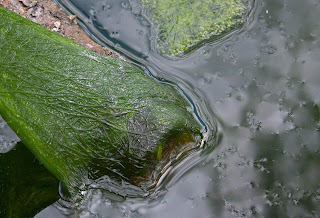
Algae filaments

Periphytic diatoms are often either tube-dwelling diatoms (e.g. Cymbella, Navicula) or diatoms growing on mucilaginous stalks (e.g. Gomphonema, Gomphoneis). Tube-dwellers and stalked diatoms tend to dominate benthic environments of altered hydrological and thermal regimes downstream of dams. These mucopolysaccharide materials also ‘glue’ everything together into a dense micro-foam.


Excited to see if I was right in my initial assessment, I returned with a small glass jar and sampled some of the tan-brown scum-froth then returned home to the microscope. And I confirmed that most of the scum was a combination of:

  • detritus (decaying organic material from organisms),

  • living diatoms and other algae, and

  • the remains of many broken diatoms 


The Diatom Forest

Diatoms adhere to submerged surfaces through mucilage produced between the frustule (the diatom’s outer shell) and its substrate. The form of the mucilage varies and includes gelatinous stalks, pads and tubes. For instance, Cymbella and Gomphonema produce long stalks that attach directly to the surface, allowing them to form a swaying canopy over the lower tier of cells such as Fragilaria vaucheriae, Synedra radians and Cocconeis placentula (think overstory and understory of a terrestrial forest or a marine kelp forest).

As part of the understory layer, diatoms such as Fragilaria vaucheriae and Synedra radians attach to the surface at one end (apical) of their rod-shaped frustules using a mucilaginous pad to form “rosettes” that resemble spiky understory shrubs.


Just like trees, the canopy-forming stalked diatoms effectively compete for available light and nutrients in the water with their vertical reach. They provide the ‘overstory’ of the diatom forest’s vertical stratification. These tree-like diatoms also provide an additional surface for other diatoms to colonize (e.g. tinyAchnanthes settle on the long stalks of Cymbella, just as lichen does on a tree trunk).

The stalked diatom forest acts like a net, trapping drifting-in euplankton, such as Pediastrum sp. and Fragilaria spp., which then decide to stay and settle in with the periphyton community. The mucilage captures and binds detrital particles in both lower and upper stories of the diatom forest; these, in turn, provide nutrients for the diatom forest and additional surfaces for colonization. In their work with periphyton communities, Roemer et al. (1984) found several diatoms (e.g. Diatoma vulgare, Fragilaria spp. Stephanodiscus minutula) entangled in the complex network of cells, stalks, and detritus of the diatom forest’s upper story. They also found rosettes of Synedra radians—like jungle orchids—attached to large clumps of sediment caught by the net of mucilage.

Eventually, ‘overgrowth’ occurs as the periphyton colony matures and grows ‘top-heavy’ with all this networking. The upper story of the community simply sloughs off—usually triggered by turbulence such as when the dams release water. This is similar to a forest fire in the Boreal forest, which creates space and light for new colonization and growth. The dislodged periphyton then ride the turbulent flow, temporarily becoming plankton, and those that survive the crashing waters provide “seed” to colonize substrates downstream. 


Amid the many dead frustules, I observed many living diatoms along with green and blue-green algae, rotifers, Protista and bacteria feeding on the detritus. I even saw one amoeba, actively feeding on the nutrient-rich interface of a micro-foam organic bubble.

The Regulated River

The dams on the Otonabee River dramatically affect its aquatic biota by altering hydrology, sediment transport, nutrient cycling, temperature regimes, and the movement of organisms. One of the main impacts of a dam is the change in flow dynamics: intensity, velocity, direction. By their very nature, dams create more lake-like environments (lentic) from a more river-like one (lotic). This forces aquatic communities to adapt from free-flowing, erosional habitats to depositional environments.

Having a less mobile substrate along with increased temperatures and higher nutrients in river sections behind dams will lead to increased biomass of certain diatoms and the proliferation of filamentous green algae (e.g. Ceratophylum, Spirogyra, Zygnema, and Mougeotia—all currently blooming in the Otonabee River along with the diatom forests. All are responsible for taste and odor of the water.


Taste and Odour of the Diatom Forest

In addition to providing hydroelectric power, the Otonabee River is a source of drinking water for the City of Peterborough. Particularly in the warm summer months, Peterborough residents notice that their tap water carries a complex taste and odor with hints of mostly earthy mustiness. This is caused by several volatile organic compounds (VOCs) created and released by benthic algae as secondary metabolites associated with growth and reproduction or in response to age, death or environmental stresses. While not harmful, the T&O compounds are detectable even at extremely small concentrations (e.g. parts per trillion).

The diatom forest provides potentially significant sources of biogenic taste and odor VOCs in a river. When diatoms slough off the top-heavy forest and their frustules break apart—particularly during a diatom crash through some disruptive event (e.g. predation, disease, temperature, photolytic stress, dehydration, chemical treatment, or destructive turbulence such as a storm, dam release, etc.)—the diatoms release oxylipins and polyunsaturated fatty acid (PUFA) derivatives, among other things. Oxylipins carry a fishy, rancid, oily or cucumber odor, caused by unsaturated and polyunsaturated aldehydes (PUAs) and other alkenes derived from the fatty acids. They can also cause a ‘grassy-fruity-floral’ odor. The hydrocarbons, amines, terpenes and sulfides released by the degrading diatom mass may smell like solvent, fuel oil or gasoline, acrid burnt fat, and old tobacco.

Diatom species implicated in these odors include Fragilaria, Synedra, Melosira, and Stephanodiscus among others—all identified in the scum I looked at.

Diatoms use volatile taste and odor compounds to modify cell function (e.g. as antioxidants, pheromones, and autoregulation) and food web interactions (grazer deterrents, inhibitors, toxins against predators, attractants) and in response to stress.

Although the production and release of volatile taste and odor compounds is natural to many river algae (in the process of cell metabolism, growth and eventual death and decay), environmental stresses can escalate and intensify the release of T&O compounds. Organic enrichment and nutrient enrichment of the river from fertilizers and urban runoff create stress by overly increasing the biomass of river algae, leading to blooms and bloom crashes with higher incidence of T&O.


References

Diatoms of North America. 2021.

Munteanu, N. & R. Maly. 1981. “The effect of current on the distribution of diatoms settling on submerged glass slides. Hydrobiologia 78: 273-282.

Palmer, Marvin C. 1959. “An Illustrated Manual on the Identification, Significance, and Control of Algae in Water Supplies.” U.S. Department of Health, Education, and Welfare, Cincinnati, Ohio. 98pp.

Roemer, Stephen C., Kyle D. Hoagland, and James R. Rosowski. 1984. “Development of a freshwater periphyton community as influenced by diatom mucilages.” Can. J. Bot. 62: 1799-1813.

Ross, R., Cox, E.J., Karayeva, N.I., Mann, D.G., Paddock, T.B.B., Simonsen, R. and Sims, P.A. 1979. “An amended terminology for the siliceous components of the diatom cell. Nova Hedwigia, Beihefte 64: 513-533.

Round, F.E., Crawford, R.M. and Mann, D.G. 1990. “The Diatoms. Biology and Morphology of the Genera.” Cambridge University Press, Cambridge. 747pp.

Smolar-Zvanut, Natasa and Matjaz Mikos. “The impact of flow regulation by hydropower dams on the periphyton community in the Soca River, Slovenia. Hydrological Sciences Journal 59 (5): 1032-1045.


26 Aug 2022

Science + Activism

by Megan Clendenan

Here in Canada, we’re nearing the end of summer, but there’s still time to take advantage of the still-hot weather. One thing I love to do is go swimming – whether it’s in the ocean, a lake or a river, there’s nothing like jumping in (usually quite cold!) water to cool off and feel like it’s vacation time.

When you head out for a nice swim on a hot day, the last thing you want is to be floating through a sea of fecal bacteria. But sometimes that’s what happens….

When Stella Bowles was 11, she began to ask questions about why she wasn’t allowed to swim in her local river in Nova Scotia. She learned it was because of straight pipes, a sewage-disposal system that flushed waste from toilets directly into the LaHave River. Even though they were illegal, there were 600 straight pipes emptying raw sewage into the river. Stella was upset by the straight pipes and wanted to know how polluted the river was because of all the fecal contamination. She decided to do her grade 6 science project on the topic. After reaching out to a local conservation non-profit, Stella found a mentor who helped her take samples of river water and test for bacteria.

Artwork by Julie McLaughlin, from pg. 84-85 of Fresh Air, Clean Water: Our Right to a Healthy Environment
 

She found contamination levels well above Canadian standards for swimming and boating. She decided she had to share her findings, as the river was a health hazard. With the help of her mom, she started a Facebook page and spread the word. She also put up a big sign by the river that said “This River is Contaminated with Fecal Bacteria.” Stella’s efforts got people’s attention, including the Canadian government. More than two years later, in 2017, the government finally announced that it would spend $15.7 million to clean up the LaHave River.

Science + activism can help create change! Citizen scientists who warn of danger and continue to speak up, as did Stella, can have important positive results for both human and environmental health.

Want to learn about more young scientists creating change? I had the opportunity to interview Stella as well as a number of other exceptional youth activists, scientists and artists for my book FRESH AIR, CLEAN WATER: OUR RIGHT TO A HEALTHY ENVIRONMENT. And Stella is herself an author – check out her book in the resource list below.


Sources/Resources

Bowles, Stella, with Anne Laurel Carter. My River: Cleaning up the LaHave River. Halifax, NS: Formac Publishing, 2018.

https://www.cbc.ca/news/canada/nova-scotia/stella-bowles-lahave-river-clean-up-funding-1.4184663

18 Aug 2022

Why Do We Crave Junk Food?

 by Anne Munier

Evolution influences human behaviour by holding on to traits that make us more likely to survive and have babies. Behaviours like avoiding vicious predators, jerking your hand away if you touch something hot, or cooperating with community members all helped our ancestors survive, and have been passed down through generations. Traits that lead to very *unhealthy* outcomes (like, say, having an irresistible urge to play with vicious predators) tend to get weeded out of the population, because kids who play with tigers generally don’t survive long enough to pass on their genes.

So why do so many of us feel compelled to overeat junk food? Junk food, for the sake of this article, means processed foods that are high in sugar, fat, and salt. This type of diet is harmful for our health, yet it is a rare person who craves steamed broccoli over milkshakes, pizza, or brownies.

Oddly enough, these cravings are very much shaped by human, and even pre-human, evolution.

A monkey with a sweet tooth munching on jackfruit
Millions of years ago, some early primates developed a taste for fruit, even though it tends to grow high up in trees, and it’s much easier to munch on plants that are close by. These particular primates did awfully well because fruit has much more energy (i.e. calories) than other foods, and is easier to digest. This leads to healthy primates in good condition to have lots of babies. These babies inherited their parents’ love of fruit, and likewise did better than their counterparts who couldn’t be bothered to climb for their food. And so it continued through the generations, until eventually the whole species were driven to eat as much fruit as possible.

(Fun Fact #1: Primate species that eat the most fruit have the biggest brains.)

Moving along our evolutionary story, early humans were developing ever-larger brains, which, along with our active hunter-forager lifestyles, meant we needed a ton of energy to keep going. We continued to love sugar from fruit or wild honey when we could get it (which wasn’t often), as well as high-fat foods, which are also high in calories. When we had the chance to eat more than we needed, our bodies stored the surplus as fat, allowing people to have more babies, and enhancing survival during times of food scarcity.

(Fun Fact #2: Humans tend to be better at storing fat than other animals. Even super-skinny humans have more body fat than the chunkiest chimpanzee).

Fast forward to the 21st century -- most of us live in relative prosperity and have constant access to junk food. And while treats that our hunter-gatherer ancestors enjoyed came wrapped up with fiber, vitamins and minerals, today’s treats -- not so much.

We are now hard-wired to seek out sugar and fat, to the point that they stimulate pleasure centres in our brain. This is true for newborns and adults, across all cultures in the world. Healthy food elicits a bit of this pleasure stimulation, junk food elicits A LOT more. And the more junk food we eat, the more we develop a tolerance to it, so we need to eat more to get that same pleasure response. Sound familiar? Addictive substances, including cigarettes and drugs like cocaine, work on our brain in the same way.

Melt-in-your-mouth Cheetos have a very profitable mouth feel.

Then there are the manufacturers of processed junk foods. They want to maximize their profit by selling as much product as they can. And they have all sorts of tricks up their sleeves about how to get us (and keep us!) hooked on the stuff. For example, they figure out a food’s:

  • Bliss point: the perfect ratio of sugar, fat, and salt to maximize deliciousness and over-consumption

  • Mouth feel: how food interacts with your mouth -- the more quickly it melts, for example, the more it confuses our brain into thinking that we’ve consumed fewer calories than we really have

What is the result of these biological forces on one hand, and the commercial forces on the other?

The number of people who are obese is growing annually, as are associated conditions such as high blood pressure, heart disease, chronic inflammation, and Type 2 diabetes. Add to this the impacts on mental, psychological and dental health, and ballooning health care costs that affect everyone.

So, given enough time, could humans evolve to lose a taste for junk food, since it’s so damaging? Maybe, but let’s not hold our breath. Evolution acts genetically, by passing on genes to our children. But most disease related to excessive junk food affect people later in life, after they’ve already had (or not had) kids.

Is it inevitable then, that we’ll continue to eat excessive amounts of junk food, and our health will keep deteriorating? Not at all! Here are two things to keep in mind as we go forth in our junk food-laden society:

  1. Evolution has also endowed us with big beautiful brains capable of critical thought. Even if things are stacked against us, we can make great (if sometimes tough) decisions about our eating and exercise habits.

  2. We need to recognize that diet goes beyond will power. Our biology and powerful market forces are designed to make us crave junk food, which, sadly, is often cheaper than whole food. So let’s NOT blame anybody for “lifestyle diseases” caused by too much junk food. Rather let’s consider societal changes that could improve things -- like limiting marketing of junk food to children, or ensuring that healthy food is easily available to all of us. What ideas do you have?

5 Aug 2022

It’s tough to be tiny—or is it??

by Kim Woolcock

Growing up, I was always the shortest person in my class. I was guaranteed to lose games of Keep Away. I could never reach the top shelf. And the basketball hoop seemed to be infinitely farther away from me than from other kids (OK, maybe there were other factors in my lack of baskets scored). But in sixth grade, my very tall friend gave me a sweatshirt that said, in glittery letters, Tiny but Tough, and that became my motto. So when my publisher sent me an image of a tardigrade (the poster children for Tiny but Tough):

Hypsibius dujardini

Taken by: Willow Gabriel, Goldstein Lab http://tardigrades.bio.unc.edu/

and asked what I thought about doing a book on minibeasts, I jumped at the chance. I decided right away that it would be about not just minibeasts, but the superpowers of minibeasts. Because there are plenty of upsides to being tiny.

I read a giant stack of science papers while researching this book, and I learned about SO many fascinating creatures. One of my favourites is the water scavenger beetle (Regimbartia attenuata). These guys are just round black dots, a few millimeters long. They look completely unassuming. They don’t have any obvious defenses, and if a frog tries to eat them, well, it succeeds. They get swallowed. <gulp!>

But!


That is not the end of the story. Because after being swallowed, these beetles walk right out. That’s right—they get swallowed, and they don’t care. A few minutes to a few hours later, the beetles emerge ALIVE from the frog’s butt. It’s not clear whether the beetles hike out through the frog’s intestines, or whether they tickle the frog’s innards, maybe by wiggling their legs, encouraging it to send them speedily on their way.* Either way, these otherwise inconspicuous creatures are escape artists par excellence.

Along the way I learned that larvae of the horse mint tortoise beetle (Physonata unipunctata) defend themselves by carrying a poop umbrella with their butt. That Asian jewel beetles (Sternocera aequisignata) camouflage themselves with glitter. That the walnut-sized bobtail squid keeps glowing bacteria in its belly, to disguise itself as a moonbeam while it feeds in the nighttime ocean. And that because ogre-faced spiders listen with their legs, they can catch prey while blindfolded (and yes, scientists make tiny blindfolds for spiders).


If you’d like to learn more about the amazing world of minibeasts, check out my book It’s Tough to be Tiny:The Secret Life of Small Creatures, illustrated by Stacey Thomas (Flying Eye Books, 2022). It’s all about the superpowers of small creatures, from springtails to cone snails, and how they stay safe, hunt for their lunch, or buddy up with bigger creatures for the benefit of both. It’s full of glitter and gross, because nature is both.

I’d like to know, which superpower would YOU choose?

* Wax-coated beetles didn’t make it out.


Resources:

K Kjernsmo, HM Whitney, NE Scott-Samuel, H Knowles, L Talas, and IC Cuthill. (2020) Iridescence as camouflage. Current Biology 30 (3): 551–555. https://doi.org/10.1016/j.cub.2019.12.013

M McFall-Ngai. (2008) Hawaiian bobtail squid. Current Biology 18(22):PR1-43-1044. https://doi.org/10.1016/j.cub.2008.08.059

JA Stafstrom, Hebets EA. (2016) Nocturnal foraging enhanced by enlarged secondary eyes in a net-casting spider. Biology Letters 12: 20160152. http://dx.doi.org/10.1098/rsbl.2016.0152

JA Stafstrom, G Menda, EI Nitzany, EA Hebets, and RR Hoy. (2020) Ogre-faced, net-casting spiders use auditory cues to detect airborne prey. Current Biology 30(24): P5033–5039.

S Sugiura. (2020) Active escape of prey from predator vent via the digestive tract. Current Biology. 30 (15): PR867–R868.

https://www.dailycamera.com/2010/07/22/jeff-mitton-tortoise-beetles-and-fecal-shields/