17 Jul 2022

A Call for Spider Hunters!

Are you a fan of Citizen Science, where volunteers assist real scientists in any of several ways? You'll want to answer a call from Dr Catherine Scott, a spider scientist. At the end of May 2022 she shared on Twitter a call for nature fans to report their spider sightings. She wrote:

Have you started to see candy-striped spiders out & about? Please help us to learn more about these introduced predators in North America by joining the Spider Hunters project! 

Dr Scott is an arachnologist and spider advocate, a natural historian and behavioral ecologist. She used to be afraid of spiders, but now she spends much of her time outdoors searching for spiders and learning new things about their lives. Dr Scott is also active in social media conversations about the natural world. You can find her posts on Twitter at @Cataranea. On July 6 she wrote:

Candy-striped spider season is now well upon us! Please keep an eye out for these spiders and submit your observations to @inaturalist, where they will automatically be added to the #SpiderHunters project. Thanks! 
If you're not on iNaturalist, please feel free to submit sightings to me directly: email photos to mail@spiderhunters.ca!

These candy-striped spiders are not dangerous to people! They hitchhiked a ride to North America on human ships. In North America, candy-striped spiders are an unexpected predator for insects that pollinate flowers.
Dr Scott goes on to add:
Do I know anyone in Saskatchewan? Do you? I am particularly keen to find out whether or not candy-striped spiders are there (yet)! There were records, but they turned out to be mis-IDs. This is the only province where they may not be!

15 Jul 2022

Weird and Wonderful Animals

By Claire Eamer

I am fascinated by animals that surprise me, that make me rethink my assumptions about what is and isn't possible. Maybe they do something I'm sure they can't do. Or they find a completely unexpected way to survive in their bit of the world. Or they make me rethink how I survive in the world. 

Take, for example, the American dipper or water ouzel, scientific name Cinclus mexicanus.

American dipper. Photo by Ron Knight.
I used to live in Whitehorse, on the banks of the Yukon River in northern Canada. The river is huge and fast-flowing. And it's cold. In winter, it's mostly covered in ice with only a few patches of open water kept clear by the current.

Walking along a river trail one winter day, I saw a small black bird standing on the ice at the edge of the open water. As I watched, it dove straight into the (literally) icy water and disappeared. Just when I began to think it was drowned and frozen, it popped back out of the water and hopped onto the ice, looking none the worse for what should have been a near-death experience.

It was an American dipper, a species that pushes the boundaries of bird life. Dippers can stick their heads under water to search for food and swim underwater by using a flying movement with their short, strong wings. They can even walk along the bottom of a fast-moving stream, holding on with their extra-long toes and claws. 

An American dipper searches for food. Photo by David A Mitchell.

Watching that bird in Whitehorse led me to think about other animals that push boundaries, and that led to my book Lizards in the Sky: Animals Where You Least Expect Them (Annick Press). Snakes that glide from tree to tree, tiny worms that survive on glaciers, salamanders that live in the complete darkness of deep caves: they're all there.

My most recent animal book came from another kind of rethinking -- about why we find some animals or their habits disgusting and what they are really like if you don't just say, "Gross!" and turn away.


The result of my fascination with everything disgusting in the animal world was Extremely Gross Animals: Stinky, Slimy and Strange Animal Adaptations (Kids Can Press). It's full of animals that use puke and poop and spit and other gross stuff to survive. And if you look closely and ask questions, you'll find that they use it very well indeed.

I started by researching all things slimy and smelly (and found some great information), but I think my favourite beastie in the book is now the humble dung beetle. That might be because I found some in my own back yard.

It truth, dung beetles aren't all particularly humble. There are thousands of species of beetle that use dung as food or home or nest or all these. Some, like the elephant dung beetle, are big and showy. Elephant dung beetles actually eat elephant dung (thought it was just a name, didn't you?). Actually, they form it into a ball, roll it away, and bury it to make both a nest and food source for their young. 

[Take a look at Sci/Why contributor Margriet Ruurs's column about a trip to Africa, where she saw elephant dung balls -- and a lot more!] 

The dung beetles in my back yard aren't nearly as big or as showy. They don't roll the dung into balls. Instead, they dig little dens under it and use it as both protection and a food source for themselves and their young.

Two tiny dung beetles scurry away from the author.
I should explain that my back yard includes a couple of acres of forest on one of British Columbia's Gulf Islands -- and a lot of passing deer. I was curious about whether anything dung-beetle-like was using the deer droppings, so I went in search. 

I found a small pile of deer poop, about the size of a pocket wallet. It was dry on top and probably a few days old. I turned it over (using a stick, not my hand -- Come on! Some things really are a bit gross!). 

And there they were! Dung beetles -- two of them, peeking out of two little holes in the ground, the tunnels they had dug under the dung. Before I could tell them how pleased I was to discover them, they scooted away in search of another welcoming patch of deer droppings.

But I was pleased. It was a delight to meet some of the stars of my book face to face.


NOTE: The photos by Ron Knight and David A. Mitchell are licensed for use under Creative Commons Attribution 2.0.

8 Jul 2022

The Japanese Beetle in Vancouver


By Raymond K. Nakamura

The first I heard of the Japanese beetle (Popillia japonica) was on signs in my neighbourhood calling for its eradication. In its native Japan, the green and copper member species of scarab beetle is called “mame-ko-gane” in Japanese, which means “bean yellow gold” or “mini gold money.” Natural predators keep it under control, although recent increases have been associated with the growth of well-manicured golf courses. 

People first noticed it in North America in 1916 on the east coast of the United States, presumably introduced on imported plants, some time before 1912, when screening became a thing. Lacking natural controls in North America, the Japanese beetle has become an invasive pest. The whitish, C-shaped larvae eat the roots of grass, while the adults, which feed on the leaves of about 300 species of plants important for food and gardening.

In 2017, routine insect surveys first detected the Japanese beetle at David Lam Park in Vancouver. Since 2018, the Canadian Food Inspection Agency (CFIA), the City of Vancouver and other cities, along with organizations such as and the Invasive Species Council of BC (ISCBC) have been working to get rid of the beetles before they become a big problem. 

To control the spread of the beetles, the movement of plants and soil is restricted in parts of Vancouver and now Burnaby. Landscapers in the area have to use special transfer stations. Traps have been set up to monitor and remove adult beetles. The fins on the traps have a floral scent and a pheromone to attract the adults. They are weak fliers and when they smack into the fins, they tumble down into the containers below. Technicians check them every few weeks, recording and disposing of any finds. In addition, areas where larvae are suspected, the City of Vancouver is applying the larvicide Acelepryn, which is is supposed to target the larvae, while being safe for people, pets and other preferred creatures.

I may have overreacted in my cartoon because the signage triggered memories of the wrongful incarceration by the Canadian government during World War II of my parents and grandparents, along with more than 20,000 people of Japanese descent, most of whom were naturalized citizens or born in Canada. The province of British Columbia recently acknowledged its role in that time. It also brought to mind the rise in Anti-Asian violence during the pandemic. And on the other side of the Pacific, I had relatives who were affected by the radiation from the atomic bomb dropped on Hiroshima.

I’m not saying that the treatment of the invasive species has anything to do with that, but after I first posted the comic on social media, Jennie McCaffrey, Director of Engagement at the Invasive Species Council of BC reached out to me,

“I wanted to let you know that the Japanese beetle name is troublesome for many and we (Invasive Species Council of BC) get questions about it. We are limited because it is the official name decided by the international entomological society. However, they are in the midst of making change! Just this year the 'Gypsy Moth' was changed to 'Spongy Moth' so we are hopeful that happens soon for the Japanese beetle common name.”


2 Jul 2022

Fiction with science elements

 Our own Joan Marie Galat shared on Facebook the news of her soon-to-be released book, Mortimer: Rat Race to Space -- which you can tell from the title and the cover image is a work of fiction with a lot of science elements!


Joan says:

Cover reveal! Scheduled for release in September 2022 by Cormorant Books. This is my first middle-grade novel and I'm super excited! I expect to hold a launch but you can also preorder through the links below. Preorders help authors and shopping at independent bookstores helps too. That's my pitch!

28 Jun 2022

Stink Bug Citizen Science!

Looking for a summer science project? Here's a note for volunteers and citizen scientists in British Columbia, Canada! 

There are stink bugs native to this region that are doing just fine, but in addition to them are new stink bugs. New to BC are Brown marmorated stink bugs ( BMSBs) from Asia. Invasive species of stink bugs have few local predators. They can become a real problem in gardens and farms, not only by drinking enough juices to weaken plants, but by spreading plant diseases. These BMSBs aren't too big a problem where they come from, as there's a kind of wasp that lays its eggs in the stink bug eggs. Now that wasp, too, has been found in BC.

Scientists in BC are looking for stink bug egg samples, to check how many of that kind of wasp are affecting stink bugs. That's where the volunteers come in. Check out this link for information on how to be a citizen scientist, gathering samples for study.

https://bcinvasives.ca/news/that-stinks-help-us-collect-stink-bug-eggs/

6 May 2022

Woolly Bears in the Mountains

By Claire Eamer 

No! Not those bears! I'm talking caterpillars.

Woolly bears are those fluffy, hairy caterpillars that look a bit like tiny plush toys. They're common from Mexico to northern Canada. You might have seen a woolly bear trundling along a warm sidewalk in summer or climbing a plant stem to munch on leaves. Eventually, the caterpillar will pupate and emerge as a moth.

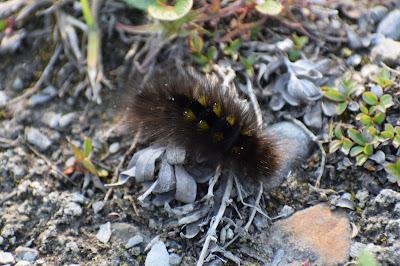
So what's so special about woolly bears in the mountains? Actually, it's one particular species -- the arctic woolly bear, Gynaephora groenlandica. Arctic woolly bears weren't supposed to be crawling around in the Yukon mountains, but that's where Isabel Barrio found them during the summer field season of 2010.

Alpine tundra in the Kluane Range, Yukon. D. Hik photo

Until then, arctic woolly bears had been found only on the tundra along the edge of the Arctic Ocean, almost entirely in Canada's Arctic Archipelago and on the shores of Greenland. They emerge from hibernation for about three weeks in June, munch mainly on Arctic willow, and go dormant again until the next June, spending much of their lives tucked away among the tundra stones, frozen solid. They spend so little time active that it takes them a seven years to develop from egg to moth -- the longest of any butterfly or moth.

There's no way a caterpillar not much bigger than a jelly bean could travel from the Arctic Ocean to the southern Yukon in that short period of activity. And yet -- there they were, arctic woolly bears, crawling around an alpine research camp in the Kluane Range, fully 900 kilometres south of where they were supposed to be.

"Caterpillars are relatively common in the alpine and I had been watching them for years," David Hik, the leader of the research group, wrote in an email, "but Isabel was the one who really started looking at them more closely."

A Yukon arctic woolly bear in search of dinner. Syd Cannings photo.

Today, Isabel Barrio is a professor at the Agricultural University of Iceland, but in 2010 she was working on her doctorate under the direction Hik, a specialist in the alpine ecosystems of the southwestern Yukon. And she had a sharp eye for caterpillars.

Hik explained that there are two arctic species of woolly bear caterpillar -- Gynaephora groenlandica and Gynaephora rossii (the larval form of Ross' tussock moth) -- and they are easy to confuse. G. rossii, however, has a wide range all around the Arctic and in the high mountains farther south, so it was logical to assume the Kluane Range caterpillars were G. rossii.

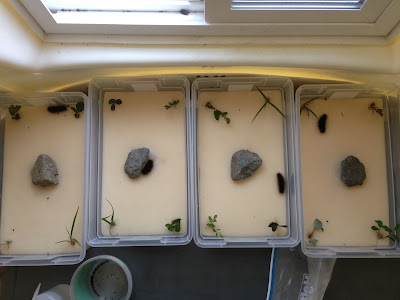
When Barrio looked closely at the older caterpillars, however, she realized they weren't G. rossii. As improbable as it seemed, they appeared to be arctic woolly bears. The research group collected 30 caterpillars that summer to confirm the identification and to learn more about them.

What's your favourite? An experiment to see what the Yukon caterpillars like to eat. D. Hik photo.

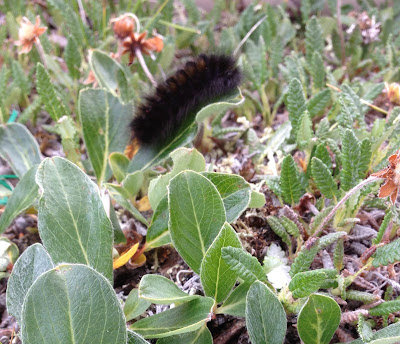
That led to another surprise. Analysis of the caterpillars' genetic code showed that the Yukon woolly bears were slightly different from other arctic woolly bears. They were, in fact, a newly discovered subspecies: Gynaephora groenlandica beringiana.

That last word is important. It refers to the fact that they were found in Beringia, the area of northwestern North America that remained ice-free during the last major glaciation. That probably explains their presence in the alpine valley. These fuzzy little beasts were likely crawling over the tough tundra vegetation of Beringia when most of Canada was buried under kilometres of ice -- and they're still there.

G. groenlandica beringiana perched on top of its supper. D. Hik photo.

Since Barrio's first identification of them, the caterpillars have been found in a few other locations in the Yukon. David Hik suspects they are widespread throughout the alpine areas of Beringia. He hopes that new research projects in the region will turn up more confirmed identifications -- and more information.

"They are very cool, and there is so much more to learn about them," he wrote.

24 Apr 2022

Can rivers, lakes and trees be granted their own rights, just like people?

By Megan Clendenan

April 22nd is Earth Day – a great opportunity to consider how we are caring for our home planet. Are we using the golden rule? Are we treating our planet how we ourselves would like to be treated?

A different perspective shows us how everything on Earth is connected. 
 

The right to life. Freedom from discrimination. These are fundamental human rights, recognized by many – if not all – countries worldwide. Basic human rights are certainly not universally applied, as many people still face discrimination, unequal treatment and outright persecution. However, when human rights are recognized they do provide a legal framework that helps to protect many people and enable them to live more secure, free and healthy lives.

Could this same idea be given to help conserve and protect nature itself?

And if so, how exactly can we define what ‘the rights of nature’ means? In his book, The Rights of Nature: A legal revolution that could save the world (2017), David R. Boyd argues that it refers to “the rights of non-human species, elements of the natural environment and…inanimate objects to a continued existence unthreatened by human activities.”

The idea that we have both rights and responsibilities to care for and respect the natural world has been a part of many Indigenous cultures for generations. In 2017, after years of discussions with the Maori people, New Zealand granted legal rights to the Whanganui River, the third longest in the country. The river is now a ‘legal person’ with rights and responsibilities. It is represented by the Maori people, who can protect the river in court if need be. New Zealand is not the only country offering nature its very own rights.

Whanganui River, New Zealand Photo credit: Duane Wilkins

Ecuador’s 2008 Constitution protects the natural world and anyone can go to court on behalf of nature. In 2011, an Ecuadorian court ruled that a proposed road would violate the Vilcabamba River’s right to health as construction would dump huge amounts of rock, sand and gravel into the river, causing the river to flood and affecting people who lived nearby. Road construction was halted, and this was the first ever legal ruling on the rights of nature.

In 2016, a group of Colombian youth between the ages of 7 and 26 took their government to the Supreme Court citing failure to protect the Amazon rainforest. Each youth had been impacted in their home community by the effects of climate change, air pollution, or water contamination stemming from a lack of environmental protection. In 2018, the Supreme Court declared that the Amazon river ecosystem itself has the legal right to environmental protection.

In 2021 in Quebec, the Mutuhekau Shipu River (also known as the Magpie River), threatened by environmental degradation, became the first river in Canada granted legal rights. In a process led by the Innu First Nation, the river was declared a ‘legal person’ with nine rights, including the right to flow and the right to be free of pollution.

There are many other countries granting legal protection to nature, including Bangladesh, India and Bolivia. Granting rights to nature is not without challenge. For example, who will speak on behalf of the protected nature? And after a court protects a river with rights, what happens next? How is protection implemented, and, if it’s not, then what? And what about farmers, industries and other communities who feel that by giving nature its own rights, their own rights are being infringed upon? There are many thorny issues to untangle. However, the provision of legal rights is one tool that can be used to help conserve and protect nature from contamination, destruction and the continuing effects of climate change. Given recent IPCC reports on the state of our planet, we need to use all available tools.

What do you think?


To learn more about the rights of nature, why the right to live in a healthy environment should be protected as a human right, as well as inspiring environmental court cases from around the world (many led by children and youth!), check out my book Fresh Air, Clean Water: Our Right to a Healthy Environment, illustrated by Julie McLaughlin and published by Orca Books (March 2022).