25 Nov 2016

Canada's Only Great Auk

by Jan Thornhill
museum illustration Jan Thornhill Tragic Tale of Great Auk
"Museum" page from The Tragic Tale of the Great Auk (Jan Thornhill)

While working on my new book about the extinction of the "northern penguin," The Tragic Tale of the Great Auk, I became aware that the Royal Ontario Museum (ROM) in Toronto was in possession of Canada's only stuffed one. Hoping to see it, I visited the ROM's brilliant Schad Gallery of Biodiversity, but was disappointed to find no Great Auk, though there was an equally extinct Labrador Duck on display. How sad, I thought, that the regal bird I sought was not on view, was instead tucked away in some dark cupboard, sealed, perhaps, inside a titanium box, safe, but invisible.


John James Audubon illustration Labrador Duck
The extinct Labrador Duck (John James Audubon)
But a couple of months later, when I arrived at the ROM to talk auks with Oliver Haddrath, the ornithology reasearch technician whose specialty is extinct flightless birds (like the poor Great Auk), I was thrilled to be led out into the same animal diversity gallery where this time—ta da!—behind two layers of glass, there it was, one of the last of the millions of Great Auks that once thrived in the North Atlantic. 


Jan Thornhill with stuffed Great Auk ROM
Me and Canada's only Great Auk (Frankie Thornhill)
There are only 78 stuffed Great Auks in the world, almost all held by museums. American museums own a decent chunk of them—eleven—though that number used to be twelve. The twelfth one was once owned by John James Audubon, the American bird painter famous for his Birds of North America book published as a double-elephant portfolio, "elephant" because it had to be big: Audubon presented all of his subjects life size. Though each page is a huge 39.5 inches tall and 28.5 inches wide, the largest birds—cranes, herons, flamingos—had to be doubled over in his compositions to fit. 


John James Audubon flamingo
Because Audubon painted birds life-size, he had to double
over the biggest ones to make them fit on the pages. 

Audubon included the Great Auk in the book, but he never saw one alive. He had to base his painting on a taxidermy model, a specimen killed in Iceland in 1830 that he bought in London in 1836. 


Great Auk John James Audubon
Audubon's Great Auks

Eventually, Audubon gave has stuffed auk to a birder friend, Jacob Post Giraud Jr., who, in turn, gifted it (along with the rest of his large collection of stuffed birds) to Vassar College in 1867. There, "Audubon's Auk" gathered dust—quite literally—for more than 50 years, until it was found under a lab sink by Dr. L.C. Sanford who had connections to the American Museum of Natural History. Though the college continued to own the bird, Sanford convinced them in 1921 to allow him to send the auk off for renovation and remounting. When it was all spiffy again, it wasn't sent back to Vassar, but was housed instead at the Museum of Natural History in New York, hidden away in a double crate for the next 43 years. 


great auk profile ROM
The friendly face of the Royal Ontario Museum's Great Auk
Though Canada had once been home to the largest Great Auk colony in the world—on Funk Island off the northeast coast of Newfoundland, (there had been no colonies on American soil at all)—by the early Sixties we still had no stuffed Great Auk of our own. The ROM was desperate to find one. Finally, they convinced Vassar to sell them Audubon's auk. In 1965 they paid $12,500 for it (the equivalent of about $100,000 today), and got a stuffed Labrador Duck thrown in for good measure—the same Labrador Duck I had seen on my earlier visit to the museum.


signs royal ontario museum ornithology
Signs on a door in the ROM's ornithology department (Frankie Thornhill)
Oliver explained that, because bird feathers deteriorate more quickly when subjected to light, the museum only shows off its Great Auk for six months of the year. For the other six months, the Labrador Duck is the star. 


illustration Geirguglasker tragic tale great auk jan thornhill
The ROM's Great Auk came from Eldey Island in Iceland,
 the last place these birds nested after 
a volcanic eruption caused safer Geirfuglasker to sink beneath the waves. (Jan Thornhill)
As thrilling as it was to finally see an actual Great Auk, I couldn't exactly get close to it, displayed, as it was, at a height and behind double panes of glass. But then Oliver led me and my sister, (who had the camera—yay!), into the secret storerooms of the bird department. First he showed us the egg room. The ROM has a lot of bird eggs. In fact, it has roughly 12,000 sets, a "set" being the number of eggs normally laid in a nest. There is a bird skin room, too, where thousands of boneless birds from around the world are laid out in drawers. 


egg collection royal ontario museum
A tiny sample of the ROM's 11,715 bird egg collection (Frankie Thornhill)
These collections are kind of shocking to see, since each skin and each egg represents a life cut short, but almost all were collected long before any of us was born, in an era when there were a) way more birds of all kinds, and b) different attitudes towards killing wildlife. 

For a while there was a question about whether or not museums should waste precious space storing so many skins and eggs, especially when some species are represented by multiple specimens. The ROM's collection wasn't culled, which is fortunate because it has become clear that these lovingly stored remains hold a treasure trove of information that no one a hundred years ago could have imagined: DNA. When the DNA from skins of birds of the same species that were collected in different places, or ones collected from similar locations but years apart, is compared, we can learn a lot about how our world has changed, and how it continues to change. 


bird study skins royal ontario museum
Nine of the ROM's 136,350 study skins (Frankie Thornhill)
Similarly, each egg in the collection has documentation of exactly when and where it was collected. These dates, sometimes from more than a hundred years ago, can be compared to the nesting dates of contemporary birds to help us learn how various species are adapting—or not adapting—to climate change. 


extinct bird great auk bones
Great Auk bones collected on Funk Island (Frankie Thornhill)
Though the eggs and study skins were fascinating and often gorgeous, the pièce de résistance of the tour was yet to come. Without saying anything, Oliver opened a drawer and pulled out a small, nondescript cardboard box. He opened it. It was filled with bones. Great Auk bones. Auk bones that included a skull and upper beak. Which Oliver handed to me. 


jan thornhill holding great auk skull and beak
Me giddily holding an extinct Great Auk's skull and beak (Frankie Thornhill)
Maybe that doesn't sound like a big deal. But it was. I'd just spent the better part of a year living with the Great Auk, reading about its amazing and tragic history, its connections to prehistoric and First Nations peoples on both sides of the Atlantic, learning about its anatomy, writing about it, drawing it, painting it, dreaming it. I was so familiar with it it had become my totem animal. And I was holding in my hands the head of one that more than two hundred years ago had swum the North Atlantic. Though you can't tell from the photograph, I was so excited my hands were shaking. 

There's only one thing that could have been better. To see an actual, living Great Auk. But, of course, that would be impossible, since the Great Auk has been extinct since 1844. But,wait! Maybe in the future it won't be impossible. Stay tuned for my next post about efforts to resurrect the Great Auk!


I made Great Auk cookies for my book launch!
great auk egg cookies
great auk cookies


Tragic Tale of Great Auk cover

published by Groundwood Books 


18 Nov 2016

Graston® Technique: Modern Therapy with a Chinese Antecedent


by Helen Mason

Graston® Therapy works on the body's connective tissue.
No pain, no gain is an exercise maxim popular among many athletes. Although many medical practitioners question the validity of that motto related to exercise, they support it when referring to the Graston® Technique, a therapy originally developed by David Graston and today credited with helping athletes like Michael Phelps maintain their competitive edge.
 
The Graston® Technique uses stainless steel instruments to assist clinicians in helping people maintain the mobility of their body's soft connective tissue, the white membrane that wraps and connects the muscles, bones, nerves, and blood vessels. It was originally developed by David Graston, an American water skier who suffered a debilitating injury to his right knee.

Disappointed by his slow recovery following surgery, Graston used his machining background to create stainless steel instruments he used to treat his soft tissue injury. After achieving success with the technique, he shared it with Ball Memorial Hospital and Ball State University in Muncie, Indiana, where the Graston® Technique was further developed. An outpatient clinic was opened in Indianapolis in 1994.
 
Graston® tools fit the various contours of the body.
The Graston® tools serve multiple purposes. Practitioners run one of six instruments along the affected part of the body. If fascial restrictions, scar tissue adhesions, chronic inflammation, and/or fibrosis are present, the practitioner detects a distinct feeling of grittiness or bumpiness. The instruments are then used to break up the adhesions, promoting healing.


The instruments prevent practitioners from getting the hand, wrist, and muscle injuries so common to those who try to break up fascial restrictions manually.

Be warned. For patients, the technique is painful. I came across it following a car accident in 1998 during which I suffered a fractured skull and level 3 whiplash. Although I thought these injuries had been treated, over the following seven years, I experienced more and more intense pain in my back and neck, finally accompanied by the inability to concentrate. After trying without success to find a non-drug method of alleviating these symptoms, I visited a chiropractor who used Graston®.
Gua Sha and Graston® break up scar tissue.

She quickly diagnosed the cause of my problem. The injuries from my accident had resulted in fibrosis of my back and neck muscles. They were in constant spasm, which was shutting down blood circulation and nerve impulses to the brain.

My first Graston® treatment resulted in an amazing reduction in symptoms. Over a period of time, regular treatments have promoted full recovery of my back and neck muscles.

At first, the days after each treatment were very painful as the affected areas turned red and then purplish or yellow with bruising, depending on how much work had been done. At one point, a dermatologist saw these injuries during a check-up and clearly thought I had been beaten. For me, the pain was nothing compared to the benefits of the treatments which helped me regain most of my physical abilities.
Michael Phelps credits the Graston® Technique for helping him win
Today, the Graston® Technique is used both by people like me and professional athletes such as basketball, hockey, football, soccer, and rugby players, as well as golfers. It's been successfully used to treat fibromyalgia, carpal tunnel, plantar fasciitis, tennis and golfer's elbow, rotator cuff tendinitis, shin splints, and post fracture pain.

The technique is similar to Gua Sha, a traditional Chinese method that has been practised for over 2000 years. Instead of stainless steel instruments, Gua Sha practitioners use a shell, piece of jade, buffalo horn, or other material to do their scraping. Like the Graston® Technique, Gua Sha causes redness, bruising, and micro traumas to the fascial tissue. The micro traumas trigger the brain to heal the area.
Credit Notice: Practitioner treating female from http://www.mynoblechoice.com/solutions/techniques/. Other photos courtesy of creativecommons.org.

Helen Mason's most recent books include What is Digital Entrepreneurship?, Be an Active Citizen in Your Community, and Be an Active Citizen at Your School, all Crabtree Publishing, 2016.
 

11 Nov 2016

Now You See Me...

If you were a superhero, what power would you pick? Reading minds? Super speed? How about invisibility? That last one is a good choice. Scientists around the world are already working on ways to make everyday objects - like humans! - invisible.
It all starts with understanding light and vision. When light waves collide with the atoms in an object, the waves bounce off, or scatter. The direction of the scatter depends on the angle of the bounce. Human eyeballs detect these scattering light waves, and our brains reconstruct the shape of the original object. So, to make something invisible, all scientists have to do is make light reflect off an object the same way it would reflect if nothing was there at all.
Easy, right? Um, no.
In fact, progress on the invisibility problem didn't really begin until around 2000, when the field of metamaterials started to develop. Engineers build metamaterials out of "artificial atoms" that interact with light in very abnormal ways. These atoms allow engineers to control the way light scatters off the metamaterial with much greater precision than would be possible using naturally-exisiting materials.
Scientists have used these materials to develop several different types of invisibility cloaks, each with advantages and disadvantages. For example, objects embedded inside a spherical cloak are invisible from all sides, but only for a certain value of invisible - they can block some wavelengths of light, but not all, meaning the object blurs rather than totally disappears. Carpet cloaks, so named because they are flat, are easier to make and work on larger objects... but those objects are only invisible from one angle. If the viewer is looking at the cloak from the side instead of dead on, the object becomes visible.
Plasmonic cloaking is a new technique that combines advantages of both spherical and carpet cloaks. Rather than trying to stop light from scattering of the object, plasmonic cloaks create a matching, opposite scatter, and the two combined cancel each other out. Mantle cloaks use a variation of the same strategy, and both types offer the advantages of both spherical and carpet cloaks. However, they also share a unique downside - size. They don't work on any object that's more than a couple of wavelengths of light across.
That's not a problem, if, for example, you're the CIA and you want to hide a tiny bug or spy camera. If you're trying to hide a human, though, you've got big problems. For example, a human-sized carpet cloak would actually have be about the same size as your bedroom. Another problem is that current cloaks block light in both directions, meaning no one could see you, but you couldn't see them, either - which would make sneaking around Hogwarts at night very difficult!
Worst of all, you'd have to stay completely still. According to invisibility scientist Majid Gharghi, going from a stationary object to a moving person would be like going from simple Newtonian physics to Einstein's relativity. He told me it will likely be decades before engineers can build something that complex. Which is kind of a bummer... but on the other hand, gives you plenty of time to come up with your superhero name!
So. What superpower would YOU choose?

28 Oct 2016

The Endangered Caribou

By Marie Powell

CC Jacob W. Frank
The caribou (Rangifer tarandus) is a remarkable animal. Part of the deer family, caribou are unique because both males and females have antlers. Also known as reindeer, caribou have roamed North America for some 1.8 million years. Barren-ground caribou evolved from these early ancestors. The Woodland and Peary caribou have been with us since before the Pleistocene epoch, or Great Ice Age.

The thing I like best about writing middle-grade non-fiction books is that you're always learning something new. The research I'm doing this week has led me north to the Yukon and Nunavut, where I've been learning about the caribou. For instance, some populations of caribou have been reduced by 95 percent in the past 15-20 years. That seems incredible.

I've also been reading Bill Waiser's A World We have Lost: Saskatchewan Before 1905, and his vivid description of the buffalo herds on the prairies a century ago. These buffalo created a whole ecosystem just by foraging on the land, Waiser says. The wanton slaughter of some 4-5 million buffalo in the 1870s led to famine and severe environmental change across the prairies. Looking out my window at the busy streets of Regina, I try to imagine how different life would be today if that hadn't happened. So, when I read about the decimation of the caribou herds, I can't help but wonder what effect this will have on our future.

CCAlfred Cook  
Caribou fall into two groups: populations that remain in one area and spread out there after calving (sedentary), and herds that move or migrate to a common calving area each year (migratory). They range across the tundra and boreal forest areas, from the Arctic and south into most Canadian provinces. As well as predators and hunting, changing weather patterns affect the foraging of migrating herds, which in turn affects the health of the females and calves. So does loss of habitat due to human development in northern regions. All of this threatens the caribou's survival.

Scientists are working together with the Inuit to see how changing weather patterns affect the ecosystem of the north. For example, studies of the sea ice show how important that ecosystem is to all life in the north. One resource that brings out these findings is the Inuit Siku (Sea Ice) Atlas at http://sikuatlas.ca/sea_ice.html, as Claire Eamer shares in her Sci/Why post from 2013.

CCAllen Shimada 
Researchers have also turned to traditional Inuit knowledge to try to save the caribou. A 2012 report calls for minimizing development activities in caribou ranges, among other suggestions. Governments have responded with what the CBC calls a "patchwork" of conservation activities. Some provinces -- like Saskatchewan -- moved to limit development, and more recently others (including Alberta) have begun to act along those lines as well.

Will our efforts be in time to save these majestic animals?

Here are some more links to information about the Arctic and the caribou:

Bergerud, A. T. “Caribou.” The Canadian Encyclopedia. http://www.thecanadianencyclopedia.ca/en/article/caribou/

Braun, David Maxwell. "Inuit Knowledge Critical to Arctic Science." National Geographic Society , August 18, 2011 http://voices.nationalgeographic.com/2011/08/18/inuit-knowledge-critical-to-arctic-science/

Eamer, Claire. "Over, under, and on Arctic sea ice." Sci/Why 2013. http://sci-why.blogspot.ca/2013/03/over-under-and-on-arctic-sea-ice.html

Lunn, Susan. "Caribou still under threat despite changing political climate, report says." CBC News, Dec. 14, 2015. http://www.cbc.ca/news/politics/caribou-still-under-threat-despite-changing-political-climate-report-says-1.3359751

Northern Involvement: Changing Animal Populations - Science Canada - July 22, 2016 http://www.science.gc.ca/default.asp?lang=En&n=CC02ABC9-1
https://www.youtube.com/watch?v=99f_VVHuR2I&feature=youtu.be 

Rudolph, T. D., Drapeau, P., St-Laurent, M-H. and Imbeau, L. 2012. "Status of Woodland Caribou (Rangifer tarandus caribou) in the James Bay Region of Northern Quebec." (Scientific report) http://www.gcc.ca/pdf/Final-Rapport-Status-of-Woodland-Caribou-James-Bay_Eeyou-Istchee.pdf

"Traditional Inuit knowledge combines with science to shape weather insights." Science Daily, April 7 2010. https://www.sciencedaily.com/releases/2010/04/100407190000.htm

Weatherhead et al. "Changes in weather persistence: Insight from Inuit knowledge." Global Environmental Change, 2010; DOI: 10.1016/j.gloenvcha.2010.02.002 http://www.sciencedirect.com/science/article/pii/S0959378010000087

Marie Powell lives on Treaty 4 land in Regina, Saskatchewan. She is the author of close to 40 children's and young adult books, including the historical fantasy Hawk (2015). She enjoys writing about science, history, and any subjects that help promote literacy.

22 Oct 2016

Iceman CSI: Tales from a 5300-year-old man

Forensic reconstruction imagines this is
what the 5300-year-old Ötzi looked like.
(Thilo Parg, CC BY-SA 3.0)
by Adrienne Montgomerie

An arrow sang through the air and plunged deep into a man’s shoulder 5300 years ago in Italy. That man fell as he gasped his last breath, his left arm flung awkwardly across his chest, pinned beneath him.

A mummy is not what you expect to find when you’re strolling through the Alp mountains with your husband. But that’s what happened to the group of mountaineers who found this mummified man in 1991.

What happened to this man? Why did he lay there, undiscovered, for so long? What can his body tell us about humans and life so long ago?

Because he died in a place that is always cold, his body did not disappear into the earth or get eaten by animals. All his parts are there, exactly where they were. He is not covered in rags like a mummy in a movie, but we say his body was mummified because it did not rot. This ancient man they named Ötzi, contains a lot of clues.
.

Learning without destroying

Early scientists would cut apart specimens to learn about them, but that destroyed the body. Today, scientists know that the more they can preserve, the more will be available for other scientists to learn from, and for new technologies that get developed in the future.

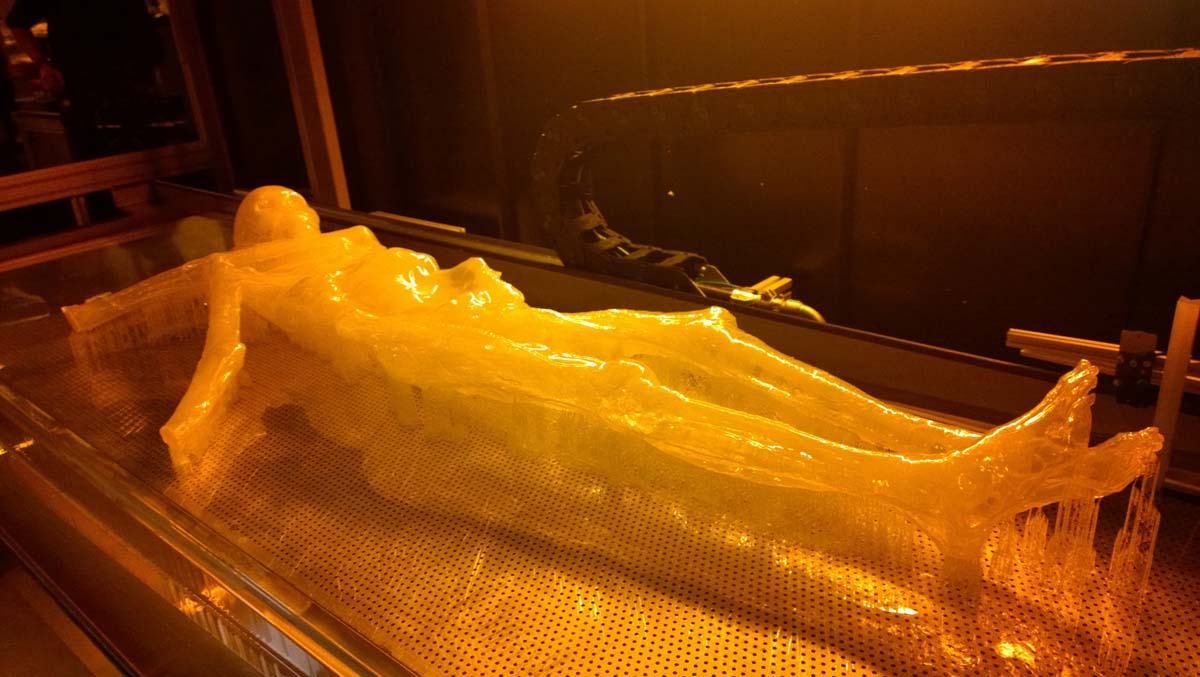
The body is too fragile let everyone examine it closely, so 3D printing was used to create a copy so people can get a closer look at him.
The 3D print formed the base that the sculpture is made from. (Materialise)
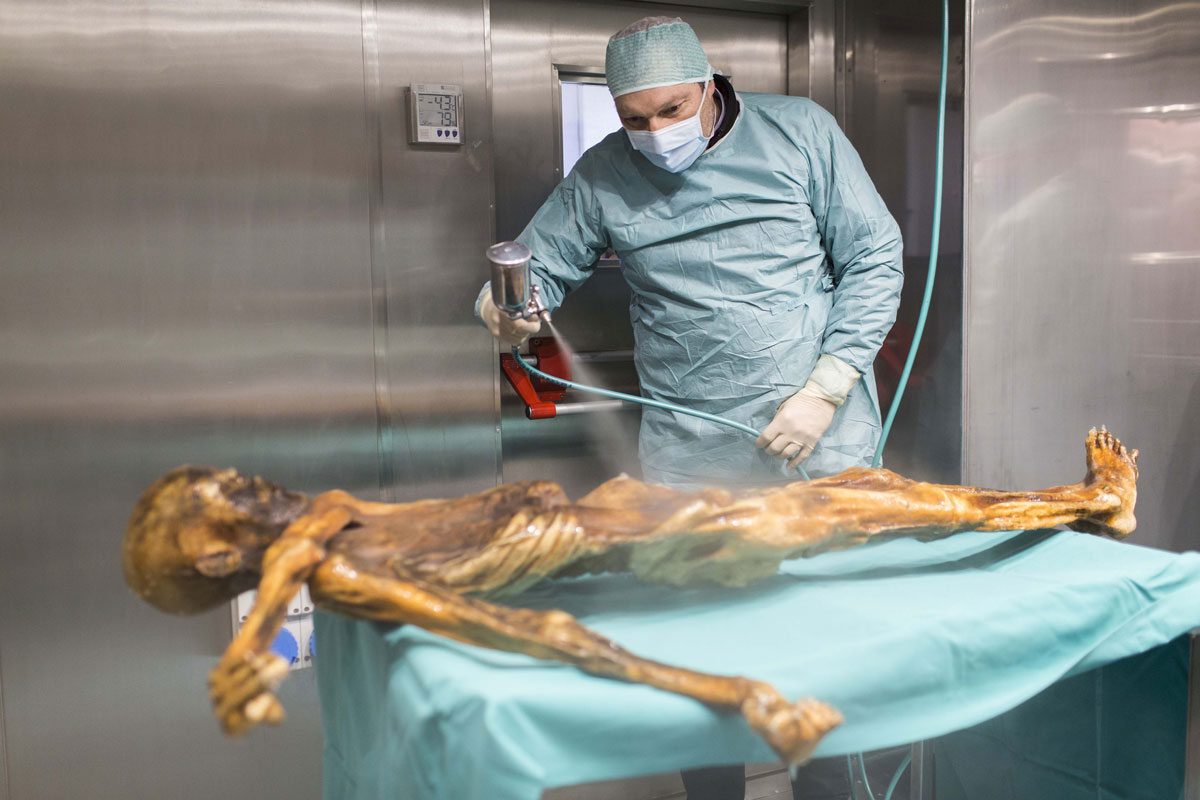
Preserving the iceman Ötzi, so that others can study him, means keeping his body in a room that is –6 °C and nearly 100% humidity — just like on a glacier. The room is dim too, to protect the artifacts from damaging light. An alarm goes off it the room changes.
Ötzi is kept at –6 °C and nearly 100% humidity. (South Tyrol Museum of Archaeology)
Dinosaur bones are replicated for display, too. That’s right, the bones you see in the museum are not the actual bones that were dug up. The originals are stored in conditions that keep them from falling apart, so that scientists (like archeologists) can study them.
.

What can scientists find out from the iceman?

Well, first, they can find out how long humans might have lived, so long ago. Because we have a lot of data about how bones age, scientists can estimate that Ötzi was 45 years old when he was killed.
Because of what we know about how vocal chords work, scientists can guess what Ötzi’s voice sounded like.

Because of the contents of his stomach, they can find out what kind of diet people had that long ago. His last meal was ibex, deer, and grain. His stomach also gives clues about where he travelled, because of the h. pylori bacteria they found in his gut came from Asia, very far away from Italy.

By analysing his DNA, they can find out that he was lactose intolerant, was likely to get heart disease, and had Lyme disease.
His shoes look a bit like Uggs.
(Wolfgang Sauber, CC BY-SA 3.0)

Because of the bits of clothes that were still on him, researchers can make guesses about the style of clothes he wore and the animals that they were able to kill (to use to make clothes).

Because of X-ray and CAT scans, we know there is an arrow-head lodged in his shoulder. But forensics showed he had many more injuries — the kinds that people get from a fight — and blood from four other people on his clothes and tools. Now experts think he actually died from a hit to his head.
.

Mysteries still

There’s still a lot you can’t know by examining a body. Wouldn’t you like to know where Ötzi lived and why he was in the mountains? Who he was fighting and why? How big was his family, and did his brothers and sisters play pranks on each other?
.

Learn more

There are a couple documentaries about Ötzi (Iceman Reborn, and others by NOVA), and several websites explaining different aspects scientists have discovered about him (follow the links in this article). You can even find out how a body becomes a mummy naturally

You can see the Ötzi copies in person at the DNA Learning Centres in New York city and Cold Spring Harbor, USA. To see him in person, you have to look through a small window into a climate-controlled room at the South Tyrol Museum of Archaeology in Bolzano, Italy.

14 Oct 2016

Just in Time for Halloween - Monster Science!

Post by Helaine Becker

Science isn't scary. Or is it?

I'm pleased to announce that my latest book, Monster Science (Kids Can Press) is out, and the reviews are in!

Here are two:

"From Frankenstein’s creation to Nessie, Becker uses the creatures of our scariest stories as a springboard for an introduction to the scientific understandings that might make such creatures possible—or impossible. In addition to man-made monsters and legendary sea creatures, she covers vampires, zombies, werewolves, and wild, humanlike creatures like Bigfoot. Chapter by chapter, she provides references from literature, film, and popular culture, including a bit of science, a bit of history, and a plentiful helping of humor. She includes numerous monster facts, suggests weapons of defense, and concludes each section with a test-yourself quiz. Science topics covered range widely: electricity, genetic engineering, “demonic diseases,” the nature of our blood and the circulatory system, the possibility of immortality, animal classification, evolution, cannibalism, optical illusions, heredity, hoaxes, and the very real profession of cryptozoology, or the search for hitherto unidentified creatures. Explanations are clear though sometimes oversimplified; they’ll provide readers with an acquaintance with the topic and its vocabulary but probably not real understanding. Lively design and zany cartoon illustrations add to the appeal. There is an index but, sadly, no sources or suggestions for further explorations by readers who will be wanting to know more.Book bait of the best sort, this is a winning combination of fancy and fact." - Kirkus

"A highlight of this work is its exploration of the often symbiotic relationship between culture and science; figures such as Shelley, John Polidori (The Vampyre), and filmmaker George Romero (Night of the Living Dead) merged cultural fascination with scientific development to create truly inspiring works and further public interest in science...VERDICT: The connection between pop culture and science is intriguing; this title will appeal to science educators as a supplemental resource for classroom activities. - School Library Journal


Want a sneak peek? Find out your Vampire IQ with this science-sharp quiz from Chapter 2!


6 Oct 2016

Bird Banding

My friends Robyn and Mark are bird-watchers. Oh, they do a lot of other things, too, that you can read about on their blog at this link. But it's their bird hobby that I'm envying today. On the first Saturday of October, Robyn and Mark were helping researchers by banding birds. It was a wonderful day for citizen scientists helping experts with hands-on gathering of data!

This bird is a hermit thrush, observing Robyn as carefully as she observes it!

As Robyn says:
This morning Mark and I volunteered with the Rocky Point Bird Observatory banding migrating song birds. We helped with retrieving the birds from the nets (37 today) and entering their info into a database. Very interesting work and it confirmed how much I DON'T know about birds


The nets used to catch birds are almost invisible, and suspended between.posts like a fence. Here's a Chestnut-backed chickadee caught safely in a net. A moment later, a researcher carefully untangled the bird and held it while Robyn and Mark helped to band the bird and write notes about it. The bird banding is also being done at night, when the researchers catch owls.


Here's the whiteboard with notes about the numbers of birds caught, and their types.The total count of birds banded by Rocky Point Bird Observatory after day 74.of their study? 2,486!

You can read more about Rocky Point Bird Observatory at this link to their Facebook page, or go to their own website at this link
The Sci/Why Blog has had another post written about volunteering for a bird banding event, and you can read it at this link.
If you want to volunteer with bird studies in your own area, start by looking up provincial resources and try the nearest university biology program to find out who needs you. Don't worry about handling the birds -- even if all you do is write down the information as fast as the expert can say it, you're doing useful work that lets the expert handle the birds. Maybe there's a birdwatching club at the local recreation centre, or a birding store at a mall. The public library will have books on birds and birdwatching as well!
.